Help id

David & Katie

Community Member
View Badges
Joined
Aug 5, 2018
Messages
70
Reaction score
67
Rating - 0%
0   0   0
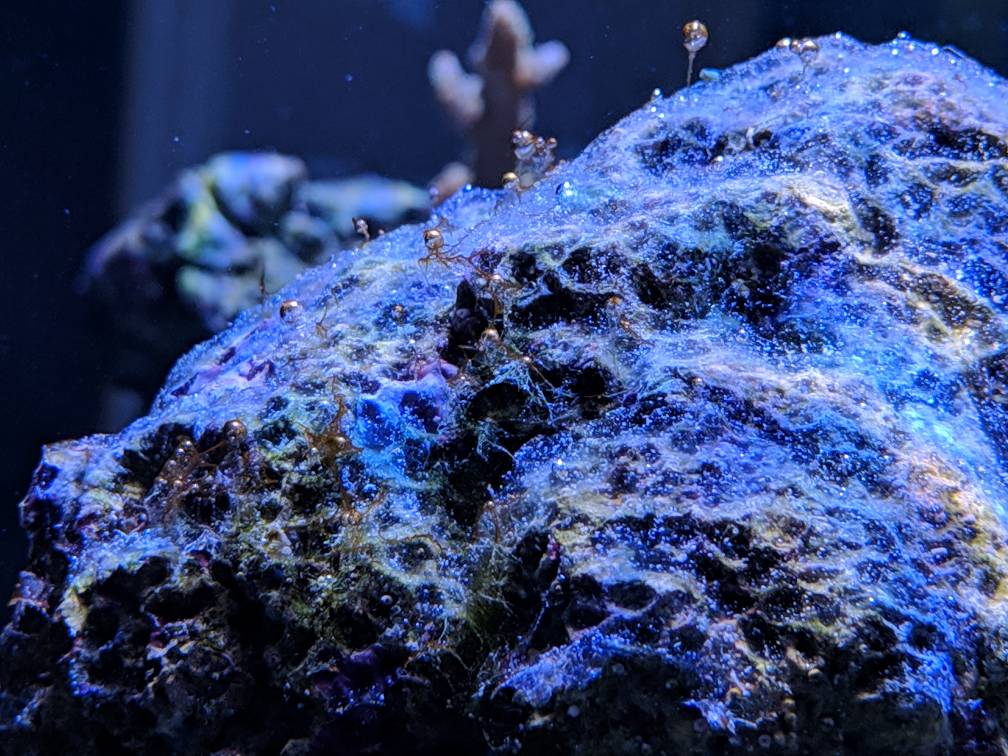
Good afternoon guys and gals. I could use more help please. I'm pretty sure this is dinoflagellates. And I have read posts about needing proper ID of which type for successful treatment. Also, that raising phosphate and nitrate levels would be a good place to start. Can someone help with proper ID? Or provide recommendations for treatment of this particular type of Dino?
IMG_20190329_131804.jpeg
 

Paullawr

Valuable Member
View Badges
Joined
Aug 12, 2016
Messages
1,333
Reaction score
957
Rating - 0%
0   0   0
Good afternoon guys and gals. I could use more help please. I'm pretty sure this is dinoflagellates. And I have read posts about needing proper ID of which type for successful treatment. Also, that raising phosphate and nitrate levels would be a good place to start. Can someone help with proper ID? Or provide recommendations for treatment of this particular type of Dino?

IMG_20190329_131804.jpeg
That could well be cyrsophytes. Without a scope image difficult to say but matting isn’t entirely consistent with dinoflagellates. Though it is possible you have those as well.

@reeferfoxx this young lass will advise. She’s quite good at that :)
 

Ron Reefman

Lets Go Snorkeling!
View Badges
Joined
Aug 12, 2012
Messages
9,628
Reaction score
12,364
Location
SW Florida
Rating - 0%
0   0   0
It looks like early stages of dinoflagellates to me, but it's a tough call from one pic.

What kind of light fixture do you use?

I've knocked it out a couple of times in 2 different tanks by going all blue on my led lights, covering the tank with a big beach towel (no room or outside light, cutting back on feeding, doing a lot of cleaning it off with a turkey baster and collecting it in a super fine net and filter socks then doing a water change. Light out is a short run and somewhat hard on the corals. But running all blue is hard on the algae that want red spectrum (from your white lights) and the coral's zooxanthellae do their photosynthesis using the blue spectrum. So they will polyp out like normal, feed and be happy. I run this for 10 to 14 days.
 

Paullawr

Valuable Member
View Badges
Joined
Aug 12, 2016
Messages
1,333
Reaction score
957
Rating - 0%
0   0   0
It looks like early stages of dinoflagellates to me, but it's a tough call from one pic.

What kind of light fixture do you use?

I've knocked it out a couple of times in 2 different tanks by going all blue on my led lights, covering the tank with a big beach towel (no room or outside light, cutting back on feeding, doing a lot of cleaning it off with a turkey baster and collecting it in a super fine net and filter socks then doing a water change. Light out is a short run and somewhat hard on the corals. But running all blue is hard on the algae that want red spectrum (from your white lights) and the coral's zooxanthellae do their photosynthesis using the blue spectrum. So they will polyp out like normal, feed and be happy. I run this for 10 to 14 days.
Im leaning towards both dinos and chryso but the picture really needs to be taken in white daylight.

The white matting isn't consistent with dinoflagelletes. Though there are clearly some brown strings forming.

@David & Katie - my suggestions -

Pickup a cheap microscope - these are actually alright for what you need and can upload the picture directly - additionally it can record and if savvy enough can download a small windows app to convert the video to a animated gif for uploading. I've done this in the past to show people different strains. Movement helps with ID.
https://www.amazon.com/Jiusion-Magn...ds=microscope&qid=1553945763&s=gateway&sr=8-4

Once you have that and an ID the treatment process can begin.

If it is just dinoflagelletes and the light is obscuring the photo then given the time of year, the location and way they are forming id be inclined to call ostreopsis spp. However it needs a proper photo.

If is it what I suspect then fastest method of removal is via UV. Around 1 watt for gallon, but quite frankly the best results have been on the Jebao 55w. Its huge though and needs to be plumbed direct to display tank. Running from sump has little effect.

Regarding lights out et el. I am not here to poo poo what has worked for others but 3 day black outs only disperse the cells in to the water column or subsurface depending on strain. They can live dormant on dry rock for years so a few days of no light is a walk in the park.

Blue light was disproved as being an effective means of reducing photosynthesis and in tests carried out on this forum no notable changes were found. However - as I say what works for one may work again and there are multiple orders of the same strain. We have barely begun to scratch the surface of the higher taxonomy.

Concerning nutrients. There is a huge debate on increasing N and P to reduce blooms. This has worked to an extent but I don't believe its directly responsible for their demise instead it changes the environment which may favour other organisms for space requirements. It won't directly harm them though and uptake of these organics are what makes life tick on earth - its food!

I did hypothesize that low nutrients maybe enticing a fight or flight response, in that we are starving them and they are making a move to get somewhere else. Truthfully though its anyones guess.

Good luck,
 
Last edited:
OP
OP
David & Katie

David & Katie

Community Member
View Badges
Joined
Aug 5, 2018
Messages
70
Reaction score
67
Rating - 0%
0   0   0
It looks like early stages of dinoflagellates to me, but it's a tough call from one pic.

What kind of light fixture do you use?

I've knocked it out a couple of times in 2 different tanks by going all blue on my led lights, covering the tank with a big beach towel (no room or outside light, cutting back on feeding, doing a lot of cleaning it off with a turkey baster and collecting it in a super fine net and filter socks then doing a water change. Light out is a short run and somewhat hard on the corals. But running all blue is hard on the algae that want red spectrum (from your white lights) and the coral's zooxanthellae do their photosynthesis using the blue spectrum. So they will polyp out like normal, feed and be happy. I run this for 10 to 14 days.
I have two Hydra 26 lights. They run a very low white light. Almost zero reds and greens.
 
OP
OP
David & Katie

David & Katie

Community Member
View Badges
Joined
Aug 5, 2018
Messages
70
Reaction score
67
Rating - 0%
0   0   0
Im leaning towards both dinos and chryso but the picture really needs to be taken in white daylight.

The white matting isn't consistent with dinoflagelletes. Though there are clearly some brown strings forming.

@David & Katie - my suggestions -

Pickup a cheap microscope - these are actually alright for what you need and can upload the picture directly - additionally it can record and if savvy enough can download a small windows app to convert the video to a animated gif for uploading. I've done this in the past to show people different strains. Movement helps with ID.
https://www.amazon.com/Jiusion-Magn...ds=microscope&qid=1553945763&s=gateway&sr=8-4

Once you have that and an ID the treatment process can begin.

If it is just dinoflagelletes and the light is obscuring the photo then given the time of year, the location and way they are forming id be inclined to call ostreopsis spp. However it needs a proper photo.

If is it what I suspect then fastest method of removal is via UV. Around 1 watt for gallon, but quite frankly the best results have been on the Jebao 55w. Its huge though and needs to be plumbed direct to display tank. Running from sump has little effect.

Regarding lights out et el. I am not here to poo poo what has worked for others but 3 day black outs only disperse the cells in to the water column or subsurface depending on strain. They can live dormant on dry rock for years so a few days of no light is a walk in the park.

Blue light was disproved as being an effective means of reducing photosynthesis and in tests carried out on this forum no notable changes were found. However - as I say what works for one may work again and there are multiple orders of the same strain. We have barely begun to scratch the surface of the higher taxonomy.

Concerning nutrients. There is a huge debate on increasing N and P to reduce blooms. This has worked to an extent but I don't believe its directly responsible for their demise instead it changes the environment which may favour other organisms for space requirements. It won't directly harm them though and uptake of these organics are what makes life tick on earth - its food!

I did hypothesize that low nutrients maybe enticing a fight or flight response, in that we are starving them and they are making a move to get somewhere else. Truthfully though its anyones guess.

Good luck,
Thanks for the suggestion and link for the microscope.
 

TOP 10 Trending Threads

WHAT AMOUNT OF LIVE ROCK AND SAND SHOULD BE PRIORITIZED FOR OPTIMAL BIODIVERSITY/FILTRATION?

  • 100% live rock + bagged sand

    Votes: 34 27.0%
  • 100% dry rock + 100% live sand

    Votes: 45 35.7%
  • 50/50 live/dry rock, 50/50 live/bagged sand

    Votes: 27 21.4%
  • 75% live rock, 25% live sand

    Votes: 11 8.7%
  • 25% live rock, 75% live sand

    Votes: 9 7.1%
Back
Top