Follow along with the video below to see how to install our site as a web app on your home screen.
Note: This feature may not be available in some browsers.
What are you talking about?
The static back pressure from 10 meters of water in a pipe with 1 mm diameter is the same as it is at 10 meters depth in the ocean.
The weight of the water column does not affect the total flow from a pump - it’s only the sum of static and dynamic back pressure that matter. (what pro´s call pressure losses )
At the same pump height – the static backpressure is the same and independent of the pipe diameter.
However – the diameter of the pipe has a large effect on the dynamic back pressure – caused by the friction between water, water and the pipe. Generally – larger pipe diameter – lower dynamic back pressure. But there is a limit where you do not gain so much more flow that it is worth to have a larger pipe diameter. And because of the fact that the dynamic back pressure is caused by friction, bends and other obstacles rise the dynamic pressure from the interface of water, water and the inside of the pipe. I write water, water just to indicate that friction among water molecules also matter (laminar or turbulent flow matter for the friction)
My experiences are that for the DC pumps (low pressure pumps) – right pipe diameter is important for the flow and right diameter is often a larger diameter compared with pumps for higher pressure. For pumps with high pressure – the pump curve has a large importance for the choice of back pressure (can be manipulated by pump height or pipe diameter) - otherwise – the pump will cavitates
I think that the linked calculator is very good
Sincerely Lasse
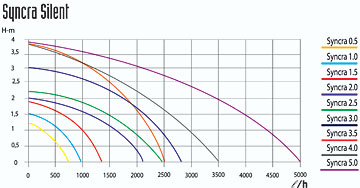
I have one. Good pump but not enough volume for my head pressure.SICCE SYNCRA 5
my walls are drywalled in now. I redid the plumping from 3/4 to 1" so I'm pretty much stuck now. But what I could do is run the 6 feet of vertical right off the pump to the ceiling in bigger diameter though. I just can't see a pump plumbed from the factory in 3/4" having that much restriction in 12 foot of 1" horizontal plumbing. And I still feel like the 2.5' drop going into the tank has to create somewhat of a vacuum that would help head pressure. The thing I'm really struggling with is dc vs ac. For instance if I buy an ecotech m1 and buy the battery backup, is that battery going to last hours? I have s generator anyway but if the power goes out while I'm at work will it last until I get home? Also it's adjustable flow, but if I run it wide open anyway what good is that feature really? A 200 dollar pump is a 200 dollar pump. If I buy one, run it a few years until it dies so be it. It's a 200 dollar pump. And to me it doesn't necessarily make sense to skimp $50 to try and get away with one that could work over something that will work. Now if I spent extra on a nice pump and it wasn't worth it, or it puked after a few years Id be ticked.From http://www.freecalc.com/fricfram.htm
Liquid Friction Pressure Loss
Pressure Loss (psi): 1.41 Head Loss (ft): 3.2
Line Number: scott.h - 1.0" PVC - 13.3 GPM
Pressure Loss (psi): 0.21 Head Loss (ft): 0.5
Line Number: scott.h - 1.5" PVC - 13.3 GPM
Pressure Loss (psi): 0.07 Head Loss (ft): 0.2
Line Number: scott.h - 2.0" PVC - 13.3 GPM
Add that on to your vertical lift distance....
Upgrading to 1.5" (or even 2" or 2.5") plumbing will get head loss down close to 6 feet....a smart move when you're up against that much head pressure. :)
800 GPH is about 3,000 liters per hour. 6 feet is about 1.8 meters.
All this comes from the Sicce home page: http://sicceus.com/aquarium.html
A Syncra 5.0 will push way more than you need if you get the right plumbing for it – around 1,000 GPH.
Sicce Syncra Silent 5.0 Multifunction Aquarium Pump (1321 GPH)
![]()
If you can find the Syncra Pro's for sale anywhere, the 5500 model (about $210) would be perfect.
Sicce Syncra PRO 5000, Flow 1500 GPH
This series appears to be the old Quiet One pumps, which were amazing. :)
According to Sicce, these are (still) their most quiet pumps. More quiet than the Syncra's. :)

![]()
I just can't see a pump plumbed from the factory in 3/4" having that much restriction in 12 foot of 1" horizontal plumbing.
It's the nature of the plumbing, fittings choices, et al....not directly the pump.....the pump is only a starting point. :)
Play with that friction loss calculator a bit to see the differet outcomes for some other types of plumbing and different fitting choices.
I'm not sure what you mean by the 2.5' drop....can you elaborate or show with a pic or something? It very well could matter....you typically only count the distance the water is being lifted. From the top of the sump water to the tippy-top of the plumbing. Outlets like spray bars, etc all obviously have an impact too, but are outside the scope of the calculators. (Unless you can find a manufacturer than publishes a K-value for their outlet. I'm not aware of any.)
If you have legitimate concerns about an extended power outage then those batter backups aren't your ticket....those are for momentary blips in power.
You either want (on the high side) a generator, or (on the low side) a quality inverter you can run from your car. Either with get you 1 hour+ running time, potentially running your whole system.
This will run a DC pump or a standard, bulletproof AC pump equally well.
thats what I was afraid of. And the l1s are just too much at this point.Ok so I have a vectra M1 and a little giant 4mdq or something like that. I would not use the vectra on ur system unless u picked up the l1. The m1 would be pushing it to the limit.
And I think the little giant would be perfect for what u want I'm guessing but I would say somewhere around 850gph and u already have ur sump drilled for the 1 inch input
i did consider that. I might just redo the up piece with 1.5 inch and change that one bend with a sweep or two 45sTake the 90 out and use two 45s. That will help more than you think. If you have a Sicce 5, try that first.
yeah I don't think the head pressure is quite as bad as what the chart says with that dropYou're right about that drop. You need some head-pressure to prime the pipes all the way to the top and blow out air, but you've potentially got a full siphon there at the end, so it won't take much pump to get good flow!
yeah I don't think the head pressure is quite as bad as what the chart says with that drop
Liquid Friction Pressure Loss
Pressure Loss (psi): 1.47 Head Loss (ft): 3.3
Line Number: scott.h-1.0" PVC-Sweep 90's-20 feet
Date: 11/10/2016
Nominal Pipe Size: 1
Pipe Schedule: SCH 40
Flow Rate (gpm): 13.3
Viscosity (cP): 1
Specific Gravity (water=1): 1.025
Temperature (F): 79
Pipe Roughness (ft): 0.000016
Actual Pipe ID (in.): 1.049
Fluid Velocity (ft/sec): 4.94
Reynolds Number: 41100
Flow Region: Turbulent
Friction Factor: 0.022
Overall K: 8.73
Piping Length (ft): 20
Long Radius Elbows: 2
Tee Flow Through: 1
Pipe Entrance: 1
Pipe Exit : 2
Liquid Friction Pressure Loss
Pressure Loss (psi): 0.22 Head Loss (ft): 0.5
Line Number: scott.h-1.5" PVC-Sweep 90's-20 feet
Date: 11/10/2016
Nominal Pipe Size: 1.5
Pipe Schedule: SCH 40
Flow Rate (gpm): 13.3
Viscosity (cP): 1
Specific Gravity (water=1): 1.025
Temperature (F): 79
Pipe Roughness (ft): 0.000016
Actual Pipe ID (in.): 1.61
Fluid Velocity (ft/sec): 2.1
Reynolds Number: 26779
Flow Region: Turbulent
Friction Factor: 0.024
Overall K: 7.15
Piping Length (ft): 20
Long Radius Elbows: 2
Tee Flow Through: 1
Pipe Entrance: 1
Pipe Exit : 2
Liquid Friction Pressure Loss
Pressure Loss (psi): 0.07 Head Loss (ft): 0.2
Line Number: scott.h-2.0" PVC-Sweep 90's-20 feet
Date: 11/10/2016
Nominal Pipe Size: 2
Pipe Schedule: SCH 40
Flow Rate (gpm): 13.3
Viscosity (cP): 1
Specific Gravity (water=1): 1.025
Temperature (F): 79
Pipe Roughness (ft): 0.000016
Actual Pipe ID (in.): 2.067
Fluid Velocity (ft/sec): 1.27
Reynolds Number: 20858
Flow Region: Turbulent
Friction Factor: 0.026
Overall K: 6.41
Piping Length (ft): 20
Long Radius Elbows: 2
Tee Flow Through: 1
Pipe Entrance: 1
Pipe Exit : 2
I love that pump, but it produces less then the ecotech m1. So I'm just concerned. I want this tank to be primarily an sps. It won't be overstocked with fish but I have an 18 inch snowflake eel that has outgrown the upstairs tank. So I'm really trying to put a lot of thought into filtration. I'm aso trying to keep my nitrates around 5 without having to carbon dose. I want to make this as easy as possible going in so I can stay consistent with my busy schedule.The RO Varios-6 that I talked about before would give you all the flow you would need. It is controllable and is APEX ready, you don't need to buy other stuff to connect it, just a cable.
Right – once the system is running.
Some updated comparisons....forgot to include the tee before, and this time I used long-radius 90º's.