


IM EXT 50

OK, I'm finally stocking this tank a bit. I am very picky about fish, so it has taken me awhile to find what I was looking for. Luckily, last week I found a Lubbuck's wrasse and Springer's damsel. Both are healthy, eating, and mostly getting along with others. There has been a little aggression from the yellow coris wrasse towards the lubbock's. I have also noticed that the flame angel has been chasing the Springer damsel a bit. Hopefully, they will calm down soon.

The tank is doing very well. There is some hair algae growing on the sand and rocks, but the snails are taking care of it. No signs of the P. parvum either. I will be looking to add some more SPS and clams to it soon.

I really like the colors on this lubbock's wrasse. It has a lot of purple and orange in it, even some red in the head and torso.
IMG_6897.JPG


I've never had a damsel before in 16 years of reefing because of their reputation. A local had some springer's damsels in his tank and told me that they were docile, so I took a chance. I like this little fish a lot. Very vibrant blue with the black flecks.
IMG_6888.JPG


I also picked up some tester corals to see if the tank is ready.

Pink Tip Sarmentosa. This has been in for about three weeks and is starting to base out.
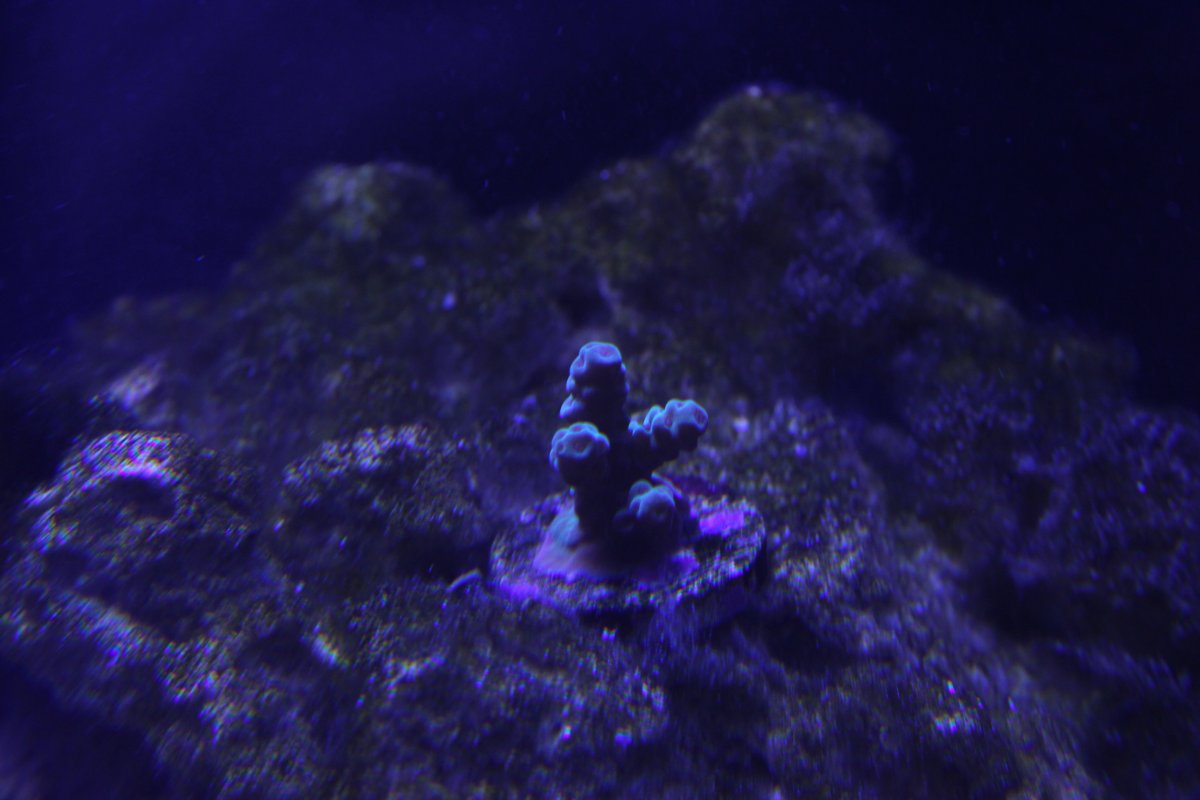
IMG_6891.JPG


This was sold to me a bowser cyphastrea. Sorry for the garbage pic. IMG_6892.JPG
 
Last edited:
OK, I'm finally stocking this tank a bit. I am very picky about fish, so it has taken me awhile to find what I was looking for. Luckily, last week I found a Lubbuck's wrasse and Springer's damsel. Both are healthy, eating, and mostly getting along with others. There has been a little aggression from the yellow coris wrasse towards the lubbock's. I have also noticed that the flame angel has been chasing the Springer damsel a bit. Hopefully, they will calm down soon.

The tank is doing very well. There is some hair algae growing on the sand and rocks, but the snails are taking care of it. No signs of the P. parvum either. I will be looking to add some more SPS and clams to it soon.

I really like the colors on this lubbock's wrasse. It has a lot of purple and orange in it, even some red in the head and torso.
IMG_6897.JPG


I've never had a damsel before in 16 years of reefing because of their reputation. A local had some springer's damsels in his tank and told me that they were docile, so I took a chance. I like this little fish a lot. Very vibrant blue with the black flecks.
IMG_6888.JPG


I also picked up some tester corals to see if the tank is ready.

Pink Tip Sarmentosa. This has been in for about three weeks and is starting to base out.
IMG_6891.JPG


This was sold to me a bowser cyphastrea. Sorry for the garbage pic. IMG_6892.JPG
It's funny the different experiences we have with some of the same livestock. I have the Cebu version of the Lubbock's wrasse and it's about to get evicted because it's too aggressive to every other fish in the tank now. My fish trap just arrived yesterday. It didn't used to be that way but as it's gotten older it's become a real butt head. On the other hand my pair of yellow wrasses couldn't be better reef citizens and frequently seem like they defuse situations, I've seen them insert themselves between the Lubbocks and the damsels when they've been picking on newcomers to the tank. I'm kind of surprised that yours is showing some aggression. I have a Springer Damsel as well and it is generally not a problem , it's nicer than my Yellow Tail which has decided it doesn't like my new Royal Gramma at all. I hope your new fish settle in well and the aggression subsides.
 
It's funny the different experiences we have with some of the same livestock. I have the Cebu version of the Lubbock's wrasse and it's about to get evicted because it's too aggressive to every other fish in the tank now. My fish trap just arrived yesterday. It didn't used to be that way but as it's gotten older it's become a real butt head. On the other hand my pair of yellow wrasses couldn't be better reef citizens and frequently seem like they defuse situations, I've seen them insert themselves between the Lubbocks and the damsels when they've been picking on newcomers to the tank. I'm kind of surprised that yours is showing some aggression. I have a Springer Damsel as well and it is generally not a problem , it's nicer than my Yellow Tail which has decided it doesn't like my new Royal Gramma at all. I hope your new fish settle in well and the aggression subsides.
Crazy that yours is aggressive. Mine is very new to my tank, but has very much been a pushover so far. To be fair, my yellow coris and flame angel sort of run the tank. My tomini tang is a pacifist.

I left this out but I should have said that while the reputation of damsels is that they are punks, my new springer damsel is a pushover so far. I think that the aggression will subside soon and everyone in the tank will get along soon... that is the hope at least.
 
Crazy that yours is aggressive. Mine is very new to my tank, but has very much been a pushover so far. To be fair, my yellow coris and flame angel sort of run the tank. My tomini tang is a pacifist.

I left this out but I should have said that while the reputation of damsels is that they are punks, my new springer damsel is a pushover so far. I think that the aggression will subside soon and everyone in the tank will get along soon... that is the hope at least.
My damsels are kinda punks, yellow tail more than the Springer but overall they’re not that much of a problem. I have a Tomini as well. We have a lot of the same fish.
 
Well, @#$%. I woke up this morning to a dead cleaner goby, a flame angel with tattered fins/swimming funny, and a tang covered in white. I guess ich made its way into my system. I don't have too much hope for the flame angel, but the tang could pull through. No feeding response on either of them. The wrasses (coris and lubbock's) and springer damsel show no signs of it. All fish are fat and a well feed, so this will be what it will be.

edit: I just looked up and the flame angel is laying in a corner of the tank, breathing heavy. It's a goner.

 
So, I still have the yellow coris wrasse and lubbock's wrasse. The rest of the fish died. I'm thinking it's ick. I won't be getting new fish for a month or so to see what happens.

Hair algae is getting bad, but at least it's not dinos. I bought a lettuce nudi and some chestnut turbos to help out with it. I also picked up a small 1.5" maxima clam from a semi-local shop. If this one does well, I will pick up another maxima and maybe a derasa. I love clams and SPS, so this is a big part of this tank's evolution. I need to buy more hermits to help with the GHA. I've never had an issue with GHA like this before, but I know it is part of a new tank's maturation process. I promise i'm not losing my head over this, thoughhhhhhh I may break some rules and get a yellow tang to help out (don't tell the tang police!). Pics to come.
 
I’m sorry to hear about the recent fish losses. I hope that’s behind you now and you can just concentrate on rebuilding. Let the CUC do its thing and then slowly start adding fish when you’re ready.
 
I’m sorry to hear about the recent fish losses. I hope that’s behind you now and you can just concentrate on rebuilding. Let the CUC do its thing and then slowly start adding fish when you’re ready.
Thanks! Beefing up the CUC is the plan! I'm no stranger to going slow, and am I am no hurry with this tank. That being said, I do have some quite large mini colonies that I was gifted. I need to get pics of those as well. :)
 
Any sign of the Prymensium parvum in your new tank? After battling dinos, PP started blooming on the glass, confirmed with microscope. Did a search here and your thread detailing your battle with PP came up. Running a jebao 55w uv unit plumbed in the display.
 
Any sign of the Prymensium parvum in your new tank? After battling dinos, PP started blooming on the glass, confirmed with microscope. Did a search here and your thread detailing your battle with PP came up. Running a jebao 55w uv unit plumbed in the display.
Hey! Sorry you have P parvum. I have not had any signs of them in my tank after the reboot. TBH, my advice would be to start the system over. IME, you cannot remove them from the tank. No amount of UV, bacterial additives, biome boosters (like TBS rock/sand), CUC, or deflocculate will remove them.

I drained this tank, tossed all the corals and LR, FW dipped the fish and moved them to a new system. I then cleaned the entire tank (including the plumbing!) and equipment in citric acid. I followed the suggested mixing amounts for BRS citric acid to make a 6g bath and soaked everything for 24hrs in a plastic tote to make sure I killed it all. After significant amounts of microscope testing, I am fairly confident that I don't have it anymore. I also have SPS PE and growth, which is encouraging.

I do, however, have Ostreopsis dinos, but I am winning that battle. I won't lie that I am getting horrible flashbacks of losing all my livestock to P. parvum when I see a couple snails die because of the toxic dinos, but I know that it is not the same. Fighting dinos is a winnable battle, but I don't believe you can fully remove P. parvum from a system once it is in there. It's just too resilient. There may be options that I didn't explore, but that was my experience.
 
Hey! Sorry you have P parvum. I have not had any signs of them in my tank after the reboot. TBH, my advice would be to start the system over. IME, you cannot remove them from the tank. No amount of UV, bacterial additives, biome boosters (like TBS rock/sand), CUC, or deflocculate will remove them.

I drained this tank, tossed all the corals and LR, FW dipped the fish and moved them to a new system. I then cleaned the entire tank (including the plumbing!) and equipment in citric acid. I followed the suggested mixing amounts for BRS citric acid to make a 6g bath and soaked everything for 24hrs in a plastic tote to make sure I killed it all. After significant amounts of microscope testing, I am fairly confident that I don't have it anymore. I also have SPS PE and growth, which is encouraging.

I do, however, have Ostreopsis dinos, but I am winning that battle. I won't lie that I am getting horrible flashbacks of losing all my livestock to P. parvum when I see a couple snails die because of the toxic dinos, but I know that it is not the same. Fighting dinos is a winnable battle, but I don't believe you can fully remove P. parvum from a system once it is in there. It's just too resilient. There may be options that I didn't explore, but that was my experience.
Ugh, I don't like the idea of a restart. I have a soft coral dominant tank with some huge leathers attached to large rocks. I imagine if I dip the leathers and their rocks in ro water that it might kill any hitchhiking P parvum before I place them in a temporary tank. Fortunately it's a bare bottom tank, so the tear down wouldn't be too labor intensive or messy if I had to do it. Dinos and P parvum were never a problem when I first started reefing in the late 90s. Now, it seems like a constant battle. Thanks for the advice!
 
Ugh, I don't like the idea of a restart. I have a soft coral dominant tank with some huge leathers attached to large rocks. I imagine if I dip the leathers and their rocks in ro water that it might kill any hitchhiking P parvum before I place them in a temporary tank. Fortunately it's a bare bottom tank, so the tear down wouldn't be too labor intensive or messy if I had to do it. Dinos and P parvum were never a problem when I first started reefing in the late 90s. Now, it seems like a constant battle. Thanks for the advice!
You could try a FW dip for the rock and leathers. My reading of the literature for P. parvum is that they can survive in a wide range of salinities, but apparently do not do well in fully FW. You could dip in FW and place in a holding tank to see if they survive. I would be interested to see what happens. My only concern is that they are known to have a cyst stage (dormancy), which makes them very difficult to kill. There was a study I read that noted the P. parvum can go into a cyst stage when the body of water they were living in dried up, attached to dirt/dust, and blew around to another source of water and reactivated. I have no idea if that is the case for the type that you or I have, but I wasn't taking chances. It is a lot of work, but I found it was either a tear down, or just live with mad corals and a dying CUC. My nutrients were so out of wack because of the P. parvum consuming N/P, as well as producing toxins, that I couldn't see my tank ever getting better. I fought it for almost a year before I gave in and restarted.

GL with your tank. I was thinking about how more common dinos are in the hobby nowadays compared to when I started in 2010. I'm not sure why it is, or if it is even true, but it does make me wonder.
 
I have been dealing with some Ostreopsis dinos for a week or so. Not a big deal. I raised nutrients, added my 13w UV, and have been dosing silicates and hydrogen peroxide. It seems to be getting better.

IMG_2235.JPG
 
You could try a FW dip for the rock and leathers. My reading of the literature for P. parvum is that they can survive in a wide range of salinities, but apparently do not do well in fully FW. You could dip in FW and place in a holding tank to see if they survive. I would be interested to see what happens. My only concern is that they are known to have a cyst stage (dormancy), which makes them very difficult to kill. There was a study I read that noted the P. parvum can go into a cyst stage when the body of water they were living in dried up, attached to dirt/dust, and blew around to another source of water and reactivated. I have no idea if that is the case for the type that you or I have, but I wasn't taking chances. It is a lot of work, but I found it was either a tear down, or just live with mad corals and a dying CUC. My nutrients were so out of wack because of the P. parvum consuming N/P, as well as producing toxins, that I couldn't see my tank ever getting better. I fought it for almost a year before I gave in and restarted.

GL with your tank. I was thinking about how more common dinos are in the hobby nowadays compared to when I started in 2010. I'm not sure why it is, or if it is even true, but it does make me wonder.
Ha! They survive on dry dirt?! When I rapidly change the salinity of a microscope sample with a few drops of freshwater, the parvum stop moving, the the fw dips might do the trick. Probably the overuse of dry sterile rock these days gives dinos a good running start. Back in the day, everyone started with nutrient and microbe rich live rock.
 
I have been dealing with some Ostreopsis dinos for a week or so. Not a big deal. I raised nutrients, added my 13w UV, and have been dosing silicates and hydrogen peroxide. It seems to be getting better.

IMG_2235.JPG
I'd take these over P parvum any day. I've never lost a battle with Ostreopsis after using the UV. Fortunately my fish are not affected by the parvum because my system is high nutrients. I went from Ostreopsis to LCA to SCA back to Ostreopsis and now parvum. It never ends.
 
Ha! They survive on dry dirt?! When I rapidly change the salinity of a microscope sample with a few drops of freshwater, the parvum stop moving, the the fw dips might do the trick. Probably the overuse of dry sterile rock these days gives dinos a good running start. Back in the day, everyone started with nutrient and microbe rich live rock.
My recent issue with P. parvum has really made me miss my old 40g reef. I set that thing up with established LR and it grew SPS with minimal effort. Imagine if I actually had more time in grad school to take care of it better!

11/2012 - 5/2015
B69A0B4B-AA44-46AF-8289-08B8A0EE64BB_1_105_c.jpeg
 
My recent issue with P. parvum has really made me miss my old 40g reef. I set that thing up with established LR and it grew SPS with minimal effort. Imagine if I actually had more time in grad school to take care of it better!

11/2012 - 5/2015
B69A0B4B-AA44-46AF-8289-08B8A0EE64BB_1_105_c.jpeg
That's a nice reef!
 
We've turned a corner with this reef in the last week. My hair algae outbreak was fine, but then the cyano came in. I started pulling hair algae and blowing off the rocks and then the dinos came as the hair algae started to die off (likely feeding on the nutrients from the dying hair algae). The dinos coated EVERYTHING pretty badly, so I raised nutrients and was blowing the rocks and siphoning what I could. I also was adding prodibio once a week to help. After two weeks, the dinos are gone, hair algae is gone, and the cyano is very slowly going away. It's on the sand in some spots, but manageable. The SPS are all fine and growing. They lost some color due to nutrients yo-yo-ing around, but growth and PE is present. Coraline algae is starting to take hold and things look to be improving.

Test results from this morning:
DkH - 7.6 I am slowly raising this, but demand starts to outpace the increase. I am aiming for 8-8.5 DkH
Nitrate - 15.6ppm I am fine with this for now. I was dosing ammonia and got it to 17ppm, but I would will let it drop to 10-ish on its own.
P04 - .06ppm I am fine with this as well. I need to keep it above .02ppm or bad things start to happen 😬

Update pics now that the tank is less ugly. I will do some top-downs once the coral start to color up.

IMG_2272.JPG


IMG_2271.JPG


FTS 04/05/26
IMG_2273.JPG
 

TOP 10 Trending Threads

As a buyer, how important are auctions to you on the NEW market?

  • As a buyer I like them

    Votes: 26 35.1%
  • As a buyer I don’t care for them

    Votes: 28 37.8%
  • I don’t care either way.

    Votes: 20 27.0%
Back
Top
Home
Post thread…
Market
What's new








