Make your own plastic mesh on a 3d printer

pooootiqe

Active Member
View Badges
Joined
Aug 15, 2022
Messages
248
Reaction score
210
Location
NY
What state or country do you live in
New York
Rating - 0%
0   0   0
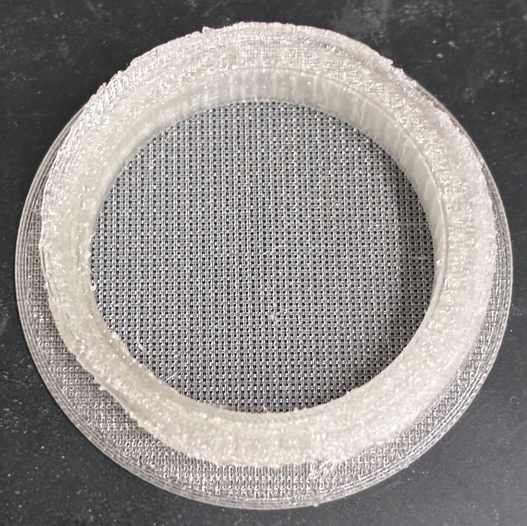
Wanna make a set of copepod sieves but don't wanna buy 20 different nylon mesh? How about a Paul B style brine shrimp feeder? Worry not, here's a way to print your own custom mesh on a 3d printer.

What you need:
0.2 mm nozzle
Your filament of interest
A matching support filament for raft
A way to switch filament between layers (AMS, BMCU, dual extruder, manually stopping the print at layer x and swap filament, etc.)

Two vital settings are needed to print a decent mesh. Using Orcaslicer as an example:

1. Generating the mesh
- Under the strength tab, set top / bottom shell layers to 0.
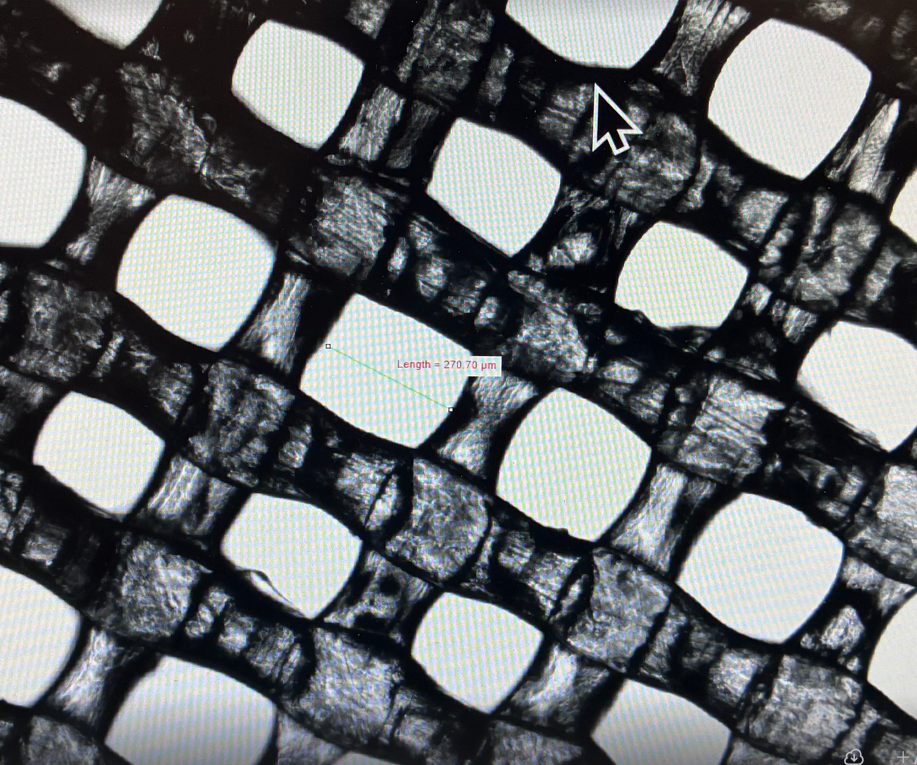
- Under "infill", set "Sparse infill density" to a desired amount. This will influence the hole size in your mesh. I'm still collecting data on this, but on my Bambu A1 mini, 50% sparse infill on an 1 inch circle prints 260-280 um square holes.
- Set "Sparse infill pattern" to "rectilinear".

2. Make a smooth base for the mesh quality
To print a secure first layer, the printer will "squish" the filament into the bed. This is undesirable since it would mess up the hole size.
- To avoid this, set "raft layer" to 1-3 layers, 0 mm raft contact Z distance. This will build a peelable base on which the mesh prints.
- Use a compatible material under "Support / raft base". Some combinations would be PETG / PLA, PVB/PLA, PC/HIPS, etc.
- Select "ironing support interface". This will ensure your mesh stays in place during printing.

Example (50% sparse infill, rectilinear, gray = PVB, black = PLA):
1792450925674.png
1792454001078.png
1792454028205.png


Happy printing!
 
Interesting idea, and surprising performance, but it unfortunately can't replace most sizes used for copepod sorting. On the large end for brine shrimp nauplii but will probably work, likely good as a coarse filter sock replacement (though the geometry isn't ideal) and would work great for collecting eggs/larvae for most larger types and in isolation baskets to keep little things penned in.
 
Interesting idea, and surprising performance, but it unfortunately can't replace most sizes used for copepod sorting. On the large end for brine shrimp nauplii but will probably work, likely good as a coarse filter sock replacement (though the geometry isn't ideal) and would work great for collecting eggs/larvae for most larger types and in isolation baskets to keep little things penned in.
100 um might be doable; printed these to do make a brine shrimp feeder for mandarins, <200 would just be too small for that purpose!

I agree it won’t be a great solution for anything needing <100 um, the lines are just too wide that the hole density would be too low. Someone with the mythical 0.1 mm nozzle is welcomed to give it a try. ;)
 
I've heard basically any filament with color flecks or other color will clog in a 0.2mm nozzle, so a 0.1mm may be out of practical reach even if the motion system has good enough positioning. SLA printers though, probably.

Another technique could be to leave the width of each strand and just try to tighten in the gaps - if the positioning is up to the task, it shouldn't be any more difficult, but it may be harder to convince the infill generation to do (still could make an STL with it, though.)

PET or PC (no CF) would probably hold up best in a saltwater environment in the long term.
Absolutely. I haven’t played around with the heterogeneous filaments but heard of the horror stories. I’ve always wanted to get an SLA printer but shied away from them cause of the fumes and cleanup. Would be the best tool for small and precise features, for sure.

I attempted 60% infill which def made the gaps smaller (eyeballing to be about 150 um?) but the hole uniformity starts to suffer.

Thanks for the suggestion on PC, maybe I’ll give it a try! It kinda bugs me to have the chamber warm up for 20 minutes just to do a 10 minute print, lol.

Here’s a harder question: how do I convince this dum dum to be interested in the feeder? I can literally see bbs wiggling in the mesh!

IMG_0817.jpeg
 
Thanks for sharing this! Very clever design!
 
Using honeycomb infill at 60% and 70%, the hole uniformity improves, but density goes down. 70% infill produces nice looking ~150 um circular-ish holes
IMG_0819.jpeg
IMG_0820.jpeg
 
Have you looked into procedural gcode generation? I don't have much experience with it, but an easier feature should be to define repeating patterns to print. I mention because it may give you a lot more control for optimization, for example with the hexagon - if you could get single extrusion width hexagons you could get a good increase in the surface area of the holes per area of mesh, which should improve its usability a lot. With the regular nylon meshes you have until about 50 microns before the hole size/concentration is so small that it's very tedious to get a lot of liquid through. With larger filaments making up the mesh, this limit may give you noticeably slow flow at much larger hole sizes.
 
Have you looked into procedural gcode generation? I don't have much experience with it, but an easier feature should be to define repeating patterns to print. I mention because it may give you a lot more control for optimization, for example with the hexagon - if you could get single extrusion width hexagons you could get a good increase in the surface area of the holes per area of mesh, which should improve its usability a lot. With the regular nylon meshes you have until about 50 microns before the hole size/concentration is so small that it's very tedious to get a lot of liquid through. With larger filaments making up the mesh, this limit may give you noticeably slow flow at much larger hole sizes.
Haven't looked into it. My feeling is that since there are so many features in the sliced file nowadays (pressure advance for example, is probably constantly changing the extrusion speed), it might not be a simple copy-and-paste into the gcode file.
There have been attempts on importing custom infill patterns however. https://github.com/OrcaSlicer/OrcaSlicer/pull/12000/files I'll see if Claude can draft something to make single line hexagons ;)
Thanks for the note on draining rate, haven't thought about that. Perhaps gentle vacuum from a small vacuum pump could help?
 
Gentle vacuum helps, getting the reverse side wet helps too, but if you're sieving small organisms, most vacuum options are going to be rough enough on them to cause injury. I wouldn't use a sieve at all for a very small fish larvae, for example, but a copepod or egg is more durable.
 
I don't speak gcode, but I have had some success using the python library for FreeCAD to procedurally generate discreet airholes for an airlift to minimize splashback, as well as this thing here to stop small fish from getting trapped in a bubble stream. I can link some resources I used to learn if you are curious

Screenshot 2026-10-21 at 9.34.49 PM.png
Yes please!

I asked Claude to generate a script in Fusion to make hexagonal holes, but the script takes forever and prob is slower than me making linear patterns by hand, lol.

Speaking of airlifts, was the splash guard successful? I always wondered if mattenfilters could be used in saltwater with an airlift.
Let me see if I can compile a list of stuff and get back to you.

This is the first time I am hearing of Fusion. That project sounds really interesting. However, I wonder if theres some overhead with the translation and abstraction thats slowing the script down, but this stuff is slow in general. It takes about a minute to generate these. To be honest though, AI will probably do a better job these days.

The splashguards are very successful, this tank is filled with all of my failed prototypes. The piece I showed above stopped convection so I was worried there would be a local hypoxia gradient. I've switched to an open design now.
IMG_4667.JPG


Now I am using this design for all of our tanks at our facility (Bali Aquarich nebula pair just for attention)
IMG_4666.JPG
 
Last edited:
If you're curious, this is the lid. Surface area was calculated so the pressure drop wouldn't force droplets out at high speeds.. Its perforated where the columns attach as well, so air won't get trapped. As long as the bubbles aren't set to too high, it does a really good job.
Screenshot 2026-10-22 at 12.02.10 AM.png


This is how the main piece looks before revolution. The constraints do get in the way visually a little though, but I am a bit OCD about making it go light green.
Screenshot 2026-10-22 at 12.04.29 AM.png
That’s really nice! Thanks for sharing.
 
Thank you. Let me know if you want the stl files.

Regarding generating the mesh, I would probably just have your AI write something in python directly. Tell it to use the FreeCAD python console to create a spreadsheet with two dimensions for the entire mesh, nominal size of the hole, width of the line, and padding thickness. Then create a sketch of the mesh. Finally tell it to pad to the thickness you want.

I would not suggest having it create a giant blank sheet then pocket every single hole or else that will take genuinely forever.
 
Fusion has always been sort of slow for repeating patterns, it's been my cad preference but punching a ton of holes in something or making a geometric mesh pattern is often annoying to constrain to scale or just slow to calculate.

I've made some small airlift pumps of various sorts and you can just cap them to deflect any droplets too. The air escape holes need to be large enough so that the air doesn't get forced down with the water flow (in a liftover kind of configuration), but then you can do a sort of inverted bowl/plate shaped piece to contain droplets and I haven't run into much of a salt creep issue.
 

TOP 10 Trending Threads

IF A LONGER TRIP GETS UNEXPECTEDLY EXTENDED, WHAT’S YOUR BACKUP PLAN FOR THE TANK?

  • I keep an experienced reefer friend on call who can check in and cover extra days

    Votes: 2 22.2%
  • A non-reefer friend or family member can follow my instructions

    Votes: 4 44.4%
  • Automation and remote monitoring should buy me time

    Votes: 4 44.4%
  • I have a local aquarium service or store I can call

    Votes: 1 11.1%
  • I don’t have a real backup plan. So, yes, I’d be sweating

    Votes: 3 33.3%
  • I don't wanna think about this question. La la la la la la...

    Votes: 1 11.1%
  • Other (Post in the comments)

    Votes: 0 0.0%
Back
Top
Home
Post thread…
Market
What's new