I recently reexamined some of the literature I have on Marine Ich, paying closer attention to what it says about temperature and its effect on the parasite’s known life cycle. As with most studies, precise conclusions can be somewhat ambiguous, but I wanted to share what I have learned and open a discussion regarding this topic.
The first article I reread was the 1997 Colorni and Burgess study, where it states: “Theront excystment is very asynchronous, occurring between 3 and 72 days.” This is the study which the infamous 72 day fallow period is based upon, and it has been suggested it took up to 72 days only because the original experimentation was done in cold water. Indeed, this excerpt from the article seems to support that:
For the reader’s reference, 20C=68F and 25C=77F.
However, later in the article (see
red highlights below) it states that that the reason for the asynchronous excystment is "unclear". Wouldn't they just say the prolonged excystment (72 days) was due to cooler water temps if they were confident that was the case?
I wouldn’t think they’d label it a “phenomenon” if the simple explanation was that cooler water temps were a contributing factor for asynchronous excystment. It could be because later on they discuss “cold water intraspecific variants” which only adds to the confusion:
Can a cold water variant infect a reef fish typically found in warmer waters? And vice versa? :eek: With regards to temperature, the study was actually more focused on its correlation to trophont/tomont/theront size:

The next “article” I reread was a 332 page PDF, written by Peter Burgess in 1992, where he conducted a series of experiments to partially fulfill the requirements for his PhD. Some of the information contained therein is now considered outdated/obsolete, but it still lays the groundwork for most of what we know about the parasite. One such example of possible outdated info is this excerpt:
I know from reading more recent studies that it has been proven ich can go dormant (for up to 6 months, I believe) if temp is lowered, but then become infectious again once the temp is returned to normal. I do not know if the same applies if you were to raise aquarium temperature above 30C/86F. According to “Table 2” from this source, it would take 40C/104F for 1 hour to disinfect SW ich from your aquarium:
https://edis.ifas.ufl.edu/fa164. However, I would think 104F would eradicate even nitrifying bacteria thus “uncycling” your tank. I don’t believe most fish/corals/inverts could handle > 86F (they would
ALL need to be removed beforehand), but I do believe bacteria could survive that. The question is how long would you need to keep the aquarium > 86F to eradicate ich from it?
Next up is this table which outlines the development of C.irritans trophonts at different temperatures:

However, I found nothing above to be useful for our purposes since most of the animals we keep couldn’t survive in 17C/62.6F water.
Finally, the study had this to say regarding temperature and immune response to SW ich:
Two other articles I have not read on the subject, so I will just copy & paste their abstracts below:
Studies on cryptocaryoniasis in marine fish: effect of temperature and salinity on the reproductive cycle of Cryptocaryon irritans - Journal of Fish Diseases Volume 2, Issue 2, pages 93–97, March 1979
Influence of Temperature and Host Species on the Development of Cryptocaryon irritans
B. K. Diggles and R. J. G. Lester
The Journal of Parasitology
Vol. 82, No. 1 (Feb., 1996), pp. 45-51
Conclusions: Some of the information above is unusable for our purposes, as many of the animals we keep will not live in the experimental temperatures shown to have a negative impact on ich’s life cycle. Although, those with cold water SW tanks battling ich might find it useful. The main thing I was looking for was whether or not the recommended 72 day fallow period is greatly exaggerated due to experimentation being conducted at cooler water temps. And while I admit there is some evidence to support it is, I also believe there are other variables in play which determines how long it can take for all the theronts to be released (or rupture) from their respective tomonts. I also cannot discount the numerous anecdotal accounts of 72 day fallow failures, or chalk every single one of them up to cross contamination or some other mental error on the part of the hobbyist. In short, we probably don’t know as much about ich as we think we do. ;)
I do think, however, that it would be prudent to monitor aquarium temp while going fallow. You probably want it to be at least 77F, and it is possible that running it at 80-82F will speed up ich’s life cycle and increase your chances of having a successful fallow period. At the very least, it does no harm as most corals/inverts handle 80-82F just fine (except for possibly certain SPS.)
Whether you decide to go fallow for the entire 72 days (actually 76 if you factor in more than just the tomont stage), or roll the dice on a shorter duration
is entirely up to you. For those who opt for the latter, Table 1 (below) provides some useful info taken from here:
http://atj.net.au/marineaquaria/marineich.html
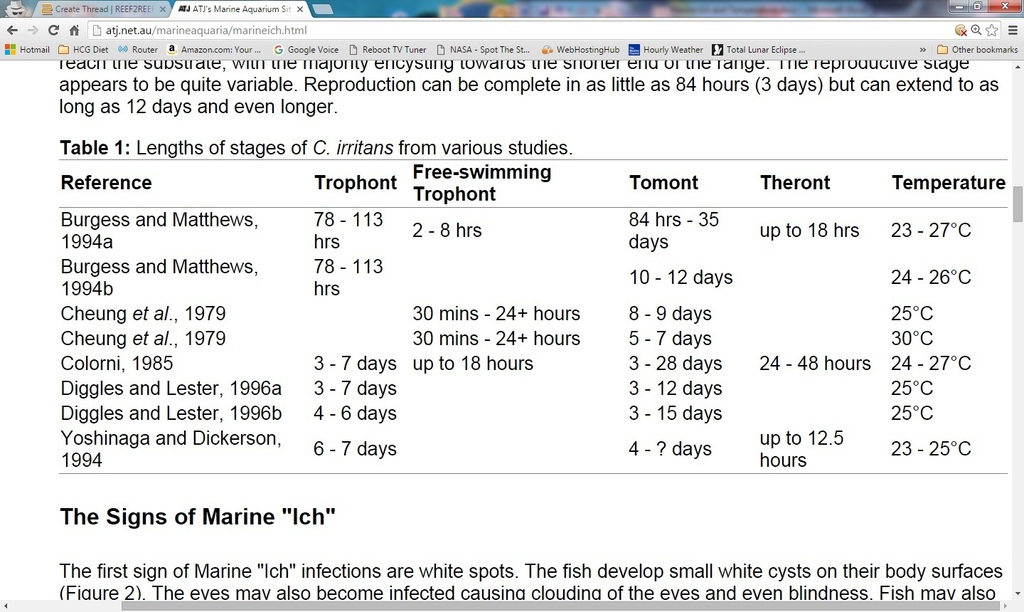
It shows lengths of stages of C. irritans from various studies
before the 1997 Colorni and Burgess Study. In these listed studies, 35 days was the longest time it took for theront release (Burgess and Matthews, 1994a). So, 45 days fallow
should be sufficient for
most garden variety strains of ich so long as temp is 77F or greater during the
entire fallow period.
One last thing I wanted to mention is something I said previously - about ich going dormant in lower temps and then becoming infectious again once the temp is returned to normal. That information is quoted below and was extracted from here:
https://edis.ifas.ufl.edu/fa164
So let’s now begin a lively discussion, debate, more info presented, etc. on Marine Ich and Temperature! :)