


- Joined
- Feb 20, 2025
- Messages
- 65
- Reaction score
- 68
- Location
- Minneapolis
- What state or country do you live in
- Minnesota
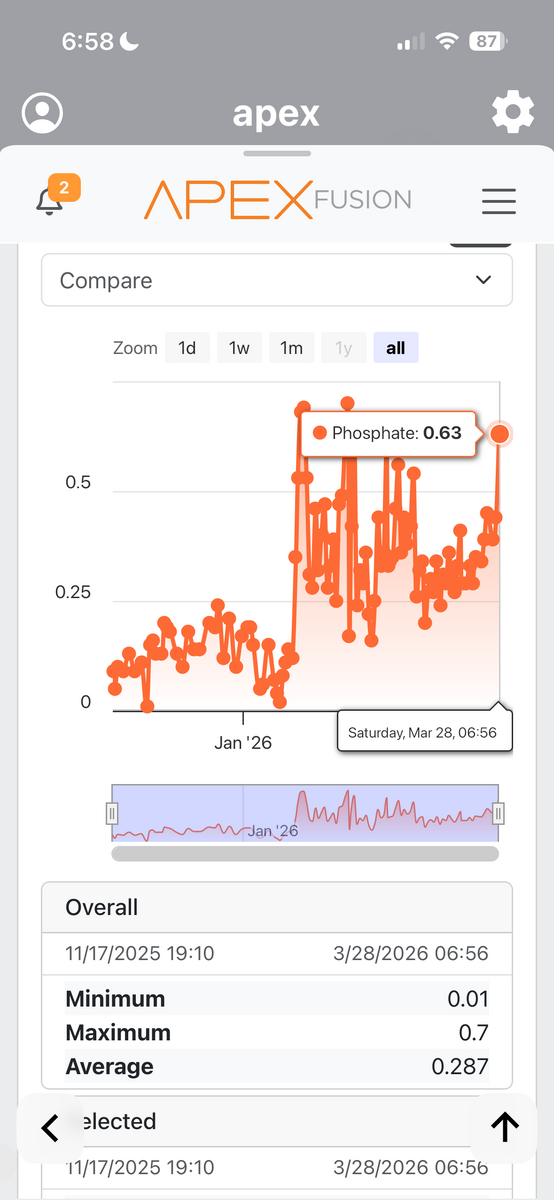
OK, I officially need help understanding and managing my phosphate levels. I posted a few days ago and at the time I was only "curious" because all reef citizens (LPS, leathers, monti, clams etc) were thriving and I thought my management plan of replacing exhausted GfO every 3 days was slowly working. I now need help understanding what is happening and what to do. The reef inhabitants continue to thrive but phosphate levels are back up to .63 after dipping to .3-.5 The graph below depicts Hanna ULR phosphate levels over time. Phosphate levels were stable between .1-.2 for months. On January 17th phosphate was .12, on January 18th it was .35 on January 19th .53 and on January 21 it was .69. In short, it spiked from a steady baseline to .7 over days. The spike did not coincide with a new box of reagent.
My mixed reef (photo below) is a Nuvo 40 long AIO with large leather corals, healthy LPS (goniopora, duncan, candy cane, torches, hammers, octospawn, favia, acans, microsusa), GSP, xenia, derasa clam, clean up crew, a few monti pieces and 7 fish (starry blenny, 2 clowns, hectors goby, neon cleaner goby, royal gramma and biota mandarin). It is 7 months old and was established with Gulf Live Rock and sand plus Australian live rock. Nitrate runs 10-15 and was 12 this morning with a phosphate of .63.. Alkalinity averaged 8-9 with AFR before the spike. Since the spike, it runs 7-8 with AFR plus supplemental Brightwell KH when I change GFO. I do not have algae issues.
At the time of the spike nutrient export included thick blue filter pads (changed or cleaned daily), IM protein skimmer, thriving chaeto refugium and weekly 10% water changes. Nutrient addition consisted of 1/2 cube of mysis or brine/day, benepets powder 3/16 teaspoons weekly and algae pod pate 1/8 teaspoon twice per week. A few weeks prior to the spike I began dosing Ocean Magic 25 ml/day in anticipation of promoting pod growth for the addition of a Mandarin. I thought I would be safe dosing phytoplankton because I was checking phosphate daily. I stopped the filter pads last week because I dont want to remove pods (other than protein skimming). I stopped phyto dosing when the phosphate level increased. I also stopped benepets powder and pod pate after the spike but added 1/8 teaspoon per day of TDO pellets for the Mandarin (target fed). I continue to perform weekly 10% water changes along with protein skimming and the chaeto refugium (harvested every 3 weeks or so).
Immediately after the spike I could not find dead organisms or dead spots and the chaeto was bright green. I thoroughly cleaned the display tank, sump, pumps and skimmer. Given the phosphate spike exceeded my target of .1-.3 I began dosing 5-6 tablespoons of BRS high capacity GFO in a reactor on January 21. I have run GFO continuously since then. The GFO exhausts after 48-72 hours and I have gone through about 2 pounds of high capacity GFO since the January spike. Despite 2 pounds of high capacity GFO over 2 months, levels remain well above my target of .1-.3. I know the reactor is working because I check KH and phosphate daily after refreshing GFO and KH and phosphate both drop the day after changing media but phosphate goes back up by day 3. I adjust the reactor to achieve shimmering movement of the top particles. I have also used GFO in media bags and the media still exh
I will summarize as follows: 2 months ago phosphate levels spiked over 3 days from a steady baseline of .1-.2 to .69 with steady nitrate levels of 10-15. Nothing changed to account for the spike except some dosing of phytoplankton (long since stopped). My export regimen of skimmer, refugium, water changes and carbon seems reasonable for my feeding schedule (basically 1/2 cube mysis plus 1/8 teaspoon TDO pellets and occasional benepets). Despite 2 pounds of high capacity BRS GFO over 2 months phosphate level this morning was .63. My chaeto remains bright green with no evidence of die off and I harvest it every 3 months.
Help! Why is my elevated phosphate so stubborn? What should I do?
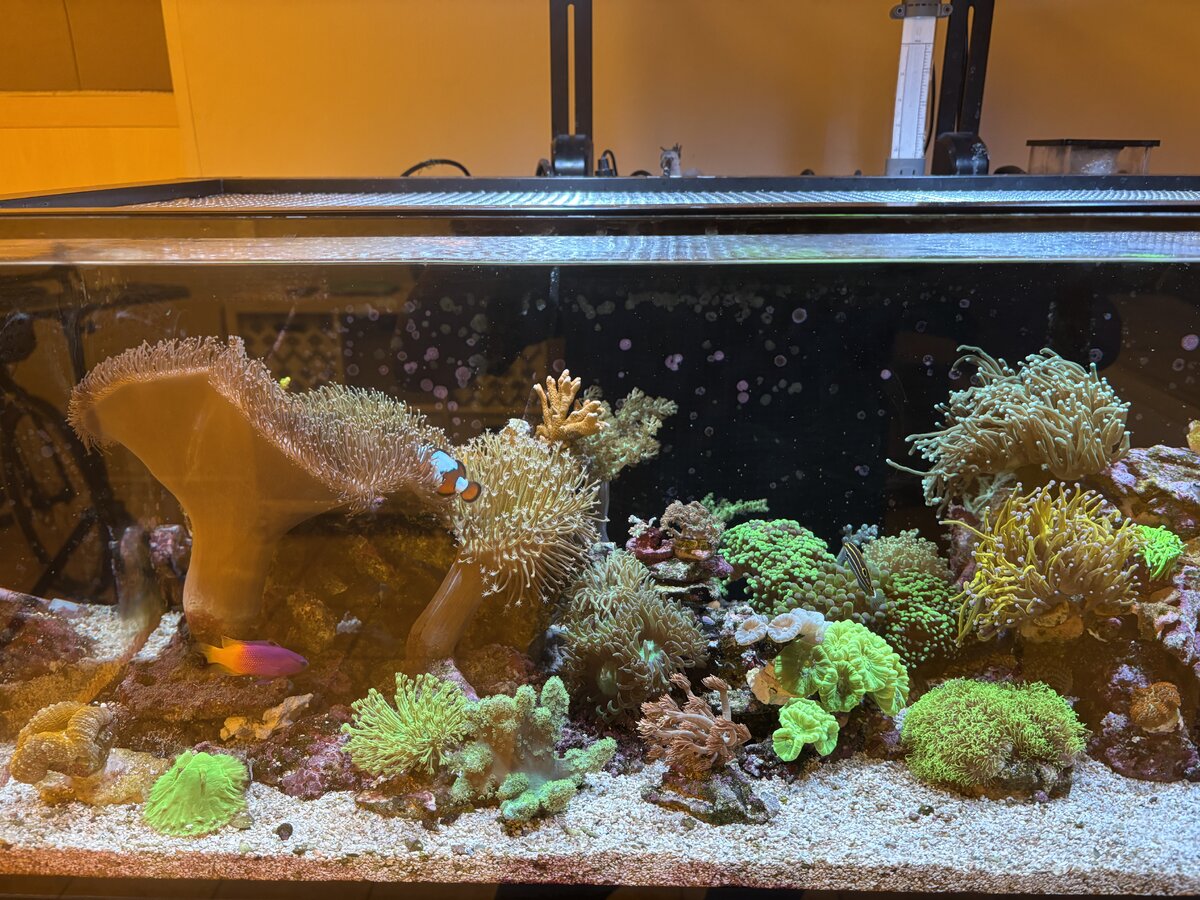
My mixed reef (photo below) is a Nuvo 40 long AIO with large leather corals, healthy LPS (goniopora, duncan, candy cane, torches, hammers, octospawn, favia, acans, microsusa), GSP, xenia, derasa clam, clean up crew, a few monti pieces and 7 fish (starry blenny, 2 clowns, hectors goby, neon cleaner goby, royal gramma and biota mandarin). It is 7 months old and was established with Gulf Live Rock and sand plus Australian live rock. Nitrate runs 10-15 and was 12 this morning with a phosphate of .63.. Alkalinity averaged 8-9 with AFR before the spike. Since the spike, it runs 7-8 with AFR plus supplemental Brightwell KH when I change GFO. I do not have algae issues.
At the time of the spike nutrient export included thick blue filter pads (changed or cleaned daily), IM protein skimmer, thriving chaeto refugium and weekly 10% water changes. Nutrient addition consisted of 1/2 cube of mysis or brine/day, benepets powder 3/16 teaspoons weekly and algae pod pate 1/8 teaspoon twice per week. A few weeks prior to the spike I began dosing Ocean Magic 25 ml/day in anticipation of promoting pod growth for the addition of a Mandarin. I thought I would be safe dosing phytoplankton because I was checking phosphate daily. I stopped the filter pads last week because I dont want to remove pods (other than protein skimming). I stopped phyto dosing when the phosphate level increased. I also stopped benepets powder and pod pate after the spike but added 1/8 teaspoon per day of TDO pellets for the Mandarin (target fed). I continue to perform weekly 10% water changes along with protein skimming and the chaeto refugium (harvested every 3 weeks or so).
Immediately after the spike I could not find dead organisms or dead spots and the chaeto was bright green. I thoroughly cleaned the display tank, sump, pumps and skimmer. Given the phosphate spike exceeded my target of .1-.3 I began dosing 5-6 tablespoons of BRS high capacity GFO in a reactor on January 21. I have run GFO continuously since then. The GFO exhausts after 48-72 hours and I have gone through about 2 pounds of high capacity GFO since the January spike. Despite 2 pounds of high capacity GFO over 2 months, levels remain well above my target of .1-.3. I know the reactor is working because I check KH and phosphate daily after refreshing GFO and KH and phosphate both drop the day after changing media but phosphate goes back up by day 3. I adjust the reactor to achieve shimmering movement of the top particles. I have also used GFO in media bags and the media still exh
I will summarize as follows: 2 months ago phosphate levels spiked over 3 days from a steady baseline of .1-.2 to .69 with steady nitrate levels of 10-15. Nothing changed to account for the spike except some dosing of phytoplankton (long since stopped). My export regimen of skimmer, refugium, water changes and carbon seems reasonable for my feeding schedule (basically 1/2 cube mysis plus 1/8 teaspoon TDO pellets and occasional benepets). Despite 2 pounds of high capacity BRS GFO over 2 months phosphate level this morning was .63. My chaeto remains bright green with no evidence of die off and I harvest it every 3 months.
Help! Why is my elevated phosphate so stubborn? What should I do?














