Po4 even slightly higher affects colors in all corals!

  • Thread starter Thread starter CHSUB
  • Start date Start date
  • Tagged users Tagged users None

CHSUB

2500 Club Member
View Badges
Joined
May 4, 2015
Messages
2,904
Reaction score
3,010
Location
Punta Gorda, FL
What state or country do you live in
Florida
Rating - 0%
0   0   0
In the last few months po4 has gone from ~.02 to today’s high of .11ppm. The rise has been gradual but on average is > than a 200% increase. I have tried to control with only wc and maintenance but po4 continues higher. The change is only observable in a slight color change; from remarkable brilliant to a hint of brownish tones. Growth is unchanged as observed through 2 part additions and measurements. The change is most noticeable in a green bird nest but also GSP seems less brilliant. Nothing else has changed as confirmed by hobby testing and ICP MS. The color differences are only noticeable at full spectrum lighting and not the last hour of my lighting cycle which is blues only.
The idea that higher po4 makes no difference or is desirable, imo, is just false. I’m now considering a few drops of E phosphate from Tropic Marin to get levels back to ~.02.
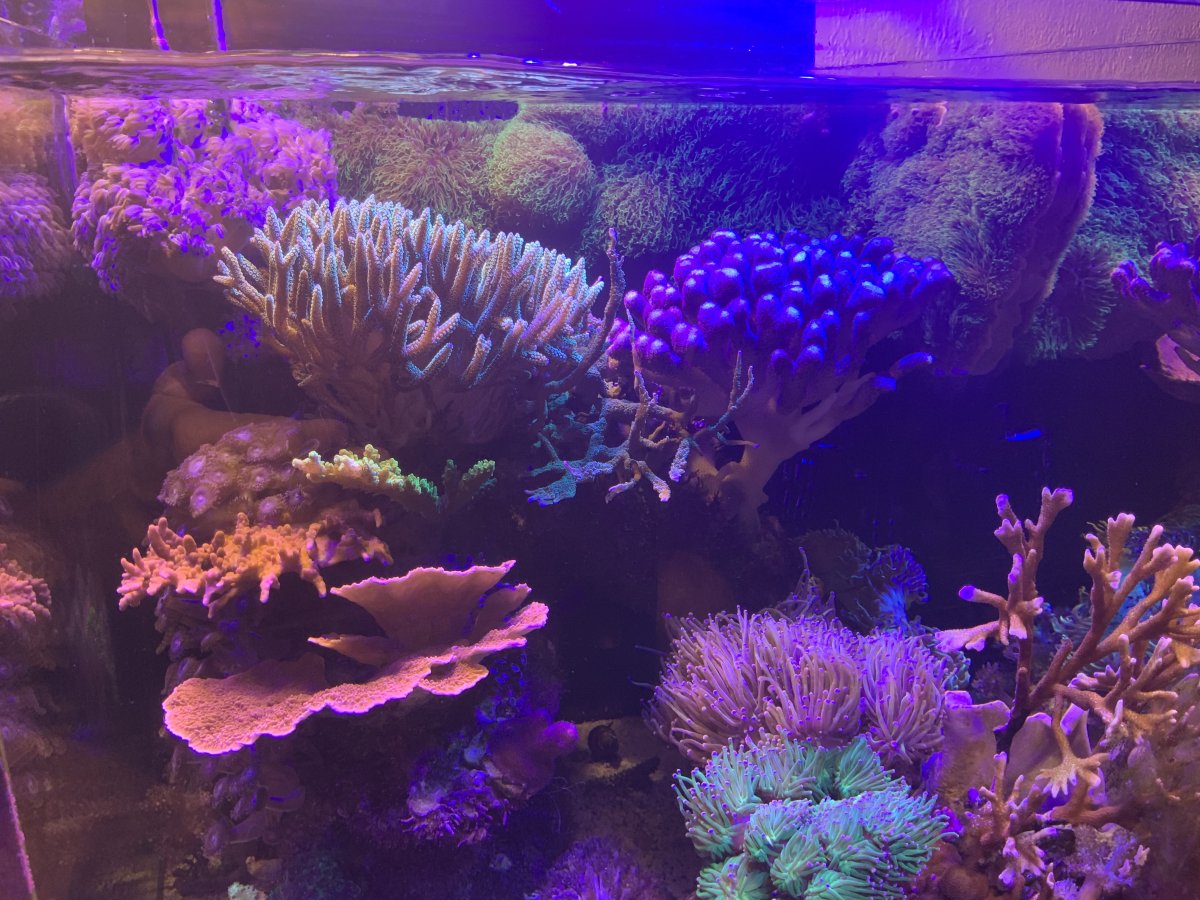
Here from today the green bird nest is dull colored when a few months ago was “nuclear” green…

IMG_1340.jpeg
 
To further expand, this color change is only observable under full spectrum lighting and not the windex blue lighting that many people and LFS use. Just now my lights went to only blue and the color change in the coral from elevated po4 is not observable. While it might not matter to most, it is imported to know the facts….low po4 at ~ .02 ppm is the most desirable!

This picture doesn’t show any evidence of color change. Corals look the same with this lighting.
IMG_1341.jpeg
 
I think a color shift in some corals with higher nutrients is not surprising. Have you noticed any other changes in coral health or growth?

Very few things with corals seem to depend on a single variable. That’s part of what makes it so interesting. I wouldn’t be surprised if someone shares the exact opposite observation as you have had.
Nothing has changed and growth is excellent, I just surpassed 3 dKH Alk usage per day. Corals and tank is healthy as ever.
 
Do you think your alkalinity consumption is higher with the higher phosphate?
 
Do you think your alkalinity consumption is higher with the higher phosphate?
Not really able to tell absolutely. I have been consistently raising 2 part for over a year and the recent increase was typically. My observational guess is that the increase in po4 has only affected color and not growth or health.
 
My tank prefers higher nutrients bc it primarily consists of softies and lps. Their polyp extension and the way they flow adds so much volume and depth to the tank. I have no experience with sps.
 
My tank prefers higher nutrients bc it primarily consists of softies and lps. Their polyp extension and the way they flow adds so much volume and depth to the tank. I have no experience with sps.
I have a few leather corals, including 1 very large Sinularia that seems unaffected by either level of nutrients. From past tanks with much higher nutrients, leathers Ime seemed indifferent to nutrient levels.

Here is my current sinularia, it is a favorite of mine and vastly underrated.
IMG_1344.jpeg
Looks stunning!
 
I think your greens would lighten back up if you raise your alk to compensate for the rise po4. Overpopulated tissue has to go somewhere. Green + brown = dark green.
 
I think it would be quite hard to rule out other factors, especially if the increase in phosphate is caused by feeding. Food obviously brings in more than just phosphate. If the phosphate isn’t fully consumed, it’s likely that other things are accumulating as well.

That said, I’ve also seen corals shift coloration many times without any noticeable change in parameters. So even if phosphate increased due to dosing, I still wouldn’t be fully convinced that elevated phosphate is the cause.

My own experience is pretty different when I intentionally raised my phosphate from undetectable to 0.2 ppm (measured with Hanna HI736) by direct dosing. I didn’t observe any significant change in the coloration of my corals (mainly SPS, including Acropora and Seriatopora). It definitely wasn’t a blue-light issue in my case, since my tank is lit solely by 14000K metal halide.

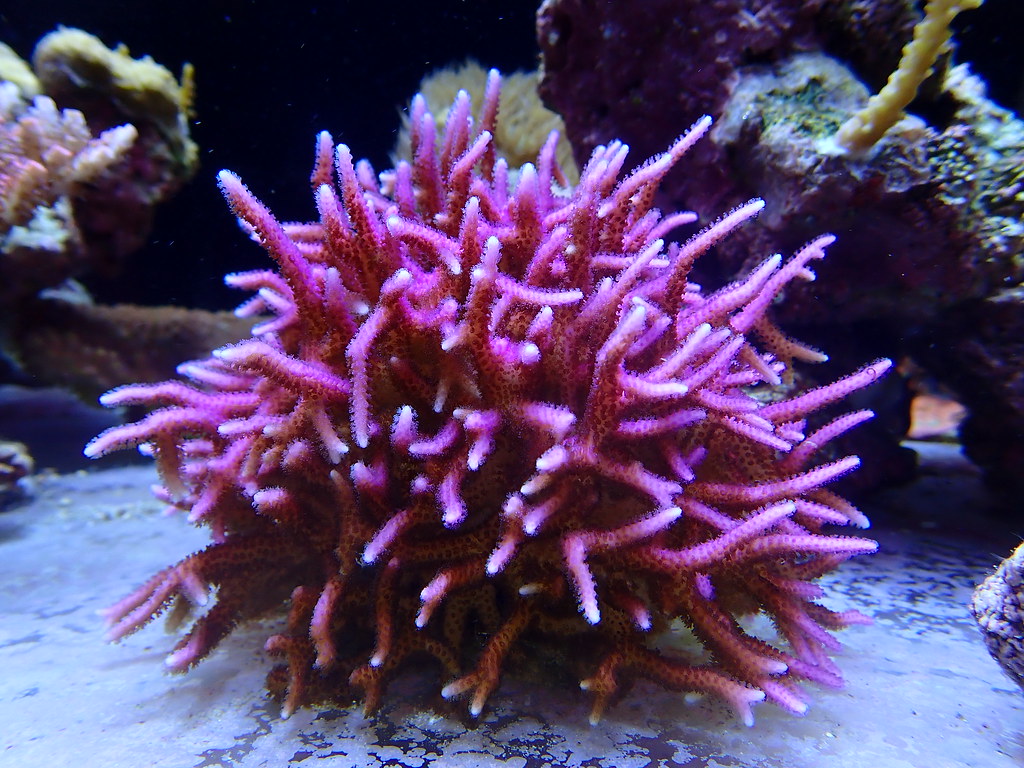
Here’s my pink birdsnest after being kept at 0.2 ppm phosphate for over three months (previously kept at undetectable phosphate for about two years).
 
I think your greens would lighten back up if you raise your alk to compensate for the rise po4. Overpopulated tissue has to go somewhere. Green + brown = dark green.
If I’m following you, imo, increasing Alk is not going to necessarily increase growth but a guess it is a possibility. Note the picture to follow from just over a year ago, growth is maxed out imo.
I think it would be quite hard to rule out other factors, especially if the increase in phosphate is caused by feeding. Food obviously brings in more than just phosphate. If the phosphate isn’t fully consumed, it’s likely that other things are accumulating as well.

That said, I’ve also seen corals shift coloration many times without any noticeable change in parameters. So even if phosphate increased due to dosing, I still wouldn’t be fully convinced that elevated phosphate is the cause.

My own experience is pretty different when I intentionally raised my phosphate from undetectable to 0.2 ppm (measured with Hanna HI736) by direct dosing. I didn’t observe any significant change in the coloration of my corals (mainly SPS, including Acropora and Seriatopora). It definitely wasn’t a blue-light issue in my case, since my tank is lit solely by 14000K metal halide.

Here’s my pink birdsnest after being kept at 0.2 ppm phosphate for over three months (previously kept at undetectable phosphate for about two years).
I agree, hard to pin point the actual cause of a color shift especially since po4 increase is not extreme. However, I general feel higher po4 is causing it and believe it would be unnoticed by the majority of hobbyist because most don’t run nutrients as low as mine. I have maintained everything in my aquarium consistent within reason. The only parameters with measurable change is po4. I believe po4 naturally accumulates as an aquarium ages and without specific intervention it will continue going higher. This is the main reason I believe dosing no3 and po4 is unnecessary. One thing I’m also considering is this coral is growing so fast my visual perspective has changed and now I’m mostly seeing areas of the coral that receives less light and the po4 level has no effect at this point?

Here is coral at just over a year ago. Now it is as big as my hand.
IMG_1345.jpeg
It's definitely quite challenging to keep the coloration of large colonies consistent. Sometimes the colors also shift when the growing tips become dormant, which can make the colony much more vibrant on the growth side but dull on the other parts.

In my case, dosing phosphate is necessary since I don't like keeping too many fish, and I’d probably blow up my fish if I tried to raise nutrients just by feeding them more. I’ve tried feeding coral foods, but I didn’t really notice much difference after switching to the inorganic route by simply dosing ammonia and phosphate. Plus, it’s a lot cheaper.
It’ll be interesting to see how things turn out once you bring the phosphate down.
 
FWIW, the evidence from some other tanks (such as that of Richard Ross) does not seem to support the idea that reasonable levels of phosphate are causing negative issues.
 
I think the coloration change is temporary when phosphate rises. Corals don't really like fast phosphate changes but their zooxanthellae (which are mostly brown) might multiply and take away some color.

Once everything stabilizes the population density of zooxanthellaes will probably also go back to normal and the vibrant colors will come through again. Down below you can see an image of a Briareum sp. polyp. The coral is toxic green with the naked eye, but up close with a microscope, you can see the brown zooxanthellae. If the population grows denser, this might affect the coral's coloration.
Briareum sp.jpg

Source for the claim that high nutrients might explain higher zooxanthellae density and brownish coloration: https://www.frontiersin.org/journals/marine-science/articles/10.3389/fmars.2017.00309/full
 
Last edited:
FWIW, the evidence from some other tanks (such as that of Richard Ross) does not seem to support the idea that reasonable levels of phosphate are causing negative issues.
Not a negative issue, only a very subtle shift in color that imo is only noticeable during specific daylight, full spectrum lighting.
 
I think the coloration change is temporary when phosphate rises. Corals don't really like fast phosphate changes but their zooxanthellae (which are mostly brown) might multiply and take away some color.

Once everything stabilizes the population density of zooxanthellaes will probably also go back to normal and the vibrant colors will come through again. Down below you can see an image of a Briareum sp. polyp. The coral is toxic green with the naked eye, but up close with a microscope, you can see the brown zooxanthellae. If the population grows denser, this might affect the coral's coloration.
Briareum sp.jpg

Source for the claim that high nutrients might explain higher zooxanthellae density and brownish coloration: https://www.frontiersin.org/journals/marine-science/articles/10.3389/fmars.2017.00309/full
Very likely a perfect explanation. I’m making no changes currently in reducing po4 levels so will see if “nuclear” green returns.
 
@CHSUB I think from a single short-term observation it is not possible to draw general conclusions.

Why is the phosphate concentration rising when nothing else has changed? Did you add a phosphate additive?

Maybe the negative change came first and caused changes in coral colors and phosphate concentration? Even if ICP-MS would give the full spectrum of inorganic conditions, which it doesn't, it doesn't include organics which may also cause beneficial or adverse effects.

Independent from this question it may be a matter of adaptation or a temporary condition like @EnterName suggests.
 

TOP 10 Trending Threads

WHAT’S YOUR MOST MEMORABLE EXPERIENCE WITH A CORAL THAT LOOKED LIKE IT MIGHT NOT MAKE IT?

  • I’ve seen a dramatic comeback. I would have sworn it was a goner

    Votes: 17 43.6%
  • A slow recovery, and it got back to looking healthy

    Votes: 7 17.9%
  • It came back some, but never looked as good as it used to

    Votes: 3 7.7%
  • I tried to save one, but it didn’t make it

    Votes: 6 15.4%
  • Mine is still struggling...no comeback yet

    Votes: 3 7.7%
  • I’ve never had a coral in serious trouble

    Votes: 0 0.0%
  • See, this is why I don’t keep corals

    Votes: 1 2.6%
  • Other (Post in the comments)

    Votes: 2 5.1%
Back
Top
Home
Post thread…

Market
What's new