



The Cambrian Period
542-488 Million years ago
542-488 Million years ago
Below is a paleogeographic (paleo = ancient) reconstruction of the earth at this time. North America is the continent of Laurentia and Europe is Baltica at this time.
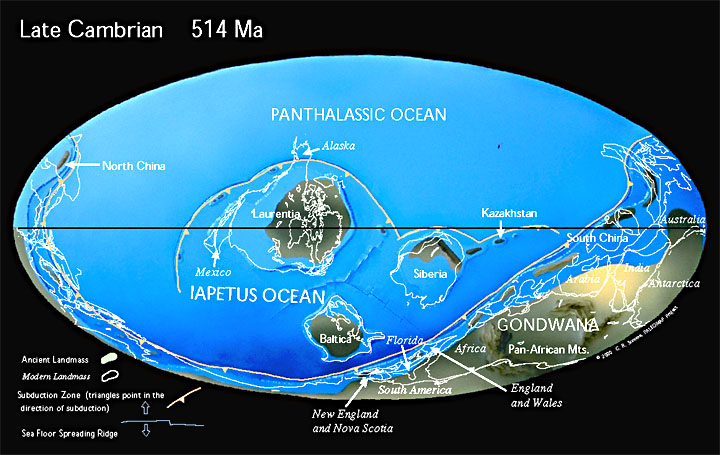
Map from www.scotese.com loaded 11/19/09
Life really expanded in its' diversity at the beginning of the Cambrian in what is known as the Cambrian Explosion. A great number of new forms of life appeared, including the first reef-building organisms in Earth's 4.5 billion year history.
Most reefs were concentrated around Laurentia and Siberia, near the equator. These reefs would seem completely foreign to us if we saw them today. The main reef-builder in the early Cambrian wasn't coral, rather calcified sponges known as archaeocyaths. Archaeocyathids were filter feeding animals like the sponges of today. Archaeocyathids did not form rigid reef structures like coral do today, but rather baffled sediment inbetween their skeletons, forming mounds. All reefs have life forms that destroy them by burrowing into the skeletons of the reef-formers. During this time it was molluscs, also known as clams and snails.

http://paws.wcu.edu/dperlmutr/Tommotian12.jpg loaded 2/9/10
The middle Cambrian saw a dramatic change. Archaeocyaths dissappeared and were replaced by microbes. Echinoderms (sea lilies) were the most common multicelled organism of the time. Though called sea lilies (crinoids in scientific terminology) they are actually animals. They still exist in today's oceans and feed with their arms. They can also pull themselves along the sea floor with those same arms. In contrast, the most common multicelled organism in the late Cambrian were sponges, but microbes and algae still made up the majority of these reef-like mounds.
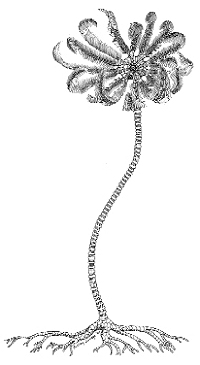
www.mcgill.ca/files/redpath/crinoid.jpg loaded 2/9/10
As you can see, life was simple during this time, and the reefs reflect that. In the next edition, covering the Ordovician, you will see a much more active time.
Reef patterns and environmental influences in the Cambrian and earliest Ordovician, Rowland, S.M., and Shapiro, R.S., 2002, in Kiessling, W., Fluegel, E., and Golonka, J., eds., Phanerozoic Reef Patterns, SEPM Spec. Publ. 72, pp. 95-128.