Reefpi Update (Raspberry Pi OS (Trixie) 64bit)

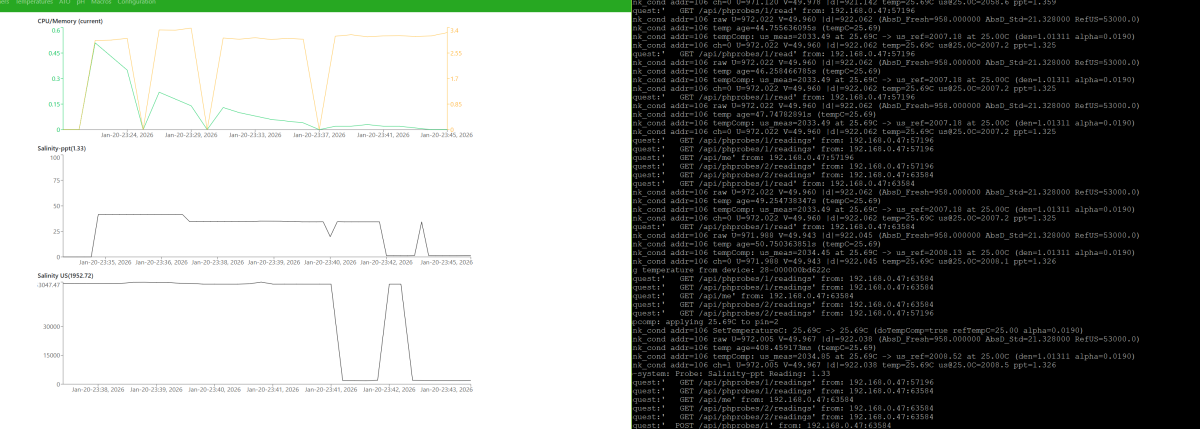
Little Update, i finally got the new version of the Robo-Tank conductivity circuit.

I have started to write the driver, i have also added the ability to use a in tank Temp probe for compensation, for those like me that want accuracy.

Robo-Tank conductivity circuit


1768913212367.png
Nice ! It is basically just the same as the Atlas Instruments one iirc, have to check.

BTW, one can also use Rob's pH circuit to measure ORP, just connect an ORP probe to the board and convert the pH that is returned back to mV and you are golden. Might actually be a great change on Rob's side: expose both values in the interface.

Regarding the temperature compensation:
Are you doing that on the Pi or on the conductivity sensor ?

Strike that, forgot that the sensor probably isn't equipped for that. Does your compensation mean that you have an alpha of 0.001145 or that it's 0.019 plus that value ?
 
Last edited:
I’ll be slowly putting together proper documentation for reef-pi.


One of the biggest challenges reef-pi has always faced is the lack of clear, straightforward documentation—especially when it comes to wiring, schematics, and understanding how everything fits together. While the software itself is incredibly powerful, getting started (and even scaling up) can be difficult without good reference material.


Alongside this, I’ll also be working on schematics and hardware examples, including DIY circuits and layouts. This will take some time, but the goal is to create something that’s easy to follow and actually useful for both beginners and more advanced users.


🔌 Current reef-pi Driver Landscape​


Before going too far down this path, I wanted to get a feel for what people are currently using.


From what I’ve seen so far, most setups tend to fall into a few common categories:


Core Drivers (Most Common)​


  • Temperature (DS18B20)
  • pH (typically Atlas Scientific EZO circuits)
  • ORP
  • ATO (float switches / optical sensors)
  • Equipment control (relays)
  • Lighting (PWM / basic dimming)

These form the backbone of most reef-pi systems and are generally well understood.


I2C / Expansion​


As systems grow, people tend to move into expanders and external controllers:


  • PCA9685 (PWM expansion)
  • PCF8575 (GPIO expansion)
  • ADS1115 (analog inputs for DIY sensors)

These are widely used but often lack consistent documentation or standard approaches.


Chemistry & Advanced Monitoring​


This is where things start to get less consistent:


  • Salinity / Conductivity (often Atlas, sometimes DIY)
  • Custom pH circuits
  • ORP via analog or EZO
  • Experimental probes and circuits

Many users attempt DIY solutions here but run into issues with drift, noise, and calibration.


Dosing & Automation​


  • Dosing pumps (relay, PWM, or stepper-driven)
  • Timed or rule-based automation
  • Increasing interest in more precise control systems


Experimental / Less Common​


There are also a number of one-off or custom implementations:


  • Flow meters
  • Leak detection
  • Pressure-based level sensing
  • Ultrasonic sensors
  • Custom Arduino/I2C bridge devices


Gaps & Opportunities​


From what I can see, there are a few key areas where reef-pi could really benefit from improvement:


1. Clear Documentation​


  • Wiring diagrams
  • Setup guides
  • Calibration walkthroughs
  • Troubleshooting

2. Standardised DIY Hardware​


  • Known working circuits
  • Repeatable builds
  • BOMs and schematics

3. Reliable Chemistry Monitoring​


  • Stable pH implementations
  • Accurate salinity measurement
  • Proper temperature compensation
  • Calibration standards

4. Closed-Loop Control​


  • Systems that don’t just monitor, but actively maintain parameters
    (e.g. salinity up/down control with safeguards)


Goal​


The goal here is to build:


  • Clear, practical documentation
  • Working, repeatable hardware designs
  • Improved drivers (especially around chemistry and ADC-based inputs)

Everything will be open source, and designed so people can build and extend it themselves.


❓ Community Input​


Before I go too far, I’d love to hear from others:


Are there any other drivers or setups people are currently using?


  • Custom drivers
  • Forks
  • DIY circuits
  • Anything that isn’t part of the “standard” setup

Even if it’s experimental or unfinished, it would be great to see what’s out there.

Since I'm from Germany, I have to use AI-based translation…

First of all: Thank you, fantastic work—a real step forward!

I use Reef-Pi for a freshwater aquarium, two terrariums for Greek tortoises, and an incubator to hatch the tortoise eggs.

Two weeks ago, I had to completely set up my aquarium from scratch—and I bought an LED light whose controller could only be operated via an app using Bluetooth: the Chihiros 80B.

I completely reinstalled Reef-Pi with Raspbian Trixie on a Raspberry Pi 4—and, using another project as an “interface” (originally for Home Assistant), “integrated” the Chihiros 80B LED lamp into Reef-Pi:

- Connecting the Raspi to the Chihiros LED lamp’s controller via BLE by adapting the scripts and documentation for HomeAssistant on the Raspi 4 for Reef-Pi

- Reading the lamp parameters set in Reef-Pi via the API (times and brightness levels)

- Transmitting the parameters to the LED lamp via BLE using a Python script, etc.

It would be great if Reef-Pi could do this directly in the near future.

Note: The brightness values are not (!) sent to the API by Reef-Pi in automatic mode, only in manual mode. Why not, actually???

I have a PDF guide for my AI-generated solution.

Other interfaces I could really use:

- Humidity sensor

- Soil moisture sensor

- Drivers for terrarium heaters that are also rated for 110V/230V. Suitable modules exist for this, but PWM is not a suitable method. Instead, phase-angle control (“dimmer” as for lamps) is needed.
 
Last edited:
Unfortunately, the link to the API documentation no longer works. The “API” link in the footer:

http://my_reefpi/assets/api.html

returns the following error message:

“404 Page Not Found”

Can this be fixed?
 
Just wanted to drop a wee post in to say thanks very much for the work on this. I'd a tank fall by the wayside while I was in hospital a couple of years ago and am just now getting back around to setting it up again. I'd a robotank running reef pi originally and before stumbling on this was thinking about using Robs robotank software, think I might give both a try now, have ordered a couple of sd cards.

For a question now, what are my options for getting both orp and ec set up, as I understand it you've now written a driver for the robotank ec board, for orp can I use the robotank ph board or the atlas one? I think you've mentioned the reefpi one, but my soldering skills are fairly basic, so not sure I fancy trying to put one of those together, would rather just pay for a pre assembled board.
 

TOP 10 Trending Threads

Back
Top
Home
Post thread…
Market
What's new