Seeing Cyanobacteria

Sophie"s mom

2500 Club Member
View Badges
Joined
Oct 25, 2023
Messages
3,556
Reaction score
4,487
Location
Va.
Rating - 0%
0   0   0
Good morning everyone! So I am seeing a few areas of cyano! I am currently treating with Microbacter clean, but I have read that lights out for a period of time will also help. How long can I safely leave the lights out? I have SPS, LPS, anemones, soft corals. But I really do not want this stuff to get out of hand. I am siphoning every day, and adding Microbacter clean every day. It is slowing down, but still shows back up every day. I will test this evening and post, but when I tested Monday, my nitrates were 30, and phosphate was.07. My nitrates have always stayed somewhere between 15 and 35. I do carbon dose as well.

 

vlangel

Seahorse whisperer
View Badges
Joined
Feb 5, 2014
Messages
7,738
Reaction score
9,262
Location
Pittsburgh, PA
Rating - 0%
0   0   0
Good morning everyone! So I am seeing a few areas of cyano! I am currently treating with Microbacter clean, but I have read that lights out for a period of time will also help. How long can I safely leave the lights out? I have SPS, LPS, anemones, soft corals. But I really do not want this stuff to get out of hand. I am siphoning every day, and adding Microbacter clean every day. It is slowing down, but still shows back up every day. I will test this evening and post, but when I tested Monday, my nitrates were 30, and phosphate was.07. My nitrates have always stayed somewhere between 15 and 35. I do carbon dose as well.
I too am fighting a light reddish, rust on my sandbed and I have been reading/watching videos on everything I can pertaining to it. Mine is only on the sandbed and I have it in the past. It seems somewhat periodic, coming and going as conditions favor it. Like you I am using a probiotic bacteria (PNS Deep cycle) and I am siphoning it off the sand. I am also using coral snow which is a flocculate that after the cyano or whatever it is siphoned the coral snow will attach to the particulate and be filtered out. It leaves the water sparkling clean and crisp and its not a hammer solution. However after several weeks if none of these measures make a real dent, then I will use chemiclean which is kind of a hammer solution in that its an antibiotic against a bacteria. However I have yet to read anyone who used it according to the directions have a negative impact on their reef. Even BRS TV said it is safe if used properly.
Oh yeah, a 3 day black out period is considered safe and some folks have safely done longer.
 
OP
OP
Sophie"s mom

Sophie"s mom

2500 Club Member
View Badges
Joined
Oct 25, 2023
Messages
3,556
Reaction score
4,487
Location
Va.
Rating - 0%
0   0   0
Good morning everyone! So I am seeing a few areas of cyano! I am currently treating with Microbacter clean, but I have read that lights out for a period of time will also help. How long can I safely leave the lights out? I have SPS, LPS, anemones, soft corals. But I really do not want this stuff to get out of hand. I am siphoning every day, and adding Microbacter clean every day. It is slowing down, but still shows back up every day. I will test this evening and post, but when I tested Monday, my nitrates were 30, and phosphate was.07. My nitrates have always stayed somewhere between 15 and 35. I do carbon dose as well.

I too am fighting a light reddish, rust on my sandbed and I have been reading/watching videos on everything I can pertaining to it. Mine is only on the sandbed and I have it in the past. It seems somewhat periodic, coming and going as conditions favor it. Like you I am using a probiotic bacteria (PNS Deep cycle) and I am siphoning it off the sand. I am also using coral snow which is a flocculate that after the cyano or whatever it is siphoned the coral snow will attach to the particulate and be filtered out. It leaves the water sparkling clean and crisp and its not a hammer solution. However after several weeks if none of these measures make a real dent, then I will use chemiclean which is kind of a hammer solution in that its an antibiotic against a bacteria. However I have yet to read anyone who used it according to the directions have a negative impact on their reef. Even BRS TV said it is safe if used properly.
Oh yeah, a 3 day black out period is considered safe and some folks have safely done longer.
Thank you! Yes I too use the coral snow! It also helps with vermitid snails! We will see how things go. I have only been treating for a week and a half.
 

Paul B

10K Club member
View Badges
Joined
Nov 3, 2010
Messages
21,374
Reaction score
71,866
Location
Long Island NY
Rating - 0%
0   0   0
I would do nothing. Maybe go out to dinner and get a nice bottle of Pino Noir. Cyano is natural and grows on every reef in the sea. It comes and goes without any help from us. The tanks with all the tweeking are the ones that crash.

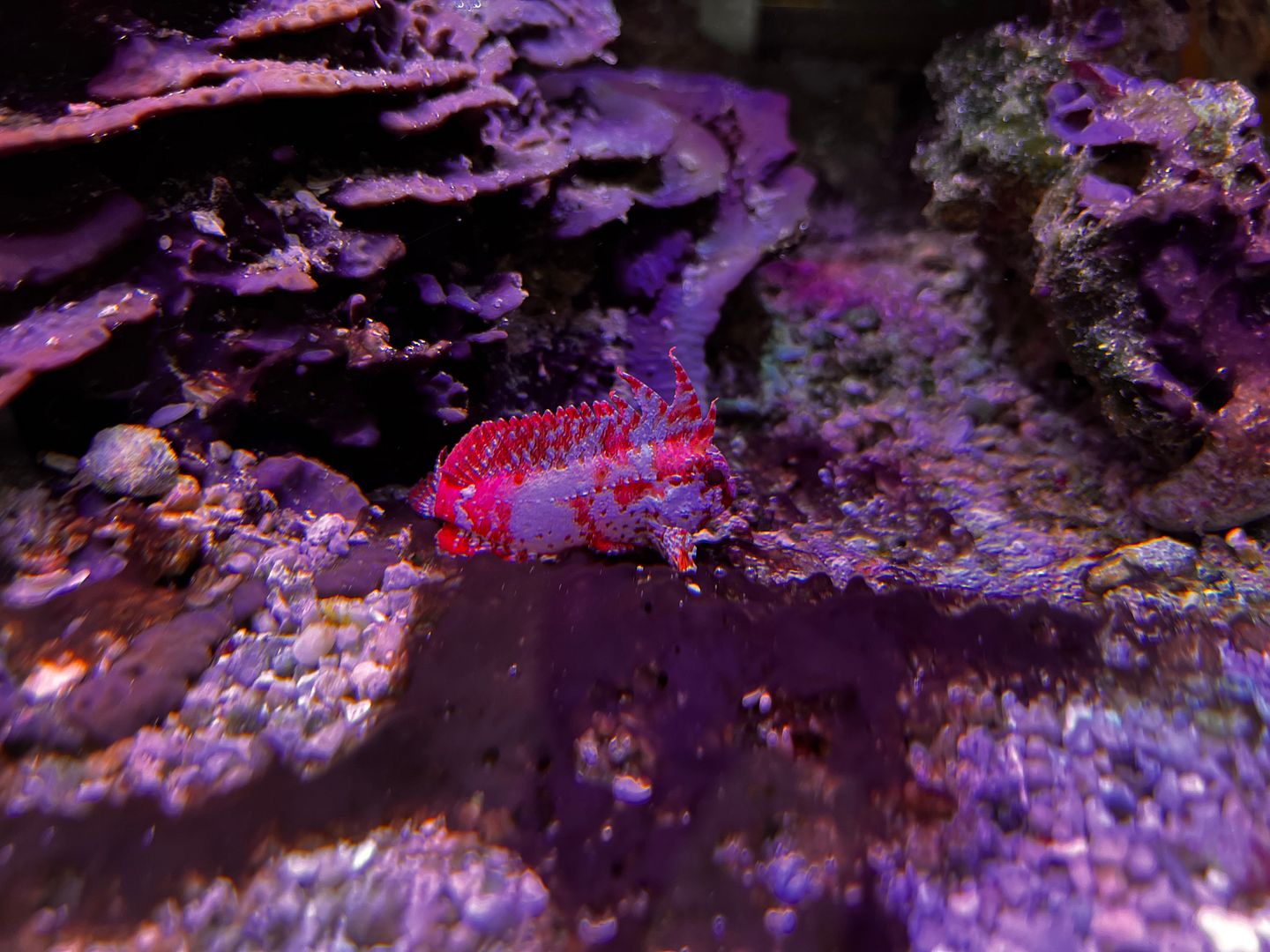
The stuff has been coming and going in my reef for over 50 years. Here is some of it last year under one of my Dwarf Waspfish.


It is mostly gone now and will come back many times. It makes me happy to see such a natural, normal thing happening in my tank and makes me realize my tank is close to ocean conditions which is my goal.

Sometimes there is algae. Also, normal and cyclic.



Sometimes Godzilla Larvae. I don't care as I know that a real reef and a natural artificial reef goes through cycles that can last a month or years that we realize if we keep a tank long enough.
 

vlangel

Seahorse whisperer
View Badges
Joined
Feb 5, 2014
Messages
7,738
Reaction score
9,262
Location
Pittsburgh, PA
Rating - 0%
0   0   0
Thank you! Yes I too use the coral snow! It also helps with vermitid snails! We will see how things go. I have only been treating for a week and a half.
Good luck Sophie, like @Paul B says, its not going to cause a problem for your fish or coral. If your NO3 and PO4 are in balance (so it doesnt turn into a dino issue) it will probably resolve itself with time with no intervention. I have had cyano many times on my sand. I suspect that our tanks like the ocean has populations of flora/fauna rising and declining constantly. Everything is opportunistic so the conditions that favor one organism over another is going to be the one that wins. However, if I can safely create an environment that keeps cyano in check, I am going to do it because my tank sits just inside our front door in our living room and cyano kind of bugs me. However in the same breath I am not going to do something drastic that tips the scales in favor of another organism that is more destructive.

I would do nothing. Maybe go out to dinner and get a nice bottle of Pino Noir. Cyano is natural and grows on every reef in the sea. It comes and goes without any help from us. The tanks with all the tweeking are the ones that crash.

The stuff has been coming and going in my reef for over 50 years. Here is some of it last year under one of my Dwarf Waspfish.


It is mostly gone now and will come back many times. It makes me happy to see such a natural, normal thing happening in my tank and makes me realize my tank is close to ocean conditions which is my goal.

Sometimes there is algae. Also, normal and cyclic.


Sometimes Godzilla Larvae. I don't care as I know that a real reef and a natural artificial reef goes through cycles that can last a month or years that we realize if we keep a tank long enough.
So Paul, I hear what you are saying about intervening in a drastic way and crashing our tank and it being a natural ebb and flow of nature. I agree with you but truly we are doing subtle things in our tanks all the time to favor our desired outcomes to keep certain fish or specific coral. If we have a small tank, we don't put a predator fish with small gobies or shrimp or they likely will be an expensive meal for the predator. If we want small gobies or shrimp, we need to make the environment favorable to them. My point being, small reasonable interventions are not a sure death sentence for our aquariums. I do however appreciate your natural approach and I am of the belief that God is the best designer and His way is superior!
 

Paul B

10K Club member
View Badges
Joined
Nov 3, 2010
Messages
21,374
Reaction score
71,866
Location
Long Island NY
Rating - 0%
0   0   0
Vlangel, I rarely put any chemical in my tank but years ago, like many people I would try this or that to remedy a perceived problem until I learned that those things are for the most part normal and will remedy by themselves with no help from me and the tank will straighten out and be healthier.

That may be why my tank has lasted so long. Of course it is not the prettiest tank on here, but it may be the healthiest. Algae, cyano, bristleworms, flatworms, diatoms, all natural ocean life and nothing to be concerned with.
 

vlangel

Seahorse whisperer
View Badges
Joined
Feb 5, 2014
Messages
7,738
Reaction score
9,262
Location
Pittsburgh, PA
Rating - 0%
0   0   0
Vlangel, I rarely put any chemical in my tank but years ago, like many people I would try this or that to remedy a perceived problem until I learned that those things are for the most part normal and will remedy by themselves with no help from me and the tank will straighten out and be healthier.

That may be why my tank has lasted so long. Of course it is not the prettiest tank on here, but it may be the healthiest. Algae, cyano, bristleworms, flatworms, diatoms, all natural ocean life and nothing to be concerned with.
You are certainly right about how your tank has stood the test of time! That speaks for itself. Here, here, for diversity!
 

BryanM

7500 Club Member
View Badges
Joined
Jun 27, 2024
Messages
7,940
Reaction score
9,737
Location
Morgan Hill
Rating - 100%
1   0   0
I respectfully disagree on the idea that cyano won't affect anything. Certain types can release toxins, and it can spread enough to smother things.

A monitor and only take action if necessary approach is more important, but I woudn't do that either.

I would actively try and rid myself of this nuisance.

@Sophie"s mom if you're not an active sand vacuumer, I would start with that. And I would continue with the manual removal, and a 3 day blackout can't hurt either. I did that with dinos with no ill effect to my corals.
 
OP
OP
Sophie"s mom

Sophie"s mom

2500 Club Member
View Badges
Joined
Oct 25, 2023
Messages
3,556
Reaction score
4,487
Location
Va.
Rating - 0%
0   0   0
I respectfully disagree on the idea that cyano won't affect anything. Certain types can release toxins, and it can spread enough to smother things.

A monitor and only take action if necessary approach is more important, but I woudn't do that either.

I would actively try and rid myself of this nuisance.

@Sophie"s mom if you're not an active sand vacuumer, I would start with that. And I would continue with the manual removal, and a 3 day blackout can't hurt either. I did that with dinos with no ill effect to my corals.
Yep! I do not vacuum my sand, but I agree, this weekend I am doing a water change and will most definitely be vacuuming the sand. I will also be adding a power head down low in a corner to create more flow down low.
 

TOP 10 Trending Threads

HOW DO YOU ADJUST YOUR CUC AS ALGAE DISAPPEARS?

  • Capture and re-home CUC

    Votes: 10 8.3%
  • Increase white light/hours in tank to spur algae growth to feed CUC

    Votes: 8 6.6%
  • Feed nori to support CUC

    Votes: 39 32.2%
  • Feed herbivore pellets to support CUC

    Votes: 43 35.5%
  • Allow attrition to balance CUC and algae

    Votes: 52 43.0%
  • Provide macro algae to feed CUC

    Votes: 8 6.6%
  • Introduce CUC predators

    Votes: 1 0.8%
  • Other (please explain)

    Votes: 12 9.9%
Back
Top