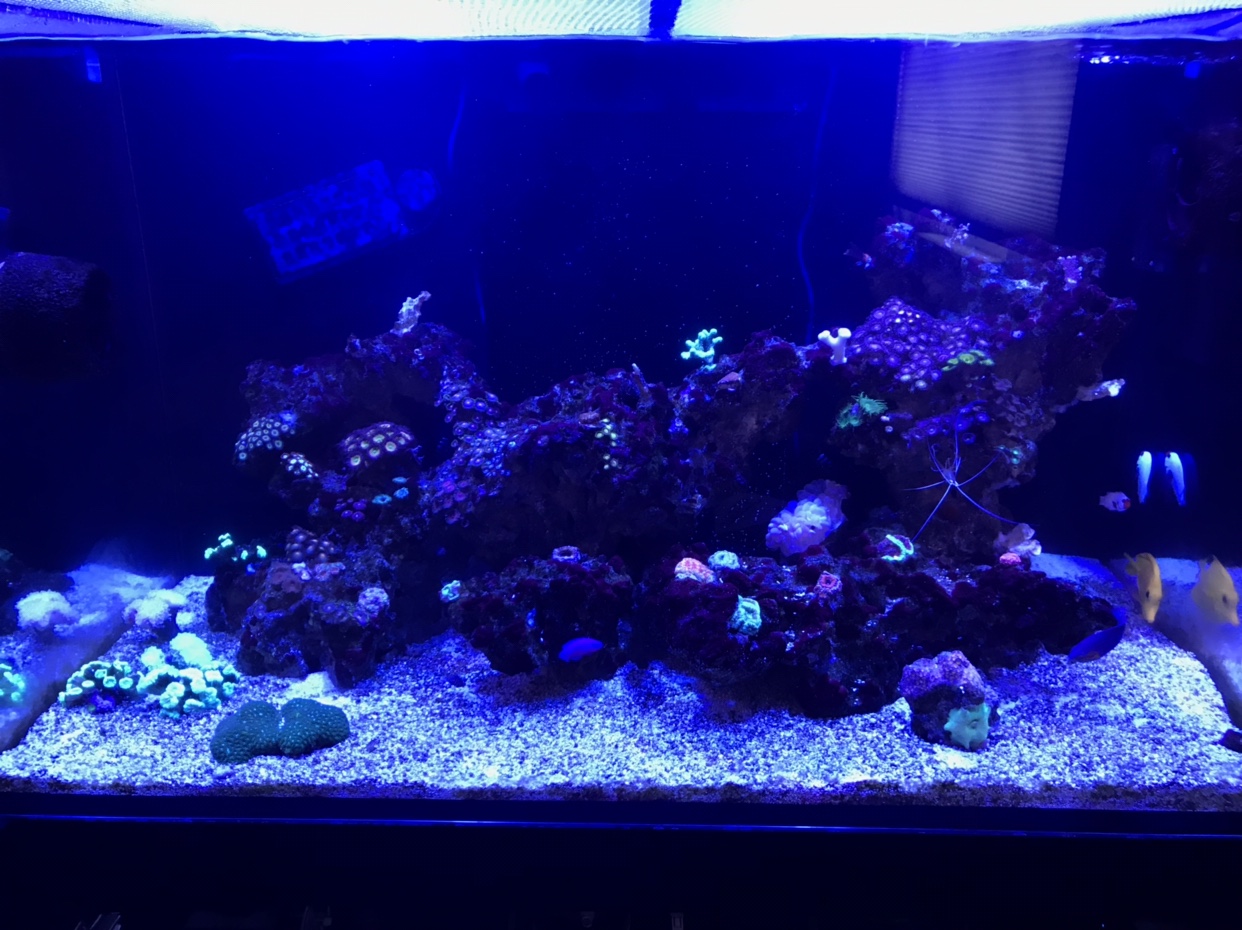
SPS Help!! They’re Dying

nickenayat

Active Member
View Badges
Joined
Oct 16, 2016
Messages
218
Reaction score
173
Location
Sherman Oaks
Rating - 0%
0   0   0
Tank: Red Sea REEFER 250
Tank Started: August 2018
Parameters (3/12/2019): Alk - 9.7, Calc - 415, Mag - 1350, nitrate - 4ppm, salinity - 1.026, temp - 79.8
Livestock: yellow tang, (2) Wyoming white clowns, melanarus wrasse, lawnmower blenny, green mandarin Toby, purple psuedochromis, cleaner shrimp, porcelain crab,

My SPS keep dying. I first thought it was the parameters but have checked them regularly and they have been in check and stabilized for the past 3 months. This is my second tank and had great success with SPS in my 20 gallon nano for over two years.

Then thought it was some nudibranchs. I dip every coral before it enters the tank but thought it may be the problem. I removed all the sps and had an intensive dip and closely looked at all the coral frags didn’t see anything.

The sps seem to start dying from the base then the tips and in about a week the whole frag is dead. Lost maybe close to 20 frags in the past two months.

All my LPS, soft corals and fish are thriving so it’s specific to the sps and I can’t seem to figure out what it may be. Maybe the tank is just not mature enough yet but I don’t have any idea what else it could be or what the problem is.

Any advice or help to what it may be. Thank you

Pictures:
3b16fbaf3adf09e8f6de10ba0281d658.jpg
fadf5d1bbc691de8d79d6ede982c0d0e.jpg
4dd5dd1ea369359b3df89c6b2686f02f.jpg
0ae4ffbb49a0da94a9a208c572d9f5af.jpg
1f917b13d6d8fdd47cbc6054cc106cfc.jpg
bed1e90fc348038ac61996cd3066f5e9.jpg
d8f1b0915b00d4a0ad5f5690b59c7115.jpg
ea76e4fb15bfc9331c895b2d8be44543.jpg
c2b70eb9abac47ab2eb79b7fb5d42614.jpg
58c255d70b4f026cf15e85184006f628.jpg
 

Sumo Reef

Active Member
View Badges
Joined
Jul 19, 2018
Messages
178
Reaction score
258
Rating - 0%
0   0   0
What brand light, schedule and settings? Also I see the eco tech mps on the sides. What intensity they set to?

The fact that you have zoas so high next to your sps is a sign to me. I think the flow and light for sps would be too much for them so the fact they are up there tells me your flow and light settings may be too low for sps
 

MadTownFess

Active Member
View Badges
Joined
Oct 29, 2018
Messages
169
Reaction score
157
Rating - 0%
0   0   0
What brand light, schedule and settings? Also I see the eco tech mps on the sides. What intensity they set to?

The fact that you have zoas so high next to your sps is a sign to me. I think the flow and light for sps would be too much for them so the fact they are up there tells me your flow and light settings may be too low for sps
Agreed 100%
 
OP
OP
nickenayat

nickenayat

Active Member
View Badges
Joined
Oct 16, 2016
Messages
218
Reaction score
173
Location
Sherman Oaks
Rating - 0%
0   0   0
Using the AB+ schedule from EcoTech using two XR15s the flow may be a little low and I can prob go a little higher.
 

SPS247

Active Member
View Badges
Joined
Aug 15, 2015
Messages
180
Reaction score
240
Rating - 0%
0   0   0
Just adding some ideas for you. I remember reading somewhere high Alk can cause SPS to burn at the tips with lower nitrates and inconsistent Alk swings will start at the base. (Probably a Randy H. article) Low flow can start at the base too. If it was my tank I would bring the Alk down to 8 with the nitrates being at 4ppm. I've been reading/seeing that higher Alk requires higher nitrates. Definitely turn the flow into a tidal wave of under water current for Acro's the Zoes should be dancing choaticly all over the place. Good luck.
 

Dkeller_nc

Well-Known Member
View Badges
Joined
Mar 2, 2019
Messages
893
Reaction score
1,249
Rating - 0%
0   0   0
Presumably you're talking about the SPS AB+ profile from the EcoTech Coral Lab publication. The default on this schedule is 50% intensity, which may well be a little bit low for your tank's water depth. But it's a bit tough to tell for sure without a PAR meter.

Your alk seems a bit high to me, but if it's stable (and I mean really stable), there's lots of tanks with successful SPS growth with alk that high. But you don't mention how you maintain that alk. Is it with dosing pumps? Another parameter you haven't mentioned is your phosphate level - what is it, and do you run phosphate remover, bio-pellets, refugium, or some combination of the 3?
 
OP
OP
nickenayat

nickenayat

Active Member
View Badges
Joined
Oct 16, 2016
Messages
218
Reaction score
173
Location
Sherman Oaks
Rating - 0%
0   0   0
Presumably you're talking about the SPS AB+ profile from the EcoTech Coral Lab publication. The default on this schedule is 50% intensity, which may well be a little bit low for your tank's water depth. But it's a bit tough to tell for sure without a PAR meter.

Your alk seems a bit high to me, but if it's stable (and I mean really stable), there's lots of tanks with successful SPS growth with alk that high. But you don't mention how you maintain that alk. Is it with dosing pumps? Another parameter you haven't mentioned is your phosphate level - what is it, and do you run phosphate remover, bio-pellets, refugium, or some combination of the 3?

I use dosing pumps with 2 part. My phosphate is very low almost undetectable. For filtration I have a nyos protein skimmer and filter floss, also have a bag of chemi pure and purigen. I occasionally add nopox from Red Sea. I increased the output to 70% over the first 3 months of the tanks life.
 

NorCal Reefer

Community Member
View Badges
Joined
Jan 22, 2019
Messages
86
Reaction score
357
Rating - 0%
0   0   0
Definitely stop using nopox. Elevated alk and carbon dosing will cause RTN and STN. I use zeovit and had same issues initially. I recommend you allow your alk to drop to 8.0.
 

Dkeller_nc

Well-Known Member
View Badges
Joined
Mar 2, 2019
Messages
893
Reaction score
1,249
Rating - 0%
0   0   0
And, ultra-low phosphate and elevated alkalinity isn't helping either. Especially if the source that you're getting your coral from is running higher nutrients and lower alkalinity. I'd personally remove the chemi-pure and the purigen. Chemi-pure (at least one type) does contain a little bit of phosphate remover in addition to the activated carbon, but it's a really expensive way to remove a little bit of phosphate, the carbon quickly becomes exhausted, and the ion exchange resins don't do anything in saltwater.

Similarly, the purigen is a substitute for granular activated carbon (GAC). While GAC does have its uses in a saltwater tank, particularly for removing medications from a QT and removing water-yellowing compounds in a tank that doesn't receive water changes, right now you're looking to increase nutrients, not decrease them.

BTW, running lots of organic removal substances like purigen, chemipure, or (cheaper and more effective) GAC is a bit antithetical to the use of a carbon dosing regime like NoPox.
 

MadTownFess

Active Member
View Badges
Joined
Oct 29, 2018
Messages
169
Reaction score
157
Rating - 0%
0   0   0
Presumably you're talking about the SPS AB+ profile from the EcoTech Coral Lab publication. The default on this schedule is 50% intensity, which may well be a little bit low for your tank's water depth. But it's a bit tough to tell for sure without a PAR meter.

Your alk seems a bit high to me, but if it's stable (and I mean really stable), there's lots of tanks with successful SPS growth with alk that high. But you don't mention how you maintain that alk. Is it with dosing pumps? Another parameter you haven't mentioned is your phosphate level - what is it, and do you run phosphate remover, bio-pellets, refugium, or some combination of the 3?
I would say for sure it is too low of light. Zoa's shouldn't be able to grow right next to SPS. If I put any of my LPS corals not in the sandbed on my mixed reef, they bleach/die quickly.
 

Rick.45cal

2500 Club Member
View Badges
Joined
Jan 14, 2016
Messages
3,693
Reaction score
8,901
Location
Lakeland Florida
Rating - 0%
0   0   0
Ah so you’re also dosing NoPOx with no phosphates detectable, you also now have a surplus of dissolved organic carbon as well as phosphate starvation. The Nitrates, no phosphates, plus surplus of DOC from the NOPOx is a perfect storm. All of these things are bad singly, let alone all together like you have going on.

What I would do (because I have been right where you are now) would be to stop dosing NOPOx immediately, and start adding phosphates via Brightwell Aquatics NeoPhos (the equivalent of 0.02 ppm) per day. You also need to test your phosphates daily because the left over DOC’s from the nopox will start to get consumed when you add the phosphates. This will result in the phosphates being zero again the next day. If phosphates test 0 the next day dose another .02ppm worth of phosphate. You will have to keep an eye on both your nitrates and phosphates to make sure they don’t go to 0 over the long term. (Your bacteria will be consuming both). Your system is phosphate limited with a surplus of dissolved organic carbon (DOC), it’s going to keep trying to keep consuming all of your phosphates and nitrates until that surplus of DOC is consumed by the bacteria. Once that has happened it will settle down.

Feeding more probably won’t fix this problem since you’ve been carbon dosing on top of zero phosphates, at least not anytime soon. If you dose a measured amount of phosphates you can solve the problem systematically.

Contrary to what people have been told or led to believe by companies that want to sell you phosphate removing media or strategies you REALLY do need some phosphate to keep everything happy in the tank. :) I have been exactly where you are, right now. This one little change of strategy will turn your reef from what you have going on into a thriving environment, but it will take time to heal and effort on your part to be dilligent about not allowing your phosphate to bottom out. (Nitrate either). Once the system is stable (nutrients aren’t dissappearing overnight or in days) and the nutrients start climbing on their own, then you can reintroduce small daily doses of NOPOx, the trick is to dose as little as possible to just keep things from increasing. You are always welcome to PM me with any concerns or questions.

My system has been through exactly what your’s is going through. That was about 2 1/2 years ago. It will work if you follow through. :)
NO3 15 ppm.
PO4 0.24 ppm
8AFF4B24-275D-40DB-AD05-9565D9DDF34F.jpeg
ABDE9A69-0427-4A1E-9CCD-EB9376E28C03.jpeg
 
Last edited:
OP
OP
nickenayat

nickenayat

Active Member
View Badges
Joined
Oct 16, 2016
Messages
218
Reaction score
173
Location
Sherman Oaks
Rating - 0%
0   0   0
Ah so you’re also dosing NoPOx with no phosphates detectable, you also now have a surplus of dissolved organic carbon as well as phosphate starvation. The Nitrates, no phosphates, plus surplus of DOC from the NOPOx is a perfect storm. All of these things are bad singly, let alone all together like you have going on.

What I would do (because I have been right where you are now) would be to stop dosing NOPOx immediately, and start adding phosphates via Brightwell Aquatics NeoPhos (the equivalent of 0.02 ppm) per day. You also need to test your phosphates daily because the left over DOC’s from the nopox will start to get consumed when you add the phosphates. This will result in the phosphates being zero again the next day. If phosphates test 0 the next day dose another .02ppm worth of phosphate. You will have to keep an eye on both your nitrates and phosphates to make sure they don’t go to 0 over the long term. (Your bacteria will be consuming both). Your system is phosphate limited with a surplus of dissolved organic carbon (DOC), it’s going to keep trying to keep consuming all of your phosphates and nitrates until that surplus of DOC is consumed by the bacteria. Once that has happened it will settle down.

Feeding more probably won’t fix this problem since you’ve been carbon dosing on top of zero phosphates, at least not anytime soon. If you dose a measured amount of phosphates you can solve the problem systematically.

Contrary to what people have been told or led to believe by companies that want to sell you phosphate removing media or strategies you REALLY do need some phosphate to keep everything happy in the tank. :) I have been exactly where you are, right now. This one little change of strategy will turn your reef from what you have going on into a thriving environment, but it will take time to heal and effort on your part to be dilligent about not allowing your phosphate to bottom out. (Nitrate either). Once the system is stable (nutrients aren’t dissappearing overnight or in days) and the nutrients start climbing on their own, then you can reintroduce small daily doses of NOPOx, the trick is to dose as little as possible to just keep things from increasing. You are always welcome to PM me with any concerns or questions.

My system has been through exactly what your’s is going through. That was about 2 1/2 years ago. It will work if you follow through. :)
NO3 15 ppm.
PO4 0.24 ppm
8AFF4B24-275D-40DB-AD05-9565D9DDF34F.jpeg
ABDE9A69-0427-4A1E-9CCD-EB9376E28C03.jpeg

Thank you so much I will try your advice and keep you posted!
 

Hitman

Reefing One Day @ A Time!!!
View Badges
Joined
Jul 10, 2017
Messages
3,712
Reaction score
13,360
Location
NW Arkansas
Rating - 0%
0   0   0
Tanks way to young in my opinion and you have a terrible Cyano outbreak going on. Just my 2cents. Let the tank mature and get those ugly stages behind you. A 6 month old tank has a lot of changes to go through yet.
 

Viking_Reefing

Valuable Member
View Badges
Joined
Mar 4, 2018
Messages
1,458
Reaction score
2,245
Location
Sweden
Rating - 0%
0   0   0
Did you start with live or dead rock? Like other said six months might be a bit to early for sps.
I also see that you are dealing with some cyano. Based of that something is probably a little bit unstable.

If I were you I would try and bump up my nutrients a bit and wait until the tank stabilizes before doing any major changes.
 

TOP 10 Trending Threads

WHAT AMOUNT OF LIVE ROCK AND SAND SHOULD BE PRIORITIZED FOR OPTIMAL BIODIVERSITY/FILTRATION?

  • 100% live rock + bagged sand

    Votes: 38 27.3%

  • 100% dry rock + 100% live sand

    Votes: 47 33.8%
  • 50/50 live/dry rock, 50/50 live/bagged sand

    Votes: 30 21.6%
  • 75% live rock, 25% live sand

    Votes: 14 10.1%
  • 25% live rock, 75% live sand

    Votes: 10 7.2%
Back
Top