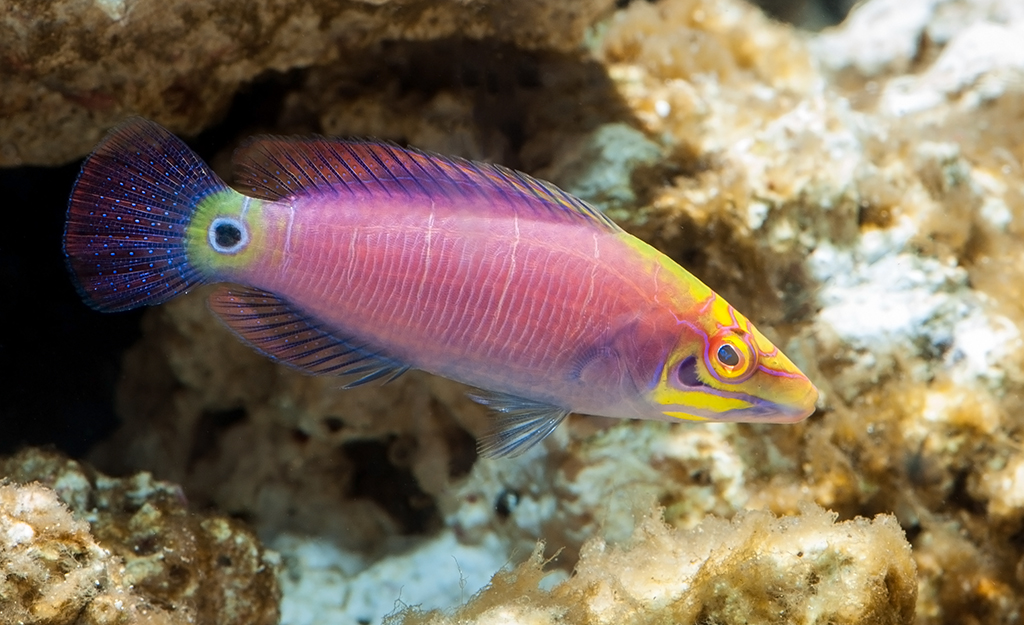
The Wrasse Lover's Thread!

evolved

[email protected]
View Badges
Joined
Dec 16, 2010
Messages
10,630
Reaction score
10,987
Location
Phoenix, AZ
Rating - 0%
0   0   0
Thanks, How can you tell? i use kuiters book for referencing but it doesnt go into too much detail.Does stay with the male almost always. And they sleep together.
Easy; because females look like this:
Fishbase.org said:
Cilub_f0.jpg

The fact it is showing male coloration yet still has the tailspot makes it a transitional male.

They might always tolerate each other, but there also might well come a day the do not. If they start nipping/ripping fins, locking jaws, or one forces the other into continuous hiding, you'll need to remove one.
 

evolved

[email protected]
View Badges
Joined
Dec 16, 2010
Messages
10,630
Reaction score
10,987
Location
Phoenix, AZ
Rating - 0%
0   0   0
Yellow-carpenters hybrid
FWIW: not a hybrid; just a P. flavianalis (yellow fin). 1-4 dorsal filaments are acceptable.

And that's a fine example of a P. lineopunctatus; one of the most undervalued IMO.
 

Arkaeus

Anthias Spoonerific
View Badges
Joined
Jan 8, 2013
Messages
51
Reaction score
1
Location
Lafayette LA
Rating - 0%
0   0   0
FWIW: not a hybrid; just a P. flavianalis (yellow fin). 1-4 dorsal filaments are acceptable.

And that's a fine example of a P. lineopunctatus; one of the most undervalued IMO.

Good to know about the Yellow Flasher Evolve. and yes P. lineopunctatus is my favorite flasher besides the Mccoskeri.
 

ReefJeeper

Community Member
View Badges
Joined
Jun 21, 2013
Messages
52
Reaction score
4
Location
Omaha, Nebraska
Rating - 0%
0   0   0
Easy; because females look like this:


The fact it is showing male coloration yet still has the tailspot makes it a transitional male.

They might always tolerate each other, but there also might well come a day the do not. If they start nipping/ripping fins, locking jaws, or one forces the other into continuous hiding, you'll need to remove one.

Thanks for the clarification. i noticed she/he? was starting to color up more. So far no issues at all but I will keep an eye on them.
 

ReefJeeper

Community Member
View Badges
Joined
Jun 21, 2013
Messages
52
Reaction score
4
Location
Omaha, Nebraska
Rating - 0%
0   0   0
This is my Mystery. How can you tell the sexes apart? What other wrasses could I possibly keep with it?
It is in a 6 foot, 150 gallon tank.

mystery-1-1024.jpg

Theres no noticable differences that i know of, except a mature mystery is male and juvies are sexually undeveloped. They vary alot in agressiveness, to the point that some dont tolerate other wrasse at all. Its dependant on the fish. Personally, i keep two mysteries and a few other species of wrasse in a 95 with no issues. I added the juvenile mystery about a year after the male. Usually when you add a new wrasse to a tank with established wrasses, or an established wrasse decides to turn male, the hierarchy will reestablish itself. This may include flashing displays, and or some brief chasing for a day or two
 

db1317

Community Member
View Badges
Joined
Dec 14, 2011
Messages
62
Reaction score
1
Location
IN
Rating - 0%
0   0   0
Usually when you add a new wrasse to a tank with established wrasses, or an established wrasse decides to turn male, the hierarchy will reestablish itself. This may include flashing displays, and or some brief chasing for a day or two

I introduced 2 cosmetus and 1fiji xmas wrasses all at the same time. The 2 cosmetus got along really well with each other in the beginning. The smallest cosmetus chased the fiji into hiding for a week. Then after a few months, the largest cosmetus did the same thing to the smallest cosmetus. After about a week of that chasing, the smallest cosmetus is now no longer being chased by the largest cosmetus and all three are co-existing. Was a new hierarchy established? If so, as long as no new halichores are added, can I expect them to continue to co-exist?

 

evolved

[email protected]
View Badges
Joined
Dec 16, 2010
Messages
10,630
Reaction score
10,987
Location
Phoenix, AZ
Rating - 0%
0   0   0
The Pseudocheilinus genus is not sexually dichromatic, therefore you cannot determine sex by looking at them.

Also, the Pseudocheilinus genus typically do not tolerate other wrasses in the same tank, whether they be of the same or different genera. To what degree varies with each species in the genus, but the safe approach is to not add potential victims.

Summary: your mystery could be either male or female; don't add any other wrasses.

This may include flashing displays, and or some brief chasing for a day or two
Or death in extreme cases.
 

evolved

[email protected]
View Badges
Joined
Dec 16, 2010
Messages
10,630
Reaction score
10,987
Location
Phoenix, AZ
Rating - 0%
0   0   0
I introduced 2 cosmetus and 1fiji xmas wrasses all at the same time. The 2 cosmetus got along really well with each other in the beginning. The smallest cosmetus chased the fiji into hiding for a week. Then after a few months, the largest cosmetus did the same thing to the smallest cosmetus. After about a week of that chasing, the smallest cosmetus is now no longer being chased by the largest cosmetus and all three are co-existing. Was a new hierarchy established? If so, as long as no new halichores are added, can I expect them to continue to co-exist?
A new hierarchy, yes; for now. It can change as individuals age and mature. They'll probably be fine together, but be aware there's always a small chance that could change with little apparent reason.
 

ReefJeeper

Community Member
View Badges
Joined
Jun 21, 2013
Messages
52
Reaction score
4
Location
Omaha, Nebraska
Rating - 0%
0   0   0
Mystery wrasse have a bad reputation. They do have an edgy attitude towards other fish. Mines only ever had a problem with one wrasse, just so happened to be the most expensive ive ever bought though.. Evolved is probably right. Better safe than sorry. Psuedocheilinus are feisty little guys
 

evolved

[email protected]
View Badges
Joined
Dec 16, 2010
Messages
10,630
Reaction score
10,987
Location
Phoenix, AZ
Rating - 0%
0   0   0
Mystery wrasse have a bad reputation. They do have an edgy attitude towards other fish. Mines only ever had a problem with one wrasse, just so happened to be the most expensive ive ever bought though.. Evolved is probably right. Better safe than sorry. Psuedocheilinus are feisty little guys
In the words of Bob Fenner: "Small, but pugnacious"
 

buddythelion

2500 Club Member
View Badges
Joined
Feb 5, 2012
Messages
3,728
Reaction score
78
Location
San Jose
Rating - 0%
0   0   0
Got these three wrasses again. Lost them in my last black out months ago which shattered the heater and stray electricity and temperature swung without us knowing. :(

But these three are gorgeous!

Here's the pics. Not the greatest, but once in the tank I'll never be able to photograph them again.

Female Rhomboid:
female_zpscb35c1c5.jpg


Male Rhomboid (check out that diamond tail):
male_zps75af2c62.jpg


Balteatus Wrasse:
balteus_zps3d37c786.jpg
 

evolved

[email protected]
View Badges
Joined
Dec 16, 2010
Messages
10,630
Reaction score
10,987
Location
Phoenix, AZ
Rating - 0%
0   0   0
Always the show stopper: A. femininus. And peaking in is M. choati I see. I will commend you for having the fortitude to throw the Thalassoma in there however.
 

TOP 10 Trending Threads

WHAT AMOUNT OF LIVE ROCK AND SAND SHOULD BE PRIORITIZED FOR OPTIMAL BIODIVERSITY/FILTRATION?

  • 100% live rock + bagged sand

    Votes: 37 27.6%
  • 100% dry rock + 100% live sand

    Votes: 45 33.6%
  • 50/50 live/dry rock, 50/50 live/bagged sand

    Votes: 30 22.4%
  • 75% live rock, 25% live sand

    Votes: 12 9.0%
  • 25% live rock, 75% live sand

    Votes: 10 7.5%
Back
Top