UV T5 Dangerous?

LadyTang2

Well-Known Member
View Badges
Joined
Aug 21, 2019
Messages
743
Reaction score
341
Rating - 0%
0   0   0
My husband is considering 1 or 2 UV T5 bulbs in an 8 bulb fixture. My question is, if we are near the tank a lot could this be at all dangerous. I'm guessing not as site just says stay over a foot away or wear protection and this would be behind a hood, light coming through water and glass. Mama bear double checking here!
1598311250467.png
 

Oscar47f

Valuable Member
View Badges
Joined
Apr 23, 2016
Messages
1,396
Reaction score
892
Location
Miami, FL
Rating - 100%
1   0   0
You’ll be fine, you’re talking about the Actinic lighting correct ? While UV is harmful, it’s only harmful in excessive amounts, the suns UV rays are way stronger than a bulbs and as long as you’re not sunbathing in it all day you’re fine... you should be able to put the UV bulbs on a separate channel depending on your t5 fixture and you can time it to come on and off after a specified time ergo if you’re near the tank during some hours turn it off and if not leave it on (this option can give you peace of mind but is not necessary)
 

ReefLab

Well-Known Member
View Badges
Joined
Aug 28, 2019
Messages
710
Reaction score
764
Location
Las Vegas
Rating - 0%
0   0   0
Good question.
The wavelength our lights produce are near-UV.
UV-A and UV-B are the types that cause sunburns and skin cancer. They span 400-315nm and 315-280nm respectively.
The minimum wavelength for ATI actinic is 375. The main part of the spectrum is at longer wavelengths as depicted in the below graph

Screen Shot 2020-08-24 at 4.24.52 PM.png
 
OP
OP
L

LadyTang2

Well-Known Member
View Badges
Joined
Aug 21, 2019
Messages
743
Reaction score
341
Rating - 0%
0   0   0
You’ll be fine, you’re talking about the Actinic lighting correct ? While UV is harmful, it’s only harmful in excessive amounts, the suns UV rays are way stronger than a bulbs and as long as you’re not sunbathing in it all day you’re fine... you should be able to put the UV bulbs on a separate channel depending on your t5 fixture and you can time it to come on and off after a specified time ergo if you’re near the tank during some hours turn it off and if not leave it on (this option can give you peace of mind but is not necessary)
It's lower than actinic I think, lots of 320-360 whereas actinic bulbs are like low 400s.
 
OP
OP
L

LadyTang2

Well-Known Member
View Badges
Joined
Aug 21, 2019
Messages
743
Reaction score
341
Rating - 0%
0   0   0
Let me clarify this lamp is mostly 320-360 so "worse" than actinic
 

ReefLab

Well-Known Member
View Badges
Joined
Aug 28, 2019
Messages
710
Reaction score
764
Location
Las Vegas
Rating - 0%
0   0   0
Let me clarify this lamp is mostly 320-360 so "worse" than actinic
I would personally not recommend using that. UV-A has the highest penetration of all the UV spectrum, meaning the light spill may expose you to it.
Furthermore, chlorophyll peaks are generally all above 400nm so there may not be any benefit to using that bulb, anyways.
Using an actinic bulb will give you all the fluorescent "pop" while providing the corals with a a useable spectrum that is not a risk to people near the tank.
 

taricha

5000 Club Member
View Badges
Joined
May 22, 2016
Messages
7,223
Reaction score
10,587
Rating - 0%
0   0   0
My question is, if we are near the tank a lot could this be at all dangerous. I'm guessing not as site just says stay over a foot away or wear protection and this would be behind a hood, light coming through water and glass.
that doesn't look like hobby bulb spectra I've seen before. That's not the kind of UV most reefers talk about. I'd need someone more knowledgable to convince me it's safe.
source/link?
 

oreo54

5000 Club Member
View Badges
Joined
Sep 18, 2017
Messages
6,892
Reaction score
4,093
Rating - 0%
0   0   0
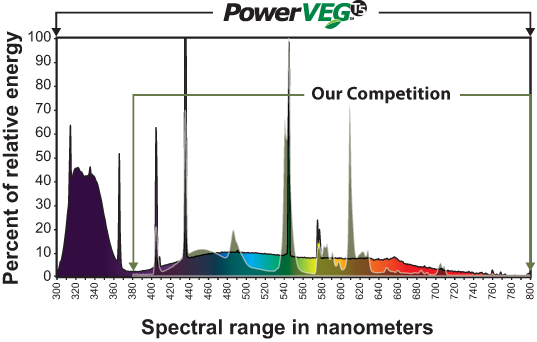
Looks like a blacklight.
Naaah. More on the lines of a horticulture specialty lamp yo coax resins and pigments out of crops..

Large amount of UV-A and B...

Their use in reef lighting is at best.. questionable.

At the short range they can produce more UV than the sun does outside.

On a personal note.. they never belong inside for a use like this.

as site just says stay over a foot away or wear protection

Likely bulb..or a close relative.
PowerVEG-FSUV-vs-T5-combined.png

ANSI RG-2: CAUTION
Product emits UVA and UVB rays. Possible skin or eye irritation can result from exposures exceeding 30 minutes when working less than 8 inches from the lamp. Use appropriate skin and eye protection.

csm_AppsPhotobiologicalsafetylamps-Risk-Group_2_c7aff3a1b8.jpg


The Power Veg lamp produces a lot of UV and in my opinion should be shielded. The other produces too much red.

Most UV light can be classified as an "irritant".
If the irritation produces things you want .. well their choice.
 
Last edited:

taricha

5000 Club Member
View Badges
Joined
May 22, 2016
Messages
7,223
Reaction score
10,587
Rating - 0%
0   0   0
Naaah. More on the lines of a horticulture specialty lamp yo coax resins and pigments out of crops..

Large amount of UV-A and B...

Their use in reef lighting is at best.. questionable.

At the short range they can produce more UV than the sun does outside.

On a personal note.. they never belong inside for a use like this.

Great post. good answers. The last quote in the post is from Dana. And he sees no benefits and some risk. I'd avoid.
There are lots of reef specific bulbs that'll give whatever benefits you are looking for from violet/UV without the concerns of this spectrum.
 

oreo54

5000 Club Member
View Badges
Joined
Sep 18, 2017
Messages
6,892
Reaction score
4,093
Rating - 0%
0   0   0
Just to add some more facts..
Glass is fairly transparent to light 350nm and greater.
Below 350 the amount of transmission dives steeply but depending on the glass type and thickness one can get a fair amount of transmission <350nm..
By approx 260 or less none ..


So the answer of if glass blocks UV.. It depends.

UV-A def penetrates the skin deeper.
AdobeStock_164382407-768x532.jpg


Should add this isn't much of an issue for Acrylic/plastic tanks. Most plastics have their sharp cut off at 400nm.

Now accidental "spill" is another issue.

I know I probably sound all gloom and doom and their is wiggle room in the def of "dangerous" so JUST consider the facts w/out judgement.

Addendum for completeness..
main-qimg-7112cf7237926407615a9f8aaab1ef99
 
Last edited:

Privateye

Well-Known Member
View Badges
Joined
Jan 17, 2020
Messages
518
Reaction score
466
Rating - 0%
0   0   0
UVC can cause severe damage as well, but that's the type produced by a UV sterilizer. It shouldn't be present in a coral light though.
 
OP
OP
L

LadyTang2

Well-Known Member
View Badges
Joined
Aug 21, 2019
Messages
743
Reaction score
341
Rating - 0%
0   0   0
It is the powerveg bulb which is mostly UVA which will penetrate glass and water, there will be minimal blocking, at least it would be under a hood so there would be no light spillage except through tank. I guess what I dont know is if a single 54watt bulb, 1 bulb only, would have enough oomph to really do anything harmful. 1 bulb under a hood, and your desk is 5 feet away from tank. Thoughts/data?
1598373671154.png
 

ReefLab

Well-Known Member
View Badges
Joined
Aug 28, 2019
Messages
710
Reaction score
764
Location
Las Vegas
Rating - 0%
0   0   0
It is the powerveg bulb which is mostly UVA which will penetrate glass and water, there will be minimal blocking, at least it would be under a hood so there would be no light spillage except through tank. I guess what I dont know is if a single 54watt bulb, 1 bulb only, would have enough oomph to really do anything harmful. 1 bulb under a hood, and your desk is 5 feet away from tank. Thoughts/data?
1598373671154.png
I'll say it again:
Using an actinic bulb will give you all the fluorescent "pop" while providing the corals with a a useable spectrum that is not a risk to people near the tank.

310nm is a very low frequency. Its unlikely that the corals would utilize it in the first place.
so its a lose-lose. Dangerous for you, potentially dangerous for the coral and fish.

If you want to be a trailblazer go for it but if it were my tank, id stick with actinic and blue plus bulbs.
 

jda

10K Club member
View Badges
Joined
Jun 25, 2013
Messages
14,342
Reaction score
21,757
Location
Boulder, CO
Rating - 0%
0   0   0
Some bad experiences with those types of bulbs over reef tanks. I would keep it above 350nm, and even then, the 350-400 should be in small amounts like what you get in a Halide with higher amounts the more near that you get to 400nm.
 

jda

10K Club member
View Badges
Joined
Jun 25, 2013
Messages
14,342
Reaction score
21,757
Location
Boulder, CO
Rating - 0%
0   0   0
Here is a very popular and very effective MH bulb with UV. You an see the taper from 400 to 350 between the black arrows. This reading is after using the glass shield to filter the higher frequency UV. If you do not use that glass, these bulbs will cause tissue damage in fish, coral and anything else - there are photos and treads from the early days of DE MH that show people not using the glass. In any case, UV if fine, just use it more like this, or in the photo of the ATI bulb above. You do not want the tissue damage from the higher frequency waves.

Screen Shot 2020-08-26 at 8.51.20 AM.png
 

blasterman

Valuable Member
View Badges
Joined
Feb 14, 2019
Messages
1,730
Reaction score
1,959
Rating - 0%
0   0   0
Here is a very popular and very effective MH bulb with UV.

Screen Shot 2020-08-26 at 8.51.20 AM.png

Not sure if you are being sarcastic, but where again is the UV? All I'm seeing is sporadic emission below 400nm with radiometric values less than 10% of peak 450nm which likely has no consequence for corals. You could double up on some UV plate glass and cut it another 90% and no coral would care.

The 400-430nm range is also pretty anemic to the LED fixtures pushed by the dudes at BRS.

Basically if the BRS guys and the forum here in general would look at that halide graph while being told it was an LED fixture the knee jerk reaction would be the light sucked and was not capable of growing coral, and Dana needs to take some responsibility for that.

Hope that helps quantify how ridiculous the entire UV / violet nonsense is.
 

jda

10K Club member
View Badges
Joined
Jun 25, 2013
Messages
14,342
Reaction score
21,757
Location
Boulder, CO
Rating - 0%
0   0   0
If the BRS guys and the general forum here would do that, then they would be wrong, not that either of these sources are always known for being right nor that they would agree with your assessment since this is one of the most tried and true light sources available and BRS has said in nearly all of their lighting comparison videos that if pure performance is what you are after, then get a Metal Halide (although I hate to quote their infomercials). Light under 400nm is truly UV and nearly every protein and pigment can use it, it creates colorful sunscreen and colors in the violet and blue range with emission after energy has been used. All of this is true even if it does not fit your agenda or beliefs.

I also think that it is funny that anybody would laugh at a 14k Phoenix graph since not a single LED has figured out how to outperform it yet. I use these bulbs, can you outperform me with your tank? I am happy to be beaten, so do it if you can.
 

oreo54

5000 Club Member
View Badges
Joined
Sep 18, 2017
Messages
6,892
Reaction score
4,093
Rating - 0%
0   0   0
this is one of the most tried and true light sources available and BRS has said in nearly all of their lighting comparison videos
Ther "go to" sell seems to be ATI Blue plus t5's .

Haven't seen mention of any Metal halides recently.
 

TOP 10 Trending Threads

HOW DO YOU ADJUST YOUR CUC AS ALGAE DISAPPEARS?

  • Capture and re-home CUC

    Votes: 7 7.1%
  • Increase white light/hours in tank to spur algae growth to feed CUC

    Votes: 6 6.1%
  • Feed nori to support CUC

    Votes: 35 35.4%
  • Feed herbivore pellets to support CUC

    Votes: 33 33.3%
  • Allow attrition to balance CUC and algae

    Votes: 43 43.4%
  • Provide macro algae to feed CUC

    Votes: 6 6.1%
  • Introduce CUC predators

    Votes: 1 1.0%
  • Other (please explain)

    Votes: 11 11.1%
Back
Top