Why does cyano grow here…and only here?

Ancient Mariner

Active Member
View Badges
Joined
May 31, 2021
Messages
441
Reaction score
998
Location
Atlanta
What state or country do you live in
Georgia
Rating - 0%
0   0   0
I do not have a cyano problem but it does pop up in spots at times. Why? Currently the only area I have it is in a low-moderate light, moderate-high flow spot on the tank bottom.
IMG_4432.jpeg


I’ve had it pop up on the back wall (low light, moderate flow) and at tips of acroporas that have reached the water surface (very high light, high flow). But it is only very occasionally.

My hypothesis is that the primary process is microbiological competition and that the mature reef has the proper micro fauna and flora to out compete cyano.

So when people speculate as to the cause and cure of a cyano outbreak and say it’s flow/light/nitrate/phosphate/low nutrients/high nutrients it gets confusing. If you can explain why cyano grows in a spot in an otherwise cyano free tank, then that’s the answer!

(My tank is a 5 year old Acropora dominant tank. Nitrate 50, phosphate 0.5, metal halide lit. I had a severe cyano problem early on that I simply did rock scraping and sand siphoning for a good period of time. At that time nitrate and phosphate was basically 0.)

 
No idea but interested to see what others say.
Never saw a spec of cyano in my 3 year old tank until a couple of months ago -- now it's my (current) major pain point!
 
Following this. I have cyano popping up solely on one small portion of the back wall and on a few portions of high light areas in the sand. Each, I believe, gets the debris from feedings. Anyways, I had a large bloom like yours but it dwindled into this and now it’s lingered for months
 
I still get it in places all the time but I don't worry about it. I am also sure no one can answer your question as it is all guesses. :)


Imo, the resolution of hobby test kits can’t adequately interpret algae problems including Cyano. Whether your test kits reads 0 or some number high, if algae is growing there is adequate supply of inorganic nutrients. Nothing will grow without nutrients, Cyano has the ability to use n2, but imo, only enough to survive. I have had Cyano grow on the outflow of a MP60 at full speed, so flow is only important in moving particle nutrients and not inhibiting Cyano growth. I agree with OP, it is primarily about real estate with all algae including Cyano.
 
probably a low flow area where detritus accumulates, happens here in one spot too
It can’t be “flow”. I have plenty of similar low flow areas where cyano does not occur. And I have high flow areas where it occurs (as I mentioned at the tips of Acroporas that break the surface).
 
I still get it in places all the time but I don't worry about it. I am also sure no one can answer your question as it is all guesses. :)

I agree it’s guesses, just like when people say they know how to solve a cyano outbreak. You know, increase your nutrients, it’s your phosphates, its low flow , its low light. So newbies do this and that and get all frustrated.
 
No idea but interested to see what others say.
Never saw a spec of cyano in my 3 year old tank until a couple of months ago -- now it's my (current) major pain point!
Your system has developed cyano so late. The time line is very different from the usual dino-hair algae-cyano timeline.

Did you start your reef with well aged live rock? Did you have any dino or hair algae problems?

(Your tank looks great by the way!)
 
Cyanobacteria always been a thought one to understand, in my view. It’s often seen starting in places were organics can get stuck, even in a tank with high flow there will always be an area were those will collect.
In addition I suspect that not all tanks will have the necessary organisms that will prey on Cyanobacteria.
 
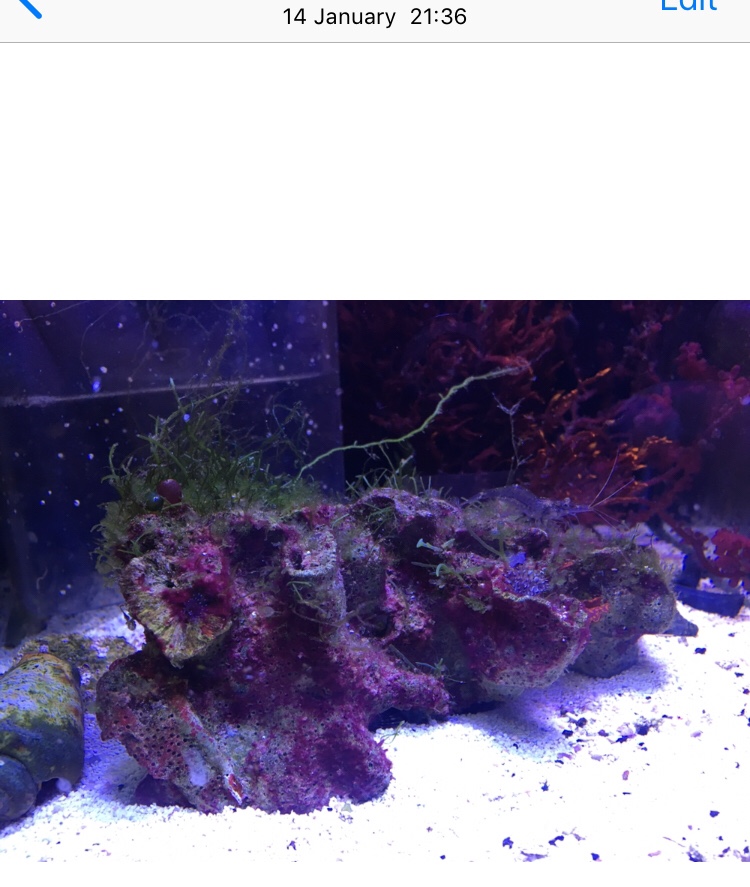
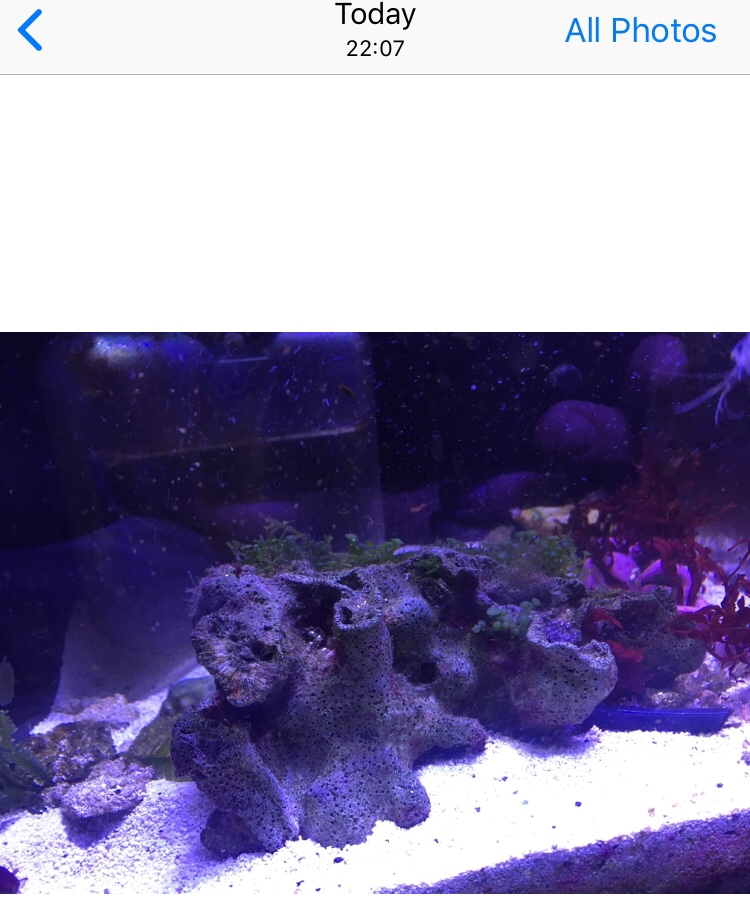
Cyanobacteria gone in under 20 days (no chemicals) the rock was bought with Cyanobacteria.

37e77c39e366a324e8773d4035bc9cff.jpg


9c71c30f4ba4e5cc8f21e4630f5433ef.jpg

Thats a example of a test I’ve done a few years back, promoting competition with just phytoplankton
 
Your system has developed cyano so late. The time line is very different from the usual dino-hair algae-cyano timeline.

Did you start your reef with well aged live rock? Did you have any dino or hair algae problems?

(Your tank looks great by the way!)
Thanks -- been trying to keep it simple.

Tank started with half dry and half aquacultured live rock.

Live rock was from Petco (that's right!) but it was fully coralline covered and had tons of amphipods (and bristle worms and stuff) so seemed pretty "live" to me.
*tag said "Fiji cultured", FWIW
...also, that (live) rock was in my previous tank for about 8 months before tank transfer

I had dinos around the 6-8 month mark when I let PO4 bottom out for too long, plus slight re-emergence when I tried dosing Coral Amino a couple months later,,, but haven't seen any dinos in quite a while (maybe a couple of years?).

Normal GHA stuff at some point when tank was progressing but nothing too bad and hasn't been an issue for a long time.

Not sure what the deal is with the cyano outbreak since I haven't had any changes (additions or parameter swings) -- just been waiting it out and doing manual removal but will probably start doing something like DIY Coral Snow after the holidays.

Finally, I purposely run around 10 ppm nitrate and 0.10 ppm phosphate (and dose when needed to stay that high) but probably will start letting those fall a bit (half?) to see if any effect.
 
Last edited:
Thanks -- been trying to keep it simple.

Tank started with half dry and half aquacultured live rock.

Live rock was from Petco (that's right!) but it was fully coralline covered and had tons of amphipods (and bristle worms and stuff) so seemed pretty "live" to me.
*tag said "Fiji cultured", FWIW
...also, that (live) rock was in my previous tank for about 8 months before tank transfer

I had dinos around the 6-8 month mark when I let PO4 bottom out for too long, plus slight re-emergence when I tried dosing Coral Amino a couple months later,,, but haven't seen any dinos in quite a while (maybe a couple of years?).

Normal GHA stuff at some point when tank was progressing but nothing too bad and hasn't been an issue for a long time.

Not sure what the deal is with the cyano outbreak since I haven't had any changes (additions or parameter swings) -- just been waiting it out and doing manual removal but will probably start doing something like DIY Coral Snow after the holidays.
I always point out the importance of biological maturity to succeed in reef keeping and your reef shows it.

My point in this thread is that the usual recommendations to eliminate cyano aren’t the answers. Time and patience to allow the proper biological balance probably is the main approach.
 
Cyanobacteria always been a thought one to understand, in my view. It’s often seen starting in places were organics can get stuck, even in a tank with high flow there will always be an area were those will collect.
In addition I suspect that not all tanks will have the necessary organisms that will prey on Cyanobacteria.

I feel the little spots of cyano that I get start with a disruption of the biological micro environment that lifts the disinhibiting effects on cyano growth. I’m not sure what that is , but it could be something like an introduction of a new sterile surface (eg a broken Acropora tip or a new dead rock) or just a natural ebb and flow of the micro fauna and flora. Then the cyano appears there and then dies away once the ecological balance in that spot is reestablished.
 
I’ve been dealing with a cyano problem in a 2 year old system for a few months now. Mostly on the sand but also a little bit on the rock, that burns out each day at the end of the lighting period. Seems to be strongest right when lights come on. I tried everything (but chemiclean). I finally sucked out the sandbed with water changes over a few weeks and it never came back - at least in the sand…few spots here and there on rock work.

I hear on the forums it’s a problem due to a build up of organics. However, I changed tons of water, skimmed wet, ran GAC, and vacuumed the sandbed and sump faithfully for 3 months and it didn’t improve. Maybe my sandbed was just too saturated. I don’t know.

Then you have folks saying - need more nutrients or nutrients are out of balance…I tried that a while too before removing the sandbed and it made no difference.

Then 7-10 years ago folks consistently reported that feeding less, and decreasing nutrients improved things and the cyano went away. I also tried that and corals just suffered…cyano remained.

I wish someone had the answer….I am burnt out trying to deal with it. Maybe I just need to accept to have a little here and there and try to ignore it. I will say it’s much less without the sandbed. My guess is it may just eventually go away on its own, only for it to come back again.
 
I do feel that we haven’t fully figured out the factors that cause a cyano outbreak and then it’s resolution. My battle with cyano sounds very much like yours. You too will get through it! I resigned myself at one point that I’ll just need to keep vacuuming the sand and scraping the rock forever, but then it just died out.
 
I do not have a cyano problem but it does pop up in spots at times. Why? Currently the only area I have it is in a low-moderate light, moderate-high flow spot on the tank bottom.
IMG_4432.jpeg


I’ve had it pop up on the back wall (low light, moderate flow) and at tips of acroporas that have reached the water surface (very high light, high flow). But it is only very occasionally.

My hypothesis is that the primary process is microbiological competition and that the mature reef has the proper micro fauna and flora to out compete cyano.

So when people speculate as to the cause and cure of a cyano outbreak and say it’s flow/light/nitrate/phosphate/low nutrients/high nutrients it gets confusing. If you can explain why cyano grows in a spot in an otherwise cyano free tank, then that’s the answer!

(My tank is a 5 year old Acropora dominant tank. Nitrate 50, phosphate 0.5, metal halide lit. I had a severe cyano problem early on that I simply did rock scraping and sand siphoning for a good period of time. At that time nitrate and phosphate was basically 0.)
Flow, likely much less flow here.
 
Flow, likely much less flow here.
Nope. Plenty of spots in my reef with less flow than this. Yet there’s no cyano. And as I mentioned before I’ve had cyano grow on the dead tips of acropora branches that breach the surface where there’s tons of flow and light. If it’s a flow issue why isn’t it growing in all low flow areas?
 
I have a weird cyano problem too. it ONLY grows on front panel of the internal overflow box and one particular area in the lower back left of my tank. The cyano on the overflow box is like green algae, its only on the surface, doesnt grow any bigger or trap any air bubbles. Its really hard to scrape off just like algae and grows back after a while. (it would very much be just a red algae and not cyano)

The cyano lower back right corner acts more like cyano where it looks slimy and wispy, it grows and bubbles up. Theres plenty of flow at that back corner, once it grows to a certain size the flow is enough to blow the cyano apart. I would keep vacuuming that particular area, scraping as I go trying to get most of it out of my tank but it would come back after a while. It doesnt grow anywhere else in my tank. I dont think i have a nutrient issue, my nitrates and phosphates arent over the top. I just leave it as it and continuing to clean and vacuum when it grows too big
 
I’ve been dealing with a cyano problem in a 2 year old system for a few months now. Mostly on the sand but also a little bit on the rock, that burns out each day at the end of the lighting period. Seems to be strongest right when lights come on. I tried everything (but chemiclean). I finally sucked out the sandbed with water changes over a few weeks and it never came back - at least in the sand…few spots here and there on rock work.

I hear on the forums it’s a problem due to a build up of organics. However, I changed tons of water, skimmed wet, ran GAC, and vacuumed the sandbed and sump faithfully for 3 months and it didn’t improve. Maybe my sandbed was just too saturated. I don’t know.

Then you have folks saying - need more nutrients or nutrients are out of balance…I tried that a while too before removing the sandbed and it made no difference.

Then 7-10 years ago folks consistently reported that feeding less, and decreasing nutrients improved things and the cyano went away. I also tried that and corals just suffered…cyano remained.

I wish someone had the answer….I am burnt out trying to deal with it. Maybe I just need to accept to have a little here and there and try to ignore it. I will say it’s much less without the sandbed. My guess is it may just eventually go away on its own, only for it to come back again.
Im at a similar spot. 2 year old tank, kicking goals with nice sps and good growth then bam - cyano. Mine tends to die down over night but by the end of the photo period it’s a crime scene.

I’ve tried no and low lights during the day and both strangely have little effect except to effect the SPS.

It’s very frustrating.
 

HOW MUCH DOES A FISH’S FEEDING REQUIREMENTS AFFECT YOUR STOCKING DECISIONS?

  • A lot! - I avoid fish that require frequent or specialized feeding

    Votes: 20 34.5%
  • Quite a bit, but an automatic feeder can change my answer

    Votes: 8 13.8%
  • It depends on whether my nutrient export can handle it

    Votes: 8 13.8%
  • It depends on how badly I want the fish

    Votes: 12 20.7%
  • Not much. I’m willing to adjust my routine

    Votes: 9 15.5%
  • Not at all. Feeding demands don’t limit my stocking choices

    Votes: 9 15.5%
  • I usually learn about the demanding feeding schedule after buying the fish!

    Votes: 2 3.4%
  • I haven’t really considered this before

    Votes: 4 6.9%
  • Something else (see my comments in the thread)

    Votes: 2 3.4%
Back
Top
Home
Post thread…
Market
What's new