3/4 inch full siphon drain gph?

  • Thread starter Thread starter Mirkus
  • Start date Start date
  • Tagged users Tagged users None
Max flow is 400gph. You can reduce further with friction and bends... such as 90s and 45s
 
It depends on the elevation difference and all the fittings, but I doubt it will be a lot more than 400 gph. I run a 1" full siphon with about 30" of elevation drop which necks down to 3/4" through the bulkhead, and an Eheim 1262 pumping against 3 ft of elevation difference through 1" tubing will overload it if I do not throttle it back.

 
Taken from that post, but also can be verified by other internet searches to be approximately the same. I've seen a resource that indicated 660gph from 3/4" pipe, but as distance increased it dropped significantly.

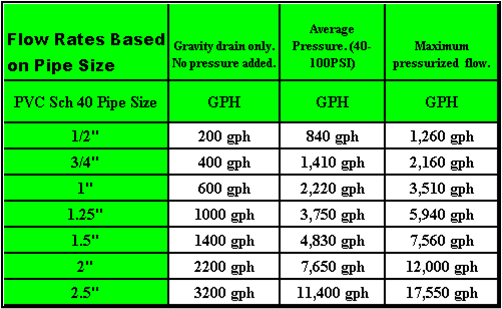
Without getting a flow meter on the end of your siphon, you'd have to approximate it for each application anyways. First column in chart indicates gravity drain.

That post states:
The below charts summarized flow rates by: no pressure, average pressure applications, and the maximum pressure that the pipe and fittings can handle in standard PVC (standard = sch 40). Once I start to talk about an example of plumbing a sump, I will be referring back to these charts
(GPH = Gallons Per Hour )


GPHpipe.png


Loss of flow (this is in regards to loosely calculating head pressure on the return pump).
Once thing to keep in mind, when planning your plumbing set-up the pump should be the last thing you choose. The reason for this is that you need to know how much loss of flow you will have from your plumbing design. Each time you add a 90 degree elbow, or a swing check valve, you will lose some flow because of these additions to your plumbing line. The below list are more of a rule of thumb with calculating flow loss of your pressurized return line only. They may not be 100% accurate, as many other factors can effect these calculations. They will be close enough for you to get an accurate estimate of the flow reduction. The below factors will become very important when planning your set-up.
• A loss of 75 to 125 GPH for each foot of height (from the pump to the display tank return)
• A loss of 50 to 75 GPH for each 90 degree elbow
• A loss of 30 to 50 GPH for each 45 degree elbow
• A loss of 50 to 75 GPH for each swing check valve
• A loss of 20 to 40 GPH for each ball valve
• A loss of ~ 3 to 5 GPH for each union
 

HOW MUCH DOES A FISH’S FEEDING REQUIREMENTS AFFECT YOUR STOCKING DECISIONS?

  • A lot! - I avoid fish that require frequent or specialized feeding

    Votes: 7 26.9%
  • Quite a bit, but an automatic feeder can change my answer

    Votes: 5 19.2%
  • It depends on whether my nutrient export can handle it

    Votes: 5 19.2%
  • It depends on how badly I want the fish

    Votes: 8 30.8%
  • Not much. I’m willing to adjust my routine

    Votes: 5 19.2%
  • Not at all. Feeding demands don’t limit my stocking choices

    Votes: 5 19.2%
  • I usually learn about the demanding feeding schedule after buying the fish!

    Votes: 1 3.8%
  • I haven’t really considered this before

    Votes: 2 7.7%
  • Something else (see my comments in the thread)

    Votes: 0 0.0%
Back
Top
Home
Post thread…
Market
What's new