Agreed. I changed my answer to better reflect yours. I do think it's possible to do and could be the better option for all coral but I personally have my sump open to see and needs to be semi clean as part of the set up also.
First, I would never pay hundreds of dollars for a 1” frag of coral. Also, as a Laissez Faire reefkeeper, I choose not to stock corals that are finicky and require large demands on alkalinity management. Passive bufferring from aroggonite sandbed takes care of alkalinity requirements in my system. I focus on nutrient recycling with refugium feeding tank with micro fauna & fana. I just did change mud/macro refugium into cryptic refugium to process DOC. At most, I spend 1 hr a week on maintenance. I choose not to be a slave to my tank, by implementing nutrient recycling strategies to process organic & inorganic nutrients thru multiple food webs to feed larvae to hungry mouths.
Consider this short post written by
@Paul B on the benefits of detritus and why MULM is good i a reef tank.
https://www.thereeftank.com/threads/mulm-in-a-reef-tank.240586/
Mulm" in a reef tank
I think one of the most important, and least understood or mentioned things in a reef tank is "mulm". That stuff that grows in the dark portions of a tank if it is set up long enough. "Mulm" is a combination of algae, sponges, bacteria, pods, worms, detritus, poop and any thing else that can be propagated or grown in the dark. I realize most people would immediately get out the sponge, razor blade or grenade to remove it but there is a word I like to use to describe those people. That word is "wrong". Mulm is a natural product that you will find in the sea all over the world. Our tanks run on bacteria, algae and a food chain. Bacteria and a food chain are dependent on having a place to reproduce. Mulm is the perfect place. Rocks and glass are flat surfaces that are only two dimensional. Mulm makes these places three dimensional allowing much more space for bacteria and microscopic organisms to grow and do the macarana. (Then love to dance) Pods, which are needed for any small fish also need to eat and their numbers are directly related to how much food they can get their hands on (or whatever pods use to eat with) The more food, the more pods, the more pods, the easier to keep smaller fish. Larger fish such as copperbands and angels also eat pods.
Many people try to keep fish such as pipefish, mandarins or other dragonettes in a sterile tank and while feeding them a couple of times a day with tiger pods or some other expensive food. Those types of fish will not live for long in such a tank and they certainly won't spawn which I consider the "only" criteria to determine the state of health for any paired fish.
Mulm (after a while, maybe a few years) should grow on the back and sides of glass as well as under rocks.
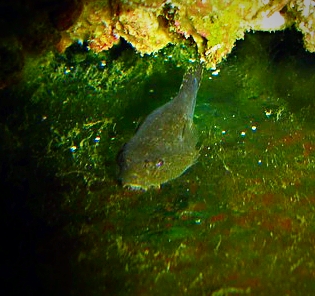
Here in this picture of my clingfish, the mulm appears green. It is really brownish and that fish is on the side of my tank. I brightened up the picture and turned it sideways because it was in the dark and the fish was hard to see.
There is a thick layer of it on the back of my tank where my mandarins and pipefish like to hunt. My long spined urchin also grazes there most of the time as there is not much algae in my tank for him to eat. He is many years old as are the mandarins and pipefish and they are dependent on this food source.
A sterile tank IMO is the biggest problem we have keeping certain fish healthy.
Sterile is good in an operating room but very bad in a tank.