Algae/Dino ID with microscopic images

rortman

New Member
View Badges
Joined
Feb 23, 2025
Messages
13
Reaction score
6
Location
Ireland
Rating - 0%
0   0   0
Hi everyone,

Longtime reefer her but taken a hiatus and started up a tank about 6 months ago now. Really planned this tank properly but running into some bad nuisance algae issues the last 1-2 months. Will try to provide some background but I am also located in Ireland:
- 400L tank started with MarcoRocks
- Clarisea SK-5000 mat + Red Sea 300 Skimmer (AC)
- Radion XR G6 Pro running around 8 hours a day but at 40% output
- Cycled tank for 1 month using Modern Reef bacteria and ammonia starter (really liked this product)
- after a few months started
** UV steriliser is on its way but not hooked up yet **

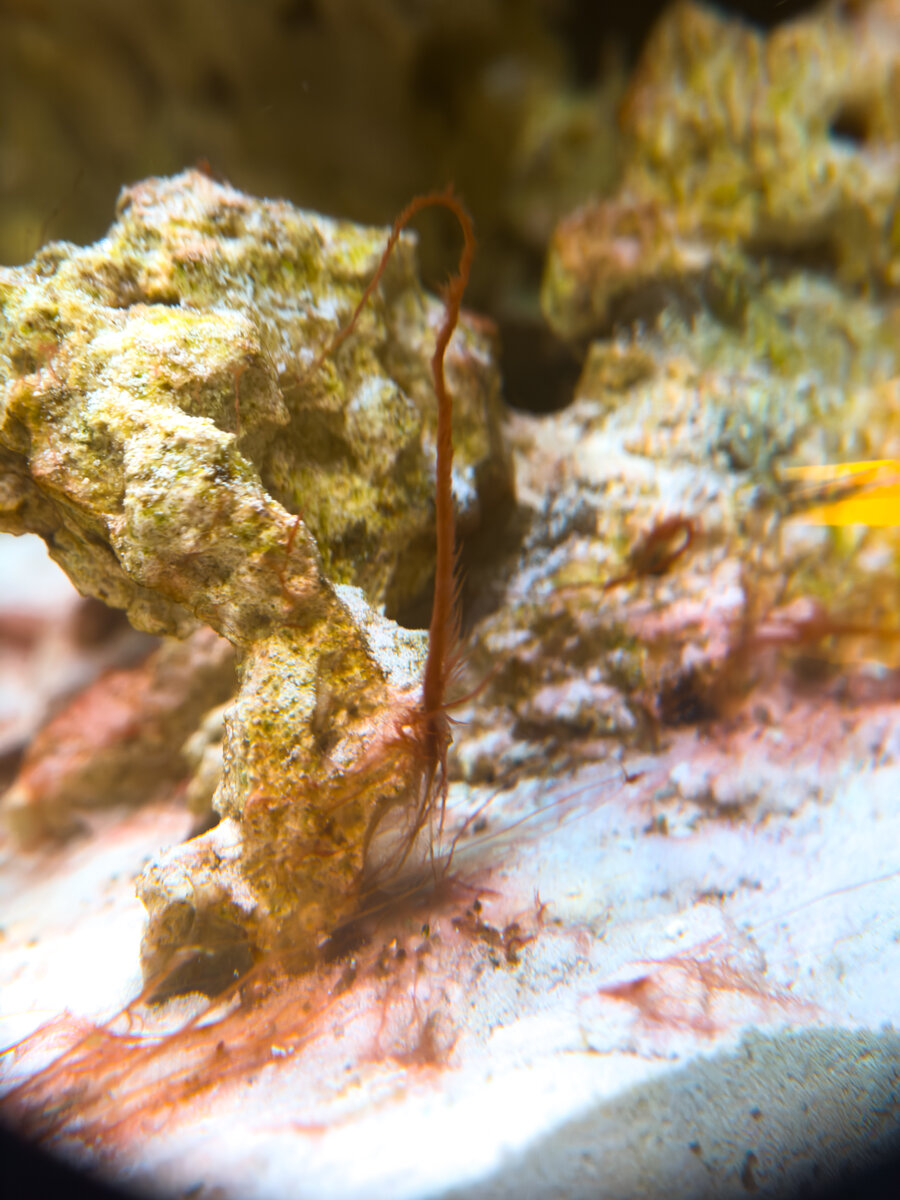
Started to add small fish slowly, then added a number of Zoas and slowly added more LPS (euphyllia etc) and small SPS to test the tank. I plan to follow Modern Reef dosing so have stuck with their products. Have low bio load with a Midas Blenny, pair of clowns and Possum Wrasse all thriving. When I started to add some of the corals I found this purple algae start to take off all over the sand bed and over the last weeks started to crawl up the rock as well. It almost like long feather/hair strands connected to a 'carpet' over the substrate. It's very heavy but blows off the sand and rocks easily but comes back quickly.

MAJOR issue I have had is my nutrients have been rock bottom. I can dump food into the tank and not see a tick up of nitrates and phosphates (checking with ICP and manually with Hanna Checkers every 2 days). 2 weeks ago I have started to dose Nitrate + and Phosphate +, again from Modern Reef, and have been able to maintain levels with:
Nitrate - 7ppm
Phosphate at 0.06ppm.

Dosing Modern Reef One4All with levels:
Salinity - 35ppt
Calcium - 445ppm
Alk - 8.6-8.8dKH
Mag - 1350ppm

Over the last month I have been following the Modern Reef Dino/Cyano Treatment Protocol (https://modernreef.eu/anti-dinoflagellates-and-cyanobacteria-protocol/). It requires dosing the products, covering the tank and lights out for about 48 hours and dosing large packs of copepods weekly. Initially the tank looks pretty good but within 1-2 days with lights back on the algae comes flooding back.

I myself am a veterinarian and treat fish but with algae and this I am a bit out of my depth. I have been able to take some samples of the algae and get some good images which I will try to attach to this post. I have found small numbers of dinoflagellates but never enough for me to truly think they are the culprit? So far the coral and fish are doing absolutely fine but I would very much like to get rid of this algae as it is just further taking over the tank.

This image is from a few weeks ago when I started the treatment:
IMG_0791.jpg
 
OP
OP
rortman

rortman

New Member
View Badges
Joined
Feb 23, 2025
Messages
13
Reaction score
6
Location
Ireland
Rating - 0%
0   0   0
From what I can see, microscopic videos from samples taken today (apologies for the shaking images, we don't have a phone mount) I see this highly motile spiralled algae :
** Sorry for audio, though I muted the videos before uploading but some have the hospital background noises**


mcarroll

10K Club member
View Badges
Joined
Jan 8, 2012
Messages
15,213
Reaction score
8,968
Location
Virginia
Rating - 0%
0   0   0
- 400L tank started with MarcoRocks
- Clarisea SK-5000 mat + Red Sea 300 Skimmer (AC)
- Radion XR G6 Pro running around 8 hours a day but at 40% output
- Cycled tank for 1 month using Modern Reef bacteria and ammonia starter (really liked this product)
This type of startup (dead rock + ammonia spike) seems particularly prone to pest algae. This is something I would have planned around, if possible. You may also be on the side of excessive filtration with the roller, etc.

- after a few months started
** UV steriliser is on its way but not hooked up yet **
This might have been advisable out of the gate given the approach you were taking....keeps waterborne critters like algae spores from spreading.

MAJOR issue I have had is my nutrients have been rock bottom.
...excess filtration, etc. Get the system down to just the rock in the display and the protein skimmer...no other gear or additive for this purpose..

Over the last month I have been following the Modern Reef Dino/Cyano Treatment Protocol (https://modernreef.eu/anti-dinoflagellates-and-cyanobacteria-protocol/). It requires dosing the products, covering the tank and lights out for about 48 hours and dosing large packs of copepods weekly. Initially the tank looks pretty good but within 1-2 days with lights back on the algae comes flooding back.
No offense, but...meh.

Try this: Dinoflagellates – Are You Tired Of Battling Altogether?

Mostly read and digest page #1, then post any questions you have.....the rest of the thread (12,000+ posts) is tank specifics, so optional for you.

It's specific for Dino's, but IMO you'll want to follow all of the guidance there and reassess if anything more is needed after a few weeks or months.
 

Lavey29

10K Club member
View Badges
Joined
Apr 29, 2021
Messages
15,161
Reaction score
16,352
Location
United States
Rating - 0%
0   0   0
Not sure if it is just the bright white pictures but cut out the white light for a month. Use blue and uv only. Check @SunnyX thread for water clarity and cyano removal.
 
OP
OP
rortman

rortman

New Member
View Badges
Joined
Feb 23, 2025
Messages
13
Reaction score
6
Location
Ireland
Rating - 0%
0   0   0
This type of startup (dead rock + ammonia spike) seems particularly prone to pest algae. This is something I would have planned around, if possible. You may also be on the side of excessive filtration with the roller, etc.


This might have been advisable out of the gate given the approach you were taking....keeps waterborne critters like algae spores from spreading.


...excess filtration, etc. Get the system down to just the rock in the display and the protein skimmer...no other gear or additive for this purpose..


No offense, but...meh.

Try this: Dinoflagellates – Are You Tired Of Battling Altogether?

Mostly read and digest page #1, then post any questions you have.....the rest of the thread (12,000+ posts) is tank specifics, so optional for you.

It's specific for Dino's, but IMO you'll want to follow all of the guidance there and reassess if anything more is needed after a few weeks or months.
Thanks for the reply, and no offence taken!

Here to learn and continue to gain more knowledge. In the past, I always set up tanks using live rock but that was around 6 years ago and this time around wanted to truly customise full aquascape, so went with dead rock.

Fully understand the over filtration. And currently thinking of taking down the filter roller for awhile.

Will check out that Dino page and go from there!

For my own interest would still love to see if any one can help ID this type of algae ;-)
 
OP
OP
rortman

rortman

New Member
View Badges
Joined
Feb 23, 2025
Messages
13
Reaction score
6
Location
Ireland
Rating - 0%
0   0   0
Not sure if it is just the bright white pictures but cut out the white light for a month. Use blue and uv only. Check @SunnyX thread for water clarity and cyano removal.
I was using blue filter lenses for my phone to take the pictures so was blocking out the blue light. Majority of light is blue, following the AB+ template for the Radion.

Thanks for the info, will check the thread you mentioned!
 

Lavey29

10K Club member
View Badges
Joined
Apr 29, 2021
Messages
15,161
Reaction score
16,352
Location
United States
Rating - 0%
0   0   0
I was using blue filter lenses for my phone to take the pictures so was blocking out the blue light. Majority of light is blue, following the AB+ template for the Radion.

Thanks for the info, will check the thread you mentioned!
Cyano feeds on organic waste on the sandbed also. I use PNS probio which is a natural heterotrophic bacteria that eliminates organic waste from the sand.
 
OP
OP
rortman

rortman

New Member
View Badges
Joined
Feb 23, 2025
Messages
13
Reaction score
6
Location
Ireland
Rating - 0%
0   0   0
Cyano feeds on organic waste on the sandbed also. I use PNS probio which is a natural heterotrophic bacteria that eliminates organic waste from the sand.
This was my fear that this is cyanobacteria but from the cytology, and what I can find, is it is not really lining up? But I could be 100% wrong.

The Modern Reef treatment does include the natural heteroptrophic bacteria, along with other things so was hoping that was covered. But I will definitely look into the PNS Probio!\. Again, thank you!
 

mcarroll

10K Club member
View Badges
Joined
Jan 8, 2012
Messages
15,213
Reaction score
8,968
Location
Virginia
Rating - 0%
0   0   0
For my own interest would still love to see if any one can help ID this type of algae ;-)
I've had no luck getting cyano ID'd online....dunno if there's lack of interest, too many species to ID at our level, something else, or a combination....but cyano is still just cyano to us. (And that's not great testimony...)

It's definitely cyano though, for what that's worth.

You can take a sample of it, shake it until it's obliterated to smithereens then let it sit in the light for an hour. Anything that's motile (eg Dino's) will re-clump. Cyano won't. That'll tell you if dino''s are present. Still need a microscope for ID on Dino's...though to a degree you can narrow it down based on their behaviors.
 

Lavey29

10K Club member
View Badges
Joined
Apr 29, 2021
Messages
15,161
Reaction score
16,352
Location
United States
Rating - 0%
0   0   0
This was my fear that this is cyanobacteria but from the cytology, and what I can find, is it is not really lining up? But I could be 100% wrong.

The Modern Reef treatment does include the natural heteroptrophic bacteria, along with other things so was hoping that was covered. But I will definitely look into the PNS Probio!\. Again, thank you!
Cut out the white light on the AB plus radion setting for 3 weeks. Its typically preset to 24%. I use the same lights. Corals don't need white light. Its primarily for viewing pleasure.
 
OP
OP
rortman

rortman

New Member
View Badges
Joined
Feb 23, 2025
Messages
13
Reaction score
6
Location
Ireland
Rating - 0%
0   0   0
I've had no luck getting cyano ID'd online....dunno if there's lack of interest, too many species to ID at our level, something else, or a combination....but cyano is still just cyano to us. (And that's not great testimony...)

It's definitely cyano though, for what that's worth.

You can take a sample of it, shake it until it's obliterated to smithereens then let it sit in the light for an hour. Anything that's motile (eg Dino's) will re-clump. Cyano won't. That'll tell you if dino''s are present. Still need a microscope for ID on Dino's...though to a degree you can narrow it down based on their behaviors.
Well then that makes absolutely sense of why I can't find anything on it. Just thought it was super interesting how the spiralled cyanobacterium are so motile even under the microscope.

On previous cytology I did find a few dino's but very few and never clumped up like I have seen on so many other images.
 
OP
OP
rortman

rortman

New Member
View Badges
Joined
Feb 23, 2025
Messages
13
Reaction score
6
Location
Ireland
Rating - 0%
0   0   0
Cut out the white light on the AB plus radion setting for 3 weeks. Its typically preset to 24%. I use the same lights. Corals don't need white light. Its primarily for viewing pleasure.
Will do, appreciate that heads up!
 

TOP 10 Trending Threads

WHAT AMOUNT OF LIVE ROCK AND SAND SHOULD BE PRIORITIZED FOR OPTIMAL BIODIVERSITY/FILTRATION?

  • 100% live rock + bagged sand

    Votes: 34 26.4%
  • 100% dry rock + 100% live sand

    Votes: 45 34.9%
  • 50/50 live/dry rock, 50/50 live/bagged sand

    Votes: 29 22.5%
  • 75% live rock, 25% live sand

    Votes: 11 8.5%
  • 25% live rock, 75% live sand

    Votes: 10 7.8%
Back
Top