"Anemones list and Information"

  • Thread starter Thread starter clowns101
  • Start date Start date
  • Tagged users Tagged users None
I might buy a lemon peel angel do you guys know if they pick on anemones? I think I saw on other link they do want to make sure before I get him
 
Any advice for a common rock anemone ? Are they OK to put with shrimp and slow moving fish ?
 
Rock anemones are fine. Should not cause problem. It is not how fast the fish move but wether or not they run into the anemone. Small fish that stay on the surface tend to have more problem with anemones.
Almost all the time fish get eaten when they got spooked and ran into the anemone.
 
Question on setting up an anemone species tank, what types can I keep together and which types would you recommend that I can keep together?
It would be a RSM 250 so about 65g.
TIA
 
I actually never have problem with keeping anemones in the same tank. Must can touch without problem. They just move apart if any stinging. I have had Malu and Haddoni that seem to sting each other sometime but not other time.
 
Hello,
I am posting this thread to help other become aware of the different species of anemones and care for anemone species.

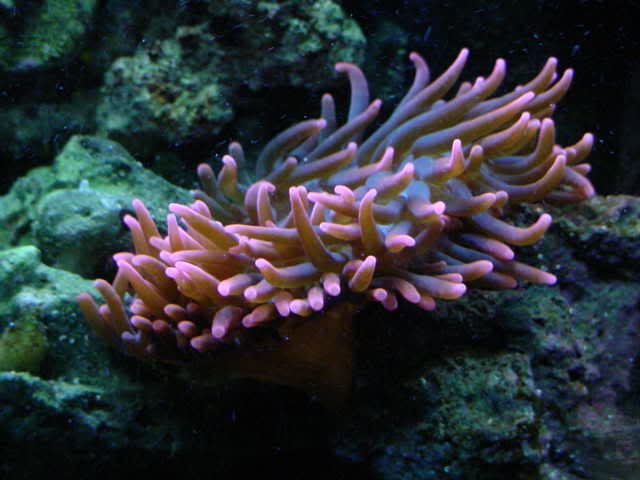
Entacmaea quadricolor:
Common names:
1)Rose Bubble Tip:RBTA's
2)Bulb Anemones
3)Maroon Anemones
4)4 Color Anemone

Tentecals will sometimes inflate at tip with white stripes around the mouth is commonly seen in this species.Ataches to hard surface with a current gently blowing over the Oral Disk.

Natural Host:
Symbiosis with this anemones has occured with all species that we know of and seen with some damsels.

Avability:10/10
Light demands:Moderate to high
Flow:Moderate
Photo:
MVC-006S.jpg


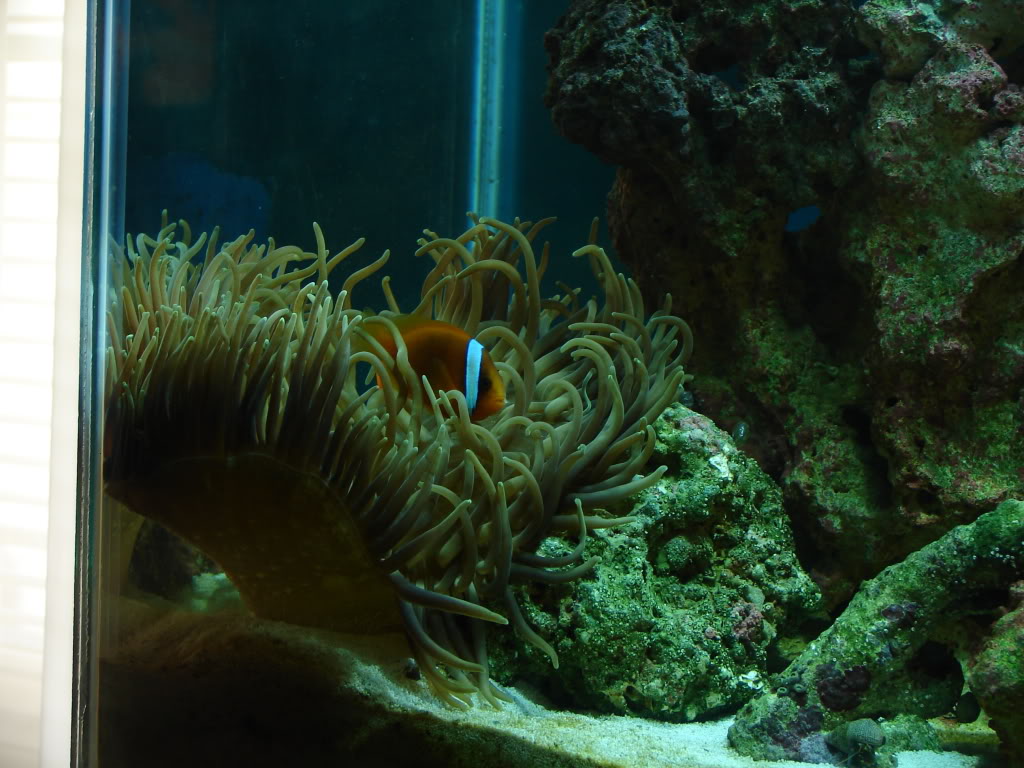
Macrodactlya doreensis:
Common names:
1)Long Tentecal Anemone
2)Red Based Anemone
3)Corkscrew Anemone
4)Sand Anemone

Attaches at Rock/Sand interface with a Moderate flow passing through the tenteclas.

Avability:9/10
Lighting:Moderate to high
Flow:Moderate

Natural Host:
Know to host many clownfish and has been seen hosting some damsels.
Photo:
DSC00904.jpg


Heteractis cripsa:
Common Names:
1)Leathery Anemone
2)Buttom Anemone
3)Sand Based Anemone
4)Sebae Anemone

Attaches to Rock/Sand interface,has been seen on rocks.

Avability:9/10
Lighting:High
Flow:Moderate to high

Natural Host:
Clarkii,Blue Stripe,True Percula,Pink Skunk,Saddle Back.Known to host other as well,as been seen with some damsels.

Heteractis aroura:
Common Names:
1)Beaded Anemone
2)Aroura Anemone

Buries foot down in sand bed,with tenteclas raised.Large beady like tentecals.

Avability:3/10
Lighting:Moderate to high
Flow:Moderate

Natural host know:
Clarkii


Hateractis malu:
Common names:
1)Singapore Anemone
2)Malu Anemone


Buries foot in sand also seen at Rock/Sand interface.Commonly has purple tips.

Avability:5/10
Lighting:Moderate to high
Flow:Moderate

Natural Host:
Clarkii
Has been known to has many more clownfish.


Heteractis magnifica:
Common Names:
1)Magnificent Anemone
2)Ritteri Anemone
3)Red Radianthus Anemone

Generally attaches to hard surface with foot completly exposed.Very bright colors and generally bigger.

Avability:7/10
Lighting:Very High
Flow:Very high and alternating

Natural host:
Ocellaris
Percula
Skunk
Has been seen hosting others as well.


Stichodactlya haddoni:
Common Names:
1)Carpet Anemone
2)Short tentecal Anemone

Attaches at Rock/Sand interface,very sticky and comes in MANY colors.

Avability:8/10
Lighting:High
Flow:Moderate

Natural host:
Clarkii
SaddleBack
Has been known to host many more clownfish.


Stichidactly gigantea:
Common names:
1)Giant Carpet Anemone

Commonly seen in the rocks but also close to the Rock/Sand Interface.

Avability:6/10
Lighting:Very high
Flow:Very high and alternating

Natural host:
Clarkii
Percula
Ocellaris
Has been know to host many other species as well.


Cerianthus sp.
Common name:
1)Tube Anemone
2)Worm Anemone

Buries foot in sand has long tenteclas that can vary in color!

Avability:8/10
Lighting:Low/Non phyto
Flow:Low Moderate

Natural host:
Dosent host any clownfish


Epicystis crucifer:
Common Names:
1)Rock Flower Anemone
2)Flower Anemone

Many live on shaded vertical rock walls.Oral disk lacks tentecals and the anemone may have beaded tentecals.

Avability:7/10
Lighting:Low
Flow:Low

Natural host:
No natural host.Has been seen hosting Tomato Clowns in the aquarium.
Let me know if you would like to have more species done.This is just your basic host selection.


Also if you have any pictures of the aneones posted please pass them along for me to post here!

Tanks!

Very good article. I have been trying to take the leap and get my first anemome but am still in the research phase. I have alot of corals and what I read scares me off thinking the anemone will sting and kill my corals. I have a large zoa colony and large pipe coral colony on the sand bed. Would I have to move them up to the rocks? All the rest are glued onto rocks. And what would be a good starter nem? I have a 75g mature tank with consistant perameters. Mixed reef mostly LPS.
 
Very good article. I have been trying to take the leap and get my first anemome but am still in the research phase. I have alot of corals and what I read scares me off thinking the anemone will sting and kill my corals. I have a large zoa colony and large pipe coral colony on the sand bed. Would I have to move them up to the rocks? All the rest are glued onto rocks. And what would be a good starter nem? I have a 75g mature tank with consistant perameters. Mixed reef mostly LPS.

Type of clowns would help w/ best advice, and maybe a pic of tank so we can see where you may have room to help decide whether a rock or sand dweller may be best for you.
 
2 ocellaris, 1 blue green chromis and lawn mower bleeny. Carpenter Wrasse and Melanurus Wrasse on way. View attachment 961119

IMG_0072.jpg


IMG_0073.jpg


IMG_0075.jpg

So natural match nem choices would most likely be too big for your space, but you could try a Malu which is a sand dweller, and would fit nicely in that right side spot below torch. (be aware torch's put out pretty long sweepers usually at night that can sting corals near)

Malu are not a natural match for occs as found in wild, but often still accepted fairly quickly.
That would be my choice.
Malu max out at 8-10" and lay low in sand bed, and can come in pretty bright colors.
 
So natural match nem choices would most likely be too big for your space, but you could try a Malu which is a sand dweller, and would fit nicely in that right side spot below torch. (be aware torch's put out pretty long sweepers usually at night that can sting corals near)

Malu are not a natural match for occs as found in wild, but often still accepted fairly quickly.
That would be my choice.
Malu max out at 8-10" and lay low in sand bed, and can come in pretty bright colors.

should I move the zoa and pipe coral off the sand bed to eliminate problem?
 
Maybe scoot over a tad bit
Gotcha. I researched the Malu a bit. What I read said they were "delicate" and were considered advanced. I would consider myself a beginner on the subject of mems but I do learn quick. Thoughts?
 
Edit: I just read your other thread on the Malu. I think that answered my question.https://www.reef2reef.com/threads/malu-anemone-care-and-breeding.370348/

That was an exceptionally nice Malu!
Yeah I don't think difficult to keep, finding them can take some effort though.

I see them mislabeled as crispa often, sometimes hard to tell when small, DD actually had one last week labeled as crispa.
Usually they have rings on tentacles, but not always, and they tend to lay low and flat on sand bed compared to crispa.

Crispa is a natural host for occs, but they get really big, 2' diameter, and they reach up for max light, would be difficult in your tank to keep from stinging corals.
 
Friend of mine wants to get rid of his Long tentacle because he said it roams all the time. Is that common for them, or will they settle up at some point? I know they can all move at any time but wondering if it's just not happy in his tank. I have a lot of LPS in my sand bed but I could move some stuff around once he finally decided on a spot.
 
IME, LTA need a deep sand bed, at least 3-4 inches, low flow and fairly bright light. Flow and DSB is what often cause them to move.
 

TOP 10 Trending Threads

ARE YOU READY TO CONFESS TO CRAZIEST, DUMBEST, FUNNIEST THING YOU’VE EVER DONE IN REEFING?

  • Yeah, I'll confess! (Share your story in the comments!)

    Votes: 42 52.5%
  • Nah, I'll keep mine a secret...(Don't be like that, share with the class!)

    Votes: 38 47.5%
Back
Top
Home
Post thread…
Market
What's new