Clown Fish Fin Damage

  • Thread starter Thread starter Trust
  • Start date Start date
  • Tagged users Tagged users None

Trust

New Member
View Badges
Joined
Nov 4, 2024
Messages
11
Reaction score
2
Location
Nightosphere
Rating - 0%
0   0   0
Hello All,

I have recently purchased clowns and everything has been going well enough. When I first got them it was difficult to find anything they would eat, but eventually the storm ate some mysis, and a few days after the mocha ate some roe, and eventually mysis as well as general picking at copepods/amphipods. There was some aggression at feeding with the storm seeming more dominant, but nothing excessive. However I did notice that they like to seclude themselves in recess in the rock, and get into it within that small space quite often.

About a day ago I noticed a small nick on the pelvic fin and some distress on the caudal fin of the mocha ocellaris, and today I saw very large and long cuts (seemingly) on the dorsal fins.


My question is, does this look like something that could happen from rough housing, or is it certainly a sign of disease?

Outside of the clowns, there is a porcelain crab, a hermit crab, a Pom Pom crab, an anemone crab and some snails. There was a small ruby emerald crab hitchhiker that I removed this evening, as well as another relatively large pistol shrimp. It is extremely reclusive, and very fast. When the clowns retreat into the recess they would be in very close proximity to these other animals.


Notes: I didn’t intend for the flash to come on for the video as to irritate the fish, but as the fish quickly showed its fins I just decided to get the clearest view of them. The bottle is a trap with mysis that I need to modify but have not fetched yet.

Any clarifying questions are welcome.

Best


Update: Not even an hour after the video I captured, I checked the tank, and the dorsal fin worsened, there seems to be a piece from the back edge now missing. I was not observing them for that time so I am unsure if a traumatic event happened in that short gap, or if the fin is just deteriorating that quickly…
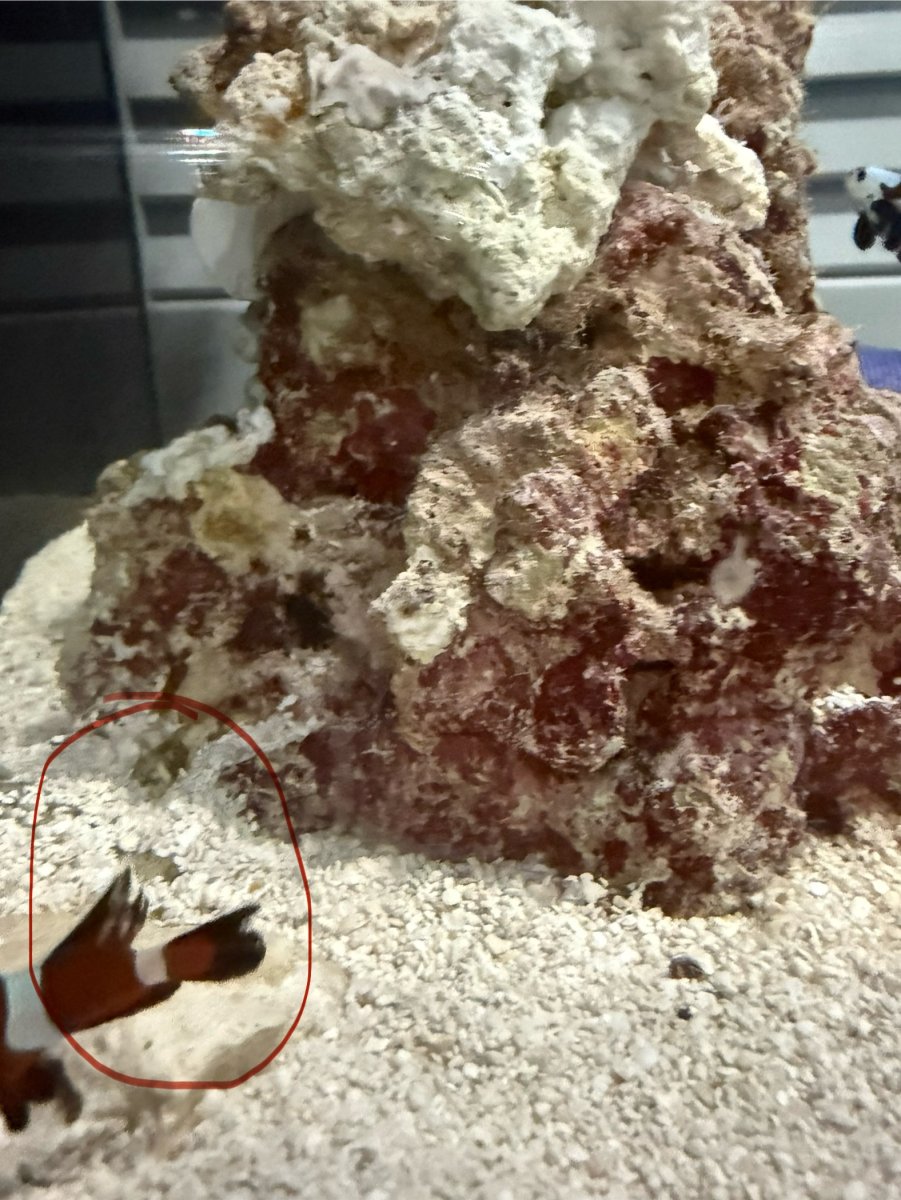
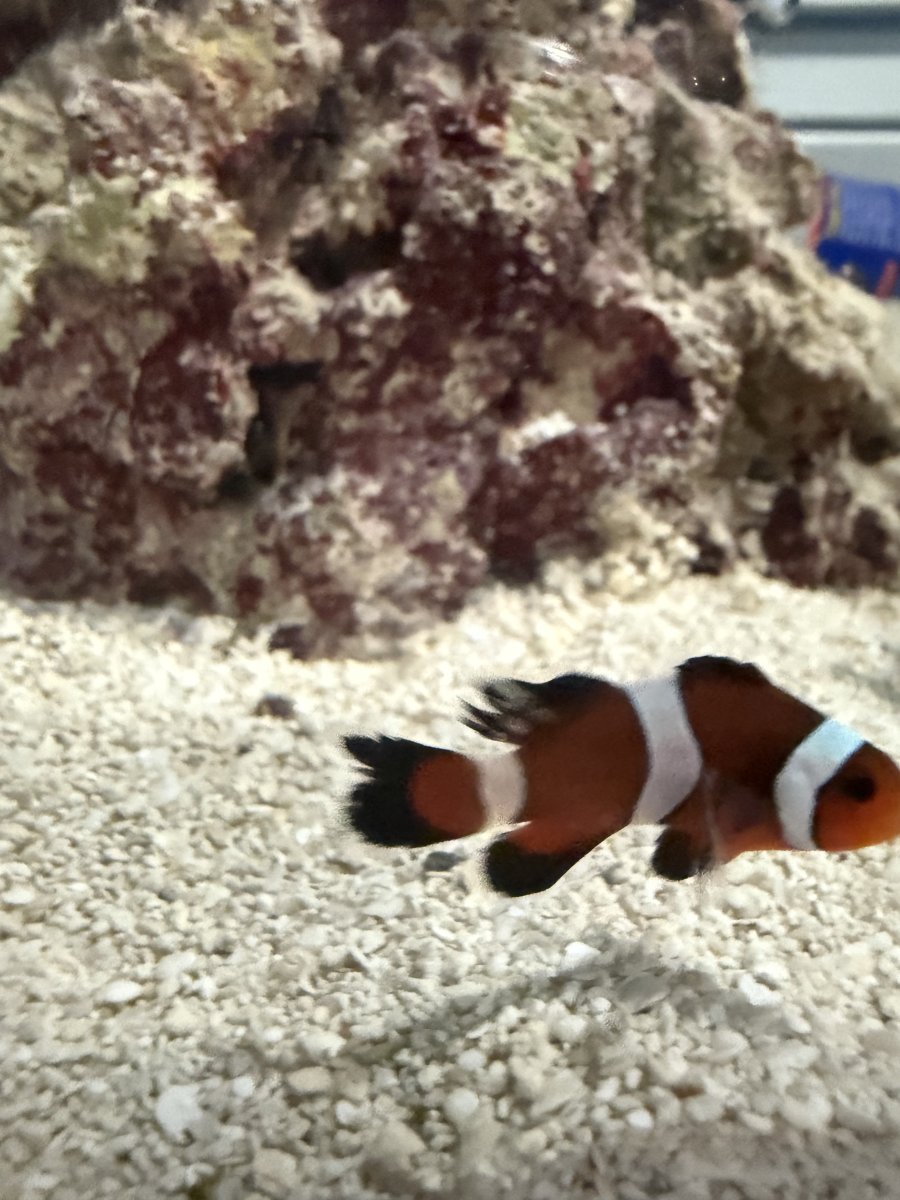
IMG_0583.jpeg

IMG_0584.jpeg
 

Attachments

  • IMG_0565.mov
    32.7 MB
Last edited:
Hello All,

I have recently purchased clowns and everything has been going well enough. When I first got them it was difficult to find anything they would eat, but eventually the storm ate some mysis, and a few days after the mocha ate some roe, and eventually mysis as well as general picking at copepods/amphipods. There was some aggression at feeding with the storm seeming more dominant, but nothing excessive. However I did notice that they like to seclude themselves in recess in the rock, and get into it within that small space quite often.

About a day ago I noticed a small nick on the pelvic fin and some distress on the caudal fin of the mocha ocellaris, and today I saw very large and long cuts (seemingly) on the dorsal fins.


My question is, does this look like something that could happen from rough housing, or is it certainly a sign of disease?

Outside of the clowns, there is a porcelain crab, a hermit crab, a Pom Pom crab, an anemone crab and some snails. There was a small ruby emerald crab hitchhiker that I removed this evening, as well as another relatively large pistol shrimp. It is extremely reclusive, and very fast. When the clowns retreat into the recess they would be in very close proximity to these other animals.


Notes: I didn’t intend for the flash to come on for the video as to irritate the fish, but as the fish quickly showed its fins I just decided to get the clearest view of them. The bottle is a trap with mysis that I need to modify but have not fetched yet.

Any clarifying questions are welcome.

Best


Update: Not even an hour after the video I captured, I checked the tank, and the dorsal fin worsened, there seems to be a piece from the back edge now missing. I was not observing them for that time so I am unsure if a traumatic event happened in that short gap, or if the fin is just deteriorating that quickly…

IMG_0583.jpeg

IMG_0584.jpeg

That is damage from fighting with the other clown. In the video, you can see a subtle sign of aggression where the one clown follows the other. The actual fighting is happening just once in awhile, when you aren’t in the room. You may need to put in a tank divider, let the fins heal, then try mixing them again.

A final note - I can’t say if there isn’t something else going on with the one fish, making it weakened and more prone to being picked on.
 
This is known as clownfish hierarchy and likely from another clown, often a larger clown which are much more dominant than the males. They become greedy and try to eat most of the food that enters the tank (which is one reason the males don't grow as large). They often become aggressive to protect their home which may be an anemone, a nesting area, or the entire tank. If it attacks your hand when you're trying to clean the glass or it won't let any other fish near its zone, you likely have a female clown. Often if you separate the female for a week or two into an acclimation box or sump, there may be a change in her behavior, and you will quickly see the male come out in the open
The mouth will heal on its own but take some time and isolation was the best thing you could do.
 
Thanks Jay Hemdal, vetteguy53081

I have ordered an acclimation box and will add the one that seems to be the aggressor for some time and see if that calms down the tension. Fortunately I haven't seen any more injury over these past two days. The box will be here tomorrow.

I will update after I reintroduce it.
 
@Jay Hemdal @vetteguy53081

Hi, I have a follow up question.

So the day I was preparing to separate them I watched their behavior and noticed the mocha, which is has the damaged fins (getting a bit better now) swimming peacfully, and then suddenly lunging at the storm, and instigating a short conflict.

As far as size, both are very similar sized so its hard for me to tell if one might be a female off apperance alone. They both seem to exhibit similar behaviors. Sometimes the storm is aggressive during feeding, some times the mocha is, sometimes the storm occupies the favorite spot in the tank, and doesn't let the mocha come by, and sometimes the mocha occupies that spot and does the same. Some time the mocha instigates aggresively in the water column, and some times the storm does. I'm not 100% sure if the mocha is the victim, or just got injured while instigating, or possibly, that they both may be acting territorially and the storm for whatever reason has been able to do more harm (I don't see any evidence at all of damage to the storm).

In a situation like this, does it matter which one is put in the box? Should I just choose the one that is the least damaged to go into the box? Are there any other tells I might look out for to get a better idea of which one might be driving this issue?
 
@Jay Hemdal @vetteguy53081

Hi, I have a follow up question.

So the day I was preparing to separate them I watched their behavior and noticed the mocha, which is has the damaged fins (getting a bit better now) swimming peacfully, and then suddenly lunging at the storm, and instigating a short conflict.

As far as size, both are very similar sized so its hard for me to tell if one might be a female off apperance alone. They both seem to exhibit similar behaviors. Sometimes the storm is aggressive during feeding, some times the mocha is, sometimes the storm occupies the favorite spot in the tank, and doesn't let the mocha come by, and sometimes the mocha occupies that spot and does the same. Some time the mocha instigates aggresively in the water column, and some times the storm does. I'm not 100% sure if the mocha is the victim, or just got injured while instigating, or possibly, that they both may be acting territorially and the storm for whatever reason has been able to do more harm (I don't see any evidence at all of damage to the storm).

In a situation like this, does it matter which one is put in the box? Should I just choose the one that is the least damaged to go into the box? Are there any other tells I might look out for to get a better idea of which one might be driving this issue?
Rather than focusing on size, focus on the aggressor. Female is often the larger and reason is the aggressor will hog all the food leaving the other with little to eat , reason they are often smaller. I have 8 clowns and they are all pretty much within the same size range. The one with no damage will be the likely culprit
 
Rather than focusing on size, focus on the aggressor. Female is often the larger and reason is the aggressor will hog all the food leaving the other with little to eat , reason they are often smaller. I have 8 clowns and they are all pretty much within the same size range. The one with no damage will be the likely culprit

They are both almost equally aggressive when I have observed them. Today the injured one was the most aggresive whenever I observed them, occupying the spot they both like and chasing away the other.

Should I just box the uninjured one to be safe?
 
They are both almost equally aggressive when I have observed them. Today the injured one was the most aggresive whenever I observed them, occupying the spot they both like and chasing away the other.

Should I just box the uninjured one to be safe?
The injured one typically but if no other fish bothering it, place aggressor in the box
 

TOP 10 Trending Threads

ARE YOU READY TO CONFESS TO CRAZIEST, DUMBEST, FUNNIEST THING YOU’VE EVER DONE IN REEFING?

  • Yeah, I'll confess! (Share your story in the comments!)

    Votes: 64 56.1%
  • Nah, I'll keep mine a secret...(Don't be like that, share with the class!)

    Votes: 50 43.9%
Back
Top
Home
Post thread…
Market
What's new