Confuse about intensity and spectrum

srpntmage

Community Member
View Badges
Joined
Sep 11, 2014
Messages
50
Reaction score
15
Location
Houston, TX
Rating - 0%
0   0   0
Hi all, maybe someone here can help. I have a 29g Biocube with a kessil 360n and a 55 gallon reefer with an ap700. Both of these tanks have more than enough wattage in lighting that I know I don't need any more. My problem is how much is enough, how much is too much and what color range should I be using.

The Biocube, I have set up to ramp from very blue 10% intensity to about half blue, half white at 50% and then back down. I just set up the reefer with the ap700, so I am still playing with it.I am trying to figure out how high off the water my ap700 needs to be.

Without a par meter, how does one know if they are providing the optimal amount of light? I know you need to watch your corals reaction, but should I keep pushing the light higher over time, or find a spot and leave it alone?

Should I have periods of total or high white spectrum? Should it almost always be mostly blue? I have seen it done both ways.

As far as I can tell, I might be hindering my corals growth by not providing enough light or correct spectrum, even though I have high end lights capable of providing both. Any tips or pointers?

 

saltyfilmfolks

Lights! Camera! Reef!
View Badges
Joined
Feb 25, 2014
Messages
28,739
Reaction score
40,625
Location
California
Rating - 0%
0   0   0
Your opening up a can of worms.
I use a Lux meter. Its $15 for a decent one. it measures intensity. Par conversion factors are available.
Dana Riddle.
The Man.
Google him and advanced aquarist. Its the best way to decide for yourself IMO

http://www.advancedaquarist.com/2007/3/aafeature1
http://www.advancedaquarist.com/2013/2/equipment

I know you need to watch your corals reaction, but should I keep pushing the light higher over time, or find a spot and leave it alone?
Imo Yes. a lux meter will tell you where you are and when and where to stop. Like tracking parameters.

Another good one. If you read in theres a bit of opinion and goes against Mr riddle.
http://www.reeftank123.com/lighting/strohmeyer_article.html

Many lux users say 20,000 lux to 80,000 lux

But there it is for you to decide.
 

reefwiser

LMAS
View Badges
Joined
Nov 24, 2013
Messages
7,539
Reaction score
7,200
Location
Louisville,Kentucky
Rating - 0%
0   0   0
I use to use a LUX meter before Par meters became cheaper. What I found instructive about a Par meter was that I could place the sensor down next to where the coral was placed in the tank. While one can get a high lux value above the water the Par reading for the same lux could be zero at the point of the light reaching the coral depending on the LED fixture that you are using. If you mount your light based on what the manufacturer says will get a certain value of Par based on the optics that the manufacturer has designed into the light. Led lighting is very focused light and it is of one spectrum based on the diodes in your light. You can not tell by your eye what the par of a light is. An corals will only show that they had trouble with the lighting when it is too late and they have been burned. Your best bet is to mount the light at manufacturer's height and then start at at 35 % and over several months ramp you intensity up. If you have a local club that has a Par meter that they can bring to your tank and help you adjust the light on your tank. Or a LFS that does this for you.
 
OP
OP
S

srpntmage

Community Member
View Badges
Joined
Sep 11, 2014
Messages
50
Reaction score
15
Location
Houston, TX
Rating - 0%
0   0   0
Well, Kessil give almost no help online as far as real world mounting heights. For instance for the ap700 they say 5-7" for SPS Dominant and 15-17" for Mixed Reef. That is all they say. Does that mean at 100% intensity? What tank depth? What about rockwork?

I am going to try to borrow a PAR meter and will probably pick up a Lux in the mean time.

Besides intensity, what role does color play? I have heard there should be a period of whiter light, as that promotes growth, but I have also heard too much white increases algae growth. I have heard blue lighting is better for deeper water species, but who knows? I will read the links you posted salty. It seems like pretty much everyone just wings it, and hopes they don't torch their tank or inhibit growth.
 

TD13

Well-Known Member
View Badges
Joined
Mar 29, 2015
Messages
789
Reaction score
386
Location
St. Louis
Rating - 0%
0   0   0
Look to your coral. If they're coloring up, have polyp extension and not bleaching, you're good. All the equipment in the world will not tell you as much as the inhabitants in your tank can, as a species can vary colony by colony. Start low and work your way up with intensity. Blues will typically produce color, and whites growth...
 

saltyfilmfolks

Lights! Camera! Reef!
View Badges
Joined
Feb 25, 2014
Messages
28,739
Reaction score
40,625
Location
California
Rating - 0%
0   0   0
but I have also heard too much white increases algae growth
not white. red yellow orange and blue:)
Because white is not white:confused: and algae control imo is best done buy nutrient control as you are in fact feeding algae with light(zooanthaline that is) and they often like similar light.

read up on dana. by selecting the appropriate spectral frequencies in correct intensities you excite specific the photosynthetic cells producing color or growth or both:)

And Yea most people are just winging it:D

Check out melevs reefs, he has a great par metering walkthrough.
 

Nano sapiens

Valuable Member
View Badges
Joined
Apr 25, 2010
Messages
2,496
Reaction score
3,463
Location
East Bay, CA
Rating - 0%
0   0   0
A PAR meter is helpful since our eyes are very inaccurate in determining true intensity, but it will only tell you the intensity of ALL wavelengths present between 400 - 700nm ('visible' light). The lower priced ones, such as Apoggee, will under report the violet-blue spectrum, so for a typical 'complete spectrum' light source people generally add around +10 - 15% to the reading (more violet/blue, higher the percentage added).

From the coral's perspective, PUR (photosynthetically usable radiation) is by far the most important. A spectometer can give you this, but good ones are quite costly. Even if a typical hobbyist might not be able to measure it, it's important to understand which wavelengths produce the most PUR since a tank can have relatively low PAR, but if the lighting produces lots of PUR, the corals can bleach.

If you read through and absorb all this info you'll soon be a reef tank lighting master :)

http://www.advancedaquarist.com/2012/10/aafeature
 

mcarroll

10K Club member
View Badges
Joined
Jan 8, 2012
Messages
15,213
Reaction score
8,968
Location
Virginia
Rating - 0%
0   0   0
Hi all, maybe someone here can help. I have a 29g Biocube with a kessil 360n and a 55 gallon reefer with an ap700. Both of these tanks have more than enough wattage in lighting that I know I don't need any more. My problem is how much is enough, how much is too much and what color range should I be using.

The Biocube, I have set up to ramp from very blue 10% intensity to about half blue, half white at 50% and then back down. I just set up the reefer with the ap700, so I am still playing with it.I am trying to figure out how high off the water my ap700 needs to be.

Without a par meter, how does one know if they are providing the optimal amount of light? I know you need to watch your corals reaction, but should I keep pushing the light higher over time, or find a spot and leave it alone?

Should I have periods of total or high white spectrum? Should it almost always be mostly blue? I have seen it done both ways.

As far as I can tell, I might be hindering my corals growth by not providing enough light or correct spectrum, even though I have high end lights capable of providing both. Any tips or pointers?

It Can Be A Simple:
  • Do not trust your eyes.
  • Do get an electronic meter of some kind
    • Lux meters can be free (apps) or cheap ($15 from most online outlets). Cheap is more recommended. :)
    • A PAR meter is not significantly better than a lux meter for this purpose.
    • You can use a PAR meter if you want, but if it is too expensive, get a lux meter.
Intensity
  • Direct sunlight at sea level is about 100,000 lux (or 2000 PAR).
  • Corals - even SPS - will be happy in 20,000-80,000 lux from reef lights.
  • 40,000-50,000 lux is a great target range.
  • Start at around 20,000 if you're acclimating corals to LED for the first time.
Spectrum:
Given good quality food and water, corals are pretty happy with blue light and a simple on/off timer to provide 6 to 8 hours of light.

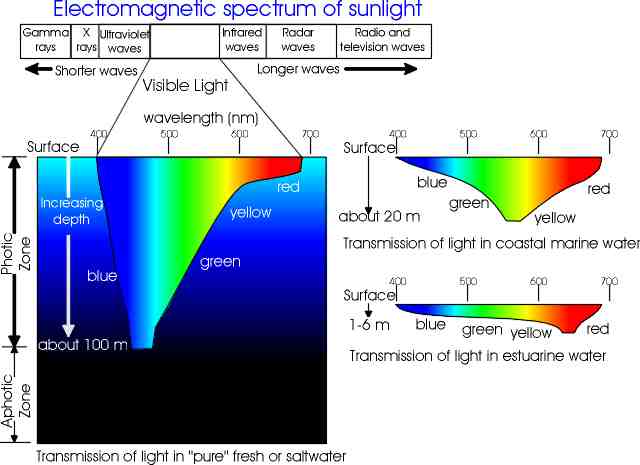
You can see in the graphic below that there is very little but bluish light (or bluish and greenish) through much of the home range of depths for our corals.

Blue is their natural (perhaps preferred....but that's difficult to gauge) medium:

electrospectruminwater.jpg

(I like that the graphic shows the vastly different curves that coastal and estuarial environments generate - not where most of the fancy SPS come from. But many other corals do. Worth noting.)

Beyond this, to an extent you are obsessing over aesthetics for yourself as much as anything and the whole matter can get just about as complicated as you want. :) Just letting that be said. ;) ;) Are we not all obsessing about something???

Anyway, for what it's worth...
  • One of my tanks has a simple on/off DIY fixture at 20,000 lux
  • The other tank has a sunrise/sunset ramping light (Razor) that I have set to peak for a few hours around midday at 40,000 lux.
  • The one that ramps comes up in the morning with whites and goes down at night with blues.
 
OP
OP
S

srpntmage

Community Member
View Badges
Joined
Sep 11, 2014
Messages
50
Reaction score
15
Location
Houston, TX
Rating - 0%
0   0   0
Maybe a stupid question, but how do you measure lux in your tank underwater? I'm assuming you measure by distance while the light isn't over the tank, but doesn't water diffuse light?
 

mcarroll

10K Club member
View Badges
Joined
Jan 8, 2012
Messages
15,213
Reaction score
8,968
Location
Virginia
Rating - 0%
0   0   0
It does, but make it easy on yourself and focus on measuring at the water surface.

If you're projecting something in the wide acceptable range around 50,000 lux, you can rest assured that the corals in that light will be happy.
 

dacianb

Active Member
View Badges
Joined
Jul 4, 2014
Messages
364
Reaction score
188
Location
Belgium
Rating - 0%
0   0   0
I dont think is that simple...

Lux is a measuring method for light as perceived by human eye and not related to real power of a light source. From 450 nm range, human eye can see approx 5%, on violets even lower. Your lux measurements will be close to nothing in this range, but easily can burn to death all your corals. On white leds, luxmeters will measure the green-yellow range as most powerfull, but again will miss the 450nm range.
Put only green leds on your fixture, will have a huge LUX reading, but no PUR at all. Put only 450 nm leds, will have close to no LUX readings, but huge PUR value.

Sun, as spectrum is completely different by what a led fixture offers - so extending the 50 000 Lux is very dangerous and not a way to do it.

I am working on a method to evaluate this by:
1. considering the sun spectrum and a value of 50-75 k lux
2. Identify within this spectrum the radiometric power of each wavelength
3. knowing the transmission factors within seawater and depths of different corals
4. knowing spectral emission of each type of led

then is easy to tune my lights to correct, natural levels :)

Any measurement method Par, pur, lux or whatever you imagine have a single one and common base - spectral radiometry. This is the basic brick of any optical measurements. Anything else is a way to interpret such data and correlate it to something. Cutting out the edges of a spectral radiometry measurements and integrate the 400-700 nm range = PAR. Integrate the 400-500nm range of same measurement = PUR.
Extract from it the Vlambda curve as defined by CIE (human eye sensitivity curve) = Lux, candelas etc

This is how spectrum of solar light looks at tropical sea levels at noon
spectrum sun.jpg

This is spectrum of a typical LED reef light

spectrum.jpg

This curve is the human eye sensitivity (curve on which Lux values are measured). As you can see, on a reef light you have almost no green-yellow to measure comparing with blue. On sun spectrum is much flatter.
Vlambda.jpg
 
Last edited:

dacianb

Active Member
View Badges
Joined
Jul 4, 2014
Messages
364
Reaction score
188
Location
Belgium
Rating - 0%
0   0   0
By the way, there is a website oceanopticsbook.info dedicated to matematically modeling of light / water interaction.... this is huge :eek:
 

saltyfilmfolks

Lights! Camera! Reef!
View Badges
Joined
Feb 25, 2014
Messages
28,739
Reaction score
40,625
Location
California
Rating - 0%
0   0   0
I dont think is that simple...

Lux is a measuring method for light as perceived by human eye and not related to real power of a light source. From 450 nm range, human eye can see approx 5%, on violets even lower. Your lux measurements will be close to nothing in this range, but easily can burn to death all your corals. On white leds, luxmeters will measure the green-yellow range as most powerfull, but again will miss the 450nm range.
Put only green leds on your fixture, will have a huge LUX reading, but no PUR at all. Put only 450 nm leds, will have close to no LUX readings, but huge PUR value.

Sun, as spectrum is completely different by what a led fixture offers - so extending the 50 000 Lux is very dangerous and not a way to do it.

I am working on a method to evaluate this by:
1. considering the sun spectrum and a value of 50-75 k lux
2. Identify within this spectrum the radiometric power of each wavelength
3. knowing the transmission factors within seawater and depths of different corals
4. knowing spectral emission of each type of led

then is easy to tune my lights to correct, natural levels :)

Any measurement method Par, pur, lux or whatever you imagine have a single one and common base - spectral radiometry. This is the basic brick of any optical measurements. Anything else is a way to interpret such data and correlate it to something. Cutting out the edges of a spectral radiometry measurements and integrate the 400-700 nm range = PAR. Integrate the 400-500nm range of same measurement = PUR.
Extract from it the Vlambda curve as defined by CIE (human eye sensitivity curve) = Lux, candelas etc

This is how spectrum of solar light looks at tropical sea levels at noon
spectrum sun.jpg

This is spectrum of a typical LED reef light

spectrum.jpg

This curve is the human eye sensitivity (curve on which Lux values are measured). As you can see, on a reef light you have almost no green-yellow to measure comparing with blue. On sun spectrum is much flatter.
Vlambda.jpg
How do you personally measure the intensity of light? what meter and/or what standard of measurement.
 
Last edited:

dacianb

Active Member
View Badges
Joined
Jul 4, 2014
Messages
364
Reaction score
188
Location
Belgium
Rating - 0%
0   0   0
Personally I use radiometric power of LEDs and Excel calculation. I dont need any measurements, as I can build theoretical models of leds quite accurate. Normally I have an error rate <1% between models and real measurements.
My biggest concern is to find out what corals really need - then I can make a rather simple tool which can be applied to other lights too.
In optics, it is not uncommon that different engineers to argue about methods and standards of measurements. But, in the end, as unique way, we all go back to the roots - radiometric power. Since almost 20 years such measurements are methods are my daily job routine.
 

saltyfilmfolks

Lights! Camera! Reef!
View Badges
Joined
Feb 25, 2014
Messages
28,739
Reaction score
40,625
Location
California
Rating - 0%
0   0   0
So you don't put a meter on your tank.
This is spectrum of a typical LED reef light
I think we should agree as we all have more access to the information that this is actually bad for many corals.
Because it doesnt look like this.
electrospectruminwater.jpg

Many of our corals come from much shallower waters than the typical provides and manufacturers(some) are noticing and adding the other appropriate colors.
In a side by side test done by Dana R the greatest growth success was from using this spectrum
spectral map.jpg

Sun, as spectrum is completely different by what a led fixture offers
Youll have to explain that one. I thought the point was to replicate natural sources.
And many don't understand that the preference for blue in photosynthesis has evolved because of the color of the sky


Ive spent 25 years in the field reading with meters lux fc color etc etc etc etc etc...and also under controlled conditions doing the same. And Ive spoken to the manufacturers and engineers who made the lights and tweak spectral responses and emission as well as intensity. Once I began in this hobby I mainly focused on Dana Riddles work as few others are as well published and compared them to other published articles by researches AND very importantly advanced users of those light sources. And their math and mine always worked. I never lost step with them, and never got lost. in the end we metered with a device using a photocell.

I understand extremely well how a par meter works. If you do as well I would put forward that there is a correction factor that needs to be used for reading the high 450nm range with a hand held lux meter. (as we both know thats the first thing a par meter does using optics and filters.).
I would assume you would be able to calculate that correction factor rather quickly. 10%, 30% 60%?
That actually does make it rather simple, and is likely 100% Correct. Id wager the percentage is also negligible as well.

You'll forgive my scepticisim of the ideology you put forward. I have been through the "new" and "totally different" more times than I care to mention. Once I spoke to actual scientists and engineers behind those New & different things. It came down to this. Its science and it was built on the science we already use and is not new.
The Ideology presented (done in many fields BTW) usually leaves the end user with no answer at all to understand what the process is. We all now understand fire, engines, electricity, computers and reef chemistry.
Why is light different.

The methodology and ideology that @mcarroll and I put forward and so highly encourage for use in the real world is to meter the light you have.
The only drawback to that, as you point out, is that a lux meter does not respond to blue wavelengths well. I agree. We are missing the correction factor. So what is it? I will tell everyone who will listen and even put it under my signature here.
If you say there isnt one. You have lost the argument. Sorry.

We make a lot of mistakes in the hobby mostly due fashion, trends and manufacturer advertising.(americans love to rip each other off)
Supplying the correct spectrum to a coral is great, but if you are doing it from a tiny single point light so only the top of the coral gets light, why did you spend so much time researching spectrum so you now only use the top half of it. . Look at all the lighting guides on MH use. the reflector was not there just to increase the light on the subject, but to get spread over the entire coral. We now commonly ignore that.
Most people would be surprised to know the best way to improve you PAR is to get rid of the black background and use blue(yes thats why they did it not aesthetics) or white(gotta choose that white carefully of course :) )
And corals come from much shallower waters than the "typical" led provides but it looks cool. And many in the hobby do understand this.

spectral map.jpg
 

mcarroll

10K Club member
View Badges
Joined
Jan 8, 2012
Messages
15,213
Reaction score
8,968
Location
Virginia
Rating - 0%
0   0   0
About one of the best things about lux meters is that they are cheap enough to possibly attain widespread use....finally allowing people to compare actual lighting setups routinely like we compare pH and calcium readings today.

And as noted the correction factor for converting to PAR is simple. Dana Riddle (and possibly others) has published a short list of conversion factors for some common light sources.

It is also worth repeating that lux, even as "inaccurate" as it is, is perfectly adequate for our purpose here and is tons more accurate and repeatable than "eyeball readings". PAR meters are nice, but don't let the price of one prevent you from using a meter at all. Get a lux meter, even if it's only one of the free lux meter apps.

@saltyfilmfolks you have a link to the Riddle article where that "ideal curve" came from?
 

saltyfilmfolks

Lights! Camera! Reef!
View Badges
Joined
Feb 25, 2014
Messages
28,739
Reaction score
40,625
Location
California
Rating - 0%
0   0   0
http://www.advancedaquarist.com/2015/4/corals
so you know, it's not an Ideal curve, it the curve of the LED array custom built for the test. It does not say if it was designed by him or the manufacturer @ buildmyled.com
it did give the best growth by weight in grams over the other sources as youll see.
 

mcarroll

10K Club member
View Badges
Joined
Jan 8, 2012
Messages
15,213
Reaction score
8,968
Location
Virginia
Rating - 0%
0   0   0
Sorry, misunderstood...somehow I thought that graph was from a different/other article. ;)

That light had more growth literally, but it wasn't statistically more growth than any of the other lights...

There was only a .25 gram difference between the worst growth and the best, for example.

All in all, it was a very scientific way of saying "folks at home won't notice a difference in growth". ;)
 

TOP 10 Trending Threads

WHAT AMOUNT OF LIVE ROCK AND SAND SHOULD BE PRIORITIZED FOR OPTIMAL BIODIVERSITY/FILTRATION?

  • 100% live rock + bagged sand

    Votes: 37 27.8%
  • 100% dry rock + 100% live sand

    Votes: 45 33.8%
  • 50/50 live/dry rock, 50/50 live/bagged sand

    Votes: 29 21.8%
  • 75% live rock, 25% live sand

    Votes: 12 9.0%
  • 25% live rock, 75% live sand

    Votes: 10 7.5%
Back
Top