



Coral Coloration & Trace Element Experiment

OP
OP
taricha

taricha

5000 Club Member
View Badges
Joined
May 22, 2016
Messages
7,223
Reaction score
10,586
Rating - 0%
0   0   0
Let's go a little deeper on coral color and how the fluorescent pigments I'm measuring relate to the appearance of these corals.

I'll go from the easiest to measure to the messiest.
First, Sarcophyton. This pigment is a booming yellow-green. Top is under normal tank lighting, and bottom is under royal blue ~450nm LED shot through a 90% yellow filter.
20241114_085426-COLLAGE.jpg


And here's what that pigment profile looks spectrally. The Blue data is using a fiber optic cable placed at the coral to measure the light "in situ" from the coral surface when lit by ~450nm royal blue. And the Red data is from my pigment extraction in water showing that the fluorescent peaks I'm measuring in the extract are indeed the important optical pigments to the color of the coral in a tank setting. (In all these charts, the vertical scales are unimportant, and data is just scaled for ease of visual comparison. )
Sarco_spectrum.png

The ~451nm peak is the reflected LED light, the 502nm peak is the dominant GFP, and chlorophyll peak is detectable around 675-680nm (chlorophyll shifts a bit when you extract it).

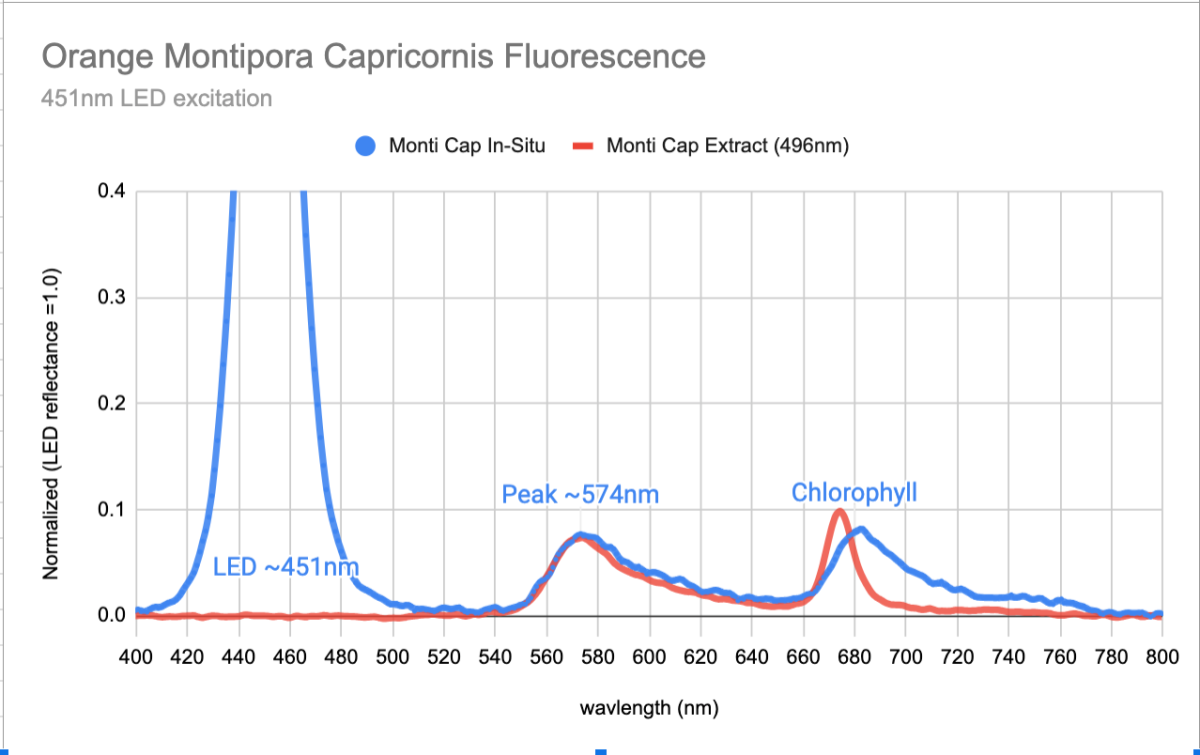
Here's the orange monti cap under normal tank lighting and ~450nm LED photographed with the yellow filter
20241114_085809-COLLAGE.jpg

Note how significant the pigment variation is from one spot to the next on these corals.


and here's the spectral view....
MontiCap_spectrum.png
The bright orange pigment has a fluorescent peak around 574nm, and it's likely the chlorophyll fluorescent contributes to the overall red/orange look.

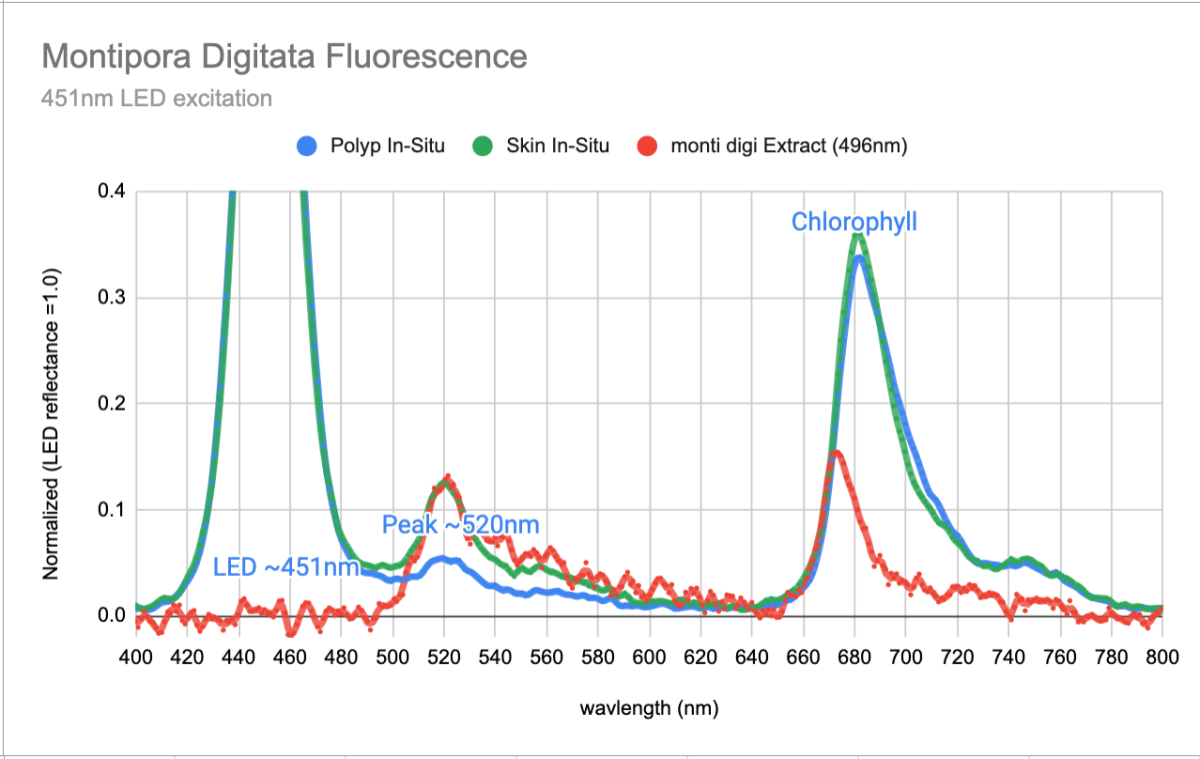
Next best-measured is monti digitata. There's a little bit more going on here. This coral is supposed to have green skin and red polyps. And although my coral is lacking almost all of that color pattern, under the royal blues with the yellow filter, you can see a patch or two where the skin is a bright green compared to the yellower color of the polyps.
20241114_090350-COLLAGE.jpg


Looking at the coral spectrally, the answer is a bit different. The blue data is collected over polyps where there's no green skin. The Green data was collected right over a patch of green skin (but polyp light is present there too.)
MontiDigi_spectrum.png

What you see from the green and blue spectral data lines is that the polyp and skin have the same GFP with a peak at 520nm - but the polyps have less of it and mixed with a lot of chlorophyll red fluorescence, while the skin would have more GFP and much less chlorophyll red.
The red data showing what's measured in the extract also shows the same GFP (and Chlorophyll.)
Also notice that the data from the extract is getting noisier compared to the first two corals - the detected fluorescence is getting smaller and harder to well-quantify.

The last two corals' GFPs are very noisy and hard to quantify due to low amounts of detected fluorescence.
This is the sinularia I got to replace an extremely bright gorgeous one. This one is has been dull with barely any detected fluorescence. Bottom pic shows the GFP isolated in the royal blue + yellow filter picture.
20241114_090716-COLLAGE.jpg


Here's the coral spectrally. The GFP is so close to the LED, what's shown is the overall measurement (yellow line), the LED by itself (black line), and then the subtraction to mathematically isolate the GFP (blue line).
Sinu_spectrum.png


The subtracted spectra shows that the fluorescent protein in this coral is around 480nm which sometimes gets categorized as a cyan fluorescent protein. The red data from the extract shows that I'm measuring the same fluorescent protein, just with a lot of noise due to a combined difficulty of exciting it and the low amounts of fluorescent protein.

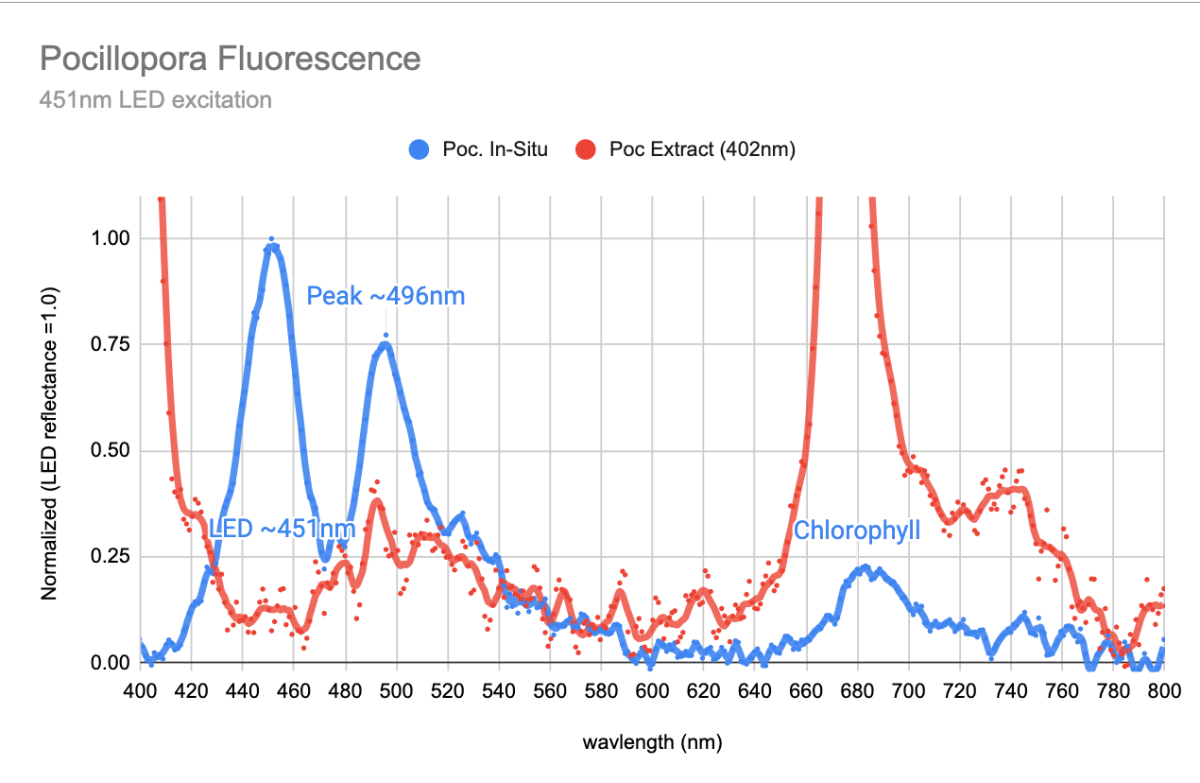
And finally, poccilopora. This is another specimen that shows how strong the variation is in the amounts of fluorescent protein from one part of the coral to another. The GFP is localized not just to the polyps but to the very tip of each polyp tentacle.
20241114_091115-COLLAGE.jpg


And spectrally, you can see that the fluorescent peak around ~496nm is extremely difficult to measure in the extract (red data).
Poci_spectrum.png


The good news is that if one of the experimental interventions causes this coral to grow a lot of green, then the effect will be very noticeable.
 
Last edited:

Randy Holmes-Farley

Reef Chemist
View Badges
Joined
Sep 5, 2014
Messages
89,265
Reaction score
92,319
Location
Massachusetts, United States
Rating - 0%
0   0   0
Nice baseline. :)

I'm curious about how apparent the most fluorescent signal here (the sarcophyton) is under white lighting. For example, is the polyp color you see under white light in your picture strongly dependent on fluorescence?

I. e., how it looks to you under white light with and without the deep blue end of lighting?
 
OP
OP
taricha

taricha

5000 Club Member
View Badges
Joined
May 22, 2016
Messages
7,223
Reaction score
10,586
Rating - 0%
0   0   0
Nice baseline. :)

I'm curious about how apparent the most fluorescent signal here (the sarcophyton) is under white lighting. For example, is the polyp color you see under white light in your picture strongly dependent on fluorescence?

I. e., how it looks to you under white light with and without the deep blue end of lighting?
If you look at the chart for the sarcophyton, you'll notice that the Green emission is actually higher than the reflected blue light of the blue LED that drives it. It's not a measurement artifact, that sort of result has been repeatable in a few different ways of looking at this coral pigment. I had to think about if that was even possible. It is. In this context it means that it captures, converts, and releases more green photons than blue photons that bounce off. It might be converting over 50% of incoming blue photons to green ones, which is pretty insanely efficient (maybe - can't say what fraction is simply absorbed, but it's a pretty pale tissue overall).
So any "white" light will have enough blue in it for the fluorescent pigment to be a big effect on the color.
Here's what it looks like under sunlight +blues (top) and sunlight without blues (bottom)
20241115_130044-COLLAGE.jpg
 
OP
OP
taricha

taricha

5000 Club Member
View Badges
Joined
May 22, 2016
Messages
7,223
Reaction score
10,586
Rating - 0%
0   0   0
Let's talk a little bit about what was done in Phase 1, and then I'll share the Phase 1 results for things that were measured in a subsequent post.
Phase 1: The algal feeding phase, I added enough daily phytofeast to be the recommended amount - it turns the water detectably green. It contains at least one strain - synechococcus - that is actually known to be ingested by hard corals commonly in the wild. The red algae is palmaria palmata and is munched by my foxface and urchins. The red algae has replaced 25% of the food protein input. The idea is that perhaps these algal sources are a good choice for traces as they are guaranteed to provide trace elements in biologically relevant amounts and if algal cells are directly ingested by corals, that might be superior to water trace dosing.
As above, I used phytofeast and for the Red algae I ended up using a mix of Two Little Fishies "red Sea veggies" (palmaria palmata) and omega one "Red Nori" (no species info).
The red algae is eaten by a fish, urchins, and some hermits - so remineralization and release of traces will depend to some extent on what is released (or not fully digested) by the animals. The phyto is a bit more interesting because it could be eaten directly by corals, and thus provide nutrients/traces directly to the target organism and bypass the water. The phytofeast also contains a little alginate as a thickener and 3 different organic acids as preservatives, so it has some carbon dose potential for growing bacteria that some corals may eat, or maybe not.
To me personally, this has a chance to be the most humorous result - if the phyto meets the coral nutritional/trace needs and increases coral color while leaving the trace elements in the water still undetectable/"depleted" on ICP-OES/MS. From a tank management perspective - it would be the opposite of the highly involved testing and dosing of a large number of elements - instead of testable water chemistry ... "just add some phyto".

Here's a very (very) rough analysis of what some element additions might look like from these Algal additions.
The last two columns are how much ppb per week is being added from the algae, and how much ppb was measured in my aquarium water (ICP-MS).
This is from a paper published on palmaria palmata element profile, and values are assumed to be inaccurate - they are merely here for a sense of the scale of these inputs.

RedAlgae_input.png

The color coding in the last column reflects recommended targets for the elements. Red = too much in the water, Blue = not enough, Green = fine, yellow = recommendations from different sources disagree.

And here's the same table done for phytofeast, using published element profile of nannochloropsis - one of the ingredients as a representative for the rest of the microalgae in the product.

Phyto_input.png


The amounts don't look very impressive, if one is trying to meet trace deficiencies in these elements. It's not going to meet the needs for Iodine, or Mn - the two elements in this list that are actually agreed as too low in my water.
They might meet needs for Fe and Zn, but probably not much else. (Cu too, but mine's already high)
The more interesting angle is that these values are divided by tank water volume, but if phyto is ingested by corals directly rather than uptake from the water, then it might be delivering these elements in much more beneficial concentrations to the corals.

So that's the logic behind phase 1. But of course it may not work at all :) . Results in a subsequent post.
 

Dan_P

7500 Club Member
View Badges
Joined
Sep 21, 2018
Messages
9,785
Reaction score
9,639
Rating - 0%
0   0   0
Let's talk a little bit about what was done in Phase 1, and then I'll share the Phase 1 results for things that were measured in a subsequent post.

As above, I used phytofeast and for the Red algae I ended up using a mix of Two Little Fishies "red Sea veggies" (palmaria palmata) and omega one "Red Nori" (no species info).
The red algae is eaten by a fish, urchins, and some hermits - so remineralization and release of traces will depend to some extent on what is released (or not fully digested) by the animals. The phyto is a bit more interesting because it could be eaten directly by corals, and thus provide nutrients/traces directly to the target organism and bypass the water. The phytofeast also contains a little alginate as a thickener and 3 different organic acids as preservatives, so it has some carbon dose potential for growing bacteria that some corals may eat, or maybe not.
To me personally, this has a chance to be the most humorous result - if the phyto meets the coral nutritional/trace needs and increases coral color while leaving the trace elements in the water still undetectable/"depleted" on ICP-OES/MS. From a tank management perspective - it would be the opposite of the highly involved testing and dosing of a large number of elements - instead of testable water chemistry ... "just add some phyto".

Here's a very (very) rough analysis of what some element additions might look like from these Algal additions.
The last two columns are how much ppb per week is being added from the algae, and how much ppb was measured in my aquarium water (ICP-MS).
This is from a paper published on palmaria palmata element profile, and values are assumed to be inaccurate - they are merely here for a sense of the scale of these inputs.

RedAlgae_input.png

The color coding in the last column reflects recommended targets for the elements. Red = too much in the water, Blue = not enough, Green = fine, yellow = recommendations from different sources disagree.

And here's the same table done for phytofeast, using published element profile of nannochloropsis - one of the ingredients as a representative for the rest of the microalgae in the product.

Phyto_input.png


The amounts don't look very impressive, if one is trying to meet trace deficiencies in these elements. It's not going to meet the needs for Iodine, or Mn - the two elements in this list that are actually agreed as too low in my water.
They might meet needs for Fe and Zn, but probably not much else. (Cu too, but mine's already high)
The more interesting angle is that these values are divided by tank water volume, but if phyto is ingested by corals directly rather than uptake from the water, then it might be delivering these elements in much more beneficial concentrations to the corals.

So that's the logic behind phase 1. But of course it may not work at all :) . Results in a subsequent post.
Am I right in assuming that we should add the two columns of weekly added trace elements and compare to the pre-phase one ICP?

Will there be an ICP-MS of the water after weeks of dosing algae?
 
OP
OP
taricha

taricha

5000 Club Member
View Badges
Joined
May 22, 2016
Messages
7,223
Reaction score
10,586
Rating - 0%
0   0   0
Am I right in assuming that we should add the two columns of weekly added trace elements and compare to the pre-phase one ICP?
Sure. That would represent a plausible total amount of traces added per week on a ug/L basis. How much of that is available for any particular organism to use is anyone's guess.

Will there be an ICP-MS of the water after weeks of dosing algae?
You betcha.
 
OP
OP
taricha

taricha

5000 Club Member
View Badges
Joined
May 22, 2016
Messages
7,223
Reaction score
10,586
Rating - 0%
0   0   0
Let's talk a little bit about what was done in Phase 1, and then I'll share the Phase 1 results for things that were measured in a subsequent post.
Ok, here's the Chemical and Coral color data from after Phase 1: 6 weeks of Algal Input (Red Algae and Phytofeast)

Chemical parameters
Phase 0 is before and phase 1 data is after... very little changed.
Phase1_ICP_p1.png


page 2
Phase1_ICP_p2.png


So, not much change.
My Mg and Ca balance was a little off (due to kalk only) when I measured it for the beginning, Phase 0, so I adjusted them slightly. The PO4 rose from input of the Red Algae and PhytoFeast (but NO3 remained steady)

Vanadium probably rose slightly (no V data on the algae sources). The ICP-MS is likely good enough on V to distinguish 1 vs 2 ppb.
The data for the Algae sources in post 25 suggested that Fe and Zn might be significant inputs, but neither accumulated in the water. Not surprising since they are also expected to be consumed or otherwise depleted in the system.

Other elements of interest:
Cu remains clearly high, F, Iodine and Mn remain low. Mn might be within uncertainty of zero even for ICP-MS (which is good at Mn).

Most of the elements color coded teal (included in Red Sea Trace C - light transition metals) are present and unchanged. Whether they should be supplemented or not given these levels varies from one source to another. But we'll look at that in Phase 3.

Coral Color Observations
Here are the photographic comparisons under the same lighting and camera settings "pro mode" 7500K temp before and after Phase 1.

Sinularia and Sarcophyton - no visual differences in color in before vs after the 6-week-long Phase 1.
Sinu_Sarco_phs1.jpg


Here's Monti cap and pocillopora - again, to the eyeball there is no detectable difference in coloration before vs after Phase 1.
Poci_MCap_phs1.jpg


And finally here's the Monti digi. This is the only coral that looks to the eye to have noticeably increased coloration.
MDigi_phs1.jpg

After phase 1, the polyps have a slightly increased green coloration. Before phase 1 you could not see any green on the brown polyps at all. After, it is slight but noticeable.


Pigment extraction data

Here's the fluorescence when illuminated by 402nm violet light. Points are individual cuttings, lines are averages of the two cuttings for most corals.
CrlFlr402nm_phs1.png

The error bars represent noise vs signal in the measurement process itself (not the sample to sample variation). With weak fluorescence, note that some of the initial values are nearly within uncertainty of zero.
Sinularia GFP seems to have likely doubled at least, but the other corals could be unchanged - or doubled too, uncertainty is large enough we can't really say.

Here's the fluorescence illuminated by 496nm cyan light
CrlFlr496nm_phs1.png

Note that the error bars are smaller compared to the much stronger fluorescent signal, but replicate samples from same coral are far apart. This reflects the reality that fluorescent pigment is highly localized on a coral, one piece of a growth tip on a coral may have half or double the fluorescent pigment of another similarly situated growth tip.

Here's the Chlorophyll A fluorescence illuminated by 402nm light - a measure of symbiont pigment.
CrlChlA402nm_phs1.png

Note again, that the variation from one cutting to the next on the same coral can be quite large, and it's hard to say how much of the trend in any particular coral is piece to piece variation and how much is a real increase in symbiont pigment. The overall trend across all corals sampled is an increase (+70% average of all sample), and so it seems statistically likely that some or most corals actually increased symbiont pigment.

Other Tank observations:
During the Phase 1 feeding of Red Algae and Phytofeast, there was an increase in colorless fluffy material on rock surfaces, suggesting possible increase in bacteria / biofilms due to the food input change most likely from the phytofeast microalgae or included carbon sources. (This fluffiness dissipated after Phase 1 ended).

Commentary on Phase 1:
One thing the data in this phase illustrates is the wiggle room for changes on one measure that go undetected on others: a 70% increase in symbiont pigment and possibly greater than doubling of sinularia GFP are not evident in photographs or visual observation. And visual observation of a slight increase in green on a brown Monti digi is not obvious in pigment extraction data. My hope from the beginning has been that one or multiple of the interventions create really obvious effects, because they will need to be that obvious to overcome the measurement difficulties.
I think that taken in full, the data on the Algal Feeding phase suggests that there isn't evidence either from chemical measurements of the water, or photographic and visual monitoring, or pigment extraction to say that there was any large enough effect on coral nutrition to result in significant color change. I do think the pigments of one or two corals increased somewhat: sinularia (by extraction data) and monti digi (by photo / visual), and I think that the symbiont pigment probably increased across the corals in general, perhaps the 50% increase in PO4 played a role.

On to Phase 2: "water changes fix everything"....
 
Last edited:

Dan_P

7500 Club Member
View Badges
Joined
Sep 21, 2018
Messages
9,785
Reaction score
9,639
Rating - 0%
0   0   0
Ok, here's the Chemical and Coral color data from after Phase 1: 6 weeks of Algal Input (Red Algae and Phytofeast)

Chemical parameters
Phase 0 is before and phase 1 data is after... very little changed.
Phase1_ICP_p1.png


page 2
Phase1_ICP_p2.png


So, not much change.
My Mg and Ca balance was a little off (due to kalk only) when I measured it for the beginning, Phase 0, so I adjusted them slightly. The PO4 rose from input of the Red Algae and PhytoFeast (but NO3 remained steady)

Vanadium probably rose slightly (no V data on the algae sources). The ICP-MS is likely good enough on V to distinguish 1 vs 2 ppb.
The data for the Algae sources in post 25 suggested that Fe and Zn might be significant inputs, but neither accumulated in the water. Not surprising since they are also expected to be consumed or otherwise depleted in the system.

Other elements of interest:
Cu remains clearly high, F, Iodine and Mn remain low. Mn might be within uncertainty of zero even for ICP-MS (which is good at Mn).

Most of the elements color coded teal (included in Red Sea Trace C - light transition metals) are present and unchanged. Whether they should be supplemented or not given these levels varies from one source to another. But we'll look at that in Phase 3.

Coral Color Observations
Here are the photographic comparisons under the same lighting and camera settings "pro mode" 7500K temp before and after Phase 1.

Sinularia and Sarcophyton - no visual differences in color in before vs after the 6-week-long Phase 1.
Sinu_Sarco_phs1.jpg


Here's Monti cap and pocillopora - again, to the eyeball there is no detectable difference in coloration before vs after Phase 1.
Poci_MCap_phs1.jpg


And finally here's the Monti digi. This is the only coral that looks to the eye to have noticeably increased coloration.
MDigi_phs1.jpg

After phase 1, the polyps have a slightly increased green coloration. Before phase 1 you could not see any green on the brown polyps at all. After, it is slight but noticeable.


Pigment extraction data

Here's the fluorescence when illuminated by 402nm violet light. Points are individual cuttings, lines are averages of the two cuttings for most corals.
CrlFlr402nm_phs1.png

The error bars represent noise vs signal in the measurement process itself (not the sample to sample variation). With weak fluorescence, note that some of the initial values are nearly within uncertainty of zero.
Sinularia GFP seems to have likely doubled at least, but the other corals could be unchanged - or doubled too, uncertainty is large enough we can't really say.

Here's the fluorescence illuminated by 496nm cyan light
CrlFlr496nm_phs1.png

Note that the error bars are smaller compared to the much stronger fluorescent signal, but replicate samples from same coral are far apart. This reflects the reality that fluorescent pigment is highly localized on a coral, one piece of a growth tip on a coral may have half or double the fluorescent pigment of another similarly situated growth tip.

Here's the Chlorophyll A fluorescence illuminated by 402nm light - a measure of symbiont pigment.
CrlChlA402nm_phs1.png

Note again, that the variation from one cutting to the next on the same coral can be quite large, and it's hard to say how much of the trend in any particular coral is piece to piece variation and how much is a real increase in symbiont pigment. The overall trend across all corals sampled is an increase (+70% average of all sample), and so it seems statistically likely that some or most corals actually increased symbiont pigment.

Other Tank observations:
During the Phase 1 feeding of Red Algae and Phytofeast, there was an increase in colorless fluffy material on rock surfaces, suggesting possible increase in bacteria / biofilms due to the food input change most likely from the phytofeast microalgae or included carbon sources. (This fluffiness dissipated after Phase 1 ended).

Commentary on Phase 1:
One thing the data in this phase illustrates is the wiggle room for changes on one measure that go undetected on others: a 70% increase in symbiont pigment and possibly greater than doubling of sinularia GFP are not evident in photographs or visual observation. And visual observation of a slight increase in green on a brown Monti digi is not obvious in pigment extraction data. My hope from the beginning has been that one or multiple of the interventions create really obvious effects, because they will need to be that obvious to overcome the measurement difficulties.
I think that taken in full, the data on the Algal Feeding phase suggests that there isn't evidence either from chemical measurements of the water, or photographic and visual monitoring, or pigment extraction to say that there was any large enough effect on coral nutrition to result in significant color change. I do think the pigments of one or two corals increased somewhat: sinularia (by extraction data) and monti digi (by photo / visual), and I think that the symbiont pigment probably increased across the corals in general, perhaps the 50% increase in PO4 played a role.

On to Phase 2: "water changes fix everything"....

Terrific effort. I appreciate the work that went into producing each data point, those little gems of information.

The ICP data was surprisingly consistent between the two phases. I’ll wager that a t-test of fluorescent measurements would support your phase 1 conclusions, though I wonder whether the apparent increases in pigment are variation (P value > 0.05).

Looking forwards to the next phase.
 
OP
OP
taricha

taricha

5000 Club Member
View Badges
Joined
May 22, 2016
Messages
7,223
Reaction score
10,586
Rating - 0%
0   0   0
The ICP data was surprisingly consistent between the two phases.
Yep.
Interesting thought. In a reef tank system that has been running with the same inputs for a long time, a slightly different input might not change testable water chemistry that much. Sorta like how adding PO4 to a well-established system often isn't enough to move PO4 measurements until it's been significant for some time.


I’ll wager that a t-test of fluorescent measurements would support your phase 1 conclusions, though I wonder whether the apparent increases in pigment are variation (P value > 0.05).
I was hoping to use the Statistics Tip: Always try to get data that's good enough that you don't need to do statistics on it.

Been thinking about this. I'll probably end up doing a round of n=5 samples on a couple of things that'll allow it, so I can have some better statistical grounding for what the data means. My current point of view on pigment extractions is that I need 100's of % increase to feel like it's real.
 

Dan_P

7500 Club Member
View Badges
Joined
Sep 21, 2018
Messages
9,785
Reaction score
9,639
Rating - 0%
0   0   0
Yep.
Interesting thought. In a reef tank system that has been running with the same inputs for a long time, a slightly different input might not change testable water chemistry that much. Sorta like how adding PO4 to a well-established system often isn't enough to move PO4 measurements until it's been significant for some time.

MMM, or maybe a case of the aquarist developing a steadier hand at managing the system, leaving well enough alone. We will have to discuss further

Sorta like how adding PO4 to a well-established system often isn't enough to move PO4 measurements until it's been significant for some time.


HaHa, I like it. I might turn that around and say that experimenters should ask questions compatible with or maybe somewhat outside their experiment design capabilities.
 
OP
OP
taricha

taricha

5000 Club Member
View Badges
Joined
May 22, 2016
Messages
7,223
Reaction score
10,586
Rating - 0%
0   0   0
MMM, or maybe a case of the aquarist developing a steadier hand at managing the system, leaving well enough alone. We will have to discuss further
Since I added phytofeast and red algae at a significant fraction of the tank's protein input for 6 weeks, and it left the testable water elements almost entirely unchanged, it's worth mentioning that there are a few different ways that this can happen. Because they probably need to be thought of separately.

One, maybe the element just isn't present in the material being fed. Element data on microalgae and macro algae shows that some Trace metals just aren't there in any numerically significant amount.

Secondly, the element might well be present in the food being added to the system, but perhaps it's mostly not bioavailable. If you look at what an herbivorous fish poops out, it looks a whole lot like the algae that the fish ate in the first place. It's not hard to imagine that much of the contents of the algae just went through, and weren't actually liberated or transferred during the digestion in the fish.

Thirdly, the element may just be in demand. Sometimes a dose of Si is rapidly consumed and subsequent testing shows none - but an accelerated brown film of diatoms forms on the glass. Just because after the dose - you still detect almost no Si in the water doesn't mean the source didn't provide it. It did the job, it provided the Si which was used up and increased organism growth resulted.

It would be interesting to ask how many trace elements are depleted even when being added because they get used by growing organisms. For those, water chemistry will tell us very little, and we are stuck with observations of organism response to our changed inputs. (I suspect this is a small number of elements.)
 

Dan_P

7500 Club Member
View Badges
Joined
Sep 21, 2018
Messages
9,785
Reaction score
9,639
Rating - 0%
0   0   0
Since I added phytofeast and red algae at a significant fraction of the tank's protein input for 6 weeks, and it left the testable water elements almost entirely unchanged, it's worth mentioning that there are a few different ways that this can happen. Because they probably need to be thought of separately.

One, maybe the element just isn't present in the material being fed. Element data on microalgae and macro algae shows that some Trace metals just aren't there in any numerically significant amount.

Secondly, the element might well be present in the food being added to the system, but perhaps it's mostly not bioavailable. If you look at what an herbivorous fish poops out, it looks a whole lot like the algae that the fish ate in the first place. It's not hard to imagine that much of the contents of the algae just went through, and weren't actually liberated or transferred during the digestion in the fish.

Thirdly, the element may just be in demand. Sometimes a dose of Si is rapidly consumed and subsequent testing shows none - but an accelerated brown film of diatoms forms on the glass. Just because after the dose - you still detect almost no Si in the water doesn't mean the source didn't provide it. It did the job, it provided the Si which was used up and increased organism growth resulted.

It would be interesting to ask how many trace elements are depleted even when being added because they get used by growing organisms. For those, water chemistry will tell us very little, and we are stuck with observations of organism response to our changed inputs. (I suspect this is a small number of elements.)
HaHa, unknowns abound! Add one more possible uncertainty: physical processes. Silicate disappearance and iron depletion are so quick that I am skeptical that it is solely uptake. The same goes for every element concentration. We do not seem to have a good handle on the effect GAC, skimming, and mechanical filtration have on trace element depletion. Another possibility is for the build up of and leaching from trace element depots. If trace elements are part of organic matter and are able to adsorb to it, I would argue that there is the possibility for reservoirs of trace elements releasing small amounts to the system.
 
OP
OP
taricha

taricha

5000 Club Member
View Badges
Joined
May 22, 2016
Messages
7,223
Reaction score
10,586
Rating - 0%
0   0   0
Add one more possible uncertainty: physical processes. Silicate disappearance and iron depletion are so quick that I am skeptical that it is solely uptake.
Fe loss by physical processes is especially going to come up in Phase 3. The Red Sea Trace Part C recommended dose is 150ppb Fe. It goes in with EDTA, but EDTA doesn't stick around forever and this is probably way above Fe solubility for reef water.
 

Randy Holmes-Farley

Reef Chemist
View Badges
Joined
Sep 5, 2014
Messages
89,265
Reaction score
92,319
Location
Massachusetts, United States
Rating - 0%
0   0   0
I was hoping to use the Statistics Tip: Always try to get data that's good enough that you don't need to do statistics on it.

Been thinking about this. I'll probably end up doing a round of n=5 samples on a couple of things that'll allow it, so I can have some better statistical grounding for what the data means. My current point of view on pigment extractions is that I need 100's of % increase to feel like it's real.

That’s such a huge problem with biological systems that are inherently not identical in many ways. It often makes the N needed for statistical significance unobtainable with limited resources, even when the effect is very strong.

In many animal experiments I have done over the years, a doubling of the potency of a drug is a big deal, but sometimes can take dozens of animals to attain statistical significance due to variability within and between animals.
 
OP
OP
taricha

taricha

5000 Club Member
View Badges
Joined
May 22, 2016
Messages
7,223
Reaction score
10,586
Rating - 0%
0   0   0
The write up of this thread is next going to be on Phase 2 - Water Changes Fix Everything, but I'm gonna jump to the future for some thoughts here.

In Phase 3, I'm currently dosing Red Sea Trace Part A: I, F, Br and Part C: Fe, Mn, other light transition metals.
Depending on which of the optional dosing methods you use, you might end up dosing very different amounts.
Dose by Calcium demand is one way: 1mL /100L of each product per 20ppm of Ca consumed. For sanity - using kalk, work it out from alk testing to give you a stable kalk dose.

The second way is test and dose: "4 day dosage"
"...test the levels of the Color Elements and supplement as necessary to achieve the optimal levels. Ensure that all of the Trace-Colors™ Elements are at optimal values and run the aquarium for 4 days at a stable salinity (compensate for evaporation daily) without adding any supplements. At the end of the 4 days test the Trace-Colors™ Elements and calculate the
“4 day dosage” of each supplement to replenish back to the optimal levels. Add the “4
day dosage” to the system. Divide this “4 day dosage” by 4 and use as the daily dosage
for the next week."


The optimal values recommended by Red Sea are Iodine = 0.060ppm (fine) and Fe = 150ppb (100x higher than other recommendations for Fe).
After a two week ramp up period, I dosed the optimal levels to look at what 4-day consumption might look like.

Here's iodine over the first 2 days...
Iodine_2day.png


And here's Iron for the first 2 days...
Iron_2day.png

(error bars shown on Fe test because the error is large enough to limit measurement at some point.)

Anyway, to my eye - the iodine looks mostly like fast but plausible uptake - I have a couple of gorgonians and some macroalgae in the sump (caulerpa). They've been in a system with depleted iodine for a long time - makes sense they'd have an appetite for it.

The Iron though, looks sketchy - that initial drop of nearly ~100ppb of Fe in ~6 hours just looks like mechanical loss of Iron from the water. Sorta makes me think of how some people do CaCO3 powder "coral snow" to bind and scrub out a bunch of stuff from the water - I wonder if this dose might be doing the same thing with Fe - precipitating a bunch of "Iron Snow". I think I'm likelier to ignore the day 0-1 behavior and take the day 1-4 change in Iron to calculate a more sane daily rate. I think that'll give me a dosage much closer to the "Ca demand" method.
The "4 day dose method" as written would result in me pouring tons of Fe in and possibly precipitating out all sorts of stuff. Not comfortable with that - feels like it might be doing a bunch of stuff that I don't intend it to.
 

Randy Holmes-Farley

Reef Chemist
View Badges
Joined
Sep 5, 2014
Messages
89,265
Reaction score
92,319
Location
Massachusetts, United States
Rating - 0%
0   0   0
I agree that there are lots more possible sinks for iron (including binding to tissues and inorganic surfaces, and precipitation of ferric and ferrous hydroxide/oxide/phosphate) which would not happen much with iodide or iodate.
 
OP
OP
taricha

taricha

5000 Club Member
View Badges
Joined
May 22, 2016
Messages
7,223
Reaction score
10,586
Rating - 0%
0   0   0
I should probably not blame simple precipitation out of the water for what's happening to Iron. I kept my initial spiked sample and retested.....
Iron_day2b.png


The spiked sample is still reading the same Fe value 2 days later, so it's not simple precipitation from the tank water - the other mechanisms in a reef tank like those mentioned here
possible sinks for iron (including binding to tissues and inorganic surfaces...
are certainly possible large effects causing Fe to drop rapidly in the tank even if not mostly being taken up by organisms necessarily.


I'll quote this here, because I think it's interesting and relevant to this discussion - Red Sea Trace C uses EDTA
I don’t actually know if it matters too much. Very strong chelation by certain molecules will actually inhibit bioavailability by not permitting release of the iron without completely taking apart the chelating molecule, but I expect that manufacturers have avoided those molecules. EDTA and citrate, and some others, actually degrade photochemically, releasing small amounts of free iron continually. It is believed to be the free iron that is actually taken up by many organisms, and likely iron(II), though some organisms may be able to convert iron(III) to iron(II) before uptake (the detailed absorption mechanisms are generally not known). There is a more detailed discussion of this degradation and uptake in “Captive Seawater Fishes” by Stephen Spotte (1992).
 

Randy Holmes-Farley

Reef Chemist
View Badges
Joined
Sep 5, 2014
Messages
89,265
Reaction score
92,319
Location
Massachusetts, United States
Rating - 0%
0   0   0
I should probably not blame simple precipitation out of the water for what's happening to Iron. I kept my initial spiked sample and retested.....
Iron_day2b.png


The spiked sample is still reading the same Fe value 2 days later, so it's not simple precipitation from the tank water - the other mechanisms in a reef tank like those mentioned here

are certainly possible large effects causing Fe to drop rapidly in the tank even if not mostly being taken up by organisms necessarily.


I'll quote this here, because I think it's interesting and relevant to this discussion - Red Sea Trace C uses EDTA

Oh, they use edta iron? That would reduce mineral surface binding.

If there is actual free or weekly bound iron there still can be binding to tissues and surfaces that may become saturated just like phosphate binding to calcium carbonate can become saturated.
 

TOP 10 Trending Threads

WHAT AMOUNT OF LIVE ROCK AND SAND SHOULD BE PRIORITIZED FOR OPTIMAL BIODIVERSITY/FILTRATION?

  • 100% live rock + bagged sand

    Votes: 38 27.1%
  • 100% dry rock + 100% live sand

    Votes: 47 33.6%
  • 50/50 live/dry rock, 50/50 live/bagged sand

    Votes: 31 22.1%
  • 75% live rock, 25% live sand

    Votes: 14 10.0%
  • 25% live rock, 75% live sand

    Votes: 10 7.1%
Back
Top








