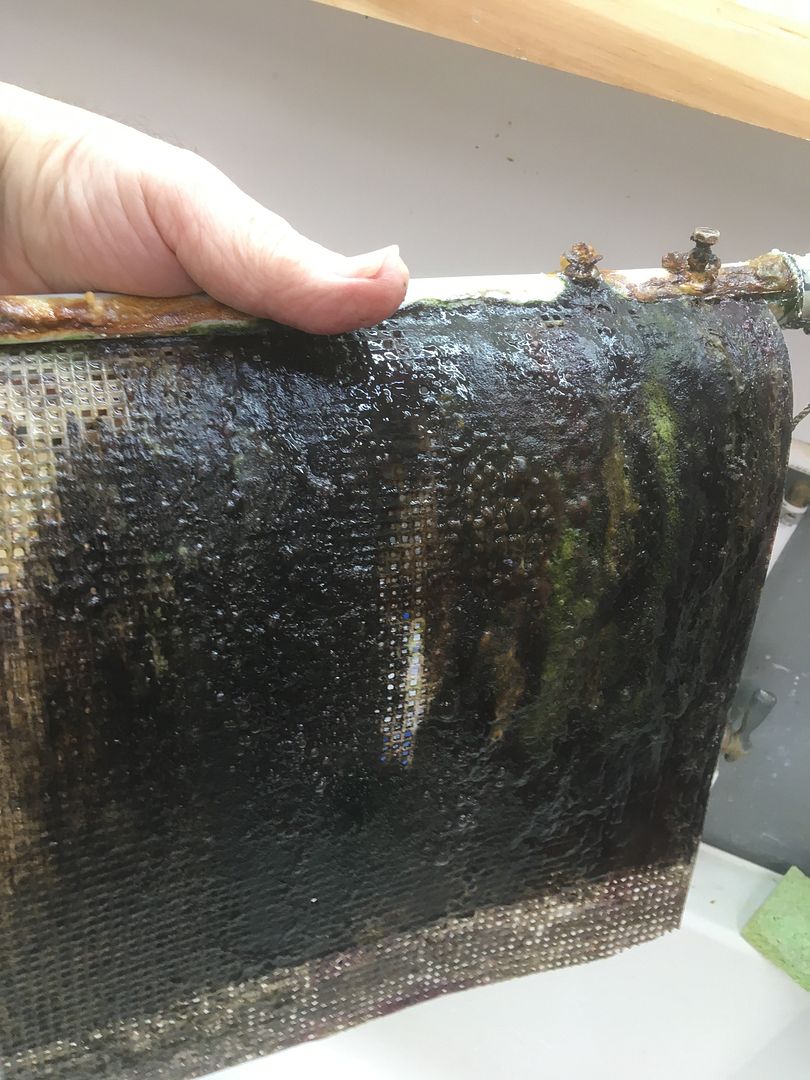
Cyano with decent nutrient levels.

  • Thread starter Thread starter welshgazz
  • Start date Start date
  • Tagged users Tagged users None
Bacteria uses doc in different ways.

Ethanol for example promote predominantly a catabolic process, it makes the bacteria respire Nitrate little goes to anabolic process in comparison to complex carbohydrates that will promote anabolism, meaning more nitrate and phosphate will be assimilated into their cell.

From what i read, in reefs most of the organic carbon comes from phytoplankton their decay promotes the formation of flocs (biological marine snow) that promotes heterotrophic bacteria cell growth via anabolism, this process feeds multiple food webs including free swimming and crawling ciliates; stalked ciliates; rotifers; nematodes; copepods and micro algae’s.
I believe the same happens in our tanks and most of the balance comes from this multiple food webs.


“From what i read, in reefs most of the organic carbon comes from phytoplankton their decay promotes the formation of flocs (biological marine snow) that promotes heterotrophic bacteria cell growth via anabolism, this process feeds multiple food webs including free swimming and crawling ciliates; stalked ciliates; rotifers; nematodes; copepods and micro algae’s.”
“I believe the same happens in our tanks and most of the balance comes from this multiple food webs.“

AMEN to the above.

Let’s add to that with the microbial loop of cryptic sponges. Dutch researches showed that DOC & POC assimilated into their biomass would double in weight in 8 hours except for the amount of carbon rich detritus sloughed off. The detritus or “mulm” feeds the microbial loop that feeds the reef.

 
Hans,
To add to the complication, let’s bring DOC exudates from coral and DOC exudates from algae into the discussion
https://www.nature.com/articles/ismej2012161 ; https://pmc.ncbi.nlm.nih.gov/articles/PMC3635233/

"We collected exudates from the dominant hermatypic coral holobiont Porites spp. and three dominant macroalgae (one each Ochrophyta, Rhodophyta and Chlorophyta) from reefs of Mo'orea, French Polynesia. We characterized exudates by measuring dissolved organic carbon (DOC) and fractional dissolved combined neutral sugars (DCNSs) and subsequently tracked bacterioplankton responses to each exudate over 48 h, assessing cellular growth, DOC/DCNS utilization and changes in taxonomic composition (via 16S rRNA amplicon pyrosequencing). Fleshy macroalgal exudates were enriched in the DCNS components fucose (Ochrophyta) and galactose (Rhodophyta); coral and calcareous algal exudates were enriched in total DCNS but in the same component proportions as ambient seawater. Rates of bacterioplankton growth and DOC utilization were significantly higher in algal exudate treatments than in coral exudate and control incubations with each community selectively removing different DCNS components. Coral exudates engendered the smallest shift in overall bacterioplankton community structure, maintained high diversity and enriched taxa from Alphaproteobacteria lineages containing cultured representatives with relatively few virulence factors (VFs) (Hyphomonadaceae and Erythrobacteraceae). In contrast, macroalgal exudates selected for less diverse communities heavily enriched in copiotrophic Gammaproteobacteria lineages containing cultured pathogens with increased VFs (Vibrionaceae and Pseudoalteromonadaceae). Our results demonstrate that algal exudates are enriched in DCNS components, foster rapid growth of bacterioplankton and select for bacterial populations with more potential VFs than coral exudates."

The difference to me seems growth of oligotrophic vs. growth of copiotrophic bacteria, in very simple terms "good bacteria" vs. "bad bacteria". This might be a key to understanding also bacterial problems in reef tanks.
 
https://www.nature.com/articles/ismej2012161 ; https://pmc.ncbi.nlm.nih.gov/articles/PMC3635233/

"We collected exudates from the dominant hermatypic coral holobiont Porites spp. and three dominant macroalgae (one each Ochrophyta, Rhodophyta and Chlorophyta) from reefs of Mo'orea, French Polynesia. We characterized exudates by measuring dissolved organic carbon (DOC) and fractional dissolved combined neutral sugars (DCNSs) and subsequently tracked bacterioplankton responses to each exudate over 48 h, assessing cellular growth, DOC/DCNS utilization and changes in taxonomic composition (via 16S rRNA amplicon pyrosequencing). Fleshy macroalgal exudates were enriched in the DCNS components fucose (Ochrophyta) and galactose (Rhodophyta); coral and calcareous algal exudates were enriched in total DCNS but in the same component proportions as ambient seawater. Rates of bacterioplankton growth and DOC utilization were significantly higher in algal exudate treatments than in coral exudate and control incubations with each community selectively removing different DCNS components. Coral exudates engendered the smallest shift in overall bacterioplankton community structure, maintained high diversity and enriched taxa from Alphaproteobacteria lineages containing cultured representatives with relatively few virulence factors (VFs) (Hyphomonadaceae and Erythrobacteraceae). In contrast, macroalgal exudates selected for less diverse communities heavily enriched in copiotrophic Gammaproteobacteria lineages containing cultured pathogens with increased VFs (Vibrionaceae and Pseudoalteromonadaceae). Our results demonstrate that algal exudates are enriched in DCNS components, foster rapid growth of bacterioplankton and select for bacterial populations with more potential VFs than coral exudates."

The difference to me seems growth of oligotrophic vs. growth of copiotrophic bacteria, in very simple terms "good bacteria" vs. "bad bacteria". This might be a key to understanding also bacterial problems in reef tanks.
Hans,
Thank you for such detail. Much to digest. Still googling terms.

@Timfish put me in contact with research from Haus, Hopefully he has it handy. In a simplified overview:

“coral exudates are lipids & proteins while algae exudates are glucose/carbohydrates and those differences produce different groups of bacteria”
 
Hi, I'm starting to get cyanobacteria on my rocks however my nutrients are decent:
Nitrate 5
Phosphate 0.1
Salinity 1.025.

My tank is a 40g cube with 5 g sump. I have flow from the return pump and a 4000lph DC wavemaker which seems to move water around. I have soft coral and lps that don't need massive flow.
Would it benefit if I put a small 1000lph in to help?
Any other suggestions please?


The tank was established for 2 years then moved to my house. Been set up for 2 months with new sand. The fish are happy and the corals in there are doing well.

Just a symptom of the tank move I’d say. Just keep siphoning it off and wait it out.

Ditto @Australian_Reef said


Like PaulB said it comes and goes and there's a lot more to the picture than what we can test for. Like amino acids are Dissolved Organic Nitrogen and have to be figured into the equation also for one example.
 
Will disagree. High levels of no3 and po4 are the results of a dirty aquarium with higher than natural level of bacteria. Unless the hobbyist is dosing these nutrients specifically.

Just FYI, Georgia Aquarium did a 14 month study of microbial counts in their system. Even though paramaeters were stable there were significant changes in counts. There also was not correlation with turbidity.

https://journals.asm.org/doi/10.1128/aem.00179-18
 
Hans,
Thank you for such detail. Much to digest. Still googling terms.

@Timfish put me in contact with research from Haus, Hopefully he has it handy. In a simplified overview:

“coral exudates are lipids & proteins while algae exudates are glucose/carbohydrates and those differences produce different groups of bacteria”

I'm not sure about simplified Pat.

Kline and Kline showed DOC, even coral DOC, kills corals faster than nitrate or PO4 by causing excess microbial growth in a coral's surface mucus layer (1) (2)

Haas demonstrated anoxic conditions in coral's surface caused by algae DOC and how algal DOC shifts microbial processes from autotrophic to heterotrophic to the detriment of corals. Here's a partial list of his papers

Influence of coral and algal exudates on microbially mediated reef metabolism.
Coral DOC improves oxygen (autotrophy), algae DOC reduces oxygen (heterotrophy).
https://peerj.com/articles/108/?utm_source=TrendMD&utm_campaign=PeerJ_TrendMD_0&utm_medium=TrendMD
Role of elevated organic carbon levels and microbial activity in coral mortality
http://www.int-res.com/articles/meps2006/314/m314p119.pdf
Effects of Coral Reef Benthic Primary Producers on Dissolved Organic Carbon and Microbial Activity
Algae releases significantly more DOC into the water than coral.
https://journals.plos.org/plosone/article?id=10.1371/journal.pone.0027973
DOC can also cause bleaching by promoting excess growth of a coral's zooxantellae disrupting the coral-algae symbiosis and creating internal N:P ratio issues.

https://onlinelibrary.wiley.com/doi/full/10.1111/gcb.13695
Sponges are also playing a role and are a double edge sword.

https://besjournals.onlinelibrary.wiley.com/doi/full/10.1111/1365-2435.12758
 
Just FYI, Georgia Aquarium did a 14 month study of microbial counts in their system. Even though paramaeters were stable there were significant changes in counts. There also was not correlation with turbidity.

https://journals.asm.org/doi/10.1128/aem.00179-18
Kind of supports my opinion….dirty aquariums are bad. Open ocean areas, which this exhibit mimics would never have bacteria blooms and have very little inorganic nutrients. This aquarium is loaded with bacteria and waste. However, not really sure as I have been accused of cherry picking data that supports my argument…haha!

‘Despite stable water column conditions, the exhibit experienced blooms in which the abundance of a single bacterial strain increased to over 65% of the community’


‘bacteria generally observed at low relative abundances in the open ocean but with dominant roles and potentially unique adaptations in the OV system. We discuss the potential determinants of OV microbiome dynamics and implications for understanding aquarium microbiome ecology and diversification.’
 
Kind of supports my opinion….dirty aquariums are bad. Open ocean areas, which this exhibit mimics would never have bacteria blooms and have very little inorganic nutrients. This aquarium is loaded with bacteria and waste. However, not really sure as I have been accused of cherry picking data that supports my argument…haha!

‘Despite stable water column conditions, the exhibit experienced blooms in which the abundance of a single bacterial strain increased to over 65% of the community’


‘bacteria generally observed at low relative abundances in the open ocean but with dominant roles and potentially unique adaptations in the OV system. We discuss the potential determinants of OV microbiome dynamics and implications for understanding aquarium microbiome ecology and diversification.’
Yes, you cherry picked what you wanted. There was quite a bit more information than that on the links provided.
 
Kline and Kline showed DOC, even coral DOC, kills corals faster than nitrate or PO4 by causing excess microbial growth in a coral's surface mucus layer (1) (2)

Haas demonstrated anoxic conditions in coral's surface caused by algae DOC and how algal DOC shifts microbial processes from autotrophic to heterotrophic to the detriment of corals. Here's a partial list of his papers

Influence of coral and algal exudates on microbially mediated reef metabolism.
Coral DOC improves oxygen (autotrophy), algae DOC reduces oxygen (heterotrophy).
I am not sure whether the publications are really very different.

The publications are by the same team, Haas and Nelson, same time 2013 and one from 2011 and have similar outcomes, only Nelson calls the "bad" bacteria "copiotrophic" while Haas calls them "bacterioplankton".

The cell yields and bacterial oxygen demand in Fig. 4 in Haas et al. 2011 are higher for the algal exudates pointing to copiotrophic bacteria also.

All comparisons of algal and coral exudates show they have different effects to the microbial community.
 
Last edited:
I get that there are potential concerns about what a macroalgae refugium may release to the water, but the question then becomes, what methods of nutrient export are better? As far as I can tell, all of them have pros and cons that one could point to and say: don't use that because X may result.
 
what methods of nutrient export are better?
I believe skimmers and algae scrubbers are the best because they remove nutrients completely while still having the benefits of having algae growing.

 
I'm not sure about simplified Pat.

Kline and Kline showed DOC, even coral DOC, kills corals faster than nitrate or PO4 by causing excess microbial growth in a coral's surface mucus layer (1) (2)

Haas demonstrated anoxic conditions in coral's surface caused by algae DOC and how algal DOC shifts microbial processes from autotrophic to heterotrophic to the detriment of corals. Here's a partial list of his papers

Influence of coral and algal exudates on microbially mediated reef metabolism.
Coral DOC improves oxygen (autotrophy), algae DOC reduces oxygen (heterotrophy).
https://peerj.com/articles/108/?utm_source=TrendMD&utm_campaign=PeerJ_TrendMD_0&utm_medium=TrendMD
Role of elevated organic carbon levels and microbial activity in coral mortality
http://www.int-res.com/articles/meps2006/314/m314p119.pdf
Effects of Coral Reef Benthic Primary Producers on Dissolved Organic Carbon and Microbial Activity
Algae releases significantly more DOC into the water than coral.
https://journals.plos.org/plosone/article?id=10.1371/journal.pone.0027973
DOC can also cause bleaching by promoting excess growth of a coral's zooxantellae disrupting the coral-algae symbiosis and creating internal N:P ratio issues.

https://onlinelibrary.wiley.com/doi/full/10.1111/gcb.13695
Sponges are also playing a role and are a double edge sword.

https://besjournals.onlinelibrary.wiley.com/doi/full/10.1111/1365-2435.12758
@Timfish,

I didn’t mean the processes were simple, I meant “I would simply the processes and generalize so I could understand the big picture.

The more I learn, the more I realize “How much there is to know”.
 
I believe skimmers and algae scrubbers are the best because they remove nutrients completely while still having the benefits of having algae growing.

Paul,
Except for infrequent water changes to limit salinity, the only time I remove nutrients from my tank, is to sell it or eat it.
 

Attachments

  • image.jpg
    image.jpg
    261.7 KB · Views: 16

TOP 10 Trending Threads

ARE YOU READY TO CONFESS TO CRAZIEST, DUMBEST, FUNNIEST THING YOU’VE EVER DONE IN REEFING?

  • Yeah, I'll confess! (Share your story in the comments!)

    Votes: 62 55.4%
  • Nah, I'll keep mine a secret...(Don't be like that, share with the class!)

    Votes: 50 44.6%
Back
Top
Home
Post thread…
Market
What's new