



- Joined
- Dec 1, 2025
- Messages
- 4
- Reaction score
- 21
- Location
- Seattle, Washington
- What state or country do you live in
- Washington
(I accidentally posted this on the meet and greet thread, this is a very DIY project so i think it fits best here. Correct me if i'm wrong.)
Hello! I'm relatively new to this, but I recently wanted to try and culture my own phytoplankton to use as food for other creatures I want to take care of, as well as run some projects on them.
I work at an aquarium, so I went and did a plankton drag to gather some samples and brought them home. I isolated a few dozen diatom cells, put them in a shallow 50Ml petri dish of freshly mixed 35 ppt saltwater, added F/2 solution, and attached a circular grow light to the top on a 12 hour timer. There are unfortunately a lot of copepods and other grazing zooplankton in my main sample, but I believe I separated them from the petri dish sample.
Will this work? The plankton were in my sealed sample vial for about 5-ish hours, as I had to finish up work, but I'd be surprised if that killed them. I have no air pump hooked up to the petri dish since it's so shallow right now. I'm not trying to make a perfectly isolated culture first try, but my goal is to at least grow some that I can isolate later and eventually move to a larger vessel I am finishing the preparations for, including an air pump.
I don't expect it to be a short process, seeing that I'm starting with such a small sample, but I was wondering things like if it's okay that the diatoms are resting on the bottom of the dish (for now, I know as they increase in numbers they will smother each other without a current), but I'd like to know if anyone has tips on how to tell if my cells are dead, if this setup will prevent them from reproducing, if the light is too close, or anything else I should note as I try to learn this neat hobby. The goal is to not have to buy a starter culture, and do it myself from direct ocean drag samples, which of course will be hard, but that's part of the fun!
I partly shattered the top part of my Petri Dish to allow airflow for them.
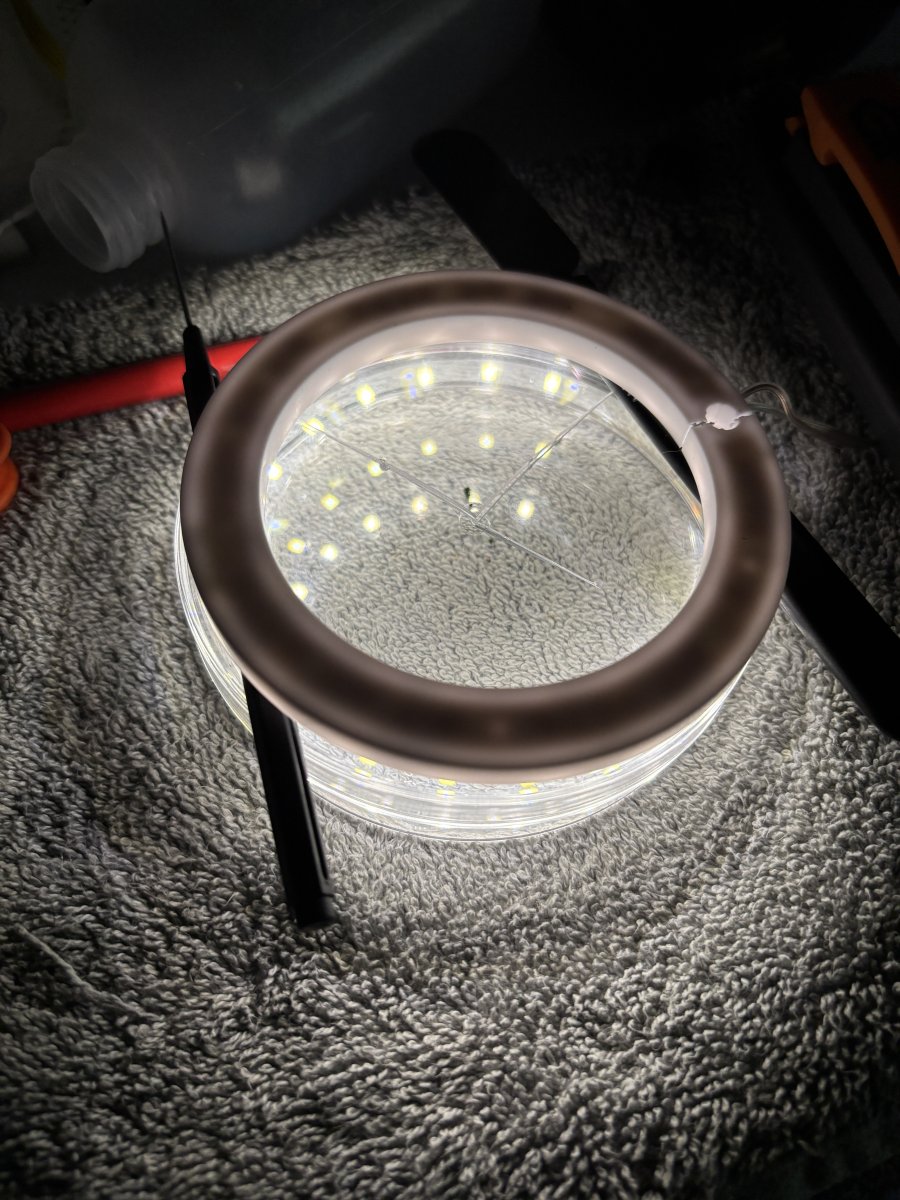
Thank ya!
Hello! I'm relatively new to this, but I recently wanted to try and culture my own phytoplankton to use as food for other creatures I want to take care of, as well as run some projects on them.
I work at an aquarium, so I went and did a plankton drag to gather some samples and brought them home. I isolated a few dozen diatom cells, put them in a shallow 50Ml petri dish of freshly mixed 35 ppt saltwater, added F/2 solution, and attached a circular grow light to the top on a 12 hour timer. There are unfortunately a lot of copepods and other grazing zooplankton in my main sample, but I believe I separated them from the petri dish sample.
Will this work? The plankton were in my sealed sample vial for about 5-ish hours, as I had to finish up work, but I'd be surprised if that killed them. I have no air pump hooked up to the petri dish since it's so shallow right now. I'm not trying to make a perfectly isolated culture first try, but my goal is to at least grow some that I can isolate later and eventually move to a larger vessel I am finishing the preparations for, including an air pump.
I don't expect it to be a short process, seeing that I'm starting with such a small sample, but I was wondering things like if it's okay that the diatoms are resting on the bottom of the dish (for now, I know as they increase in numbers they will smother each other without a current), but I'd like to know if anyone has tips on how to tell if my cells are dead, if this setup will prevent them from reproducing, if the light is too close, or anything else I should note as I try to learn this neat hobby. The goal is to not have to buy a starter culture, and do it myself from direct ocean drag samples, which of course will be hard, but that's part of the fun!
I partly shattered the top part of my Petri Dish to allow airflow for them.
Thank ya!









