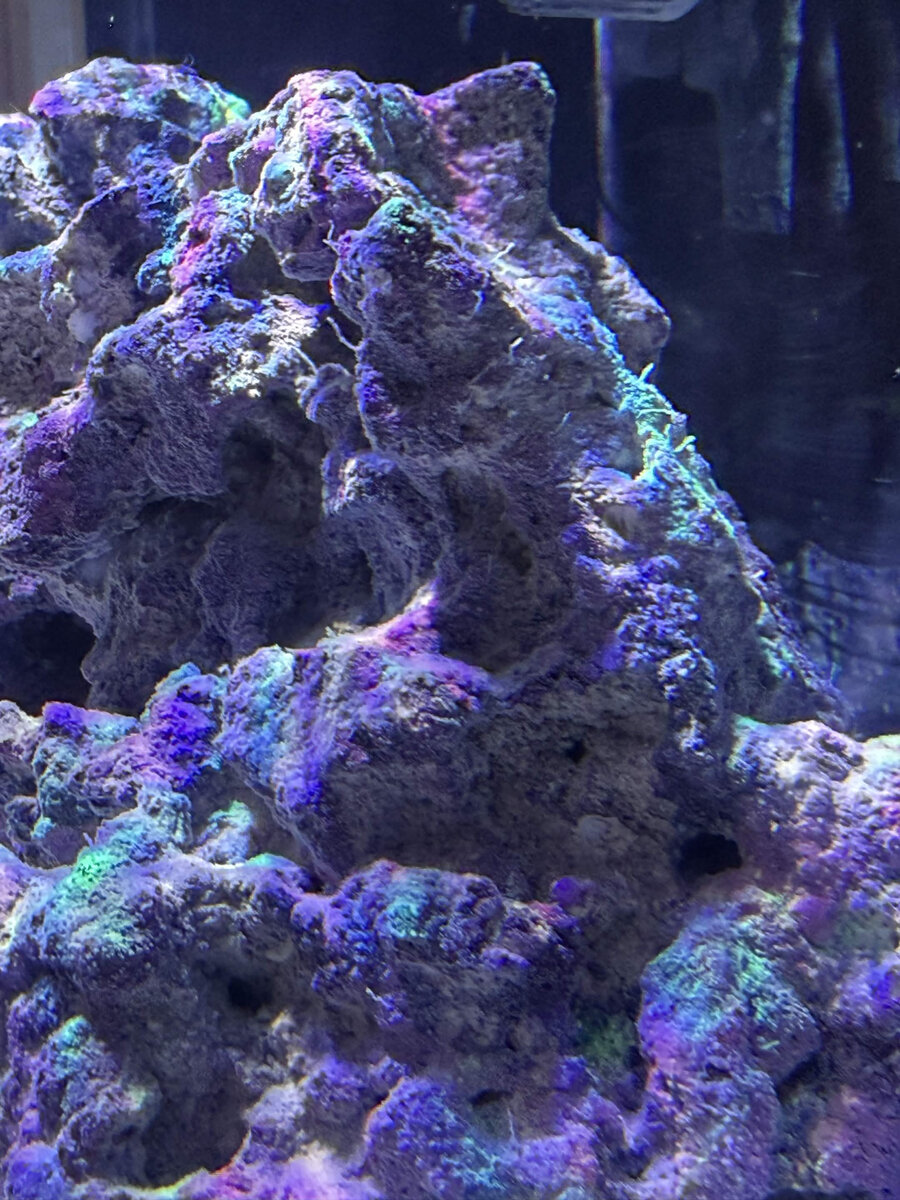
If you are just starting up your tank you will soon enter what is known as "the ugly phase". Depending on how the tank was set up, this phase can pass more quickly or take a few months. Usually you will start seeing brown "dust" all over the substrate, which are microalgae known as diatoms. Then a green hair algae (GHA) follows where the entire rockscape will be covered in GHA. Once the GHA dies, coralline algae (the algae that gives reef rock their typical red/pink/purple color) will start to grow. If you want to introduce corals the safest approach is to do so after the ugly phase, but many people decide to try it early.
Right now it looks like you have a less common start to the ugly phase, and instead of diatoms you see chrysophytes. They come in various shapes and can sometimes grow these "worm-like" filaments, but it's not a certain giveaway, we would need a microscope to verify. Both microalgae (diatoms and chrysophytes) use silicates that new substrate introduces into the tank or that might not have been fully filtered out by the Reverse Osmosis / Deionization (RO/DI) filtration system. As long as you make sure the water you use for your tank is properly deionized, both diatoms and chrysophytes will vanish on their own, but you will have to wait a few weeks. This process is totally normal and expected, I wouldn't worry about it.
To verify that the water is properly deionized, you need a "Total Dissolved Solids" (TDS) meter that can detect down to 1 ppm TDS. In some countries it is more common to measure the conductivity of the RO/DI water in µS/cm. Either way, both devices should display 0 for freshly made RO/DI. If RO/DI is sitting too long exposed to air (and therefore CO₂), the readings will increase. This doesn't make the water bad or unsuited for reef tank use, but it's important to measure freshly made water or the readings might be off. There are very useful "inline TDS meters" that can be directly connected to your RO/DI system's outlet if you are making your own RO/DI water. Once it shows 1 or 2ppm you need to replace the deionization resin that should be located in the very last filter cartridge(s) of your system. The other filters can usually be used much longer.
Edit:
You don't need to worry about nitrite, in comparison to freshwater nitrite is not dangerous in saltwater at realistically achievable levels. Your nitrate test will also display wrong readings while nitrite is present.