Experiments with Hydrogen peroxide

OP
OP
Lasse

Lasse

10K Club member
View Badges
Joined
Mar 20, 2016
Messages
12,660
Reaction score
31,346
Location
Källarliden 14 D Bohus, Sweden
Rating - 0%
0   0   0
From today - 312 hours - 13 days still H2O2 left in both bottles

1751799514934.png


1751799650981.png


Sincerely Lasse
 

Dan_P

7500 Club Member
View Badges
Joined
Sep 21, 2018
Messages
9,785
Reaction score
9,638
Rating - 0%
0   0   0
The use of hydrogen peroxide is more and more common in saltwater aquaria both in the form of using oxidators and directly dosing.

1751627368861.png
It is believed that hydrogen peroxide residence time in an aquarium is hours or maybe a day or two.

Hydrogen peroxide has been (and still is) used as a controller of both gill parasites and salmon lice in commercial fish farms. Treatment concentrations between 300 and 1500 ppm. Some investigations around fish farms in fjords have indicated that the residence of uncatalyzed H2O2 in open water is much. much longer than earlier believed


I have started some tests to get a picture of how H2O2 breakdown in normal aquarium water and how it oxidizes other compounds. It’s clear that the whole molecule can act as an oxidizer, but the main oxidizing power seems to be by the metabolites of the process when H2O2 transfers to H2O and some oxygen radicals (the O atom itself and the hydroxide radical). Here the O will form some O2 gas, and it is the amount of this and its production rate I can measure with my simple method.

I use 2 pcs of 500 ml bottles with a cap that have a 4 ml hole in it. The bottles are filled with aquarium water and the amount of H2O2 I want to test. After that I turn the upside down and place them in a coca cola glass that allow the hole in the cap to "float" in the air and when gas is formed in the vessel – it rise to the bottom (remember upside down) of the bottle and for a gas bubble. The amount of water that is pressed out into the Coca Cola glass through the hole in the cap is equal to the volume of gas at the top. The theory is that if gas is produced - it’s still uncatalyzed H2O2 in the solution.

design-1.jpg


design-2.jpg
design-3.jpg

In tge first run – for 164 hours - I used 5 ml 12% H2O2 in 500 ml total and one bottle without any H2O2 at all. The zero sample was because I want to see if there was any other gas production taking place. The test was done with natural light.

After 164 hours – it was still gas production in the bottle with 5 ml 12% H2O2 added and no gas at all produced in the control bottle.

1751627844265.png


2025-06-23 I start a second run - now including one bottle with added 5 ml 12% H2O2 and one with 1 ml 12% H2O2, The reason why I use this rather high concentrations is that they are around the concentration for dip treatment in fish farms. I want to see the pattern here before I test with lower concentrations of H2O2

Calculation 1 ml H2O2 (100%) is 1,45 g - in order to make 12 % solution (volume) I mix 12 ml 100% H2O2 with 88 ml water. The weight of 12 ml 100 H2O2 is 17.4 gram - which means that each ml of 12 % (volume) H2O2 contain 0.174 g or 174 mg H2O2. I mix 1 ml in 500 ml water -> 348 mg/L. The 5 ml solution will be 1740 mg/L. The extra O in H2O2 is 47% of the weight of the whole molecule - each ml 12% H2O2 contain 0.47*174 mg = 82 mg O or 82 mg O2 or around 60 ml O2 and my 5 ml 12% H2O2 will correspond to 410 mg free O and hence around 287 ml O2 gas. - Please - someone - correct me if I´m wrong - I´m no chemist.

However - I have run this experiment for more than 10 days now and the result is rather surprising. The bottle with 5 ml 12% H2O2 act rather like the first experiment with a total gas formation of around 156 ml gas in both runs (run 1 = 164 hours - run 2 = 168 hours)

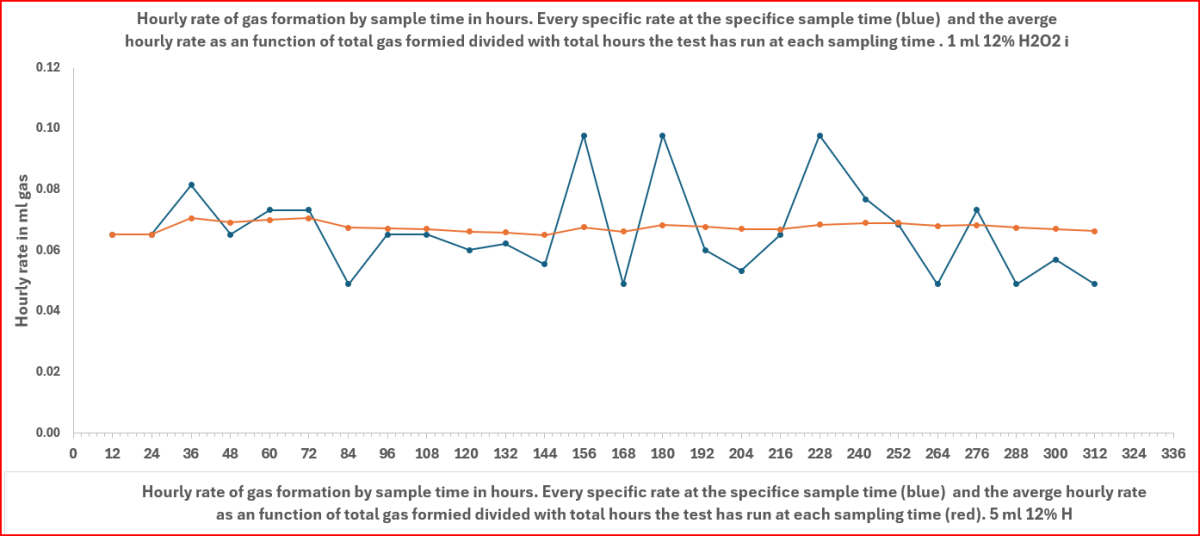
However - the bottle with 1 ml 12% H2O2 acts a little different - it has been a rather steady production of gas and much lesser than expected

1751632954496.png


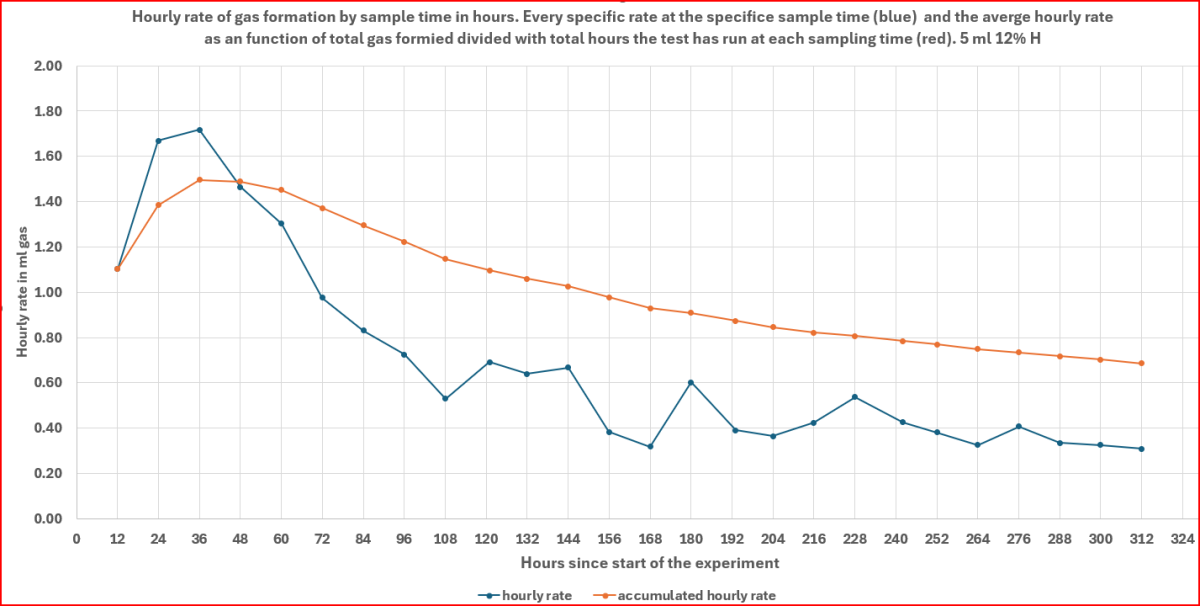
The 5 ml 12% H2O2 shows another pattern - note the decline of both the specific and average hourly rate

1751633098709.png


Interesting is also that in both 5 ml experiment - the hourly rate is highest after around 36 hours

After more than 10 days - its clear that it still H2O2 left in the test solution. However - the 1 ml sample is very different - it needs to be tested again.

At the moment - my test indicate that even in aquarium water - the lifetime of H2O2 molecule is larger than earlier believed

The test is still ongoing

Sincerely Lasse

Why aren’t you measuring the hydrogen peroxide level? The titration test is simple and more accurate than your method.
 

dangles

Valuable Member
View Badges
Joined
Sep 22, 2022
Messages
1,810
Reaction score
2,338
Location
Ohio
Rating - 100%
3   0   0
A before and after ICP analysis would be nice to see as well. Probably not a concern for major elements and other water parameters but the trace elements could take a hit from the H2O2. At least that’s what Grok tells me 😅
 
OP
OP
Lasse

Lasse

10K Club member
View Badges
Joined
Mar 20, 2016
Messages
12,660
Reaction score
31,346
Location
Källarliden 14 D Bohus, Sweden
Rating - 0%
0   0   0
Why aren’t you measuring the hydrogen peroxide level? The titration test is simple and more accurate than your method.

I have not access to that type of methods. This is an easy method (and cheap) to both illustrate what´s happens and get some understanding about it. I´m aware of the lack of precision and accuracy but on the other hand some people use to recommend hobby methods with equipment's with lesser precision, accuracy and more depending on the eye of the beholder than this. People with access to better methods is free to do experiment by themself and either confirm or reject my results.

A before and after ICP analysis would be nice to see as well. Probably not a concern for major elements and other water parameters but the trace elements could take a hit from the H2O2. At least that’s what Grok tells me 😅

ICP give us the amount of different elements of a compound - not the compound itself. No matter how effective H2O2 is - it will not change the presence of elements in a solution - only their different combinations. Of course - if the reaction involves the formation of a gas containing different elements - then this can happen. Oxidation - regardless of the type - can always change a compound of elements but mostly not the total amount of different elements in a solution. ICP cannot give the answer to which compound an element is in - only that the element itself exists in the solution.

Sincerely Lasse
 

DEdiver

Community Member
View Badges
Joined
Jan 25, 2025
Messages
28
Reaction score
21
Location
Elkton, MD
Rating - 0%
0   0   0
I took all the rock out since it was full of Bubble algae. Poured straight 3% on all of it and let it sit for a few minutes. Then put it straight back in the tank without rinsing it off. This is in 7 gallons of water. The remainder of the algae on the sand and walls/back of AIO all died. Water was a mess and did a 2 gallon water change the next day and started dosing 2ml of MB7 and will continue for one more week. Do you think the peroxide has depleted yet?
Peroxide test strips are cheap, check out the 0-100 ppm options on amazon, ie Amazon product

I dose 1mL of 3% H2O2 per 5 gal through my UV sterilizer which breaks it down quickly. Test strips show H2O2 falling from about 2 ppm to <0.5 ppm within 30 mins. Fish, snails, starfish, crabs, RFAs and corals are all fine with it.
 
OP
OP
Lasse

Lasse

10K Club member
View Badges
Joined
Mar 20, 2016
Messages
12,660
Reaction score
31,346
Location
Källarliden 14 D Bohus, Sweden
Rating - 0%
0   0   0
Yes - using UV-C together with dosing hydrogen peroxide is excellent - you will have the action (oxidation of organic matter including pathogens ) in one place and during a rather shorth time - no or little residue in the tank. Its a good option if your goal is to defeat pathogens in the water column. However not all UV-C:s is effective in this case.

Here in Europe - an oxidator is rather common when using H2O2. Its construction with a secondary catalyst will also give a low residue of H2O2 in the water column (if no too strong solution or too many catalyst is used in the reaction chamber).

However - I have seen people dosing peroxide directly into the aquarium - an in this case - the breakdown rate is interesting. Its also interesting for me that run 12% H2O2 and 3 catalyst in my oxidator

Using a strip may not give an accurate value either

MVH Lasse
 
OP
OP
Lasse

Lasse

10K Club member
View Badges
Joined
Mar 20, 2016
Messages
12,660
Reaction score
31,346
Location
Källarliden 14 D Bohus, Sweden
Rating - 0%
0   0   0
Now - I´m in day of 18 - and still H2O2 left in the bottles

1752228558904.png


1752228469076.png


I can´t decide if I should stop this test now and run another on with 12 hours light - 12 hours not light or let this run for some day´s more.

I´ll think at least that I have shown that a water from a reef tank do not break down H2O2 very fast - at least not in these concentrations and only daylight in a dark place in a room.

Next run will be exactly the same but with light on between 11:00 and 23:00. The problem is if there will be any algae producing oxygen in the bottles.

Probably start he new run tomorrow att 11:00

Sincerely Lasse
 
OP
OP
Lasse

Lasse

10K Club member
View Badges
Joined
Mar 20, 2016
Messages
12,660
Reaction score
31,346
Location
Källarliden 14 D Bohus, Sweden
Rating - 0%
0   0   0
I decided to continue the experiment but to include a 12 hours light period after the first 256 hour of running the experiment. Because I use 5 ml H2O2 and 1 ml H2O2 - in the ideally world - this should means a 5:1 interrelationship between the bubbles - but day 3 - it was nearly 21:1 - but look now!

1752660937666.png


There was an increase in bubble size growth rate in the low H2O2 sample but nearly the same rate in the 5 ml sample

Sincerely Lasse
 
OP
OP
Lasse

Lasse

10K Club member
View Badges
Joined
Mar 20, 2016
Messages
12,660
Reaction score
31,346
Location
Källarliden 14 D Bohus, Sweden
Rating - 0%
0   0   0
Its a while since I post in this thread but I have investigate this further. The test construction - described above - is a simple way to see how much gas x ml of H2O2 will produce during time. I have run 2 test runs over 276 H (around 11.5 days) On bottle content 5 ml H2O2 - the other 1 ml H2O2 (12%). The produced amount of water in the outer chamber has ben measured by weight around every 12 hours. After Dark period and after the light period. The concentration quota is 5:1 and its also the expected gas production quota. Interesting is to see how the real quota differ along a time line - if they differ at all. The light regime have been dark 12 H and light 12 hours. Light on between 11:00 and 23:00. A little natural light will reach the bottles between 08:00 to 11:00

@Randy Holmes-Farley - you have earlier in this thread mention that you think that the stronger concentration will have a longer halftime in the long run. I think you will be a little surprised of the data I present here.

First the quota of total formed gas in a timeline between 0 and 276 H is not ideal in the beginning because the quota skyrocket in the start (favour the high concentration sample) and slowly get close to 5:1 F3 quota was around 66 as highest (after 48 H) and F4 quota was around 36:1 after 24 hours. After around 144 H - both get close to 5:1

1755526782847.png


The high quota in F4 is mainly due to a very low hourly rate for F4:s 1ml H2O2 sample in the start - see below

If we look att the hourly rate of gas production - based on the read volume divided with the amount of hours since the las reading - a truly interesting pattern was revealed. First the 5 ml H2O2 sample. here is max ml of gas formed/hour after 24 hours

1755526952808.png


However - the "1ml H2O2" has another pattern - here its take between 107 and 138 H before max hourly rate happens


1755525834124.png


This is only two test runs but - in general they show the same - Maximal rate of gas formation is after 24 hours for the 5 ml H2O2 sample but it takes up to 4 times longer time before the "1ml H2O2" reach max gas forming rate/H

I have started a new identical constructed run now - I´ll be back. I´m interested to see if the rate max will be in the same way.

Sincerely Lasse
 

Randy Holmes-Farley

Reef Chemist
View Badges
Joined
Sep 5, 2014
Messages
89,239
Reaction score
92,257
Location
Massachusetts, United States
Rating - 0%
0   0   0
When I suggested higher concentration would give a longer half life, that meant half life of the peroxide in the water. It may also not be true, but I’d be wary of using gas produced as a perfect surrogate for the amount of peroxide present.

My hypothesis is that elements like iodide may react with and deplete hydrogen peroxide without producing gas. Those are the reactions that get depleted faster at higher concentration, and will take out a larger fraction of the total at lower concentration.

I cannot really follow exactly what was done, but is it correct to say that the same amount of gas was produced vs time for two different peroxide concentrations? If true, that implies something other than the peroxide is limiting the production rate, which seems unusual and I’m not sure what it would be. Container surface area???
 
OP
OP
Lasse

Lasse

10K Club member
View Badges
Joined
Mar 20, 2016
Messages
12,660
Reaction score
31,346
Location
Källarliden 14 D Bohus, Sweden
Rating - 0%
0   0   0
I check the amount of gas produced every 12 hours. Then I calculated an hourly rate for that period. I use 5 ml 12 % H2O2 and 1 ml 12% H2O2. I did 2 runs of each 276 hours. I plot the hourly rate for each 12 hours period. Sometimes it was 11 hours and once 24 hours but I calculated hourly rates. My excel graphs was maybe not so good.

Here is maybe better graphs

1 ml H2O2 first run. Here you can see that the hourly gas formation was as highest after 107 hours

1755558668434.png


1 ml H2O2 second run. Its the same pattern - highest hourly rate rather late - in this case after 132 hours

1755559034339.png

This is the two most interesting findings - it took around 5 days to achieve the highest hourly rate of produced gas = highest rate of decomposing ?


I leave it here for tonight - 1 AM here. Take the rest tomorrow

Sincerely Lasse
 
OP
OP
Lasse

Lasse

10K Club member
View Badges
Joined
Mar 20, 2016
Messages
12,660
Reaction score
31,346
Location
Källarliden 14 D Bohus, Sweden
Rating - 0%
0   0   0
Here is the 5 ml H2O2 sample - first run

1755602993127.png

5 ml H2O2 sample - second run

1755603075760.png


Both shoe a different pattern than the 1 ml sample. Both have max hourly rate already after 24 H - not above 100 H like the 1 ml samples.

I have a theory about this. I can see 3 major stages in the oxidation and breakdown of H2O2 (It's not on/off of course, they gradually transition into each other.) First there the whole molecule is an oxidant and oxidize certain compounds like Iodine. Second stage - the breakdown of the molecule forms active radicals that oxidize organic matter and the third stage where there is not much to oxidize and therefor the forming of O2 is dominant. This is not the chemists explanation - I know. However something like that could explain the two patterns. The stronger solution will rather fast pass through the two first phases but it will take some time before the weaker solution mostly produce gas.

I´m doing a third run for the moment

Sincerely Lasse
 
OP
OP
Lasse

Lasse

10K Club member
View Badges
Joined
Mar 20, 2016
Messages
12,660
Reaction score
31,346
Location
Källarliden 14 D Bohus, Sweden
Rating - 0%
0   0   0
Because the 5 ml solution is 5 time stronger than the 1 ml solution I expect 5 time more gas should be produced by the 5 ml solution compared with the 1 ml solution. Therefore I calculate the total sum of water collected at each sample time and did a quota between the 5 ml and 1 ml solution. My ideal was 5:1

Run 1

1755604514299.png


Run 2

1755604782520.png


Sincerely Lasse
 

TOP 10 Trending Threads

WHAT AMOUNT OF LIVE ROCK AND SAND SHOULD BE PRIORITIZED FOR OPTIMAL BIODIVERSITY/FILTRATION?

  • 100% live rock + bagged sand

    Votes: 34 26.4%
  • 100% dry rock + 100% live sand

    Votes: 45 34.9%
  • 50/50 live/dry rock, 50/50 live/bagged sand

    Votes: 29 22.5%
  • 75% live rock, 25% live sand

    Votes: 11 8.5%
  • 25% live rock, 75% live sand

    Votes: 10 7.8%
Back
Top