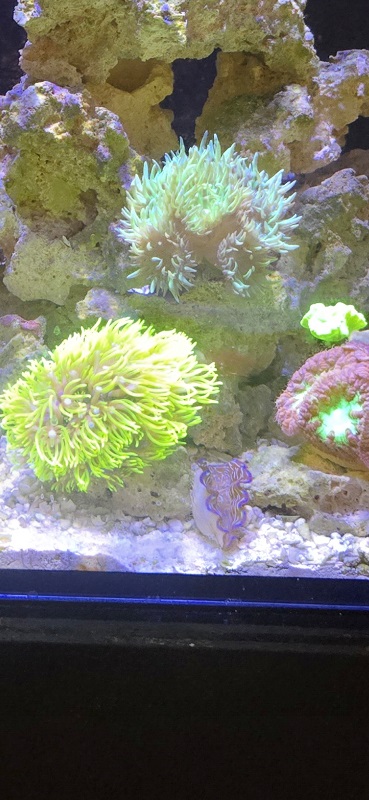
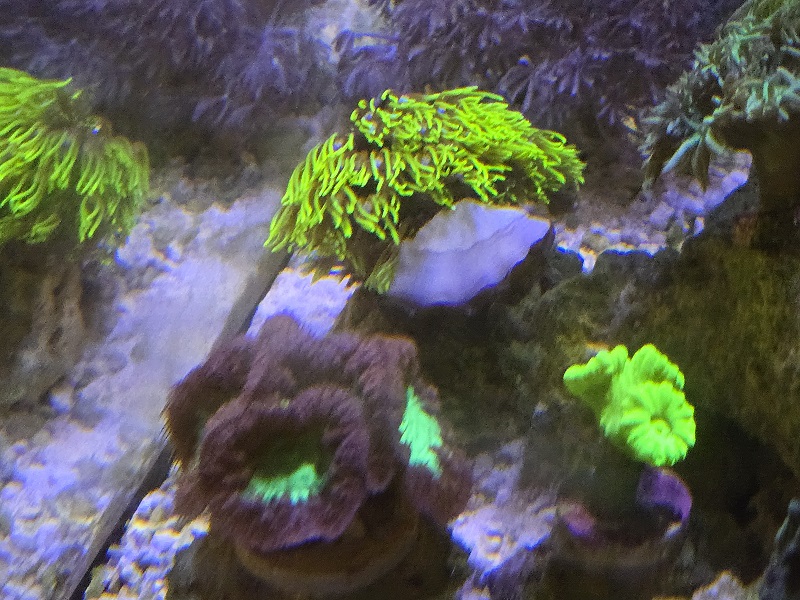
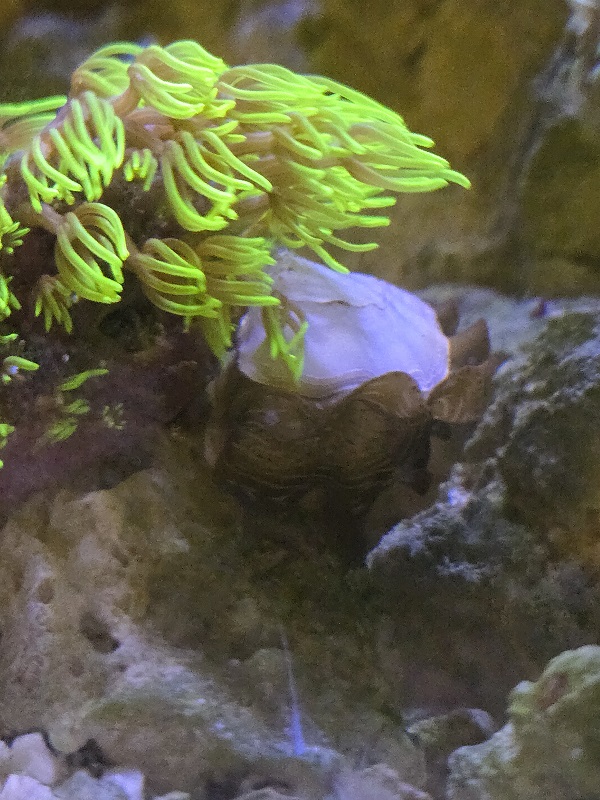
I got a small derasa clam 2 weeks ago. I started by trying to get it to be propped up by my rockwork but it migrated over towards the glass which I was fine with. Today I found it on my GSP rock facing away from the light. Do I just let it be?
Follow along with the video below to see how to install our site as a web app on your home screen.
Note: This feature may not be available in some browsers.
A specific tank for clams is great, substrate depends on the species you want to keep? Crocea, maxima, noae, squamosina and squamosa prefer solid surfaces and stay attached their holes lives (squamosa may or may not stay attached), but gigis, derasa and hippopus rely on their weight to keep them upright and are found on substrate or flat areas of the reef (still mostly on substrate).I might do a calm specific tank. I see some vendors with large substrate. My tank is bare bottom, but if I do a clam tank attached to the main system is this large substrate a good idea? Maybe a flat Marco rock or two to place them on? Mine often seem to "jump" or fall in my main display. I usually place them up high, but apparently they don't like it. I am out of room anyway (two Maximas thriving in there now) hence the possability of "clam tank".
![]()
Most certainly Maxima and Crocea. The other ones just get too big too fast.A specific tank for clams is great, substrate depends on the species you want to keep? Crocea, maxima, noae, squamosina and squamosa prefer solid surfaces and stay attached their holes lives (squamosa may or may not stay attached), but gigis, derasa and hippopus rely on their weight to keep them upright and are found on substrate or flat areas of the reef (still mostly on substrate).
With those two species they need a solid surface to attach to. Maxima will take any flat surface for the most part, but I find crocea likes to "dig in" more, so rock that has concave areas always work best.Most certainly Maxima and Crocea. The other ones just get too big too fast.
An old Derea I had a year or so before I had to get rid of it. It was HUGE, but that was like 10 years ago :).
![]()
It may just be that the water quality finally caught up and the clam is suffering from exposure? I think it would suffer more with no flow instead of "added" flow. I would do some water changes to get things back on track, especially if you want to keep it long term. We are the stewards to these animals, so it's our responsibility to give them everything they deserve to thrive and live.I have an 18 inch gigas in a neglected mixed reef. Yesterday, I noticed NONE of my powerheads were working and the tank may have been that way for some time. I cleaned and got one running and the clam does not appear happy I fixed the problem. Will it adjust? Or do I need to back off the flow?
Many thanks for this great resource. I’ll be reading later!Hello all you fellow clam keepers out there. I thought I would do a thread on clam keeping and all of the good stuff you will need to know.
One of the first things you will need for successful clam keeping are perfect water parameters.
#1 Calcium 380-450 ppm
#2 Salinity 1.024-1.026
#3 Alkalinity 2.5-4 meq/L
7-11 dKH
125-200 ppm CaCO3 equivalents
#4 Ph 8.1-8.4
#5 Magnesium 1250-1350 ppm
#6 Temp 78-82 deg F
#7 Nitrates 0
#8 Nitrites 0
#9 Phosphate < 0.03 ppm
#10 Ammonia <0.1 ppm
Other things that I highly recommend for successfully keeping clams are:
Read, read, read, you can't ever get enough info so take it all in.
Know what to do when you have an issue and have to ask a question, post pic's, params, and fish lists.
There is another thread here and it really tells a lot about how to keep clams and has many recommendations, once again read.
Now you may be wondering what kind of clam you may have right? Well There are many online clam ID pages but the one that I use the most is found here .
Do clams need to be placed in a Quarantine Tank "QT"? In my honest opinion yes they do with out a doubt. No matter who you get it from and how good their reputation is. A quarantine tank is really simple and fairly cheap to set up. The most expensive thing you will need is the light. But think of it this way, say you have 3 or 4 clams and want to add just one more. Now say that one more has a disease and it wipes out all your other clams too. Now you have just lost more money in clams than what a QT would cost. If you need to know how to set up a QT you can look at this thread and get some idea's.
Now lets say you did the right thing and did set up a QT tank, and while your new clam was in said tank you noticed that it was infested with Pyramidellidea Snails. Honestly they sound bad and the treatment sounds real painstaking but I honestly don't mind it. As long as you know you have them and do the proper treatment your clam should be fine. All you need is a toothpick and a tooth brush and get to scrubbing.
Some people will try and tell you that you need to feed clams. I believe that that is a false statement. As long as you have a good strong light set up you should be fine. If you still aren't convinced and would like to read some on the matter you can do so here.
And lastly I have compiled a group of video's with a bunch of clam info and if you are interested in viewing them you may do so here.

![]()
My durasa clam likes to hang out in the sand bed on the front glass panel. I've tried moving it higher up on the rocks but it always goes back to the glass so I leave it there.
Yesterday I saw my urchin on top of clam and it was completely closed (it was fine the day before), the urchin was only on it for a few minutes then wandered away. I decided to just let it be and see if the clam opened up on its own.
Today it's still in the same position, completely closed. Should I try to prop it up or move it somewhere else in the tank?
Looking at your previous pic, there doesn't seem to be much new growth on the shell. With a clam that size, there should always be a healthy amount of new growth. My guess is that it starved to death, which is common when you don't see any new growth. I think most people new to clams underestimate how much light they require and much water quality matters as well. Sorry to hear about the clam, it's never a good feeling. And if I or others haven't mentioned it before, pick up James Fatherree's book on clams, it's worth the read and has a wealth of information on their care. BookThe clam is unfortunately dead. I did wait about a day then propped it up so the mantle would face the light but it never opened up. Today I noticed it was a little bit open and looked empty inside. I pulled it out and opened the shells but there wasn't a trace of anything organic in it. It's kind of crazy, it looked fine a day before the urchin was on top of it.
The clam has been in the tank for 8 months and was always open. Tank has a longfin ocellaris, pink streaked wrasse, tailspot blenny, yasha goby, candy cane pistol shrimp, 2 emerald crabs, and a variety of smaller things like bristleworms, micro bristlestars, and asterina starfish. Other than the urchin I never saw any cleanup crew near it.
Sand is fine or flat rock big enough to settle in, just make sure they’re getting plenty of full spectrum light. I would shoot for at least 300 µmol for 8hrs+ a day.It looks like there was one reply already, but not too much information. Biota has Squamosina clams up for sale and I bought two.
I tried playing them on a small flat rock, but they move off of it every time. This has been a week dance with one of them. Flow wasn't moving it off and nothing else (one spent a week in QT with no fish or inverts).
Is sand fine? It seems to prefer that.