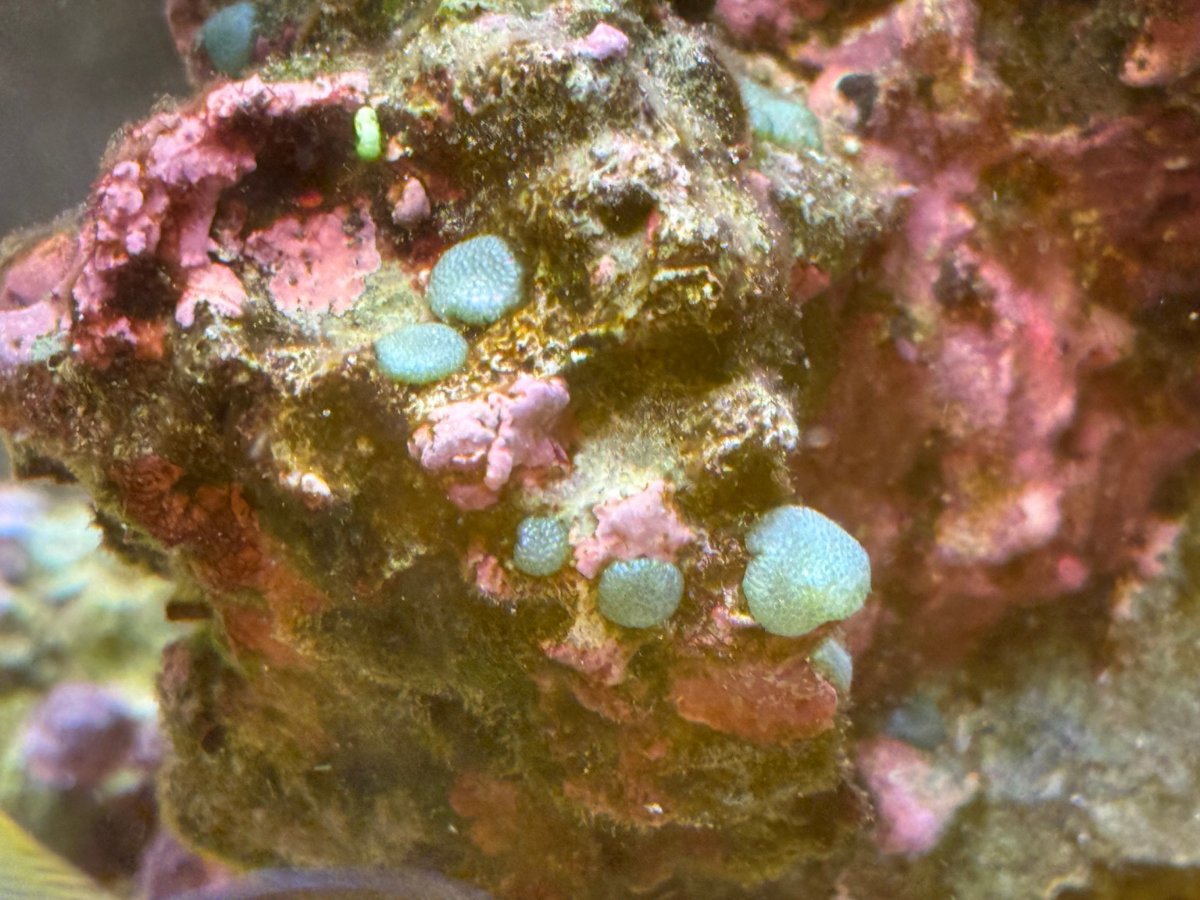
How do I get rid of this bubble-like algae?

  • Thread starter Thread starter pober
  • Start date Start date
  • Tagged users Tagged users None

pober

New Member
View Badges
Joined
Oct 9, 2026
Messages
4
Reaction score
9
What state or country do you live in
Canada
Rating - 0%
0   0   0
This bubble-like algae has spread to dozens of spots in my mixed reef tank over the past month. I believe it’s Dictyosphaeria versluysii.

I have SPS, LPS, mushrooms and a clam. I have a blue tuxedo urchin, but I haven’t seen it eat this stuff. I can’t take the rockwork out.

Anyone had luck getting rid of it? What eats it? Would an emerald crab help without bothering the corals or clam? Any treatments that work with the rocks left in the tank?

Any help would be appreciated. Thanks!
reef-rock-01.jpg
reef-rock-02.jpg
reef-rock-03.jpg
reef-rock-04.jpg
 
Yes, Emerald and Pythos crabs will eat bubble algae. Some warn against manually picking the bubble off the rock, but I've done that, and I don't think it caused them to spread and more than they already were.

Good luck!
 
I think "bubble algae" is a generic term applied to many species of algae that happen to grow in a ball shape. Indeed, what you have in your picture looks a lot like what's pictured in the link, but that's not typical reef aquarium "bubble algae", and I'm not sure critters like crabs will eat it.

@EnterName can you ID this growth?
Like pober, my guess would be Dictyosphaeria sp.
 
Like pober, my guess would be Dictyosphaeria sp.
Do you know what eats it?
Unfortunately I don't know and have not seen any records of what eats this kind of algae so my best guess would be an Emerald Crab which at least is known to touch other bubble algae 🫤

The whole ID is a blind guess, but I feel like an Emerald crab wouldn't discriminate based on taxonomy but rather on morphology and palatability 😁 so it's probably good enough 😁

Turning off all flow and siphoning it out to get all potentially shed tissue and zoospores is another approach.
 
Looks more like sponge.
I have never seen algae look like that TBH.
@ISpeakForTheSeas
I am sorely out of practice at the moment (life is keeping me far busier than I prefer to be, haha), but Dictyosphaeria is a solid guess (I don't recall offhand if there are any superficially similar types of algae to Dictyosphaeria, so I can't eliminate the possibility of a similar-looking species).

I know some photosynthetic colonial tunicates look somewhat similar to this, but I'm not seeing any holes in the photos that would indicate a tunicate to me.
 
Do you know what eats it?
Looks like my blue tuxedo urchin has eaten some of it! The two patches I circled are gone, but it’s left most of the growth alone.

I’ve put it near the algae a few times, and it doesn’t go for it every time. Maybe some spots are hard to reach on the uneven rock, or maybe it’s just not that interested. Either way, it hasn’t cleared the rest.

Here are the before and after photos.


urchin_before.png

urchin_after.png
Urchins rock at eating algae!
 
Quick follow-up with some close-up photos.

The urchin hasn’t been eating much of this, and I haven’t found reliable biological control in my tank, so I took the rock out and removed the algae manually.

One interesting observation: using the thin metal edge of a scalpel handle, I could pry most patches off in one piece if I got the angle and pressure right. This worked with both small and larger patches, with only a few breaking apart. If I squeezed or accidentally punctured a patch, liquid would squirt out.

The close-ups attached show the surface texture and the removed pieces more clearly. Still strongly suspect this is Dictyosphaeria.

After removal, I applied a small amount of hydrogen peroxide to the attachment spots, waited about five minutes, then rinsed thoroughly. This is just a record of what I tried, not a proven treatment. I don’t yet know whether it will grow back.

Will keep an eye on those spots and see if it comes back.


IMG_0432.jpeg

IMG_0436.jpeg

IMG_0437.jpeg
 

TOP 10 Trending Threads

WHAT’S YOUR MOST MEMORABLE EXPERIENCE WITH A CORAL THAT LOOKED LIKE IT MIGHT NOT MAKE IT?

  • I’ve seen a dramatic comeback. I would have sworn it was a goner

    Votes: 20 45.5%
  • A slow recovery, and it got back to looking healthy

    Votes: 7 15.9%
  • It came back some, but never looked as good as it used to

    Votes: 4 9.1%
  • I tried to save one, but it didn’t make it

    Votes: 7 15.9%
  • Mine is still struggling...no comeback yet

    Votes: 3 6.8%
  • I’ve never had a coral in serious trouble

    Votes: 0 0.0%
  • See, this is why I don’t keep corals

    Votes: 1 2.3%
  • Other (Post in the comments)

    Votes: 2 4.5%
Back
Top
Home
Post thread…
Market
What's new