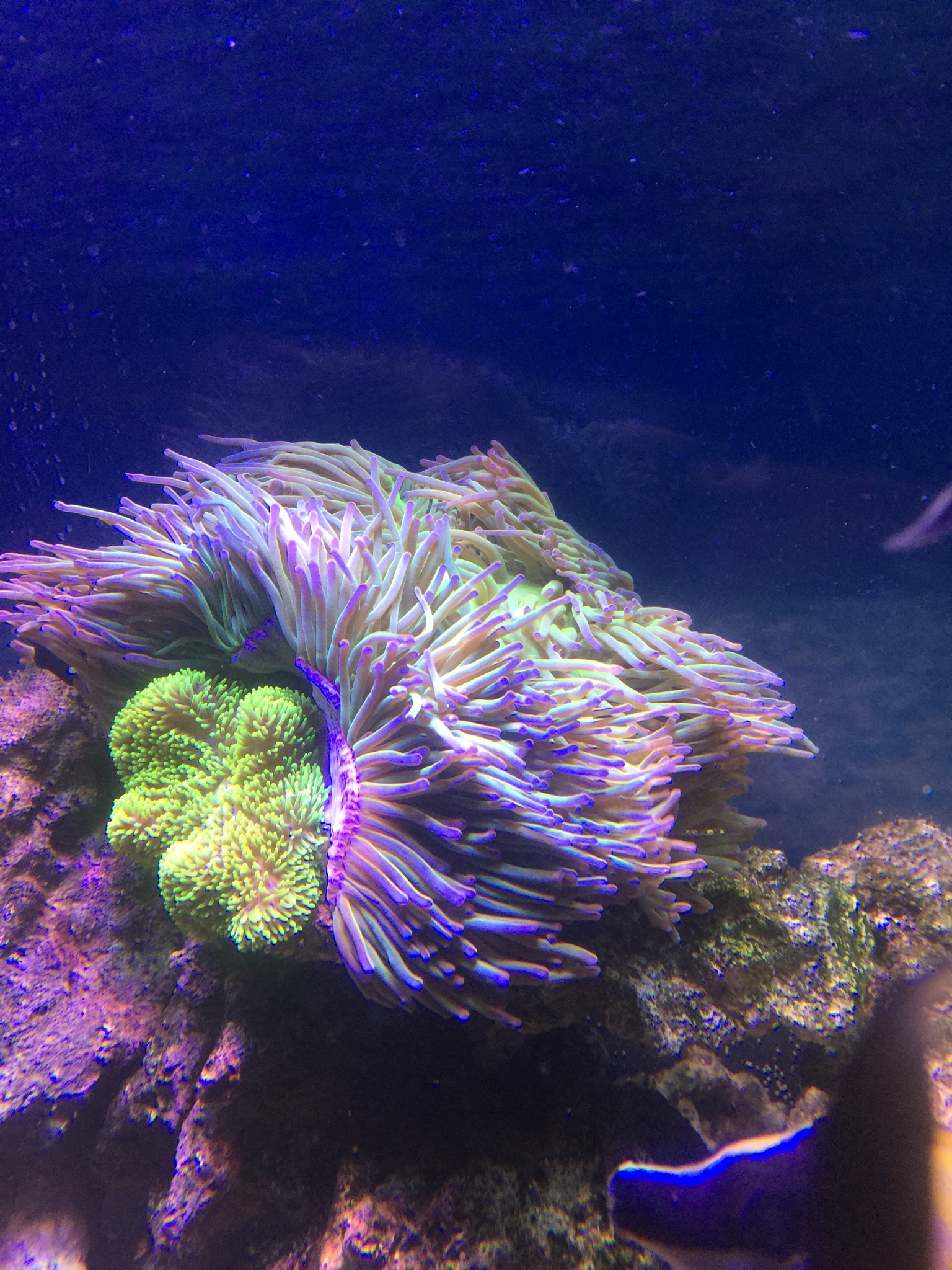
Introducing multiple Anemones

potatocouch

Well-Known Member
View Badges
Joined
Feb 16, 2016
Messages
617
Reaction score
219
Rating - 0%
0   0   0
As we know, Anemones move and they sting each other.

How do folks get their Anemones to live side-by-side? By luck or there's a trick to it?

I haven't seen any articles that explain this. If you've seen any, can you please pinpoint me?

 
Are you asking about different anemones, carpets, Long Tentacle and BTAs, or multiples of the same type?
 
Agree, what species, and really not all move, some species do tend to stay put if given proper conditions according to their needs, which will be different depending on species, and sometimes that can be an issue.
Many people lump them all up typically in the BTA category, and those typically move around quite a bit.
 
Are you asking about different anemones, carpets, Long Tentacle and BTAs, or multiples of the same type?

Let's start with introducing multiple BTAs with differing colouring so same type of Anemones, BTA.
 
If they're all Entacmaea quadricolor, the bubble tip anemone, you shouldn't have any issues with aggression. There's been some talk about them releasing chemicals and nematocysts into the water to combat each other but nothing I've ever seen problems with personally.
 
There's been some talk about them releasing chemicals and nematocysts into the water to combat each other but nothing I've ever seen problems with personally.

At the end of the day, my conclusion is that we don't know what this animal is thinking right? So all in all, luck plays part.

Say we purchased an expensive RBTA which is dang expensive here in Australia. Settled well and all.. Happy bubbly etc.

Then tank a bit empty, thought hey let's get another BTA with different colour, let's get Green with orange tip this time which is significantly cheaper compared to RBTA.

Put it in and luck draining short and RBTA lost the battle and gone it goes.

So cheap BTA kills the expensive RBTA, which is ***.

It does happen right?
 
I've had them right next to each other even new ones and haven't seen them hurt each other. It could have had other complications before you got it, was it actually next to the other nem and it killed it? Or just in the same system? With two separate species I'd try hard to keep them away from each other on separate sides.
 
You are right that we don't know what they are thinking, because they don't don't have a brain!

As for multiple BTA's, should be no issue at all, and I doubt any allelopathy issues(chem warfare), that would mostly be among different species when they bump into each other, or if they are messed with.

As for crispa, probably ok, try to keep them separated if you can.

The beauty of BTA's is even if there were issues that stressed them, you're most likely just going to end up w/ splits/more BTA's
 
I have never seen a BTA sting another BTA. They will lay on top of another, often smaller BTA not allowing light or current. The smaller nem can either walk away or stay and die. Funny thing is the smaller nem will often stay! So I never place a small nem next to a large one.

Male on Male aggression is higher than towards females or female to female aggression in my observation so new nems are never placed around large males. Since you don't know what they are until you see them spawn I assume all new nems are male.

In watching my nems I have found some that prefer a solitary life and others will travel down the length of the tank to join up with others. They stay in contact with their family group and form large masses. Interesting creatures to watch!
 
If I recall correctly, anemones, corals, jellyfish - all the cnidarians - require two triggers to fire a nematocyst (stinging cell). One is a "touch" trigger, and the other a chemical (think "taste") trigger. Something has to touch a tentacle, and it's gotta taste like something the cnidarian can eat - no wasting stinging cells (they only fire once, and have to be replaced) on rocks, seaweed ... or their own tentacles.

Since they won't sting their own tentacles, they also don't trigger for something sufficiently similar to themselves - such as another anemone of their own species, or a clownfish who's incorporated some of the anemone's slime into its own mucous coat. Any two, four, or three-dozen bubble-tip anemones ought to get along - but be careful with more distant relatives!

~Bruce
 
I have 2 BTA on the same rock. No problem. You probably don't want a mertens next to a gig. I have seen a gig next to a mag without issue.
 
In this video there are 19 individuals with around 10 or so different varieties. The tank is stirred up right now after adding a very busy pair of diamond gobies.

The nems tend to spread themselves out.

 
^^ Cool vid, all BTA's, looks nice
 
move over.JPG


Here is an example of that nems do when they get crowded out. The large green BTA moved to the right in this picture yesterday and ended up shielding the pink one. The pink one made its own move to the right on the rocks to get back into the light. Some shoving around but no physical damage to either nem.
 
move over.JPG


Here is an example of that nems do when they get crowded out. The large green BTA moved to the right in this picture yesterday and ended up shielding the pink one. The pink one made its own move to the right on the rocks to get back into the light. Some shoving around but no physical damage to either nem.
it is amazing to see the surrounding corals alive and thriving.
 
I've had the following anemones touch without incident: gigantea/gigantea, gigantea/haddoni, gigantea/magnifica, magnifica/rbta, gigantea/rbta, magnifica/magnifica, hadonni/haddoni. Your mileage may vary.
 
Yeah dude a lot of nems can touch with no problem it's shading that can be something more to worry about like this mag shading my gig
54e271e0497dd19f5a5c005a7328e2e6.jpg
Man, I absolutely love that pic.
 

TOP 10 Trending Threads

IF ONE SYSTEM FAILED WHILE YOU WERE AWAY, WHICH WOULD WORRY YOU MOST?

  • Power or backup power

    Votes: 14 30.4%
  • Heating or cooling

    Votes: 2 4.3%
  • Auto top-off

    Votes: 3 6.5%
  • Return pump or water circulation

    Votes: 4 8.7%
  • Dosing or automated testing

    Votes: 0 0.0%
  • Plumbing, overflow, or leaks

    Votes: 5 10.9%
  • Tank sitter or remote monitoring

    Votes: 2 4.3%
  • Electrical failure of some sort

    Votes: 1 2.2%
  • Seam or structure failure

    Votes: 12 26.1%
  • Something else (tell us in the comments)

    Votes: 3 6.5%
Back
Top
Home
Post thread…
Market
What's new