Is my light TOO bright?

john.m.cole3

cyclOps
View Badges
Joined
Apr 1, 2015
Messages
2,626
Reaction score
2,179
Location
Lubbock, TX
Rating - 0%
0   0   0
72 gallon bowfront
48" ATI 6 bulb dimmable
2 blue plus
2 coral plus
1 actinic
1 purple plus

15" above water line

my zoas closed up in this tank and won't re-open in my other tank i grew them in
my hammers aren't fully extended and kinda withdrawn to be honest
my monti cap is either showing growth lines or bleaching

my 2 coral plus are at 50% for 6 hours
blues/purple/actinic are at 100% for 8 hours

What's the best combination of fixture height, percentage, and bulb combo to keep LPS and SPS? or do I have to choose a species and stck w/ it?

 

jamie callard

Active Member
View Badges
Joined
Feb 14, 2016
Messages
379
Reaction score
170
Rating - 0%
0   0   0
Do you have a local fish store that may rent a par meter so you can your readings
 

hybridazn

Acro killer.....
View Badges
Joined
Apr 29, 2010
Messages
7,925
Reaction score
9,753
Location
Grapeville PA
Rating - 0%
0   0   0
How are your parameters(cal, alk, ph, so on)?

You say the corals were in another tank before, what kind of lighting? Did you light acclimate the corals to this tank?
 
OP
OP
john.m.cole3

john.m.cole3

cyclOps
View Badges
Joined
Apr 1, 2015
Messages
2,626
Reaction score
2,179
Location
Lubbock, TX
Rating - 0%
0   0   0
I didn't acclimate. I dont kniw how. I had them in a46 gallon with marine orbit leds. My parameters in that tank was 9dkh. 430 calc, 1500 mg. The new tank had to break in the bulbs fir 50 hours and I thought I could add everything right away because I transferred all my live rock, added some bacteria in a bottle, and some prime
 
OP
OP
john.m.cole3

john.m.cole3

cyclOps
View Badges
Joined
Apr 1, 2015
Messages
2,626
Reaction score
2,179
Location
Lubbock, TX
Rating - 0%
0   0   0
New tank parameters

Alk 10.2
Calc 450
Mg 1280
 

Salty1962

Wrasse and SPS Lover
View Badges
Joined
Jan 28, 2015
Messages
8,484
Reaction score
7,640
Location
Charlotte, NC
Rating - 0%
0   0   0
Probably becoming used to new light. Give them a couple of days to see how they do. Maybe turn off a couple of bulbs if your worried about light but I agee with everyone it's not too much light. Great bulb combo for colors!
 
OP
OP
john.m.cole3

john.m.cole3

cyclOps
View Badges
Joined
Apr 1, 2015
Messages
2,626
Reaction score
2,179
Location
Lubbock, TX
Rating - 0%
0   0   0
Tank went into a diatom bloom today. 1 week after adding fish and coral

20160323_215842.jpg
 
OP
OP
john.m.cole3

john.m.cole3

cyclOps
View Badges
Joined
Apr 1, 2015
Messages
2,626
Reaction score
2,179
Location
Lubbock, TX
Rating - 0%
0   0   0
Probably becoming used to new light. Give them a couple of days to see how they do. Maybe turn off a couple of bulbs if your worried about light but I agee with everyone it's not too much light. Great bulb combo for colors!
This makes me feel better
 

mcarroll

10K Club member
View Badges
Joined
Jan 8, 2012
Messages
15,213
Reaction score
8,968
Location
Virginia
Rating - 0%
0   0   0
Too much and too little light (which are relative to "normal" for the coral) can both be stressful - even fatal - to corals, even in the wild in otherwise "ideal" conditions.

Are you using a light meter? If not you are more or less rolling the dice when moving mature corals between lighting systems. (Relatively new frags are a different story in most cases....extremely adaptable.)

Get a [HASHTAG]#lux[/HASHTAG] [HASHTAG]#meter[/HASHTAG] and see what you get for a peak and range of readings across the surface of both tanks.

(You can get a $free [HASHTAG]#lux[/HASHTAG] [HASHTAG]#meter[/HASHTAG] for your smartphone's camera to get you started right now, but a $15 handheld meter is my recommended minimum.)

BTW, if you can afford a PAR meter that's great, but under no circumstance should one of us "hold out" for one due to cost. (The extra accuracy, such as it is, is really just not that important for this basic purpose. 100,000 lux = 2000 PAR = 1000 watts per square meter. That works well enough.)

Use a lux meter - stop guessing! NOW! :D:D:D
 
OP
OP
john.m.cole3

john.m.cole3

cyclOps
View Badges
Joined
Apr 1, 2015
Messages
2,626
Reaction score
2,179
Location
Lubbock, TX
Rating - 0%
0   0   0
I've downloaded a lux meter for my Galaxy Note 4. It reads 12000 on the water line for my T5 fixture, and it read 5000 on my old system
 
OP
OP
john.m.cole3

john.m.cole3

cyclOps
View Badges
Joined
Apr 1, 2015
Messages
2,626
Reaction score
2,179
Location
Lubbock, TX
Rating - 0%
0   0   0
From what I've been reading on this site I want my Lux reading to be 50000 or better. How accurate is this information? So is my reading of 12000 acceptable?
 

mcarroll

10K Club member
View Badges
Joined
Jan 8, 2012
Messages
15,213
Reaction score
8,968
Location
Virginia
Rating - 0%
0   0   0
That's approximately "double and half" the amount of light, so ya, there could be some light shock. (I wouldn't discount any other theories tho....check water and everything else that you think is suspect.)

If the new light is not dimmable, you can get the same effect just by cutting the lighting cycle to (literally) a few hours a day. Gradually add one or two hours to the schedule every few days or once a week until the system is where you wanted it....probably no more than 6 or 8 hours a day will be needed:

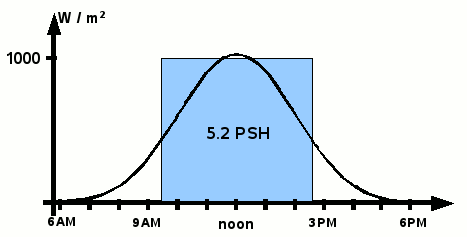
100,000 lux = 2000 PAR = 1000 watts per square meter = "direct sun" at sea level

So this chart shows that a typical equatorial day of 12 hours is equal in power (including photsynthetic power) to about 5 hours of "noon sun".
PSHCurve.gif

Now 12,000 lux is not the noon-day sun!!! ;););)

So you can probably get away safely with more than five hours per day on your system. :)

The main point is really that you don't need to light the tank for the typical 12 hours when you have a basic on/off fixture. And in fact, doing so could be stressful to your corals.
 

mcarroll

10K Club member
View Badges
Joined
Jan 8, 2012
Messages
15,213
Reaction score
8,968
Location
Virginia
Rating - 0%
0   0   0
From what I've been reading on this site I want my Lux reading to be 50000 or better. How accurate is this information? So is my reading of 12000 acceptable?

It's acceptable - you were growing corals even under 5000 lux, if I'm reading your thread correctly...right?

Corals survive in the wild down to about 1% of surface illuminance levels. That's about 1000 lux.

They can actually start growing between 5000 and 10000 lux. So with a lot of corals, you can be fine even at those low levels. Lots of food for them, and starting with small frags will help a lot.

Between 20,000 and 80,000 lux seems to be the "safe zone". 40,000 or 50,000 lux seems to be where many commercial fixtures peak out.

I don't think anything more than your corals seem to require is ideal.

I know that seems contrary to the whole "use a lux meter" thing from earlier...the meter is mostly just for tweaking the lights on the old and new systems to be more equivalent in their intensity so you don't blast or shade-out your corals. With mature colonies, you really want minimal variance of intensity (which includes a factor of time...see that chart again on last post) between the old and new systems.

If they seem happy under the new light once acclimated, then you're fine - trust your eyeballs in this case!!! :p:rolleyes::p:D

Having said that, you might appreciate more light on the tank for other corals - and maybe even other reasons. Just don't feel obligated because more is somehow better.
 
OP
OP
john.m.cole3

john.m.cole3

cyclOps
View Badges
Joined
Apr 1, 2015
Messages
2,626
Reaction score
2,179
Location
Lubbock, TX
Rating - 0%
0   0   0
That's approximately "double and half" the amount of light, so ya, there could be some light shock. (I wouldn't discount any other theories tho....check water and everything else that you think is suspect.)

If the new light is not dimmable, you can get the same effect just by cutting the lighting cycle to (literally) a few hours a day. Gradually add one or two hours to the schedule every few days or once a week until the system is where you wanted it....probably no more than 6 or 8 hours a day will be needed:

100,000 lux = 2000 PAR = 1000 watts per square meter = "direct sun" at sea level

So this chart shows that a typical equatorial day of 12 hours is equal in power (including photsynthetic power) to about 5 hours of "noon sun".
PSHCurve.gif

Now 12,000 lux is not the noon-day sun!!! ;););)

So you can probably get away safely with more than five hours per day on your system. :)

The main point is really that you don't need to light the tank for the typical 12 hours when you have a basic on/off fixture. And in fact, doing so could be stressful to your corals.
Thank you very much for all the detailed information. The fixture is dimmable. So maybe if I cut my intensity in half and slowly raises up over the course of two weeks let's say, I am now acclimating these Coral to their new light?

 
OP
OP
john.m.cole3

john.m.cole3

cyclOps
View Badges
Joined
Apr 1, 2015
Messages
2,626
Reaction score
2,179
Location
Lubbock, TX
Rating - 0%
0   0   0
It's acceptable - you were growing corals even under 5000 lux, if I'm reading your thread correctly...right?

Corals survive in the wild down to about 1% of surface illuminance levels. That's about 1000 lux.

They can actually start growing between 5000 and 10000 lux. So with a lot of corals, you can be fine even at those low levels. Lots of food for them, and starting with small frags will help a lot.

Between 20,000 and 80,000 lux seems to be the "safe zone". 40,000 or 50,000 lux seems to be where many commercial fixtures peak out.

I don't think anything more than your corals seem to require is ideal.

I know that seems contrary to the whole "use a lux meter" thing from earlier...the meter is mostly just for tweaking the lights on the old and new systems to be more equivalent in their intensity so you don't blast or shade-out your corals. With mature colonies, you really want minimal variance of intensity (which includes a factor of time...see that chart again on last post) between the old and new systems.

If they seem happy under the new light once acclimated, then you're fine - trust your eyeballs in this case!!! :p:rolleyes::p:D

Having said that, you might appreciate more light on the tank for other corals - and maybe even other reasons. Just don't feel obligated because more is somehow better.
So if I dial my lights down to 5000 looks like they were in the old tank and then start to raise them up slowly would be most ideal for acclimation. Am I reading what you're trying to tell me correctly?
 

mcarroll

10K Club member
View Badges
Joined
Jan 8, 2012
Messages
15,213
Reaction score
8,968
Location
Virginia
Rating - 0%
0   0   0
Ideally, I'd say so....actual results will depend on the current state of stress from the light O.D., however. Along with whatever stress is happening, they may already be somewhere along the "acclimation process" themselves.

Their tissues can get over-oxidated (my term....not a scientist....whatever you call too much oxygen from the sudden increase in photosynthesis), so that's what you may be up against.

Increased water flow to help them "breathe" and plenty of food to eat (fish poop! fish poop! fish poop!) will both help a lot.

 
OP
OP
john.m.cole3

john.m.cole3

cyclOps
View Badges
Joined
Apr 1, 2015
Messages
2,626
Reaction score
2,179
Location
Lubbock, TX
Rating - 0%
0   0   0
Slightly angled backward to prevent all the light from spilling into the whole room
 

TOP 10 Trending Threads

WHAT AMOUNT OF LIVE ROCK AND SAND SHOULD BE PRIORITIZED FOR OPTIMAL BIODIVERSITY/FILTRATION?

  • 100% live rock + bagged sand

    Votes: 34 28.3%
  • 100% dry rock + 100% live sand

    Votes: 41 34.2%
  • 50/50 live/dry rock, 50/50 live/bagged sand

    Votes: 27 22.5%
  • 75% live rock, 25% live sand

    Votes: 10 8.3%
  • 25% live rock, 75% live sand

    Votes: 8 6.7%
Back
Top