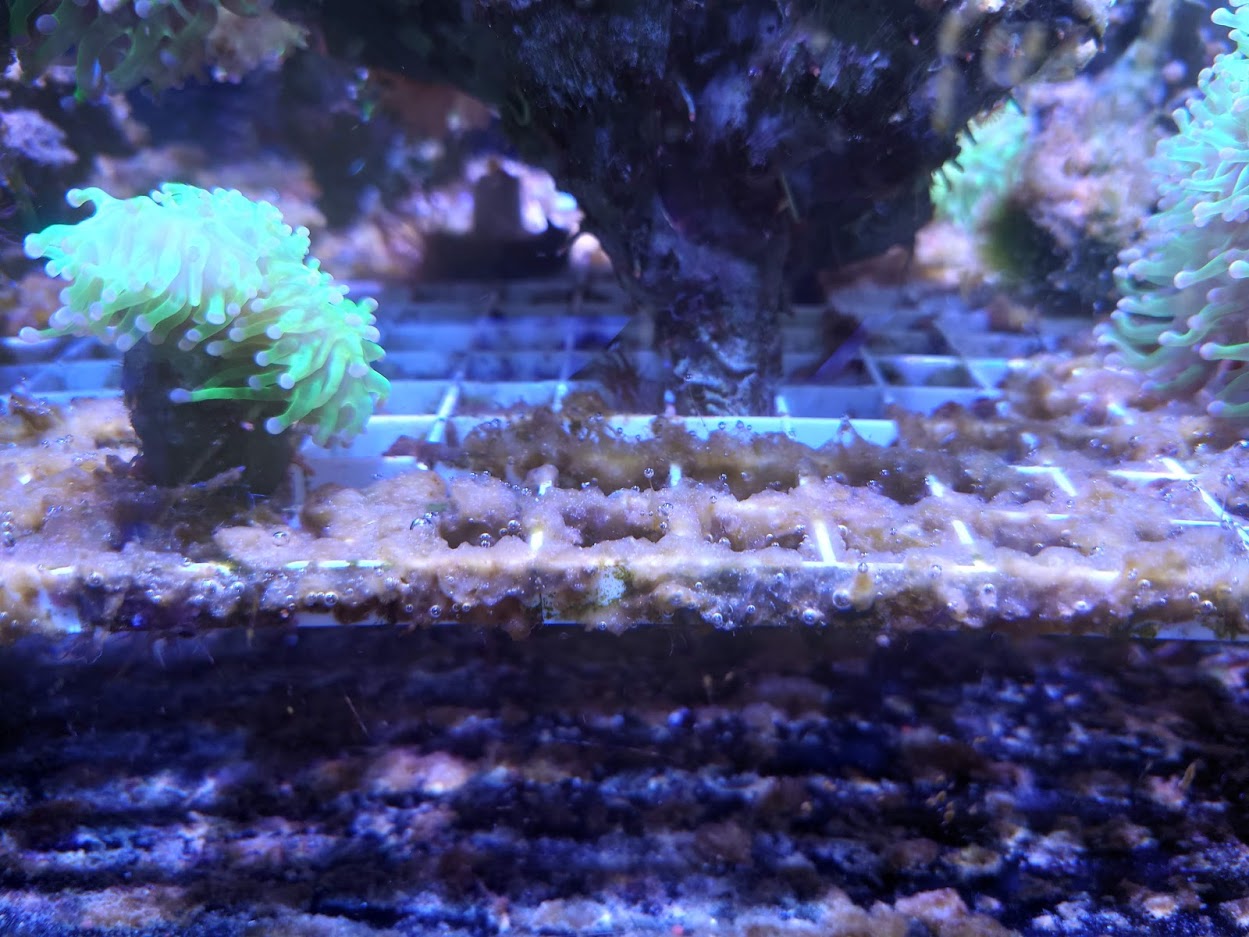
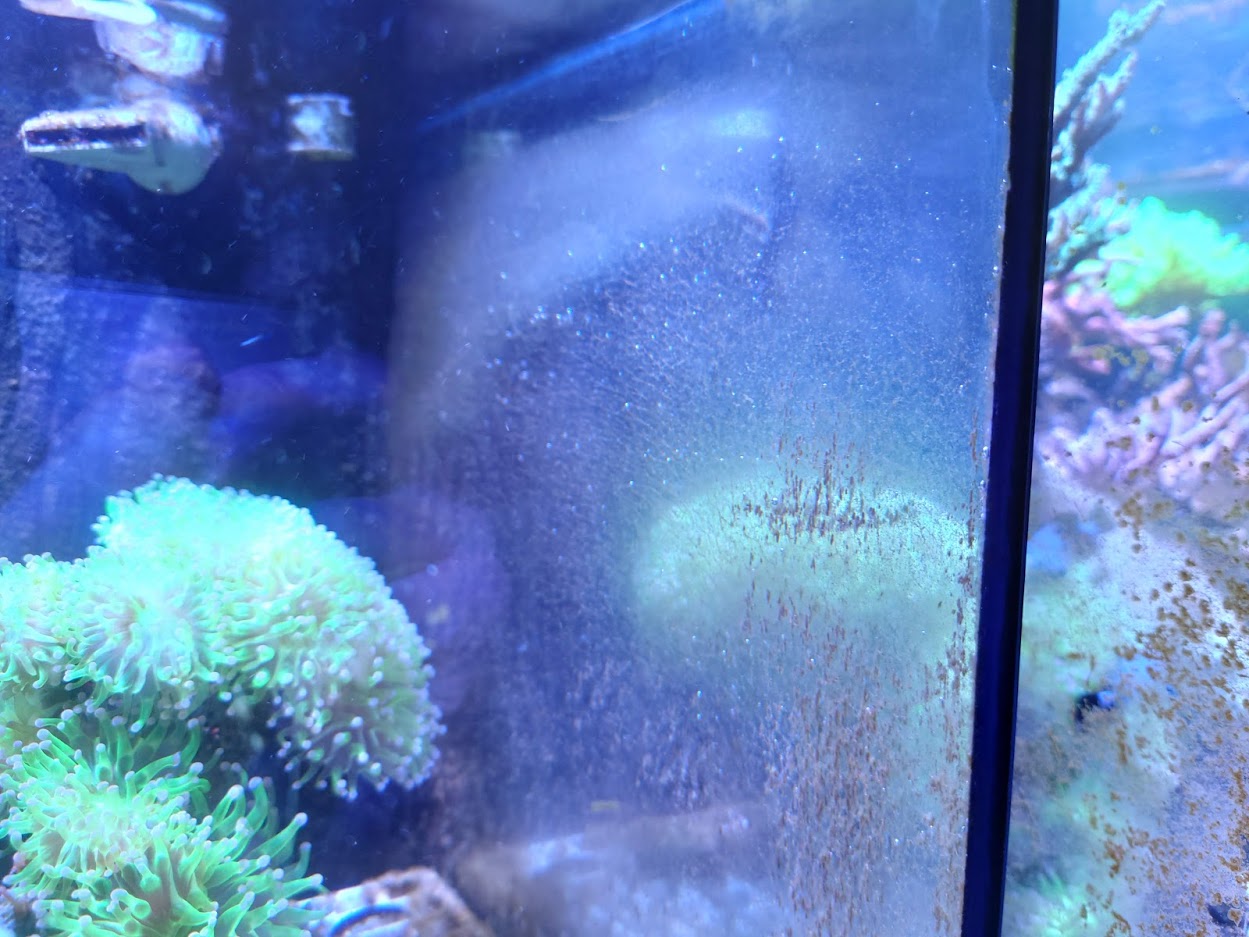
Is this Lyngbya?

OP
OP
ChuzUThisDay

ChuzUThisDay

Active Member
View Badges
Joined
May 2, 2016
Messages
286
Reaction score
156
Location
East Tennessee
Rating - 0%
0   0   0
I was asked how this turned out for me. The below information is what I shared:


I finally got rid of it by dosing peroxide into my tank daily. I started off with the minimum amount recommended (seems like I started with 10ml in my 125 gallon). Over the course of a few weeks, I started adding a little more. I honestly don't recall how much I ended up using daily, but I went through a 32 ounce container for my 125 gallon. I also would turn off my skimmer for about 30 minutes after adding the peroxide. I also skimmed wet, emptying my cup every two days. I ran a 7" 200 micron filter sock that I changed every two days as well. I believe the sock and skimmer helped to collect the nasties as they broke down.
I did pull a few rocks and scraped them with wire brushes and a rotary tool, rinsed them with tank water, dried as much as possible, sprayed them with peroxide, rinsed them again, then placed them back into the tank. They never grew the nasty stuff again. I constantly cleaned my glass and even wiped down what glass was above water with peroxide when I did a 50% water change. That seemed to slow down regrowth on the glass.

The only reactions to adding peroxide to the tank were the zoas/pallys would shrivel up within seconds of adding it. Within 10 minutes they would start to open up though. I just watched my tank and would decrease the amount of peroxide if it seemed off.

It can be beat without disassembling the whole tank and without scraping every rock as well. Like most things in a reef tank, it doesn't happen overnight. Good luck!
 

brandon429

what, exactly, are you doing in your avatar
View Badges
Joined
Dec 9, 2014
Messages
31,035
Reaction score
23,923
Location
tejas
Rating - 0%
0   0   0
Hey thank you for reminding me of a slam dunk work thread this is shocking reminder of the power of being cloud free and manually gardening.

I’m about to relink this thread to some active ones. Your update time frame is really rare to get thank you much

We kinda got lucky here if truly no growback occurred the whole time, that’s rare. Usually we do need follow ups, the grazers aren’t matched to the invader in these tanks and the whole point is that you can access to force clean, if you want to, without recycling or loss. you were so thorough in test modeling, knowing maximum work/outcome options that you learned how to control the invader with minimal effort

I thought your careful planning around shrimp use was really good to note, this is the #1 works example we have linked for study in the peroxide thread. Any and all updates appreciated
 
Last edited:
OP
OP
ChuzUThisDay

ChuzUThisDay

Active Member
View Badges
Joined
May 2, 2016
Messages
286
Reaction score
156
Location
East Tennessee
Rating - 0%
0   0   0
I hope that others can learn from what I went through/faced and really appreciate all of your info and help Brandon. I had never heard of using peroxide in an aquarium prior to you, and honestly thought you were crazy in the beginning. I can tell you though that peroxide is the trick to killing off algae and similar problems.

I had some 3% in a spray bottle and would spray my frag rack with it once a week or every couple of weeks as needed when algae would start on my frags or come back on the light diffuser. I never lost a frag from the peroxide, but lost a lot of algae!

However, the story of my tank is a sad one. I had an auto feeder that I used for vacation and it worked great. I loved that I could feed multiple times a day and not even be home to do so. Wanting to save time when work became busy, I continued to use the auto feeder. It worked well for a few months until something happened and it dumped a whole container of food into the tank. It was over a weekend and by Monday the ammonia sky rocketed and killed every fish and invert I had and started the demise of the coral. After removing all the death and performing a 50% water change, the ammonia was still off the chart for every test kit I used. Over the course of two weeks, many, many, many water changes, and a lot of heart ache, it all was lost.

I have two trash cans of rock that I cooked with heavy bleach, I've rinsed multiple times, allowed the rock to sit in the sun for a few days, rinsed again, then into the cans and filled with water. They've now been cooking in the cans with a powerhead for months awaiting the next evolution of the tank. I check on them once a month or so and the water is crystal clear and no debris in on the water, so I'm pretty sure there's nothing there to begin badly. I enjoy the hobby too much to stay away, so I know I'll be back after this break.

I still get email reminders and messages from fellow reefers, so feel free to comment or reach out with questions if needed. I'll likely be back in several months, but until then, have fun and keep the peroxide handy!
 

brandon429

what, exactly, are you doing in your avatar
View Badges
Joined
Dec 9, 2014
Messages
31,035
Reaction score
23,923
Location
tejas
Rating - 0%
0   0   0
That can happen to any of us friend so sorry! My own reef is recovering from going January - feb without a heater, nearly bleached, I didn’t know it was out
I thought my lfs was mixing poison water and killing my hard work but it was really just me not monitoring any single param/getting that rare sting on hardware

You documented resolve, that’s the enduring takeaway here it’s my fav work thread so far because the actions will cover the gamut of invasions in any tank where someone is willing to work. It doesn’t have to be anyone’s total method, also can be blended...hammer out an invasion then use precise tuning of nutrients and params to ward off invasions and support a diverse micro ecosystem. Imagine how strong the next go around will be though, you are armored now with design ability having just rec’d that one gut punch we’re all getting one day / hardware

The best thing anyone can do is design their reef to not need any of this.


And then if surgery is still required one day, a roadmap is clear. There is nothing wrong with using only natural means to fix invasions but much like we don’t want to wait 25 mins to download songs anymore there are much quicker ways of fixing up reefs. Your tank will fix many yes

I learned peroxide from reading a Justin Credabel article in 2010, got to take a pic w him at aquashella Dallas two mos ago that was a neat circle of events
 

GoVols

Cobb / Webb - 1989
View Badges
Joined
Nov 29, 2016
Messages
13,076
Reaction score
35,080
Location
In-The-Boro, TN
Rating - 0%
0   0   0
I was asked how this turned out for me. The below information is what I shared:


I finally got rid of it by dosing peroxide into my tank daily. I started off with the minimum amount recommended (seems like I started with 10ml in my 125 gallon). Over the course of a few weeks, I started adding a little more. I honestly don't recall how much I ended up using daily, but I went through a 32 ounce container for my 125 gallon. I also would turn off my skimmer for about 30 minutes after adding the peroxide. I also skimmed wet, emptying my cup every two days. I ran a 7" 200 micron filter sock that I changed every two days as well. I believe the sock and skimmer helped to collect the nasties as they broke down.
I did pull a few rocks and scraped them with wire brushes and a rotary tool, rinsed them with tank water, dried as much as possible, sprayed them with peroxide, rinsed them again, then placed them back into the tank. They never grew the nasty stuff again. I constantly cleaned my glass and even wiped down what glass was above water with peroxide when I did a 50% water change. That seemed to slow down regrowth on the glass.

The only reactions to adding peroxide to the tank were the zoas/pallys would shrivel up within seconds of adding it. Within 10 minutes they would start to open up though. I just watched my tank and would decrease the amount of peroxide if it seemed off.

It can be beat without disassembling the whole tank and without scraping every rock as well. Like most things in a reef tank, it doesn't happen overnight. Good luck!

This post saved my reef.

After identifying that is was Lyngbya
lyngbya-majuscula-1954a869-ab8f-4ab5-9653-edfbedc5c43-resize-750.jpg


Searched Reef 2 Reef and knew it was super bad and might be worse than dinos... :(

@brandon429 led me over here from another thread.

For the first time in many years, did a three-day black and dosed 2.2 mls to every 10 gallons (going off the display rating of 110 gallons) h2o2 every twelve hours.

The blackout with h2o2 sure did help, but it was still alive.

Kept up doing the 2.2 to 10 every twelve hours during daylight on and it still kept breaking down.

Once it really paled out, my Purple tang and Achilles tang took matters on from there, ripping it off the live rock.

My personal physician did call in 500mgs of Azithromycin, but truly happy that I never had to go that route.

Thanks so much for both you two to leave a trail on Reef 2 Reef.
 

brandon429

what, exactly, are you doing in your avatar
View Badges
Joined
Dec 9, 2014
Messages
31,035
Reaction score
23,923
Location
tejas
Rating - 0%
0   0   0
Hey did u know it’s the oddest thing in peroxide work, the triggering of grazers as if you painted the dying algae in whatever catnip is for fish


there is something about lysing cells breaking down that just attracts the grazers big time, a staunch pattern in any peroxide post pretty much. Before treatment, they might not even consider it

but after it’s blanched and sautéed and half bleached, yummy crack
 

GoVols

Cobb / Webb - 1989
View Badges
Joined
Nov 29, 2016
Messages
13,076
Reaction score
35,080
Location
In-The-Boro, TN
Rating - 0%
0   0   0
Hey did u know it’s the oddest thing in peroxide work, the triggering of grazers as if you painted the dying algae in whatever catnip is for fish


there is something about lysing cells breaking down that just attracts the grazers big time, a staunch pattern in any peroxide post pretty much. Before treatment, they might not even consider it

but after it’s blanched and sautéed and half bleached, yummy crack

I'm learning from my Purple tang with breaking down bubble algae and Lyngbya that it is very true.

When both paled out, he fired up like a bloodhound on a sent!

Thanks for verifying that you've watched the same thing, Brandon
 

disaster999

Well-Known Member
View Badges
Joined
Oct 22, 2007
Messages
522
Reaction score
249
Location
Hong Kong
Rating - 0%
0   0   0
i had this for a few years now...just didnt know how to get rid of it and nothing i did seem to work. Im going to try dosing peroxide as it doesnt seem to affect things in the tank that much. All I have are SPS and some LPS
 

TOP 10 Trending Threads

WHAT AMOUNT OF LIVE ROCK AND SAND SHOULD BE PRIORITIZED FOR OPTIMAL BIODIVERSITY/FILTRATION?

  • 100% live rock + bagged sand

    Votes: 38 26.6%
  • 100% dry rock + 100% live sand

    Votes: 48 33.6%
  • 50/50 live/dry rock, 50/50 live/bagged sand

    Votes: 32 22.4%
  • 75% live rock, 25% live sand

    Votes: 15 10.5%
  • 25% live rock, 75% live sand

    Votes: 10 7.0%
Back
Top