Follow along with the video below to see how to install our site as a web app on your home screen.
Note: This feature may not be available in some browsers.
way cheap. I think ill get all three and make a harem so one goes super male.


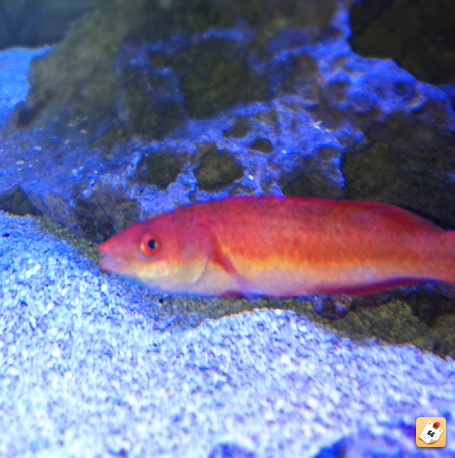
As stated on RC, it's either a McCosker's or a Yellow-fin (since you said it has one dorsal filament).
If the anal fin is red on the outer half -> McCoskers
If the anal fin is all yellow -> Yellow-fin
Regardless, it is a young male. In which case, you do NOT want to add another male of the same species. You could however add females of the same species, but females of any Paracheilinus species are hard to come by.
Hard to tell without dorsal fin extended, but it looks like a juvi male McCoskers fairy wrasse to me. Good looking fish.
No worries.Thank you, I figured I would post this both places to cover all bases. I am sure that the anal fin is red and there is one filament so McCoskers it is. I'm glad I asked now that I know it is a male, I will keep my eye out for a verified female. I see LA offers them but they are out of stock. If I can find a female do the pair easily or is there any tricks to that?
No worries.
Wrasses don't really "pair"; it's all about dominance and submission. But no, there's no "trick" per se; it's a male asserting his dominance over females.
Yes, the first fish is M. bipartitus (not geoffroy).
The second appears to be H. iridis (radiant), but that top down makes it hard to tell.
Male/Female difference is subtle. Males have bolder colors, especially in the dorsal and caudal fins (which also have more distinct patterns).
Cirrhilabrus rubripinnis. No sand required for Cirrhilabrus (fairy) wrasses.Sorry best I could do with my iPhone and a swimming fish lol. Bought as a red wrasse lol
Really is pretty good description lol probably 3" nose to tail, does not borrow in the sand that I have seen. But was in a bare bottom for a year and now in a tank with sand.
![]()
-Alex-
Female Cirrhilabrus of the lubbocki complex.