mangrove sprouts and leather toadstools can grow outdoors
Yes, it's been rained in. We live in San José, near a CalTrain + LRail station, by a heavily-trafficked street. I have bird feeders and many flowers, and flowers just fall in. I just leave them. Bugs too. Someone tried to tell me this would never work with bird feces and bugs. Now, I wouldn't say I'm an expert, aren't most reefs and mangrove estuaries outdoors?
We decided we no longer wished to live in this part of town, but it might be a bit of time until we actually move; that means we won't expand. Right now, the indoor tank is just sitting in the living room, empty. We decided that since we're planning to move anyway, rather than tear everything apart, we'll work on the tiny kitchen reef tank and this outdoor tank, as separate aquaria.
These poor mangrove plants die with a lot of people (speaking as someone who's grown a lot of plants, not so much as a reefer growing aquatic plants), and a lot of it is due to acclimitisation: there's the bit where people change the salinity too much, but what I wasn't aware of is that there may be gaps in knowledge in terms of handling these guys: don't float the saltwater ones temporarily in a freshwater tank, or they turn into desiccated sticks, as you can see below. I used to tie them to sticks I pushed into the water. I did that in my Taiwan home. Like all plants, roots are delicate, and it'll reduce their chances to survive if you agitate them. For aquatic and terrestrial plants (ornamentals and fruit), on I like sand. All I did was place them into Home Depot playground sand, which helps keep everyone steady, and the roots protected, and the bacteria and fungi stuff too:
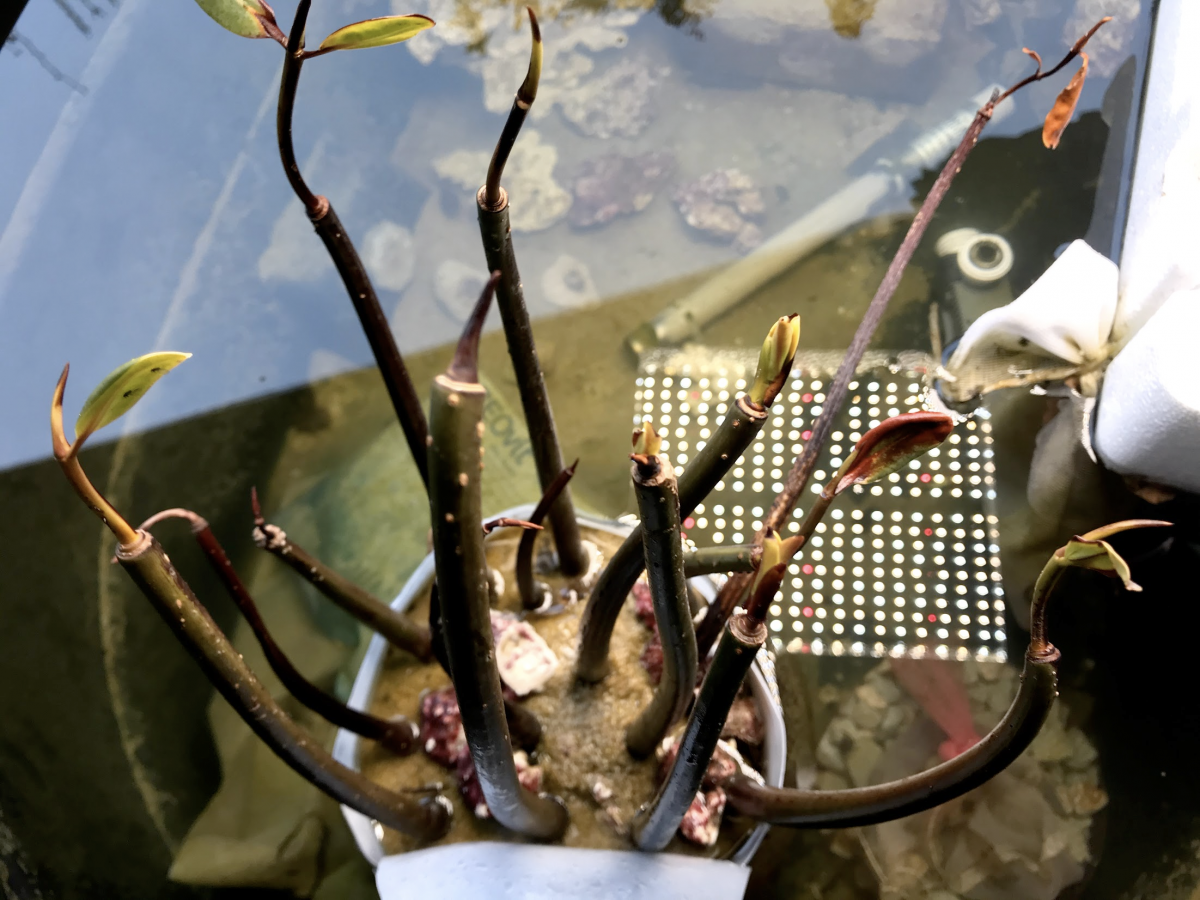
Literally, I recycled garbage, such as milk jugs, poked lots of holes all over, so the water level within the "planter" would mimic the water level in the watering trough. Right now, there is no ATO. I turn on a switch once every week to fill it up over a few hours, and that would be a swing of 33 to 36 PPT; at 2 week, it gets to 38 PPT, which is not great for the one coral. You can see the leaves tips are opening up. I tried to tune the lighting with a PAR metre, because Ryan and Randy from
BRSTV are right: more is not better. The right amount is better. A lot of people have been saying a good amount is fine, but there is no upper bound. I used to grow these guys outdoors using just the sun. There's a roof overhead and things blocking the sun at some hours, so I used a PAR metre to plot for 12 hours, what the PAR looks like, and adjusted my light output so we don't blast plants or corals with more than peak photoperiod. Then, I expanded the photoperiod to become 16/8: for me, that's ON at 10 am, and OFF at 2 am. The Fluval reef tank and other plant lighting in the house follow a similar shifted day-nite period.
This one came this way, but it's my favourite one:
There's a
BRS heater in there, that's tied to the
BRS thermostat. That, in turn, is tied to an inexpensive Smart Life, a Home-compatible smart socket, tied to monitoring weather conditions. If it's blazing hot outside, the heater shouldn't be on. (Plus, saying "Hey Google, turn on Mangrove Lights" is neat). If you track my project, this is all proof-of-concept. The end goal is to move out of San Jose in the Pacific coast area, with land to dig a big pond in the ground—kind of like a bigger version of what Julian Sprung did .. all hail Julian Sprung =o) However, how awesome would it be to create a mini version of those coastal wetlands at the edges of the SF Bay?
Yes, that's a KZ system: those are ZEOvits. Yes, I shook them the first few weeks. Now, it's kinda cold to be going outside shaking ZEOvits. I also use a ton of ceramic surfaces. I dose carbon (though I can't detect nitrates) various other KZ products—mostly the amino acids, bacteria, and other food items.
The only thing that wrecks the ecosystem is dosing too much of an amino acid that's gone rancid. This is on me, not Polyp Lab, but though the amino acid contains some nitrates or phosphates as a fresh product, it is not great if gone rancid. It didn't raise nitrates or phosphates, but made the water very tinted.
Not an experimental guinea pig. A loved leather toadstool, just like every other pet. Quite the contrary, I think the larger body of water brings better overall stability, even though normally we'd say 33-36 ppt range is bad (indoor tanks have it locked down just under 35, just over 34. But look. Growing. On sunlight.
Thanks for everyone's interest.
















