


Nitrogen Fixation in Cyanobacteria

Subsea

7500 Club Member
View Badges
Joined
Jun 21, 2018
Messages
8,927
Reaction score
11,558
Location
Austin, Tx
Rating - 0%
0   0   0
Why I don’t limit nitrogen or phosphorus in my mixed reef.

To further make the point, Cyanobacteria can assimilate free nitrogen gas and convert it to ammonia in a process called “nitrogen fixation”.

For this reason, opportunistic algae’s like Cyanobacteria & Dinoflagellets flourish when inorganic nitrogen & phosphate are limited.

Overview
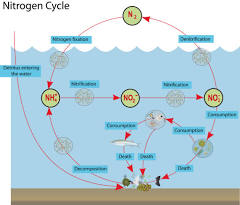

The marine nitrogen cycle | Words in mOcean


Nitrogen fixation in the marine environment is a critical, steady-state process that converts inert atmospheric nitrogen (N2) into bioavailable ammonia.

These processes are primarily driven by microorganisms called diazotrophs. It supports ocean productivity, particularly in nutrient-poor (oligotrophic) regions, by providing new nitrogen that fuels phytoplankton growth. Key nitrogen fixers include cyanobacteria like Trichodesmium and, surprisingly, non-cyanobacterial diazotrophs on marine 1772933935072.gif particles.

Key Nitrogen-Fixing Organisms
While traditionally attributed to a few cyanobacteria, the diversity of marine nitrogen-fixers is broader than previously thought.
  • Trichodesmium
    : A filamentous, colony-forming cyanobacterium responsible for nearly half of global marine nitrogen fixation, often forming large surface blooms.
  • Unicellular Cyanobacteria (UCYN)
    : Small, single-celled groups (UCYN-A, B, and C) that are widespread and often equal or exceed Trichodesmium in activity.
  • Symbiotic Diazotrophs
    : Organisms like
    Richelia
    that live inside or on the shells of diatoms, providing nitrogen in exchange for carbon and protection.


  • Non-Cyanobacterial Diazotrophs (NCDs)
    : Diverse heterotrophic bacteria and archaea that fix nitrogen in the dark, on sinking particles, or in the deep sea.
  • Nitroplasts
    : A recently discovered nitrogen-fixing organelle in certain marine algae (
    Braarudosphaera bigelowii
    ), representing an evolutionary transition from symbiont to organelle.

Environmental Drivers and Limitations
Nitrogen fixation is an energy-intensive process regulated by several physical and chemical factors.
  • Nutrient Availability: The enzyme nitrogenaserequires high amounts of iron (Fe)and phosphorus (P); limited supply of these elements often constrains fixation rates.
  • Oxygen Levels: Nitrogenase is inhibited by oxygen; diazotrophs use strategies like temporal separation (fixing at night) or specialized cells (heterocysts) to protect the enzyme.
  • Temperature: Most active diazotrophs prefer warm tropical and subtropical waters, though fixation has been detected in colder polar regions

 

Fish Fan

Master of Disaster
View Badges
Joined
Dec 8, 2017
Messages
12,922
Reaction score
33,638
Location
461 Ocean Boulevard
Rating - 100%
6   0   0
Nice write up, thank you for posting this!
 

CHSUB

2500 Club Member
View Badges
Joined
May 4, 2015
Messages
2,653
Reaction score
2,691
Location
Punta Gorda, FL
Rating - 0%
0   0   0
Agreed, trying to control algae and nuisance “slimes” with nutrient starvation is a nonstarter. Specifically since nearly all hobby testing lacks the resolution to show what low is, Salifert no3 tester for example, at its lowest reading is over 200% higher that most ocean reefs.

Borneman, imo, gives a great overview with documented scientific evidence of why closed systems with corals should be very concerned with nutrient levels.

“… in perhaps the most direct study on the subject, Marubini and Davies 1996, found that enriching water with nitrate for 30 days, doubled the zooxanthellae population, reduced photosynthetic rates and decreased skeletalgenesis by 50%. Other studies show that at higher levels there are toxic effects to coral. It is also very important to realize that even if nitrogen theoretically stimulates coral growth, there is usually no lack of nitrate in reef aquariums. Any aquarium is likely to have much higher levels than natural reef waters even if readings are very low. Because of the complex and still somewhat unknown mechanisms of coral metabolism, it is essential that those keeping corals do not use studies suggesting nitrate-enhanced growth as an excuse to not maintaining high-quality water, corals will not benefit from an intentional disregard of high nitrate levels, and the other effects of nitrogen enrichment within a close system may well become unmanageable.”
 
OP
OP
S

Subsea

7500 Club Member
View Badges
Joined
Jun 21, 2018
Messages
8,927
Reaction score
11,558
Location
Austin, Tx
Rating - 0%
0   0   0
CHSUB,

I am quite familiar with Boreneman. It’s been some time since I have read one of his book.

Marubini and Davies 1996

I am not familiar with this study and from what you posted, not impressed.

“there is usually no lack of nitrate in reef aquariums”

I dose ammonia so I don’t see that.

“it is essential that those keeping corals do not use studies suggesting nitrate-enhanced growth as an excuse to not maintaining high-quality water, corals will not benefit from an intentional disregard of high nitrate levels, and the other effects of nitrogen enrichment within a close system may well become unmanageable.”

It’s hard for me to see this as objective. Very opinionated.

Because of the complex and still somewhat unknown mechanisms of coral metabolism”

Considering what we know about coral metabolism today, I see the above statement as an example of incompetent honesty.


I am sure there is more if this is a scientific peer reviewed article, but I have read too much of it already.
 
OP
OP
S

Subsea

7500 Club Member
View Badges
Joined
Jun 21, 2018
Messages
8,927
Reaction score
11,558
Location
Austin, Tx
Rating - 0%
0   0   0
@CHSUB
Let’s park here:

“Agreed, trying to control algae and nuisance “slimes” with nutrient starvation is a nonstarter. Specifically since nearly all hobby testing lacks the resolution to show what low is, Salifert no3 tester for example, at its lowest reading is over 200% higher that most ocean reefs.”

Wild Reefs operate with the microbial loop which moves carbon up to higher trophic levels. Particulate organic carbon & dissolved organic carbon feed the wild reef. I emulate nature and encourage diversity of micro fauna & fana that establish multiple food webs.

“Borneman, imo, gives a great overview with documented scientific evidence of why closed systems with corals should be very concerned with nutrient levels”

What is Borneman’s concern? Your point is unclear to me, please elaborate.
 

Randy Holmes-Farley

Reef Chemist
View Badges
Joined
Sep 5, 2014
Messages
89,263
Reaction score
92,306
Location
Massachusetts, United States
Rating - 0%
0   0   0
It would be interesting if we knew under what circumstances cyano found it more beneficial to fix N2 than get it from other sources. Certainly, at some low enough availability of N from various sources (nitrate, ammonia, organics, etc) it would, but if and when that happens in reef aquaria is, IMO, a question that we do not presently know the answer to. :)
 
OP
OP
S

Subsea

7500 Club Member
View Badges
Joined
Jun 21, 2018
Messages
8,927
Reaction score
11,558
Location
Austin, Tx
Rating - 0%
0   0   0
It would be interesting if we knew under what circumstances cyano found it more beneficial to fix N2 than get it from other sources. Certainly, at some low enough availability of N from various sources (nitrate, ammonia, organics, etc) it would, but if and when that happens in reef aquaria is, IMO, a question that we do not presently know the answer to. :)
Randy,
What I find amazing about Cyanobacteria feeding strategies is a DNA code with an ability for bacteria using gene expression to crosstalk and adjust environmental parameters.

Years ago, I read an article, which I attributed to you, about how Cyanobacteria mats removed sequestered ortho phosphate from reef tank sediments by using a biofeedback loop to adjust chemistry. As a control systems engineer for well control in deep water drilling, I was intrigued with the idea of bugs operating a positive feedback loop to enhance their world. A young microbiologist I knew coined the term “microbial overlords”.

Now, I see substantial research in the area of the Coral Holibiont.

For certain, the more I learn; the more I realize how little I know.
 

CHSUB

2500 Club Member
View Badges
Joined
May 4, 2015
Messages
2,653
Reaction score
2,691
Location
Punta Gorda, FL
Rating - 0%
0   0   0
Your point is unclear to me, please elaborate
J. Sprung statement on no3 over 30 years ago clearly defined my beliefs.

‘’… public aquariums, as well as home aquariums have demonstrated quite plainly that fish and invertebrates not only tolerate high nitrate levels, they can thrive in waters with high nitrates… many Reef aquariums have naturally low nitrate levels less than 1 PPM despite good fish populations in regular feeding.”

I can quite plainly see in my aquariums that “low” nitrates are not keeping my aquariums from being at its best. Testing 0 or clear with Salifert NO3 hobby test kit is only a confirmation that my aquarium ecosystem is functioning properly. I prefer “low” levels but do nothing particular to achieve low levels, only good maintenance and a properly functioning system. I’m certainly not going to believe low levels of nitrates need to be “fixed”.
 
OP
OP
S

Subsea

7500 Club Member
View Badges
Joined
Jun 21, 2018
Messages
8,927
Reaction score
11,558
Location
Austin, Tx
Rating - 0%
0   0   0
J. Sprung statement on no3 over 30 years ago clearly defined my beliefs.

‘’… public aquariums, as well as home aquariums have demonstrated quite plainly that fish and invertebrates not only tolerate high nitrate levels, they can thrive in waters with high nitrates… many Reef aquariums have naturally low nitrate levels less than 1 PPM despite good fish populations in regular feeding.”

I can quite plainly see in my aquariums that “low” nitrates are not keeping my aquariums from being at its best. Testing 0 or clear with Salifert NO3 hobby test kit is only a confirmation that my aquarium ecosystem is functioning properly. I prefer “low” levels but do nothing particular to achieve low levels, only good maintenance and a properly functioning system. I’m certainly not going to believe low levels of nitrates need to be “fixed”.
“Proper functioning system” to me indicates coral recycling nutrients.

I have zero nutrient export in my systems, yet nitrate is undetectable, so I dose ammonia.
 
OP
OP
S

Subsea

7500 Club Member
View Badges
Joined
Jun 21, 2018
Messages
8,927
Reaction score
11,558
Location
Austin, Tx
Rating - 0%
0   0   0
“I have zero nutrient export in my systems, yet nitrate is undetectable, so I dose ammonia.“

As I further thought on this, I know I have bacteria in low oxygen environments that perform denitrification chemistry to scavenge oxygen from nitrate molecule and release free nitrogen gas. I don’t know of a way to calculate this. In Reef Aquarium, Volume 3, Julian Sprung describes the process as “coupled” where nitrification and denitrification happen in close proximity of each other.

PS
As a municipal waster water superintendent operating oxidation pods, we used the same bacteria (Faculative) to perform nitrification & denitrification chemistry.

Aerobic and anaerobic bacteria can be identified by growing them in test tubes of thioglycolate broth:
1: Obligate aerobes need oxygen because they cannot ferment or respire anaerobically. They gather at the top of the tube where the oxygen concentration is highest.
2: Obligate anaerobes are poisoned by oxygen, so they gather at the bottom of the tube where the oxygen concentration is lowest.
3: Facultative anaerobes can grow with or without oxygen because they can metabolise energy aerobically or anaerobically. They gather mostly at the top because aerobic respiration generates more ATP than fermentation.
4: Microaerophiles need oxygen because they cannot ferment or respire anaerobically. However, they are poisoned by high concentrations of oxygen. They gather in the upper part of the test tube but not the very top.

5: Aerotolerant anaerobes do not require oxygen as they use fermentation to make ATP. Unlike obligate anaerobes, they are not poisoned by oxygen. They can be found evenly spread throughout the test tube.
 
Last edited:

TOP 10 Trending Threads

WHAT AMOUNT OF LIVE ROCK AND SAND SHOULD BE PRIORITIZED FOR OPTIMAL BIODIVERSITY/FILTRATION?

  • 100% live rock + bagged sand

    Votes: 37 27.2%
  • 100% dry rock + 100% live sand

    Votes: 46 33.8%
  • 50/50 live/dry rock, 50/50 live/bagged sand

    Votes: 30 22.1%
  • 75% live rock, 25% live sand

    Votes: 13 9.6%
  • 25% live rock, 75% live sand

    Votes: 10 7.4%
Back
Top






