


"Redirecting" the uglies

Johnd651

Getting back in after 14+ years
View Badges
Joined
Oct 29, 2019
Messages
4,866
Reaction score
7,008
Location
Upstate NY
Rating - 100%
1   0   0
So, redirecting may not be the best term, but I am just thinking out loud, trying to see if there's any logic to this thought.

I have been thinking about some of the posts and videos I found corelating the uglies, biome, competion for nutrients, light, and new tanks.

If the uglies are dependent on the amount of good vs bad bacteria present, and nutrients such as silicates being used up in the presence of light, how would that be affected if instead of running lights on the main display, you ran them on the sump instead?

Would that give the good bacteria time to colonize and the uglies could be controlled in the sump, almost like an algea reactor?

How does something like 4 year old used live rock ( cleaned before being reused) compare nutrient wise to new rock?

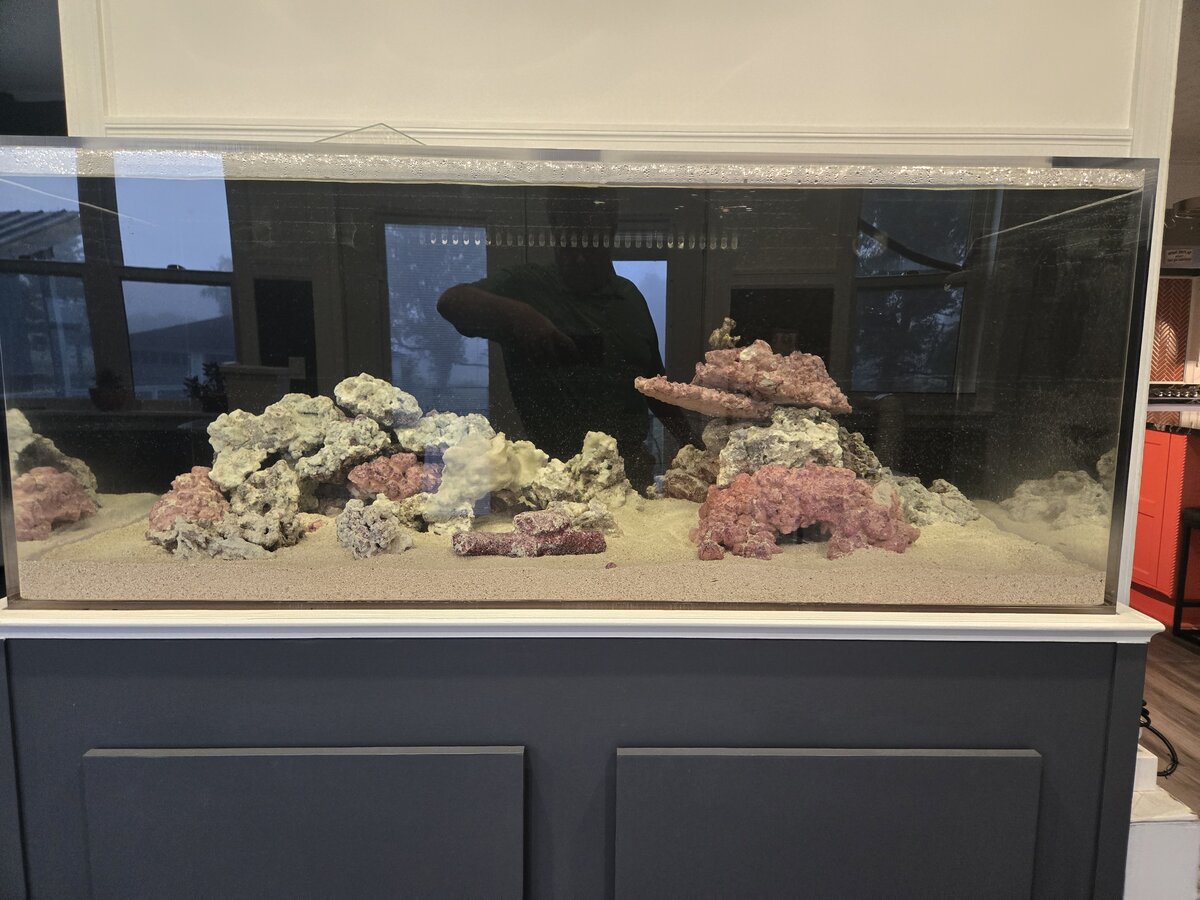
Pic of tank with fish only at the moment.
1000023461.jpg
 

bluemon

Lazy DIY Reefer
View Badges
Joined
Jun 20, 2017
Messages
2,620
Reaction score
2,507
Location
California
Rating - 0%
0   0   0
As long as the dry rock in the Display tank is then exposed to light at some point in the near future, the ugly phase will still happen.

The only way I can imagine you skipping it is really having it mature in the DT over a long time and a good seeder live rock.

Even then I believe photosynthetic organisms that cause the ugly phase must use different trace elements within the rock that means even a mature rock that was “pre cycled” in darkness would still get quite some algae build up when light is introduced
 
Upvote 0
OP
OP
Johnd651

Johnd651

Getting back in after 14+ years
View Badges
Joined
Oct 29, 2019
Messages
4,866
Reaction score
7,008
Location
Upstate NY
Rating - 100%
1   0   0
As long as the dry rock in the Display tank is then exposed to light at some point in the near future, the ugly phase will still happen.

The only way I can imagine you skipping it is really having it mature in the DT over a long time and a good seeder live rock.

Even then I believe photosynthetic organisms that cause the ugly phase must use different trace elements within the rock that means even a mature rock that was “pre cycled” in darkness would still get quite some algae build up when light is introduced
So i am not at all saying skip the uglies. I am saying if it is light dependent, would having the light elsewhere ie sump, move that reaction? Or are you saying that the algea must physically "suck" on the rock for the trace elements? Which if that is the case, why can't ocerseeding control competion?
 
Upvote 0
OP
OP
Johnd651

Johnd651

Getting back in after 14+ years
View Badges
Joined
Oct 29, 2019
Messages
4,866
Reaction score
7,008
Location
Upstate NY
Rating - 100%
1   0   0
In no way, shape, or form do I think I have the magic formula for the uglies. It's just 11 PM and my mind is questioning some of what I have read.
 
Upvote 0

bluemon

Lazy DIY Reefer
View Badges
Joined
Jun 20, 2017
Messages
2,620
Reaction score
2,507
Location
California
Rating - 0%
0   0   0
So i am not at all saying skip the uglies. I am saying if it is light dependent, would having the light elsewhere ie sump, move that reaction? Or are you saying that the algea must physically "suck" on the rock for the trace elements? Which if that is the case, why can't ocerseeding control competion?

I don’t know if the algae actually “suck” elements from their substrate like actual plants do, but algae are limited as well by real estate.

If you introduce new rock, for example, to an established tank, it will go through a mini ugly phase, with diatoms and then more traditional algae.
 
Upvote 0

sjfishguy

Active Member
View Badges
Joined
Nov 18, 2016
Messages
221
Reaction score
177
Rating - 0%
0   0   0
I have always taken rock and soaked it a 5 gal bucket with di water for a few days. Then pour in lanthinum chloride, give it another day, then pour it all out and start over. Keep doing this until the lanthinum no longer turns the water cloudy. You have then leached all the phosphate out. Then use the rock. In my 20 years I have never had cyano or hair algae or anything else using rock when prepared this way
 
Upvote 0

bluemon

Lazy DIY Reefer
View Badges
Joined
Jun 20, 2017
Messages
2,620
Reaction score
2,507
Location
California
Rating - 0%
0   0   0
I have always taken rock and soaked it a 5 gal bucket with di water for a few days. Then pour in lanthinum chloride, give it another day, then pour it all out and start over. Keep doing this until the lanthinum no longer turns the water cloudy. You have then leached all the phosphate out. Then use the rock. In my 20 years I have never had cyano or hair algae or anything else using rock when prepared this way
I wouldn’t do this with lanthanium chloride.


Their precipitate is really dangerous for fish as it binds to their gills. If you don’t properly get everything out, you will kill animals.

If you want phosphates leeched out, just do a water change? Or put in a GFO reactor
 
Upvote 0
OP
OP
Johnd651

Johnd651

Getting back in after 14+ years
View Badges
Joined
Oct 29, 2019
Messages
4,866
Reaction score
7,008
Location
Upstate NY
Rating - 100%
1   0   0
I don’t know if the algae actually “suck” elements from their substrate like actual plants do, but algae are limited as well by real estate.

If you introduce new rock, for example, to an established tank, it will go through a mini ugly phase, with diatoms and then more traditional algae.
Yes, but it's usually on that new rock. So if the lights were removed and rock added, would the elements disapate over x amount of time?

Based on @sjfishguy method, I would say yes?
 
Upvote 0

bluemon

Lazy DIY Reefer
View Badges
Joined
Jun 20, 2017
Messages
2,620
Reaction score
2,507
Location
California
Rating - 0%
0   0   0
I don’t know if the algae actually “suck” elements from their substrate like actual plants do, but algae are limited as well by real estate.

If you introduce new rock, for example, to an established tank, it will go through a mini ugly phase, with diatoms and then more traditional algae.
Yes, but it's usually on that new rock. So if the lights were removed and rock added, would the elements disapate over x amount of time?

Based on @sjfishguy method, I would say yes?
It would help, but not entirely.

If you introduce a rock that theoretically has 0 phosphates in it, the moment you introduce it to a tank, phosphates will also leech back into the rock to equilibrium.

The rock has to have a mature benign biofilm on it to block algae, in a sense. That can work to a degree but you’ll still get some algae growth with introduction of light
 
Upvote 0
OP
OP
Johnd651

Johnd651

Getting back in after 14+ years
View Badges
Joined
Oct 29, 2019
Messages
4,866
Reaction score
7,008
Location
Upstate NY
Rating - 100%
1   0   0
It would help, but not entirely.

If you introduce a rock that theoretically has 0 phosphates in it, the moment you introduce it to a tank, phosphates will also leech back into the rock to equilibrium.

The rock has to have a mature benign biofilm on it to block algae, in a sense. That can work to a degree but you’ll still get some algae growth with introduction of light
So the idea that there has to be a bio film vs free floating makes the uglies theory make more sense.
 
Upvote 0

mcarroll

10K Club member
View Badges
Joined
Jan 8, 2012
Messages
15,213
Reaction score
8,968
Location
Virginia
Rating - 0%
0   0   0
The foundational issue withe "the uglies" is that we are creating ideal conditions for photosynthetic lifeforms.

Algae and corals love the same conditions.

The catch is that algae is a superior competitor by about two miles...omnipresent airborn spores, the ability to gain nutriens from the water or from rootlets, the ability to create massive quantities of spores once established. Their spores are highly successful at populating well-lit, bare aragonite sites in the tank this way.

A UV or micron filter will help with this by minimizing the number of spores that survive long enough to settle.
A fleet of herbivorous snails will help since they mow down newly sprouted spores with gusto.

But making the aragonite surface itself less hospitable is a sneakier way to confront the uglies. Having the rock fully populated with corals reduces the available area for spores to almost zero. Having the rock fully populated with coralline algae also reduces the available area to almost zero. Though possible, both of those can be tricky to pull off in a new tank. Another option is letting the rock mature in the dark, but with all the non-photosynthetic critters added. Even un-lit, the rock is going to develop a periphyton layer that should be more resistant to spore settlement than bare aragonite.

As others have said, no approach is going to be perfect....algae are highly competitive and very successful for very good reasons! Respect!!!!
 
Upvote 0

mcarroll

10K Club member
View Badges
Joined
Jan 8, 2012
Messages
15,213
Reaction score
8,968
Location
Virginia
Rating - 0%
0   0   0
Worth adding that every wild reef has copious algae and cyano living among/between the corals on it.

So alage isn't out of place when it blooms in our reef tanks....it's just (temporarily) out of balance.

BTW there might some articles related to algae here that you haven't bumped into before....stuff I bumped into and saved.
 
Upvote 0

sjfishguy

Active Member
View Badges
Joined
Nov 18, 2016
Messages
221
Reaction score
177
Rating - 0%
0   0   0
I have always taken rock and soaked it a 5 gal bucket with di water for a few days. Then pour in lanthinum chloride, give it another day, then pour it all out and start over. Keep doing this until the lanthinum no longer turns the water cloudy. You have then leached all the phosphate out. Then use the rock. In my 20 years I have never had cyano or hair algae or anything else using rock when prepared this way
I wouldn’t do this with lanthanium chloride.


Their precipitate is really dangerous for fish as it binds to their gills. If you don’t properly get everything out, you will kill animals.

If you want phosphates leeched out, just do a water change? Or put in a GFO reactor
By the time you are done, there is no lanthinum chloride “dust” left. It’s no problem. Now keep in mind, it will grow the normal green film algae before getting coraline. But I have never had cyano or GHA. One exception was when I added a rock once where I didn’t do this. Battled HA on that one rock until I finally took it out and did the process
 
Upvote 0

sjfishguy

Active Member
View Badges
Joined
Nov 18, 2016
Messages
221
Reaction score
177
Rating - 0%
0   0   0
Also, I tired to the same with running GFO before. Just takes longer and more expensive.
 
Upvote 0

Euphyllia97

FOWLR and reef member
View Badges
Joined
Oct 22, 2019
Messages
1,026
Reaction score
1,493
Location
Belgium
Rating - 0%
0   0   0
Watch the biome cycle experiment from BRStv on youtube if you want to have a very interesting and scientific look at the different strategies. In a nutshell, the tank is always finding a balance and is constantly a biological warfront.

The ugliest we refer to are photosynthetic and can be kept in check by keeping light reduced and yes If you blast your sump with LED’s, you will see an explosion of these photosynthetic uglies there. However if you turn on the lights in your display tank it is not going to keep your display more noticeable clean.

However I do believe if you are setting up your tank and you keep the DT dark and you run lights on the sump, the natural predators of these “uglies” will have a chance of developing in the sump and will increase the “resistance” against uglies in your DT once you decide to turn on the lights. (This is compared to when you would run the sump with no lights).

The biodiversity in your tank is way more than just bacteria. Make sure you study the natural predators of each photosynthetic ugly and make sure you win that battle as soon as possible. (Introduce copepods, snails, crabs, fish that take care of certain pests).

Always remember it is about finding a balance, the ocean has all the nasty stuff you can think about, but as the system is more or less balanced out in a natural way it looks to be clean.

From the brs experiment I remember the best way of cycling a tank and having the least problems with uglies is using rock rubble from a cycled/stable tank that was kept in the dark. Biodiversity was proven to be increased significantly by using reef mud “Aquaforest Live source”.
 
Upvote 0
OP
OP
Johnd651

Johnd651

Getting back in after 14+ years
View Badges
Joined
Oct 29, 2019
Messages
4,866
Reaction score
7,008
Location
Upstate NY
Rating - 100%
1   0   0
Watch the biome cycle experiment from BRStv on youtube if you want to have a very interesting and scientific look at the different strategies. In a nutshell, the tank is always finding a balance and is constantly a biological warfront.

The ugliest we refer to are photosynthetic and can be kept in check by keeping light reduced and yes If you blast your sump with LED’s, you will see an explosion of these photosynthetic uglies there. However if you turn on the lights in your display tank it is not going to keep your display more noticeable clean.

However I do believe if you are setting up your tank and you keep the DT dark and you run lights on the sump, the natural predators of these “uglies” will have a chance of developing in the sump and will increase the “resistance” against uglies in your DT once you decide to turn on the lights. (This is compared to when you would run the sump with no lights).

The biodiversity in your tank is way more than just bacteria. Make sure you study the natural predators of each photosynthetic ugly and make sure you win that battle as soon as possible. (Introduce copepods, snails, crabs, fish that take care of certain pests).

Always remember it is about finding a balance, the ocean has all the nasty stuff you can think about, but as the system is more or less balanced out in a natural way it looks to be clean.

From the brs experiment I remember the best way of cycling a tank and having the least problems with uglies is using rock rubble from a cycled/stable tank that was kept in the dark. Biodiversity was proven to be increased significantly by using reef mud “Aquaforest Live source”.
So i do have @Aquaforest mud that I will be using in part with their Kickstart method.
 
Upvote 0

TOP 10 Trending Threads

WHAT AMOUNT OF LIVE ROCK AND SAND SHOULD BE PRIORITIZED FOR OPTIMAL BIODIVERSITY/FILTRATION?

  • 100% live rock + bagged sand

    Votes: 34 26.6%
  • 100% dry rock + 100% live sand

    Votes: 45 35.2%
  • 50/50 live/dry rock, 50/50 live/bagged sand

    Votes: 28 21.9%
  • 75% live rock, 25% live sand

    Votes: 11 8.6%
  • 25% live rock, 75% live sand

    Votes: 10 7.8%
Back
Top










