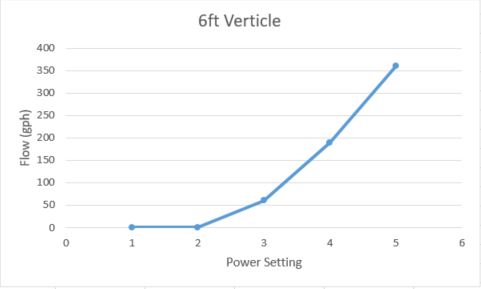
Reef Octopus VarioS-8 - Flow vs Height test results

Skep18

Valuable Member
View Badges
Joined
Feb 3, 2018
Messages
1,229
Reaction score
948
Location
Southeast US
Rating - 100%
1   0   0
So I am setting up a 225gal tank. For a return pump I ordered a Reef Octopus VarioS-8 return pump. I've watched all those videos that generalize to say, "expect 50% flow from advertised amount on your return pumps." I totally get that and took that into consideration when selecting a unit. The VarioS-8 advertises a max flow of 2700gph. Half that is still 1350gph. 2-5x my display volume (209gal empty) is 418gal to 1045gal. So even if I want to flow 1045gph through my sump, this pump should have the head room. Keyword here is should...

I setup my plumbing and leak tested the tank. In doing this I noticed my return bulkheads looked like they really weren't flowing much. I made it a point to run 1.25" plumbing throughout the return plumbing, never necking down lower than that as this is RO's recommendation.

Thinking maybe I have too many elbows and such in my system, I setup a sort of a test bench to get some quantitative data from the pump. I figured then I could use this to not only get a visual reference of a given flow rate but also compare the results to the advertised RO VarioS-8 flow rate graph.

RO advertised VarioS-8 flow rate graph:
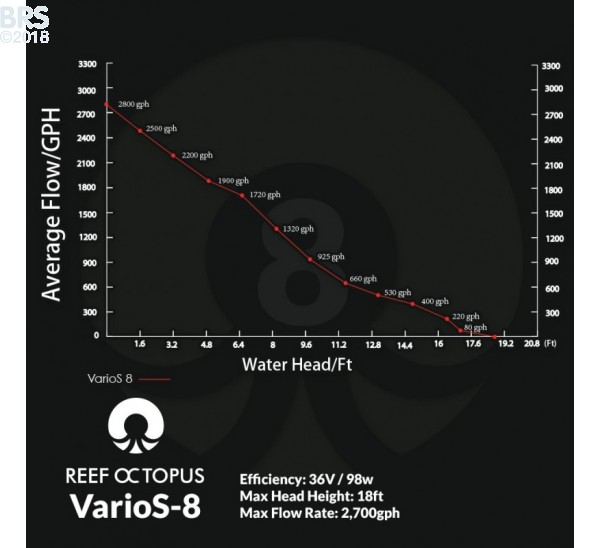
flow-chart-v8.jpg

In my setup I used 1.25" PVC measured from the pump outlet. At the pipe outlet I ran a 90deg fitting to redirect the water so I could catch it. This was included in the calculator. I also ran a 45deg fitting after that but at that point the water was trickling out most of the time so I left that off. (for reference, when I did add it in, it added roughly 1ft of head pressure to the calculated value.)

Here's a glimpse at the test setup. Pump is in the pool, filled to pump discharge. 1gal container in-hand. I caught the water on video and recorded time stamps to get my fill time for each data point:
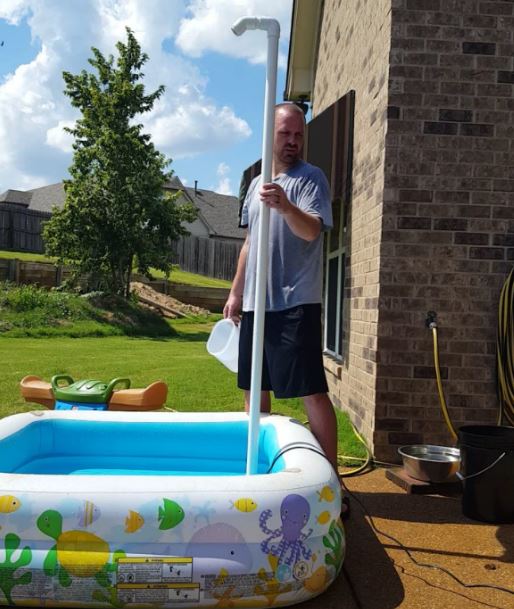
Capture.JPG

Well, I must say, I am terribly disappointed with the results. Understanding the graph uses a "water head" for the X-axis, I ran my numbers through a head loss calculator to get the calculated head loss for each.

Here were my calculated head loss results:

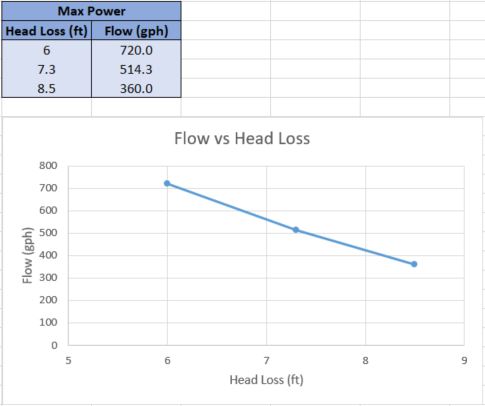
6ft verticle lift - 8.5ft head loss
5ft verticle lift - 7.3ft head loss
4ft verticle lift - 6.0ft head loss​

I will say, there was some circular logic that didn't make sense to me when using head loss calculators. That is they request you enter a flow rate. Having to give a flow rate to determine your head loss and thus use the RO graph to get your flow rate kinda didn't make sense to me... As such, I proceeded to assume the input flow rate was that as delivered by the pump outlet. In this scenario it would be the RO VarioS-8 at max power, 0ft so 2700gph.


Without further ado, here were my test results:
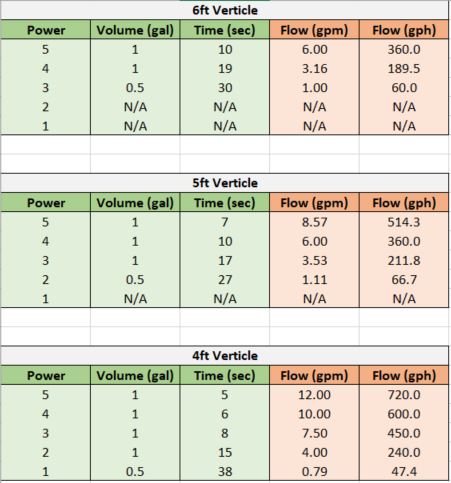
test results.JPG

And some rearranging to show some comparable and recognizable graph results:
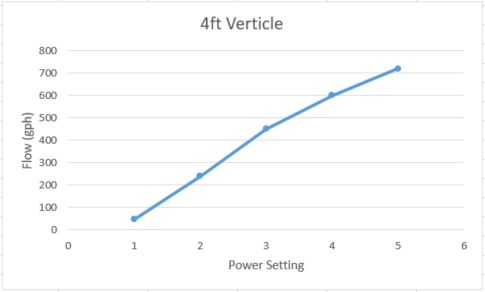
4ft.JPG


5ft.JPG


6ft.JPG

And the following represent the pump at the maximum power setting (5).

Flow vs Lift.JPG


Flow vs Head Loss.JPG

Unfortunately, I'm feeling this pump is just not going to do it for me. Hopefully others can use this data to better understand what they're buying into before settling on a decision. If @Jeremy@CoralVue wanted to chime in, I'd love to hear some more on RO's representation of their product and/or how they came about the numbers in their graph. However, at this point I'm kinda feeling like I wasted $375.
 
Last edited:

wiselyy73

Active Member
View Badges
Joined
Nov 15, 2017
Messages
307
Reaction score
84
Rating - 0%
0   0   0
Thanks for sharing was thinking about getting one because it’s compatible with Apex.
 
OP
OP
Skep18

Skep18

Valuable Member
View Badges
Joined
Feb 3, 2018
Messages
1,229
Reaction score
948
Location
Southeast US
Rating - 100%
1   0   0
Thanks for sharing was thinking about getting one because it’s compatible with Apex.

There seems to be a lot of positive to this pump if it meets your flow requirements. Even at 100% its super quiet. In the back of my mind I'm hoping I'll find something wrong with it to be fixed or whatever but something tells me I might just be outta luck...
 

wangspeed

Well-Known Member
View Badges
Joined
Feb 10, 2014
Messages
721
Reaction score
559
Rating - 0%
0   0   0
Those numbers look off to me based on my Varios 8. I have mine plumbed into 2” line so I can use a 2” flow meter. A bit after that it splits into 2 1” lines. A total of 3 90 degree turns in each 1” section. I run my pump at the 2 setting and get 720-730 gph. Maybe 5 ft of vertical height, not including loss from piping.
 

wangspeed

Well-Known Member
View Badges
Joined
Feb 10, 2014
Messages
721
Reaction score
559
Rating - 0%
0   0   0
I have a second Varios8 that runs a UV sterilizer and in-line heater. I literally cannot make it flow slow enough. I had to add a ball valve at the end of the run. Granted it’s 0 head pressure since it’s essentially a loop, still I get 500 gph through 1” piping on the 1 setting.
 

mcarroll

10K Club member
View Badges
Joined
Jan 8, 2012
Messages
15,213
Reaction score
8,968
Location
Virginia
Rating - 0%
0   0   0
"expect 50% flow from advertised amount on your return pumps."

That's definitely not how to do it. :D

In a nutshell:

How long is your plumbing run in total feet?
How high is the water being pumped?
How many fittings (be specific with types) and how many exits and reducers?

The height is your basic limitation – the pump has to defeat gravity.

But the friction of the water flowing through the system also has to be overcome.


Take that data to a friction loss calculator like this:
http://www.freecalc.com/fric.htm

  • Let's say your return pump has to bring the water up 5' through a total of 7' of plumbing. Pretty typical for a normal setup on a normal stand.
  • Let's say that it take 4 90º elbows to get it there.
  • We'll compare 1" to 1.25" plumbing.
  • For a 220g you'll need anywhere from 500-1000 GPH. (8-16 gpm)
Here's the result for 1" plumbing @ 500gph.....almost no added pressure on top of the 7'...compare with the pump's flow curve to see the actual flow you can expect at this level:
Liquid Friction Pressure Loss
Pressure Loss (psi): 0.23 Head Loss (ft): 0.5
Line Number:
Date: 7/12/2018
Nominal Pipe Size: 1
Pipe Schedule: SCH 40
Flow Rate (gpm): 8
Viscosity (cP): 1
Specific Gravity (water=1): 1.025
Temperature (F): 79
Pipe Roughness (ft): 0.000016
Actual Pipe ID (in.): 1.049
Fluid Velocity (ft/sec): 2.97
Reynolds Number: 24722
Flow Region: Turbulent
Friction Factor: 0.025
Overall K: 3.84
Piping Length (ft): 7
Short Radius Elbows: 4

Here's the flow through 1" @ 1000 gph....added pressure quadruples to 2' bringing total head pressure to 9' (compare with curve):
Liquid Friction Pressure Loss
Pressure Loss (psi): 0.87 Head Loss (ft): 2
Line Number:
Date: 7/12/2018
Nominal Pipe Size: 1
Pipe Schedule: SCH 40
Flow Rate (gpm): 16
Viscosity (cP): 1
Specific Gravity (water=1): 1.025
Temperature (F): 79
Pipe Roughness (ft): 0.000016
Actual Pipe ID (in.): 1.049
Fluid Velocity (ft/sec): 5.94
Reynolds Number: 49444
Flow Region: Turbulent
Friction Factor: 0.022
Overall K: 3.57
Piping Length (ft): 7
Short Radius Elbows: 4

FYI, going up to 2000 gph almost quadruples added pressure again up to +7.4', which would make total head pressure almost 15 feet.

Now for 1.25" plumbing....only doing the 1000 gph calculation...which you can see adds almost nothing to head pressure. Compare with 1" and compare with the pump's curve:
Liquid Friction Pressure Loss
Pressure Loss (psi): 0.26 Head Loss (ft): 0.6
Line Number:
Date: 7/12/2018
Nominal Pipe Size: 1.25
Pipe Schedule: SCH 40
Flow Rate (gpm): 16
Viscosity (cP): 1
Specific Gravity (water=1): 1.025
Temperature (F): 79
Pipe Roughness (ft): 0.000016
Actual Pipe ID (in.): 1.38
Fluid Velocity (ft/sec): 3.43
Reynolds Number: 37584
Flow Region: Turbulent
Friction Factor: 0.023
Overall K: 3.14
Piping Length (ft): 7
Short Radius Elbows: 4

If you give us the total parts list for your real plumbing we can do a good estimate on that as well.
 
OP
OP
Skep18

Skep18

Valuable Member
View Badges
Joined
Feb 3, 2018
Messages
1,229
Reaction score
948
Location
Southeast US
Rating - 100%
1   0   0
Those numbers look off to me based on my Varios 8. I have mine plumbed into 2” line so I can use a 2” flow meter. A bit after that it splits into 2 1” lines. A total of 3 90 degree turns in each 1” section. I run my pump at the 2 setting and get 720-730 gph. Maybe 5 ft of vertical height, not including loss from piping.

That's definitely not how to do it. :D

In a nutshell:

How long is your plumbing run in total feet?
How high is the water being pumped?
How many fittings (be specific with types) and how many exits and reducers?

The height is your basic limitation – the pump has to defeat gravity.

But the friction of the water flowing through the system also has to be overcome.


Take that data to a friction loss calculator like this:
http://www.freecalc.com/fric.htm

  • Let's say your return pump has to bring the water up 5' through a total of 7' of plumbing. Pretty typical for a normal setup on a normal stand.
  • Let's say that it take 4 90º elbows to get it there.
  • We'll compare 1" to 1.25" plumbing.
  • For a 220g you'll need anywhere from 500-1000 GPH. (8-16 gpm)
Here's the result for 1" plumbing @ 500gph.....almost no added pressure on top of the 7'...compare with the pump's flow curve to see the actual flow you can expect at this level:


Here's the flow through 1" @ 1000 gph....added pressure quadruples to 2' bringing total head pressure to 9' (compare with curve):


FYI, going up to 2000 gph almost quadruples added pressure again up to +7.4', which would make total head pressure almost 15 feet.

Now for 1.25" plumbing....only doing the 1000 gph calculation...which you can see adds almost nothing to head pressure. Compare with 1" and compare with the pump's curve:


If you give us the total parts list for your real plumbing we can do a good estimate on that as well.

Definitely appreciate the feedback but you guys realize this was actual physical test results with the setup in the photo, right? Plumbing parts are in the photo and just as simple as they appear.

Sounds like the only possibility is I have a faulty pump?

I bought a run of 2in pvc to test later today. My only hope is the friction loss in the 1.25in pvc is bigger than I think it is.

Edit: @mcarroll I can definitely concede my head loss calculation is likely off. I'm still struggling how you use an unknown actual flow rate in a calculator to get head loss to find that unknown flow rate. That said, I did it with your link and follow what you're writing.

All that aside I'm not sure how to reconcile counting how long it took to fill a bucket.

Oh and that 50% swag came from a Marine Depot video IIRC. Fwiw. They might not be a great source though, idk, I don't watch them much.
 
Last edited:

mcarroll

10K Club member
View Badges
Joined
Jan 8, 2012
Messages
15,213
Reaction score
8,968
Location
Virginia
Rating - 0%
0   0   0
"50%" may be a serviceable rule of thumb for some scenarios, but I dunno what their context was for saying it. ;)

I certainly don't see the point in using a rule of thumb like that since only the worst pump makers fail to include a flow curve with their pump. The height vs flow curve supplied should be accurate on a basic, vertical, unrestricted pipe. (A couple elbows won't count as restriction of any significance.)

To run the friction loss calculation you have to have a target flow rate. This serves as an estimate of the flow you're putting through it in real life, so it needs to be close and that's what makes it usable.

Start with a basic estimate from the flow curve.

If your pluming is "normal" it'll be a good estimate since gravity is mostly what you're up against. (Long (20'+) or otherwise exotic plumbing systems are worth running a friction loss calculation on.)

That flow number is what you'd start with for your friction loss calculation for max accuracy.

Some more thoughts...

The flow causes a layer of turbulence (i.e. NOT flow) which increases in thickness as the flow rate increases.

The only part of the plumbing that passes laminar flow is what's leftover INSIDE the layer of turbulence.

This is why pipe size is the next most important factor after gravity in most systems.

What fittings are used seems to be a distant third in importance, depending on the specifics of course.

And yes I agree it sounds like a defective pump....or a defective flow curve.

Folks have reported DC pumps being overrated in LOTS of threads, but you're the first person I've seen do tests. So thanks for posting this! It'll be interesting to see how this pans out. :)
 
OP
OP
Skep18

Skep18

Valuable Member
View Badges
Joined
Feb 3, 2018
Messages
1,229
Reaction score
948
Location
Southeast US
Rating - 100%
1   0   0
"50%" may be a serviceable rule of thumb for some scenarios, but I dunno what their context was for saying it. ;)

I certainly don't see the point in using a rule of thumb like that since only the worst pump makers fail to include a flow curve with their pump. The height vs flow curve supplied should be accurate on a basic, vertical, unrestricted pipe. (A couple elbows won't count as restriction of any significance.)

To run the friction loss calculation you have to have a target flow rate. This serves as an estimate of the flow you're putting through it in real life, so it needs to be close and that's what makes it usable.

Start with a basic estimate from the flow curve.

If your pluming is "normal" it'll be a good estimate since gravity is mostly what you're up against. (Long (20'+) or otherwise exotic plumbing systems are worth running a friction loss calculation on.)

That flow number is what you'd start with for your friction loss calculation for max accuracy.

Some more thoughts...

The flow causes a layer of turbulence (i.e. NOT flow) which increases in thickness as the flow rate increases.

The only part of the plumbing that passes laminar flow is what's leftover INSIDE the layer of turbulence.

This is why pipe size is the next most important factor after gravity in most systems.

What fittings are used seems to be a distant third in importance, depending on the specifics of course.

And yes I agree it sounds like a defective pump....or a defective flow curve.

Folks have reported DC pumps being overrated in LOTS of threads, but you're the first person I've seen do tests. So thanks for posting this! It'll be interesting to see how this pans out. :)

Truth be told, I'm a mechanical engineer. While it's been while since my fluid dynamics course I'm intimately familiar with general physics concepts. Definitely why I trying to increase pipe diameter to give some confidence in my understanding of what's going on.
 
OP
OP
Skep18

Skep18

Valuable Member
View Badges
Joined
Feb 3, 2018
Messages
1,229
Reaction score
948
Location
Southeast US
Rating - 100%
1   0   0
2in PVC, 6ft tall, maximum flow settings, 11sec to fill. 327gph. It went down...

My only guess is the transition coupling from the 1.25in pump exit to the 2in pipe created turbulence loss. That and somethings wrong with my hardware.

Oh and what I work with to pay for the hobby:

thumb-cf6-80e1.jpg


Turbulence, compressible/incompressible flow, fluid boundary layers, all things in my normal repertoire. I'm no civil engineer and don't specialize in plumbing so the tribal knowledge from experience in those fields is something I lacking. But most of the basic concepts translate from one subject to another rather easily.
 
OP
OP
Skep18

Skep18

Valuable Member
View Badges
Joined
Feb 3, 2018
Messages
1,229
Reaction score
948
Location
Southeast US
Rating - 100%
1   0   0
Also, just tested the DC voltage coming out of the power supply. It settled down at ~40V. The brick says it's rated for 36V. Not yet sure but the 40V sure seems out of spec. That said, it's not on the low side which one might expect from an underperforming pump.
 
OP
OP
Skep18

Skep18

Valuable Member
View Badges
Joined
Feb 3, 2018
Messages
1,229
Reaction score
948
Location
Southeast US
Rating - 100%
1   0   0
Well I just checked a laptop charger rated for 19.5V and it tested @ 19.7V. I'm starting to think maybe a bad power supply. Unfortunately testing the pump for amperage is kinda difficult with that style connector.
 
OP
OP
Skep18

Skep18

Valuable Member
View Badges
Joined
Feb 3, 2018
Messages
1,229
Reaction score
948
Location
Southeast US
Rating - 100%
1   0   0
Aaaaand my VarioS-6S power supply also rated for 36V tested at 36.3V right away. Didn't wander like the VarioS-8 supply did.

Going with a bad PSU. We'll see what CoralVue says.
 

Monkeynaut

Active Member
View Badges
Joined
Dec 15, 2016
Messages
463
Reaction score
208
Rating - 0%
0   0   0
@Skep18 I had issues with the pump being loud. I had 1 inch piping and 5 elbows and 2 times 3/4 inch loc line outputs. Even with all that and 4 feet of head I was getting 820gph using a 2 inch apex flow meter.

I moved up to the 1 and 1/4 inch piping and removed the flow meter (it clogged a bunch) and I removed one elbow.
I didnt adjust the overflow main siphon valve from the original 1 inch piping setup because I didn’t have the flow meter anymore and I wanted confirmation the flow went up. Well I ran out of water in my return chamber almost. Lucky the Herbie secondary overflow just kept up.

Bottom line. I have a varios 8 getting in my estimation 1000 plus gph but with absolute certainty greater than 820gph with several restrictions.

By the way. I only went to the 1 1/4 pipe to finally eliminate the dc wine noise at 100 percent. These pumps don’t run quiet with a bunch of restriction.
I don’t even have a full 1 1/4 diameter output. I am using the 2 - 3/4 inch loc lines and 1 - 1/2 inch loc line outputs.

Something isn’t right with your pump.
 

Forsaken77

Valuable Member
View Badges
Joined
Sep 26, 2016
Messages
1,961
Reaction score
1,225
Location
Long Island, NY
Rating - 0%
0   0   0
So I am setting up a 225gal tank. For a return pump I ordered a Reef Octopus VarioS-8 return pump. I've watched all those videos that generalize to say, "expect 50% flow from advertised amount on your return pumps." I totally get that and took that into consideration when selecting a unit. The VarioS-8 advertises a max flow of 2700gph. Half that is still 1350gph. 2-5x my display volume (209gal empty) is 418gal to 1045gal. So even if I want to flow 1045gph through my sump, this pump should have the head room. Keyword here is should...

I setup my plumbing and leak tested the tank. In doing this I noticed my return bulkheads looked like they really weren't flowing much. I made it a point to run 1.25" plumbing throughout the return plumbing, never necking down lower than that as this is RO's recommendation.

Thinking maybe I have too many elbows and such in my system, I setup a sort of a test bench to get some quantitative data from the pump. I figured then I could use this to not only get a visual reference of a given flow rate but also compare the results to the advertised RO VarioS-8 flow rate graph.

RO advertised VarioS-8 flow rate graph:

flow-chart-v8.jpg

In my setup I used 1.25" PVC measured from the pump outlet. At the pipe outlet I ran a 90deg fitting to redirect the water so I could catch it. This was included in the calculator. I also ran a 45deg fitting after that but at that point the water was trickling out most of the time so I left that off. (for reference, when I did add it in, it added roughly 1ft of head pressure to the calculated value.)

Here's a glimpse at the test setup. Pump is in the pool, filled to pump discharge. 1gal container in-hand. I caught the water on video and recorded time stamps to get my fill time for each data point:

Capture.JPG

Well, I must say, I am terribly disappointed with the results. Understanding the graph uses a "water head" for the X-axis, I ran my numbers through a head loss calculator to get the calculated head loss for each.

Here were my calculated head loss results:

6ft verticle lift - 8.5ft head loss
5ft verticle lift - 7.3ft head loss
4ft verticle lift - 6.0ft head loss​

I will say, there was some circular logic that didn't make sense to me when using head loss calculators. That is they request you enter a flow rate. Having to give a flow rate to determine your head loss and thus use the RO graph to get your flow rate kinda didn't make sense to me... As such, I proceeded to assume the input flow rate was that as delivered by the pump outlet. In this scenario it would be the RO VarioS-8 at max power, 0ft so 2700gph.


Without further ado, here were my test results:

test results.JPG

And some rearranging to show some comparable and recognizable graph results:
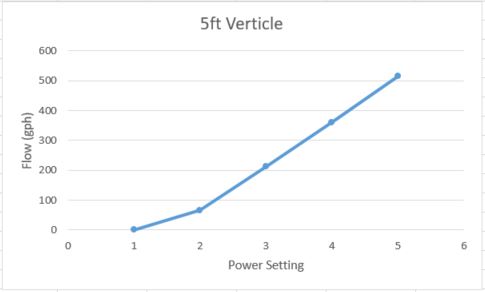
4ft.JPG


5ft.JPG


6ft.JPG

And the following represent the pump at the maximum power setting (5).

Flow vs Lift.JPG


Flow vs Head Loss.JPG

Unfortunately, I'm feeling this pump is just not going to do it for me. Hopefully others can use this data to better understand what they're buying into before settling on a decision. If @Jeremy@CoralVue wanted to chime in, I'd love to hear some more on RO's representation of their product and/or how they came about the numbers in their graph. However, at this point I'm kinda feeling like I wasted $375.

How did you test the flow rate? I know you said you used the exiting water, which I'm assuming was directly coming out of the pump itself, but how were you able to measure that?

If using the Apex flow monitor, doesn't it reduce inside? Just curious...

I also wish these dc pumps would give at least an approximate flow rate for each setting on the controller (ex. 20%, 40%, 75%, ect....). I know you can guesstimate based on the amount of settings available, but that's not guaranteed to give what the pump is actually outputting.
 
Last edited:
OP
OP
Skep18

Skep18

Valuable Member
View Badges
Joined
Feb 3, 2018
Messages
1,229
Reaction score
948
Location
Southeast US
Rating - 100%
1   0   0
I'd send it back.

I'm working with CoralVue now. I'm hoping for a positive outcome.

@Skep18 I had issues with the pump being loud. I had 1 inch piping and 5 elbows and 2 times 3/4 inch loc line outputs. Even with all that and 4 feet of head I was getting 820gph using a 2 inch apex flow meter.

I moved up to the 1 and 1/4 inch piping and removed the flow meter (it clogged a bunch) and I removed one elbow.
I didnt adjust the overflow main siphon valve from the original 1 inch piping setup because I didn’t have the flow meter anymore and I wanted confirmation the flow went up. Well I ran out of water in my return chamber almost. Lucky the Herbie secondary overflow just kept up.

Bottom line. I have a varios 8 getting in my estimation 1000 plus gph but with absolute certainty greater than 820gph with several restrictions.

By the way. I only went to the 1 1/4 pipe to finally eliminate the dc wine noise at 100 percent. These pumps don’t run quiet with a bunch of restriction.
I don’t even have a full 1 1/4 diameter output. I am using the 2 - 3/4 inch loc lines and 1 - 1/2 inch loc line outputs.

Something isn’t right with your pump.

Yea, you're the second one saying they're getting good flow. I'm thinking it's not getting good power from the supply but definitely something is wrong.

How did you test the flow rate? I know you said you used the exiting water, which I'm assuming was directly coming out of the pump itself, but how were you able to measure that?

If using the Apex flow monitor, doesn't it reduce inside? Just curious...

I also wish these dc pumps would give at least an approximate flow rate for each setting on the controller (ex. 20%, 40%, 75%, ect....). I know you can guesstimate based on the amount of settings available, but that's not guaranteed to give what the pump is actually outputting.

I'm catching the water in a 1gal pitcher and recording it. Then I use the time it took to fill 1gal (determined by the video), divide 60 by that time to get gpm. Then multiply that by 60 to get gph.

If it takes 11sec to fill 1gal, that's...

(1gal / 11sec) * (60sec/min) = 5.45gal/min

Then to get gph...

(60min/hr) * (5.45gal/min) = 327gal/hr

Just follow the canceling units.

EDIT: Brain fart. Fixed math.
 
Last edited:

Monkeynaut

Active Member
View Badges
Joined
Dec 15, 2016
Messages
463
Reaction score
208
Rating - 0%
0   0   0
Yea, you're the second one saying they're getting good flow. I'm thinking it's not getting good power from the supply but definitely something is

I only explained my whole situation because I spent a bunch of time in plumbing adjustments just getting it to the 820gph and eventually beyond. I am certain you have a power supply or some other defect.
 
OP
OP
Skep18

Skep18

Valuable Member
View Badges
Joined
Feb 3, 2018
Messages
1,229
Reaction score
948
Location
Southeast US
Rating - 100%
1   0   0
I only explained my whole situation because I spent a bunch of time in plumbing adjustments just getting it to the 820gph and eventually beyond. I am certain you have a power supply or some other defect.

No doubt. I always appreciate someone who knows the technical discussion. Definitely not trying to claim I know it all but I definitely follow and agree with your logic.

Now just to see if CoralVue would agree I might have a defective power supply or something... @Jeremy@CoralVue

I'm going to have a chat with my electrical engineer colleague tonight about it a bit. I wouldn't think the off and/or high voltage could cause damage to the pump internals but I will talk with him about it nonetheless.
 

TOP 10 Trending Threads

WHAT AMOUNT OF LIVE ROCK AND SAND SHOULD BE PRIORITIZED FOR OPTIMAL BIODIVERSITY/FILTRATION?

  • 100% live rock + bagged sand

    Votes: 38 26.2%
  • 100% dry rock + 100% live sand

    Votes: 48 33.1%
  • 50/50 live/dry rock, 50/50 live/bagged sand

    Votes: 33 22.8%
  • 75% live rock, 25% live sand

    Votes: 15 10.3%
  • 25% live rock, 75% live sand

    Votes: 11 7.6%
Back
Top