reef-pi :: An opensource reef tank controller based on Raspberry Pi.

Diamond1

Valuable Member
View Badges
Joined
Oct 17, 2013
Messages
1,368
Reaction score
1,914
Location
Cleveland Ohio
Rating - 0%
0   0   0
Probably, but I am not sure. They have a voltage drop (this is why 12V input maps to 11.6V output), but I think it may work. I can check it. But why you need this? Pi itself provides 3.3V rail

I was looking for a way to hook up my OR t247 lights to reef pi. They run on 3.3v pwm and all the circuits I've seen seem to run on 5v or 10v pwm. If you have a schematic for a cicuit that runs on 3.3v could you link it please?
 
OP
OP
Ranjib

Ranjib

7500 Club Member
View Badges
Joined
Apr 16, 2016
Messages
9,876
Reaction score
16,680
Location
Pleasant Hill, Concord
Rating - 0%
0   0   0
I was looking for a way to hook up my OR t247 lights to reef pi. They run on 3.3v pwm and all the circuits I've seen seem to run on 5v or 10v pwm. If you have a schematic for a cicuit that runs on 3.3v could you link it please?
The raspberry Pi GPIO 18 and 19 is 3.3 V PWM. You can use it as long as the current draw is not very significant (i.e. less than 20ma). Since theres no additional circuit involved, theres no schematic. But its limited to two channels only.
 
OP
OP
Ranjib

Ranjib

7500 Club Member
View Badges
Joined
Apr 16, 2016
Messages
9,876
Reaction score
16,680
Location
Pleasant Hill, Concord
Rating - 0%
0   0   0
This weekend I upgraded my kessilncobtroller. I have built a new one during the adafruit guide development so this one is now replaced . I thought I’ll tear it down and salvage the parts I want (lm2596 modules , pi zero). I realized a few things ,
- this was a old workhorses . It ran for more than a year and four months . I knew lot less about fabricating plastic enclosure during that time
2AD660CF-1565-4D3C-A326-F931C65619E9.jpeg

Most of my approach were influence by wood working. Metal standoffs , metal screws ,
990512BB-CA18-4FD2-BD53-6D8AE0D48D2C.jpeg

It was an onerous build process
E4344633-0D64-4B16-964A-DC5F9E7D7B30.jpeg

Thenperf board was cheaper and lot worse.
And I never used rails , instead the power source jack had multiple female jumpers soldered to then :)
19FB4099-F750-4BC0-A176-5B0950D3307F.jpeg


Bye bye old kessil .

5B046915-BBF2-46CB-9448-956058C18187.jpeg

I have spend several days when this controller was not accessible via ui , due to network issues I suspect , but light cycle was spot on. I hated the fact that there was not way to power down the build other than unplugging the jack . All my follow up builds have spdt buttons now. I also didn’t like the cheap 3.5mm audio jacks (panel mount). These were so bad that they’ll almost always loose their grip if pressed hard. The gold plated ones are far far better, and only little bit expensive. Always go for those.
 

Diamond1

Valuable Member
View Badges
Joined
Oct 17, 2013
Messages
1,368
Reaction score
1,914
Location
Cleveland Ohio
Rating - 0%
0   0   0
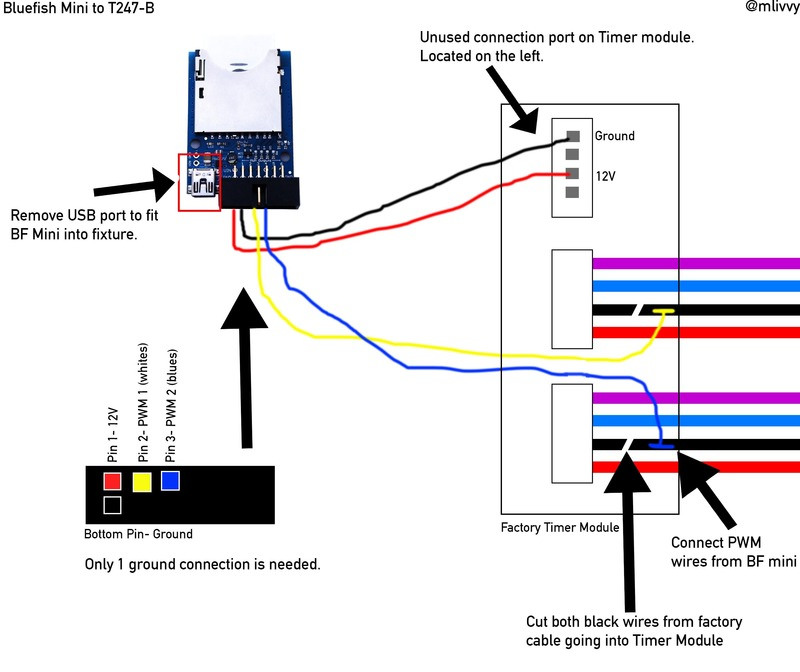
That's great! so if I connect pins 18 and 19 to the wires shown in the diagram below I should be able to control the with reef pi without anything else? Ignoring the blue fish mini controller.

43681202990_3559487b3b_b.jpg
 
OP
OP
Ranjib

Ranjib

7500 Club Member
View Badges
Joined
Apr 16, 2016
Messages
9,876
Reaction score
16,680
Location
Pleasant Hill, Concord
Rating - 0%
0   0   0
That's great! so if I connect pins 18 and 19 to the wires shown in the diagram below I should be able to control the with reef pi without anything else? Ignoring the blue fish mini controller.

43681202990_3559487b3b_b.jpg
grounds should be connected as well.
 
OP
OP
Ranjib

Ranjib

7500 Club Member
View Badges
Joined
Apr 16, 2016
Messages
9,876
Reaction score
16,680
Location
Pleasant Hill, Concord
Rating - 0%
0   0   0
That's great! so if I connect pins 18 and 19 to the wires shown in the diagram below I should be able to control the with reef pi without anything else? Ignoring the blue fish mini controller.

43681202990_3559487b3b_b.jpg
To use the Pi's PWM pins, make sure pwm module is loaded in kernel: https://learn.adafruit.com/reef-pi-installation-and-configuration
In reef-pi, declare a jack with two channels, 0 & 1 and driver as rpi.
Screen Shot 2018-10-22 at 11.37.13 PM.png

GPIO 18 is represented as pin 0, and 19 as 1 (due to how linux expose these timers/pwm pins)
 

b4tn

Valuable Member
View Badges
Joined
Jun 17, 2015
Messages
1,679
Reaction score
2,227
Location
Columbia MD
Rating - 0%
0   0   0
Thats good to know! @Ranjib, are your lights on/off cycle 100% controlled by the PWM input? For example if pwm is at 0 volts the lights are off then 1% and up they turn on? Or do you have to control the power separate? Do you know the current draw for your PWM controllers?

I have two lights with 4 channels total, 2 white 2 blue. I would like to send the PWM signal to both white channels and both blue channels in parallel. You mentioned that the current capability of the pi is 20mA I thought I had read 50mA somewhere but regardless its probably to low to handle both lights so I was thinking to use a driver. I have found several mosfet drivers that use a 3.3 volt PWM input and use a higher current power source to drive the target but they are all 5 volts and up. I am still looking.
 
OP
OP
Ranjib

Ranjib

7500 Club Member
View Badges
Joined
Apr 16, 2016
Messages
9,876
Reaction score
16,680
Location
Pleasant Hill, Concord
Rating - 0%
0   0   0
Thats good to know! @Ranjib, are your lights on/off cycle 100% controlled by the PWM input? For example if pwm is at 0 volts the lights are off then 1% and up they turn on? Or do you have to control the power separate? Do you know the current draw for your PWM controllers?

I have two lights with 4 channels total, 2 white 2 blue. I would like to send the PWM signal to both white channels and both blue channels in parallel. You mentioned that the current capability of the pi is 20mA I thought I had read 50mA somewhere but regardless its probably to low to handle both lights so I was thinking to use a driver. I have found several mosfet drivers that use a 3.3 volt PWM input and use a higher current power source to drive the target but they are all 5 volts and up. I am still looking.
Kessil does not dim to 1%. The lowest I have been able to get is 10%. So, I configure reef-pi with a minimum threshold of 10% in the intensity channel. The spectrum channel (which controls the color) does go from 1-100%.
If you current draw is less than 50-70 ma , then a common NPN transistor (like 2n2222a) to pass the PWM signal before sending to lights, if its more than that (say 1 Amp) then go for power mosfet. Since you need four channels, you'll need a pca9685. Do you know by any chance whats the current draw is>
 

b4tn

Valuable Member
View Badges
Joined
Jun 17, 2015
Messages
1,679
Reaction score
2,227
Location
Columbia MD
Rating - 0%
0   0   0
Kessil does not dim to 1%. The lowest I have been able to get is 10%. So, I configure reef-pi with a minimum threshold of 10% in the intensity channel. The spectrum channel (which controls the color) does go from 1-100%.
If you current draw is less than 50-70 ma , then a common NPN transistor (like 2n2222a) to pass the PWM signal before sending to lights, if its more than that (say 1 Amp) then go for power mosfet. Since you need four channels, you'll need a pca9685. Do you know by any chance whats the current draw is>

Thanks, so the OR lights seem to have the same issue in that they will not go below 10% but we do not have a spectrum channel. So what would need to happen is use PWM to dim it down to 10% then use a 12 volt relay to shut the power to the light. 10% on my lights is still pretty bright so its not really worth the effort to me if I cannot get it to fade into darkness.

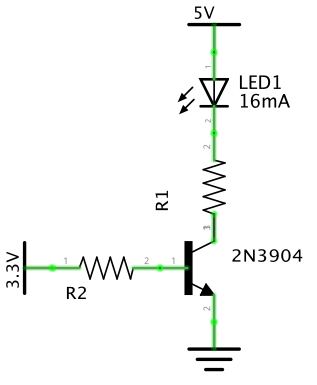
But you are on the same train of thought as me. The bluefish controller supports hanging a couple identical channels off each output so I was thinking to run both white channels on say GPIO 19 in parallel and likewise with the blue on 18 but run the outputs off a transistor like pictured.
TransistorsWithoutValues.png
 
OP
OP
Ranjib

Ranjib

7500 Club Member
View Badges
Joined
Apr 16, 2016
Messages
9,876
Reaction score
16,680
Location
Pleasant Hill, Concord
Rating - 0%
0   0   0
You have made leaps and bounds over your first project! As everyone else has said thanks for all the effort you have put into this. It has really gotten me fired up. I even took my son to a Maker Faire a couple weeks ago. :)
Maker Faire's are the best :-) . We have one (Bay Area Maker Faire) very close by to my apartment that we go everywhere. 5 years back when I first went there I was like... i want to be here, this is the community i want to belong to :-) . And three years after that I was there as maker, exhibiting reef-pi builds. Its a great place for the kids. My son loves visiting there. I have couple of other projects (model railroad for example) that I am planning to exhibit next, may be after reef-pi development has settled a bit.
 

b4tn

Valuable Member
View Badges
Joined
Jun 17, 2015
Messages
1,679
Reaction score
2,227
Location
Columbia MD
Rating - 0%
0   0   0
I miss the bay area! I used to work in the Concord, Walnut Creek, Antioch area setting up home networks in the early 2000's Other than the horrid traffic the weather was great and always something going on. Now I am stuck int he DC metro area ;Vomit
 

cvrle1

Well-Known Member
View Badges
Joined
Sep 13, 2018
Messages
902
Reaction score
988
Rating - 0%
0   0   0
This weekend I upgraded my kessilncobtroller. I have built a new one during the adafruit guide development so this one is now replaced . I thought I’ll tear it down and salvage the parts I want (lm2596 modules , pi zero)....

Bye bye old kessil .

I have spend several days when this controller was not accessible via ui , due to network issues I suspect , but light cycle was spot on. I hated the fact that there was not way to power down the build other than unplugging the jack . All my follow up builds have spdt buttons now. I also didn’t like the cheap 3.5mm audio jacks (panel mount). These were so bad that they’ll almost always loose their grip if pressed hard. The gold plated ones are far far better, and only little bit expensive. Always go for those.

You should keep that and one day use it for reef-pi museum. It is after all the original that started it all.
 

b4tn

Valuable Member
View Badges
Joined
Jun 17, 2015
Messages
1,679
Reaction score
2,227
Location
Columbia MD
Rating - 0%
0   0   0
That's great! so if I connect pins 18 and 19 to the wires shown in the diagram below I should be able to control the with reef pi without anything else? Ignoring the blue fish mini controller.

43681202990_3559487b3b_b.jpg

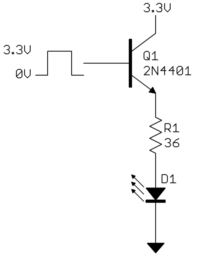
So i will not be doing this just because dimming 40% where my lights run to 10% is not really worth the effort. Maybe someday I will look into building my own LED's but for now the built in timer is fine. But if you decide to do this, and someone correct me if I am wrong I would not advise running it directly off the GPIO pin. I would use the following:

2vrSj.gif

The PWM GPIO signal out would go in the 3.3v side with a square wave. Use the buck converter you linked above dialed down to 3.3.volts to supply the upper pictured voltage. D1 would be the OR light controller or where the black wire would connect. The key is to find out what the current draw is so that you can size the transistor and resistor appropriately. If you use the built in OR timers all you need to do is hijack the black wire and run ground from your pi build spliced into the red ground wire of the OR fixture.

If your your lights are anything like mine the clock sucks and never keeps time perfectly. So if you wanted to use the built in timers your brightness level and timer will over time be mismatched. To fix this disconnect the plug on the light. The purple and blue would need to be on a 12 volt relay timer programmed to come on and off at your set times with reef pi. The black wire would go to the same input on the transistor above and the red wire would go to your common ground. Since your clock is the same on both power and dimming you would be matched. Here is more on the OR light using the same basic concept.

 
OP
OP
Ranjib

Ranjib

7500 Club Member
View Badges
Joined
Apr 16, 2016
Messages
9,876
Reaction score
16,680
Location
Pleasant Hill, Concord
Rating - 0%
0   0   0
You should keep that and one day use it for reef-pi museum. It is after all the original that started it all.
My wife said the same for the first one. Which was even more strange looking :) . I live in a small apartment so I just don’t want to hoard these .
This reef-pi 2.0 series builds I think I can give away in next maker faire. I want newer ones to work on some improvements . I am happy with these ones, uxcell clear case enclosures. But there are a few things that could be better. The screws get rusty and the hinges inside create problem for mounting pcbs using standoffs.
 
Last edited:
OP
OP
Ranjib

Ranjib

7500 Club Member
View Badges
Joined
Apr 16, 2016
Messages
9,876
Reaction score
16,680
Location
Pleasant Hill, Concord
Rating - 0%
0   0   0
So i will not be doing this just because dimming 40% where my lights run to 10% is not really worth the effort. Maybe someday I will look into building my own LED's but for now the built in timer is fine. But if you decide to do this, and someone correct me if I am wrong I would not advise running it directly off the GPIO pin. I would use the following:

2vrSj.gif

The PWM GPIO signal out would go in the 3.3v side with a square wave. Use the buck converter you linked above dialed down to 3.3.volts to supply the upper pictured voltage. D1 would be the OR light controller or where the black wire would connect. The key is to find out what the current draw is so that you can size the transistor and resistor appropriately. If you use the built in OR timers all you need to do is hijack the black wire and run ground from your pi build spliced into the red ground wire of the OR fixture.

If your your lights are anything like mine the clock sucks and never keeps time perfectly. So if you wanted to use the built in timers your brightness level and timer will over time be mismatched. To fix this disconnect the plug on the light. The purple and blue would need to be on a 12 volt relay timer programmed to come on and off at your set times with reef pi. The black wire would go to the same input on the transistor above and the red wire would go to your common ground. Since your clock is the same on both power and dimming you would be matched. Here is more on the OR light using the same basic concept.


Dimming 40% with rpi driver? Did you try playing with the pwm frequency ? For me that helped dialing down the coralife moon light , which is powered by 12v 1amp signal
 

b4tn

Valuable Member
View Badges
Joined
Jun 17, 2015
Messages
1,679
Reaction score
2,227
Location
Columbia MD
Rating - 0%
0   0   0
Dimming 40% with rpi driver? Did you try playing with the pwm frequency ? For me that helped dialing down the coralife moon light , which is powered by 12v 1amp signal

I meant that I run my lights at 60% blue and 40% white during the day and turning them down to 10% they are still pretty bright. All the work and wiring is not worth it to me to dim them from 40% to 10% and 60% to 10% and then shut them off with a relay. Now if they dimmed from 40% down to 0% or 1% it would be worth the effort. But the OR light will not dim below 10%.

 
OP
OP
Ranjib

Ranjib

7500 Club Member
View Badges
Joined
Apr 16, 2016
Messages
9,876
Reaction score
16,680
Location
Pleasant Hill, Concord
Rating - 0%
0   0   0
I meant that I run my lights at 60% blue and 40% white during the day and turning them down to 10% they are still pretty bright. All the work and wiring is not worth it to me to dim them from 40% to 10% and 60% to 10% and then shut them off with a relay. Now if they dimmed from 40% down to 0% or 1% it would be worth the effort. But the OR light will not dim below 10%.
Got it.
The new kessil lights allow 1% dimming. I cant wait to tinker with those...
 

TOP 10 Trending Threads

WHAT AMOUNT OF LIVE ROCK AND SAND SHOULD BE PRIORITIZED FOR OPTIMAL BIODIVERSITY/FILTRATION?

  • 100% live rock + bagged sand

    Votes: 37 27.8%
  • 100% dry rock + 100% live sand

    Votes: 45 33.8%
  • 50/50 live/dry rock, 50/50 live/bagged sand

    Votes: 29 21.8%
  • 75% live rock, 25% live sand

    Votes: 12 9.0%
  • 25% live rock, 75% live sand

    Votes: 10 7.5%
Back
Top