

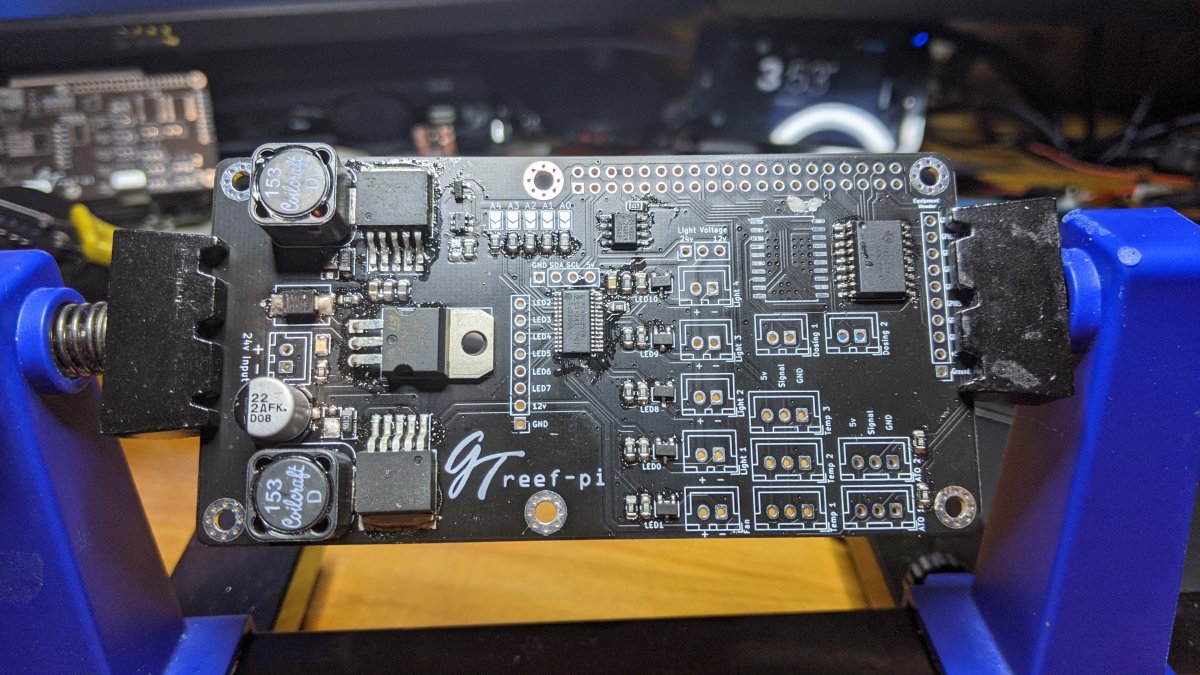
Looking good :-)and a little teaser.. ;)
![]()
Follow along with the video below to see how to install our site as a web app on your home screen.
Note: This feature may not be available in some browsers.
Looking good :-)and a little teaser.. ;)

![]()
Mine uses a L293DD for dosing pumps..Consider a L293D full bridge driver for I/O?
How did the integration go with the Wills lights, looks like it was pretty straight forward but I thought I read something about blowing some mosfets? Wasn't sure where it ended up build wise.Had to cobble together another box last night so I can control my new lights on my nem tank.
![]()
![]()
![]()
How did the integration go with the Wills lights, looks like it was pretty straight forward but I thought I read something about blowing some mosfets? Wasn't sure where it ended up build wise.
Looks good though :)
I get that blinking sometimes too, it happens when the signal oscillates above and below the treshold at which the light turns on. You can fix it by looking at what level reef-pi sets the light when that is happening and set the "minimum" value in the light settings to a point or two above that.I'm not sure why that driver blew a mosfet. I have a replacement, but haven't fixed it.
Overall they are working fine. I added a second set of those same lights to my nem tank and the blue channel on it blinks for about 3 minutes at the end of the cycle when they are ramping down. Not sure why.
I will be honest I don’t know enough about that chip to consider it at all but heard that it gets really hot so that would put me off.Consider a L293D full bridge driver for I/O?
I will be honest I don’t know enough about that chip to consider it at all but heard that it gets really hot so that would put me off.
I'll take a look at that. Odd thing, it's just the blue channel in one fixture. If course the drivers in these are junk, but I have seen any similar that I think would work that wouldn't raise the cost a over what a better light would cost. Defeating the purpose of buying this one in the first place.I get that blinking sometimes too, it happens when the signal oscillates above and below the treshold at which the light turns on. You can fix it by looking at what level reef-pi sets the light when that is happening and set the "minimum" value in the light settings to a point or two above that.
Could be anything, inadequate low pass filter, long cables picking up interference, more intricate electrical stuff, but the minimum setting "fixes" them all, at the cost of losing a bit of range.
It is more flexible than the ULN2803 many of the reef-pi were built with.I will be honest I don’t know enough about that chip to consider it at all but heard that it gets really hot so that would put me off.
Actually, the PH value using the API seem to be continently .07 less than the dashboard - is this a known bug?Do you notice the API for PH reading does not return the same current value that is on the Dashboard? Temp is OK, but ph seems to be an old value when using:
curl -b cookie.txt http://0.0.0.0:80/api/phprobes/{2}/read
Not that I’m aware of. I can check the code, if it’s due to calibrationActually, the PH value using the API seem to be continently .07 less than the dashboard - is this a known bug?
In my testing The readings command does return the proper array including last values of both current and historical- but something seems off with the read only, I was thinking missing cal offset too. Thanks.Not that I’m aware of. I can check the code, if it’s due to calibration
overcurrent? curious, are you using 2x of required capacity of that mosfet?I'm not sure why that driver blew a mosfet. I have a replacement, but haven't fixed it.
Overall they are working fine. I added a second set of those same lights to my nem tank and the blue channel on it blinks for about 3 minutes at the end of the cycle when they are ramping down. Not sure why.
could be kickbacks? diods will help? I don't know.. I'm kinda guessing. I think you need some passives to protect the transistorovercurrent? curious, are you using 2x of required capacity of that mosfet?
overcurrent? curious, are you using 2x of required capacity of that mosfet?
I have used the file driver to do something like that , for my model rail road setup.Has anyone tried "spoofing" a sensor and using a physical button/switch to trigger a macro?
Basically looking at making a push-button feed mode and a push-button or two some some equipment.
How did you implement it?I have used the file driver to do something like that , for my model rail road setup.
I used a digital input using the INLETS Connector Pi17 pin - it under the ATO feature. I use it for a skimmer overflow sensor but this would work for a switch to trigger a MACRO I believe. You may need to hold it for 2 seconds or so but good to debounce anyway.How did you implement it?
The check frequency on the sensor would have to be quite high, like 2-3 seconds to register the button press.I used a digital input using the INLETS Connector Pi17 pin - it under the ATO feature. I use it for a skimmer overflow sensor but this would work for a switch to trigger a MACRO I believe. You may need to hold it for 2 seconds or so but good to debounce anyway.









