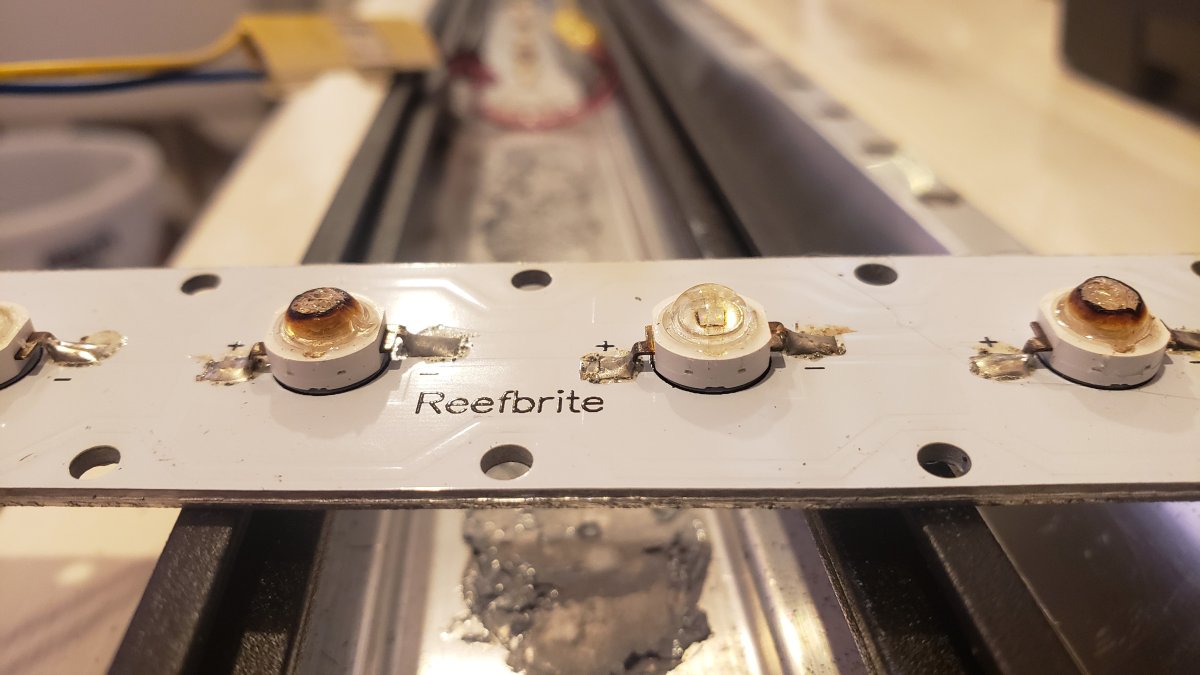
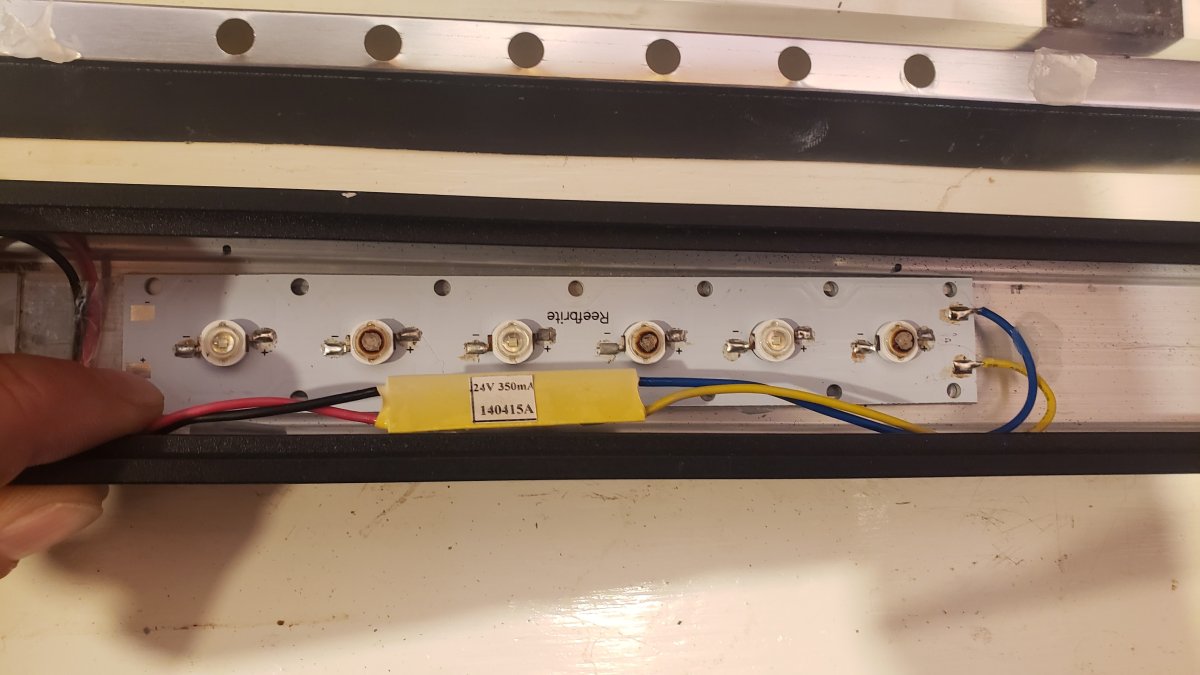
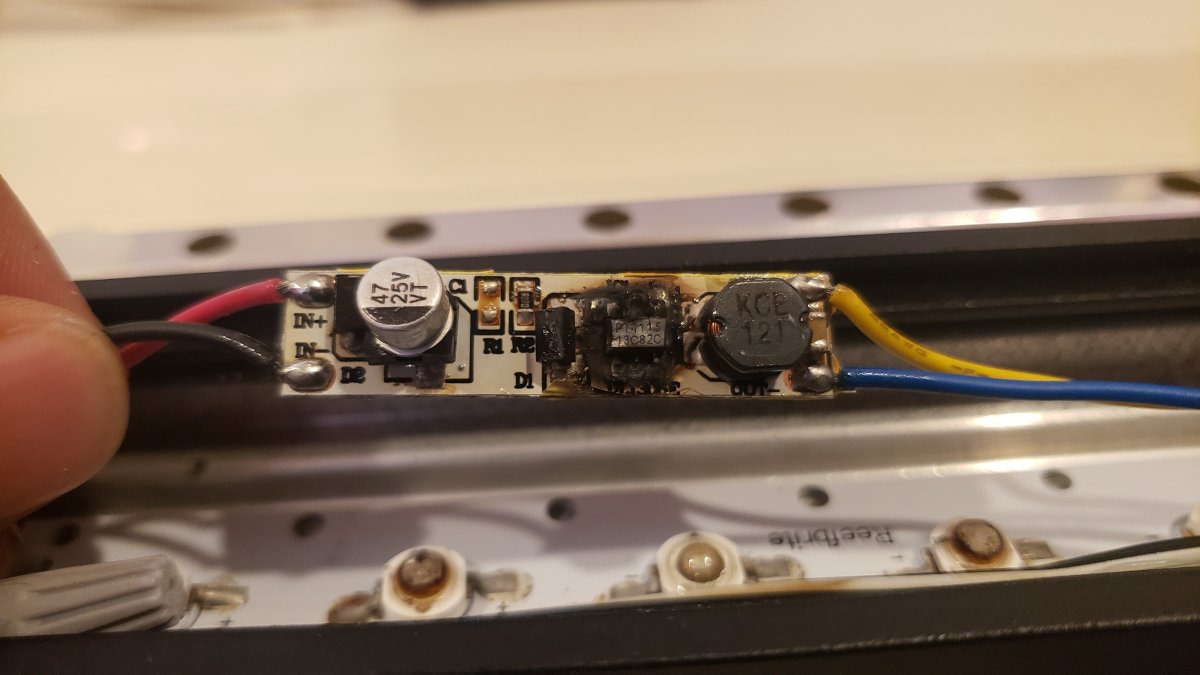
The cheap diodes are less than $1 ea. The power supply still works. Mainly, this just seems like an easy thing to do, and for <$50, I have a new light. I'm also curious to compare it to the new XHO unit.
Yea I get it. I was a bit harsh in my above post.
Tricky thing will be finding drivers that fit.
From the looks of the one I'd replace all 4 most likely.
You could eliminate them all together and replace it with a simple resistor.
Changing from constant current to constant voltage.
What you would need is finding out the new strings real V(f).
A 5w " class" ( probably overkill) resistor at around 10 ohms should work.
Under ( sometimes way under) $1 each.
You can get more precise by using real world numbers After one new board is assembled and if you have any functional drivers you can fire it up and measure the real V (f) at 350mA.
An advantage to the conversion is you could add a cheap $4 manual dimmer.
Depending if the center slug is soldered or just attached with thermal compound will make it more or less difficult to remove the old ones.
You could try an electric frypan to desolder a whole board at a time.
Old school just desolder the contact ends a more than likely just breaks the old diode apart with a twist .
On reassembly thermal adhesive in the center and solder arms "Heatsink plaster" is a common thermally conductive electrically insulating silicone.
Last " catch" using resistors can " waste" power.
At 24v and a single diode V(f) of 3.5 v and 350mA of current your total wattage of 4 6 diode bars in series parallel is 34.3 watts with 4.9 watts as waste heat in the resistors.
Closer the power supply voltage gets to the V(f) of the string the more efficient it gets.
With a 24 v and 6 diode string obviously the ind. diode voltage should approach 4v.
That's the voltage each of 6 would receive without a resistor. They wouldn't live long.
Thus the constant current advantage.
Some bars still run cv.
Most small diode strip lights as well.
Trend is cc.
You can play with this calc
Just use voltage sum of 6 in series
Or this one.
LED series current limiting resistor calculator - useful when designing circuits with a single LED or series/parallel LED arrays - for both the common small-current (20mA) LEDs and the more expensive, high power LEDs with currents up to a few Amperes. The LED calculator will display the...
www.hobby-hour.com