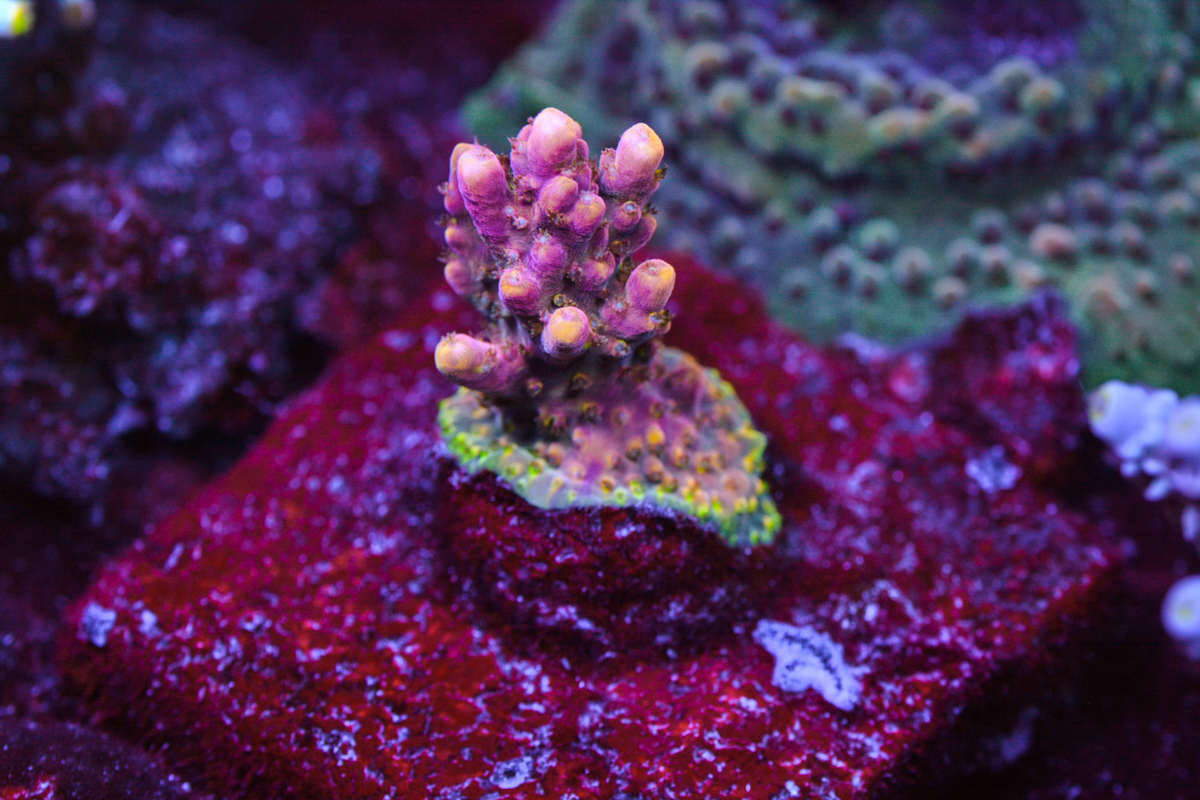
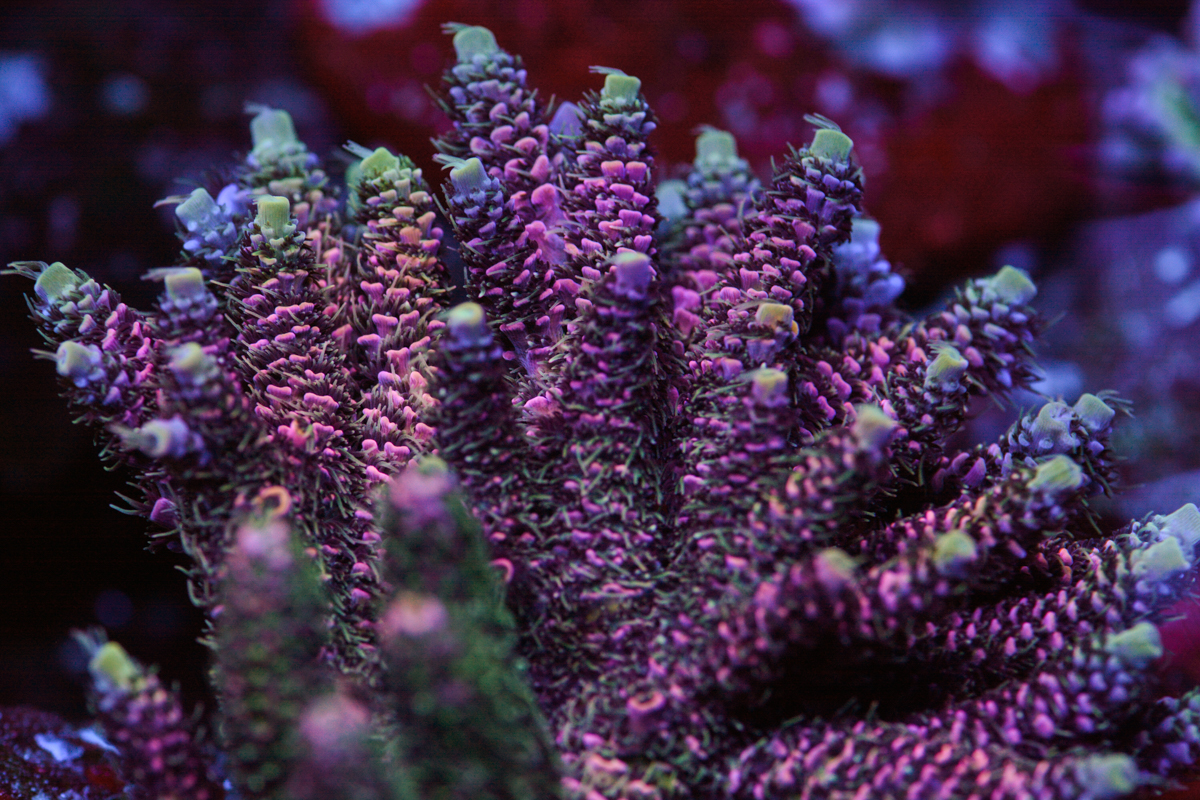
Some of my Acro Collection

Ending the night with some pics!

_DSC8239.JPG

CRT Insidious, I haven't posted this one up in ages. Mostly because it hasn't grown in ages! This is one of my classics, hoping to grow out a nice colony again soon.


_DSC8243.JPG

CRT Acromancer, one of my growout pieces lookin fly!


_DSC8259.JPG

CRT Navy Orange, I've held onto this gem for several years now and have grown a few nice colonies out. Now it's time for a hair cut!
hi can i ask what is the red algae growing on the frag plug. Do you know...btw awesome tank corals and pics
 
Yeah I'm not sold on these products, from what I can extract from their information it's mostly nitrifying bacteria

Rebiotic - Nitrifying mix, can't tell what strain
Zeoback - Monoculture of probably a nitrifying bacteria
ProBio S - Nitrifying mix strain and they are doing an awesome job of marketing wording to make it look special.


All these are simply good bacteria to breakdown poop basically. I don't mean they don't work, they probably do their job but... It's like putting shampoo one time, rinse and later on the shower you use again the shampoo on your hair.

It doesn't mean it's not working, but I don't see the value of these products. I believe they are great once you hit a little bump of organic compound in water and they become source of food for corals.

If the corals looks good, it's more link to the fact they have food and the water is clean. With or without this kind of product you already achieve this.

That's my line of thought, but I could be wrong somewhere, it's just the informations is scarce and seems to point not where we think it should go. The mirage.
Completely fine to be skeptical, especially with the amount of products out there.
Zeobak is the main proponent of the zeovit system, and while I do not run full zeovit anymore I have found it to be an amazing tool to feed the corals and maintain nutrients. Probio S is essentially Aquaforest's version of zeobak with some different ingredients I presume. The rebiotic is a dried bacterial supplement, and from the recommendation of Perry I began using it. Using these 3 in conjunction has not led to any ill effects in my system, but that could be attributed to how I administer these products and my overall husbandry.

What makes you believe that all of those products are specifically nitrifying bacteria? They certainly could be, but who knows. Each of those products are a different color, and the rebiotic comes in a dry form with other particulates mixed in. So I think that they all have a distinct composition. Also, I've used nitrifying bacteria products such as Dr. Tims, MB7 and Fritz turbostart (Fritz salt is complete DOOKIE, I can explain via pm if interested) in the past. They do not perform the same as these products, and also do not elucidate the distinct feeding response that I currently experience when used with my concoction. Sonny, a proponent of bacteria dosing, noted a difference from switching from mb7 to zeobak too. This also makes me more inclined to believe that the bacterial compositions are different. I also did not notice corals recovering from RTN events on their own, whereas I do now, even without human intervention. These anecdotes seem to align with the study where the researchers dosed probiotics and noticed the corals recovering from stress events.

Marine probiotics: increasing coral resistance to bleaching through microbiome manipulation - The ISME Journal

All these are simply good bacteria to breakdown poop basically. I don't mean they don't work, they probably do their job but... It's like putting shampoo one time, rinse and later on the shower you use again the shampoo on your hair.
I agree, these bacteria products are great for nutrient cycling! However, in many cases our home aquariums are not so great at nutrient cycling. That's why many reefers get cyano blooms, detritus piles, and films on their sand bed. I don't have these issues anymore, and if I do it is not to the same degree as before.
This can also be a result of many other factors too, but the only difference since before is my incorporation of these bacteria products and zeozyme. Many reefers expect immediate results, but instantaneous change is catastrophic.
Also if we use these bacteria and enzymes in a different manner, we can also achieve different results. I don't just dose the bacteria into the tank, I dose the bacteria into a concoction of food, aminos, trace elements, and enzymes which I believe then creates a more bioavailable source of nutrition. With the added benefit of nutrient reduction, and water clarity.

It doesn't mean it's not working, but I don't see the value of these products. I believe they are great once you hit a little bump of organic compound in water and they become source of food for corals.
I think the value of these products stem from microbial stability, and not necessarily diversity. Most likely these bacteria sources can outcompete pathogens and mitigate stress. Research has repeatedly shown that the bacterial composition of the water and the coral mucus are largely different, this indicates that the coral hosts can curate their bacterial composition. My theory is that if the water column is filled with beneficial bacteria, then they will be able to outcompete pathogens and then transplant themselves onto the coral which they then provide additional support by helping the coral cycle nutrients and potentially provide an added antiseptic effect.
Again this is just my theory, as I have no direct evidence. I do believe that this theory has some merit though, as I have noticed certain corals exhibit a larger area of denial as they grow. I use "area of denial" to represent the perimeter of area the coral clears out as it continues to grow. I'm sure most sps keepers have noticed that as certain sps encrust they create a barren environment prior to encrusting over. Typically one will notice that the algae and other organisms are cleared out of the way before the sps encrusts over that spot.
Prior to my dosing, this area of denial was not very visually noticeable. Perhaps because those corals were not growing very fast, but after I began dosing my concoction I noticed that the corals began to grow faster and that this area of denial was becoming more prevalent.

If the corals looks good, it's more link to the fact they have food and the water is clean. With or without this kind of product you already achieve this.
Sure, completely agree. By no way am I telling anyone to go out and do what I do. You can achieve success without the use of any supplements and by just relying on a good salt mix. What my specific goals are will not translate to every other reefer. However, I am specifically looking to

1. Reduce stress on new corals and limit random RTN/STN events
2. Promote increased pigmentation and coloration
3. Enhance coral growth

My methods have checked off these three for me, and so I will keep on doing it.

While many people seem to point out that bacteria can reproduce at a very fast rate, they seem to neglect that their population can also dwindle at a very fast rate especially when you factor in predation and competition. The research has also shown that healthy corals are mostly dominated with only a few specific types of bacteria too, so in theory, if we keep those specific bacteria in abundance then it would limit foreign pathogenic bacteria from invading and becoming substantial enough to cause mortality.

From my experience the results achieved from my method can drastically reduce both N and P within one day. In a significant amount, and without any visual signs of stress from the corals. Like I mention earlier in this thread, I was able to reduce 50 ppm of nitrate and roughly .6 ppm of phosphate within the period of one day.

Nutrient control by other means such as excessive GFO, would probably result in a major RTN event. Macroalgaes directly compete against my corals for trace elements as well, so that is why I do not employ them.
However, I've been repeatedly dosing my concoction without any issues whatsoever. If anything I've noticed my acros have developed much richer coloration, tissue, and polyp extension. I experienced a calcium drop from 400 to the low 300's, at the same time I noticed the majority of my acros experience an explosion of growth tips. So what does that say?
You can even visually verify my claims if you go back and analyze the pictures I post.

I understand that what I am trying convey is hard to believe without seeing it for yourself, but I definitely would not be continuing this regimen if it did not produce noticeable and reproducible results. The sheer amount of product used is quite expensive and it would not make any sense for me to keep using them if they did not work. I have 4 full blown sps systems to experiment on so it makes it easy for me to notice change, especially with a keen eye. I have also shared my concoction with a few of my friends to use and they also noted significant changes as well.
If I thought my systems were already top notch before, then this takes it to the next level!

 
hi can i ask what is the red algae growing on the frag plug. Do you know...btw awesome tank corals and pics
I'm not exactly sure on the name of that algae, it seems to grow on mature rocks. It's not very problematic in my experience, and the corals have no issues of growing over it.
 
It's an interesting debate indeed. It's great to see your friend having good feedback to Concorde with your experience.

There's also the syndrome of corals taking off because they are simply ready and mature well anchor. There's so many variables that is hard to truly know at times what cause X.

The nitrifying info is with the text companies write their salad. They all in a way formulated towards nitrification... but this is subject to debate also. If only companies could elaborate...

Indeed bacteria population dwindle at time, it's a continuous evolution.

speaking of GFO, I use it in a newer system, somehow it melted with 2 other product, never seen before, it killed my clam in few hours. Took me 5month recover correctly and dissipate most of the pathogen that was spreading from new frag to new frag. rough 6month. I saw some piece affected by disease (can't tell what) and was hoping they will recover but... having "hope" killed many others. Decided to remove all affected one day and the tanks started to flourish after a week. Was basically feeding the disease by keep infected frag.

I have an mature tank where it was in contact at the beginning with live rock. It's a tank I'm trying to close and not taking care of. Yet. That tank even if temperature fluctuate (slapped T5 direct on tank) and mega alk swing, is "curing" bad corals. It's like an hospital. and this anecdote, made me wonder if microbiome should at top 3 instead of top 6 of priorities. Salnity, Temperature, Microbiome, Alkalinity, Phosphate, Nitrate. The most important aspect I keep an eye on personally.

For now the only method to know a product is word to mouth, if we see some mass of people saying X product is good for Y and those people can understand cause of mortality of a coral (instead of pointing wrong thing because of lack of experience) than yeah, why not use it. So your soup could be a good one indeed. Or could be just more water in the soup too ;). Hard to tell, just need volume of feedback.

Very interesting debate and discussion.

I'm tempted to try but... I'm making an aquarium without much product, The least possible to see where it leads with pociloporidae coral and max 3 acro. No bacteria additive have been used so far only from coral purchase on their rock and skin.
 
I saw this article on ReefBuilders and thought members of this thread may enjoy reading and discussing it:
https://reefbuilders.com/2023/08/24/study-reveals-how-corals-gain-n-and-p-in-darwins-paradox/
to summarize: the study seeks to answer the question known as the "Darwin's Paradox": how can highly diverse coral reefs exist in nutrient-poor water? The study concludes that symbiotic zooxanthele in the coral tissue transports ammonium, nitrogen, and phosphorous to the coral. Corals are not capable of absorbing N and P themselves and rely on the symbiotic algae to transport these valuable nutrients into their tissues. The study concluded that supplementing nitrogen and phosphorous resulted in increased growth rates in captive corals, and that insufficient N and P levels stunted growth and resulted in bleached coloration.


My conclusion from this study as it pertains to hobbyist reef keeping: nitrate and phosphate should be considered necessities for growth and providing proper nutrition to SPS corals. I don't think exact levels of N or P should be targeted as long as food is being added, because ideally symbiotes should transport those elements directly to the corals before they show up on a test kit. Perhaps a small surplus should be the benchmark just to ensure the corals aren't going hungry. I would add that anecdotally, I've seen faster calcification and better colors in my SPS corals when I supplement an organic carbon source in addition to feeding fish/coral foods. I don't think introducing new bacterial populations is nearly as important as feeding the population that already exists in the tank and letting them do the heavy lifting when it comes to feeding corals.


Curious to know what other reefers think about this article and how they might implement this info in their approach.
 
Hi Allan,
Here is an interesting thread, I am sure you have seen and read, but just in case, some of the posters here may also want to view for different perspectives. I totally agree with ANYONE questioning ANY company about snake oils, marketing hype, SM influencers, etc. You are doing a great job with your research, as well as testing. Keep it up, brother :)

https://www.reef2reef.com/threads/why-cant-u-keep-sps.670707/
 
I saw this article on ReefBuilders and thought members of this thread may enjoy reading and discussing it:
https://reefbuilders.com/2023/08/24/study-reveals-how-corals-gain-n-and-p-in-darwins-paradox/
to summarize: the study seeks to answer the question known as the "Darwin's Paradox": how can highly diverse coral reefs exist in nutrient-poor water? The study concludes that symbiotic zooxanthele in the coral tissue transports ammonium, nitrogen, and phosphorous to the coral. Corals are not capable of absorbing N and P themselves and rely on the symbiotic algae to transport these valuable nutrients into their tissues. The study concluded that supplementing nitrogen and phosphorous resulted in increased growth rates in captive corals, and that insufficient N and P levels stunted growth and resulted in bleached coloration.


My conclusion from this study as it pertains to hobbyist reef keeping: nitrate and phosphate should be considered necessities for growth and providing proper nutrition to SPS corals. I don't think exact levels of N or P should be targeted as long as food is being added, because ideally symbiotes should transport those elements directly to the corals before they show up on a test kit. Perhaps a small surplus should be the benchmark just to ensure the corals aren't going hungry. I would add that anecdotally, I've seen faster calcification and better colors in my SPS corals when I supplement an organic carbon source in addition to feeding fish/coral foods. I don't think introducing new bacterial populations is nearly as important as feeding the population that already exists in the tank and letting them do the heavy lifting when it comes to feeding corals.


Curious to know what other reefers think about this article and how they might implement this info in their approach.

to summarize: the study seeks to answer the question known as the "Darwin's Paradox": how can highly diverse coral reefs exist in nutrient-poor water? The study concludes that symbiotic zooxanthele in the coral tissue transports ammonium, nitrogen, and phosphorous to the coral. Corals are not capable of absorbing N and P themselves and rely on the symbiotic algae to transport these valuable nutrients into their tissues. The study concluded that supplementing nitrogen and phosphorous resulted in increased growth rates in captive corals, and that insufficient N and P levels stunted growth and resulted in bleached coloration.
At this point, this observation is pretty well known among experienced sps keepers. No longer do we want to drive our systems ULNS like before. The symbionts, and other microbes make up the coral holobiont and the coral relies on these symbiotic relations to gather the additional nutrition that the coral itself cannot produce.


My conclusion from this study as it pertains to hobbyist reef keeping: nitrate and phosphate should be considered necessities for growth and providing proper nutrition to SPS corals. I don't think exact levels of N or P should be targeted as long as food is being added, because ideally symbiotes should transport those elements directly to the corals before they show up on a test kit. Perhaps a small surplus should be the benchmark just to ensure the corals aren't going hungry.
Agreed, there should be some testable levels. However, just because you have testable levels does not mean that there is adequate nutrient cycling in your system.

Let's imagine a system where someone has an algae outbreak, and pale looking corals. They test their N and P and they receive "normal results" like 10 ppm N and .1 ppm P. They also have down an ICP and received back "perfect" results a 100/100 if you will.
Would you say that this is optimal? The presence of an algae outbreak and pale corals would indicate a NO.
It would seem in this made up scenario that there is an imbalance of nutrient cycling that is allowing the algae to proliferate and the corals to become pale.

Perhaps we could proceed with your method in hopes to resolve this situation.
I would add that anecdotally, I've seen faster calcification and better colors in my SPS corals when I supplement an organic carbon source in addition to feeding fish/coral foods.
While I do think that one could certainly do this, you have to remember that this would also feed potentially pathogenic bacteria as well. In this hypothetical situation there is a chance that the corals rebound and the algae dies back. However, there is also the chance that by following an indiscriminate carbon dosing regimen you potentially feed the pathogenic bacteria to the point where you experience mass RTN.
Many people have experienced this RTN from carbon dosing. Soooo many anecdotes of carbon dosing gone wrong, biopellets gone wrong, etc...

My personal experience of carbon dosing vs. bacteria dosing is night and day.

A simple analogy would be to liken carbon dosing as giving an inexperienced chef (your system microbiome) a myriad of gourmet ingredients(carbon source). Can you be sure that this inexperienced chef can produce a gourmet result? or will they produce an abomination and destroy those ingredients?

Whereas bacteria dosing likens to the inexperienced chef going out to a fancy restaurant and eating a gourmet steak dinner.

Given the fact that you choose the right bacteria use for each use case you can see that the potential for error or catastrophe is much lower when you dose bacteria vs carbon dosing.

In my opinion, carbon dosing can do more harm than good for an inexperienced reefer. Whereas bacteria dosing can serve as a more versatile tool in our reefing arsenal.
If you dose bacteria, you will eventually hit the carrying capacity for your system due to the nature of it being a closed system. The bacteria can only populate the open niches and are limited by the resources (food, aminos, carbon sources) that exist in the tank prior to their introduction.

If you were to carbon dose, you are artificially raising the carrying the capacity for your system by providing an influx of resources for all bacteria to use, in some cases you are allowing pathogenic bacteria to proliferate too.

So just view carbon dosing as a generalist method and bacteria dosing as a specialist method. The best approach would be to combine both (which is what I do) , however one should not dose directly into the system. Instead, let that mixture of carbon sources and beneficial bacteria to "marinade" in a separate container and then dose that once it is done "marinading".


Also if you want to see an acropora actually eat, check this video out. It is my concoction at work! @Heabel7 got to see first hand how my corals reacted. It's not that typical "blow food on an Acro and watch it slough off" reaction. It's a distinct all across the board feeding response as the coral catches the food as it drifts slowly by.

 
How do you even begin to approach the proper ratios of nutrients, aminos, chemicals, bacteria, etc in your “concoction”? I’m very fascinated by this idea. But I’m wondering how your process has evolved or is evolving for determining what to mix together.

Additionally, if someone where to “begin” a comparable method, how to gradually dose some similar (albeit smaller volume) “bacteria concoction”

Thanks for the thoughts!
Well, it's pretty much every single product I own mixed into one concoction. I just follow the product's guidelines and put in the equivalent amount of product for my system's volume. I have been tweaking around with the ratios of each product though. You will notice different effects depending on whether you use more bacteria, or foods, or enzyme.

I've been playing around with how frequent to use it and how it impacts the test levels. I definitely think that you would have to decide on your own dosage ultimately to cater to your system. I don't necessarily think that there will be a one size fits all dosing regimen.
 
Took a peak inside the oven, too much heat escaped!

_DSC8286.JPG

The polyps on this one are bonkers! They're starting to transition and I'm seeing some reds and orange. The pink is also beginning to form!!


_DSC8331.JPG

Another nutty smoothie


_DSC8342.JPG

A diamond in the rough, this one's still got a long ways to go but I'm excited! The nicest ones always start out the ugliest lol


_DSC8359.JPG

I thought tenuis were kinda boring, but this one has me excited again. I got a feeling that this one is going to knock your socks off!
 
You’re killing me man. I got the fever
 

TOP 10 Trending Threads

WHAT FIRST SPARKED YOUR INTEREST IN REEFING?

  • I saw a reef tank that hooked me

    Votes: 17 20.7%
  • I was already keeping freshwater aquariums

    Votes: 31 37.8%
  • A particular fish got me interested

    Votes: 10 12.2%
  • Corals and inverts were the draw

    Votes: 14 17.1%
  • A friend or family member introduced me

    Votes: 10 12.2%
  • The science and ecosystem challenge appealed to me

    Votes: 16 19.5%
  • I stumbled into it… and here we are

    Votes: 11 13.4%
  • Other (Post in the comments)

    Votes: 12 14.6%
Back
Top
Home
Post thread…
Market
What's new