

Temperature probe placement

Where do you keep your temperature probes?


  • Total voters
    19

Alexander1312

Active Member
View Badges
Joined
Oct 10, 2022
Messages
184
Reaction score
117
Location
San Francisco Bay Area, California, United States
Rating - 0%
0   0   0
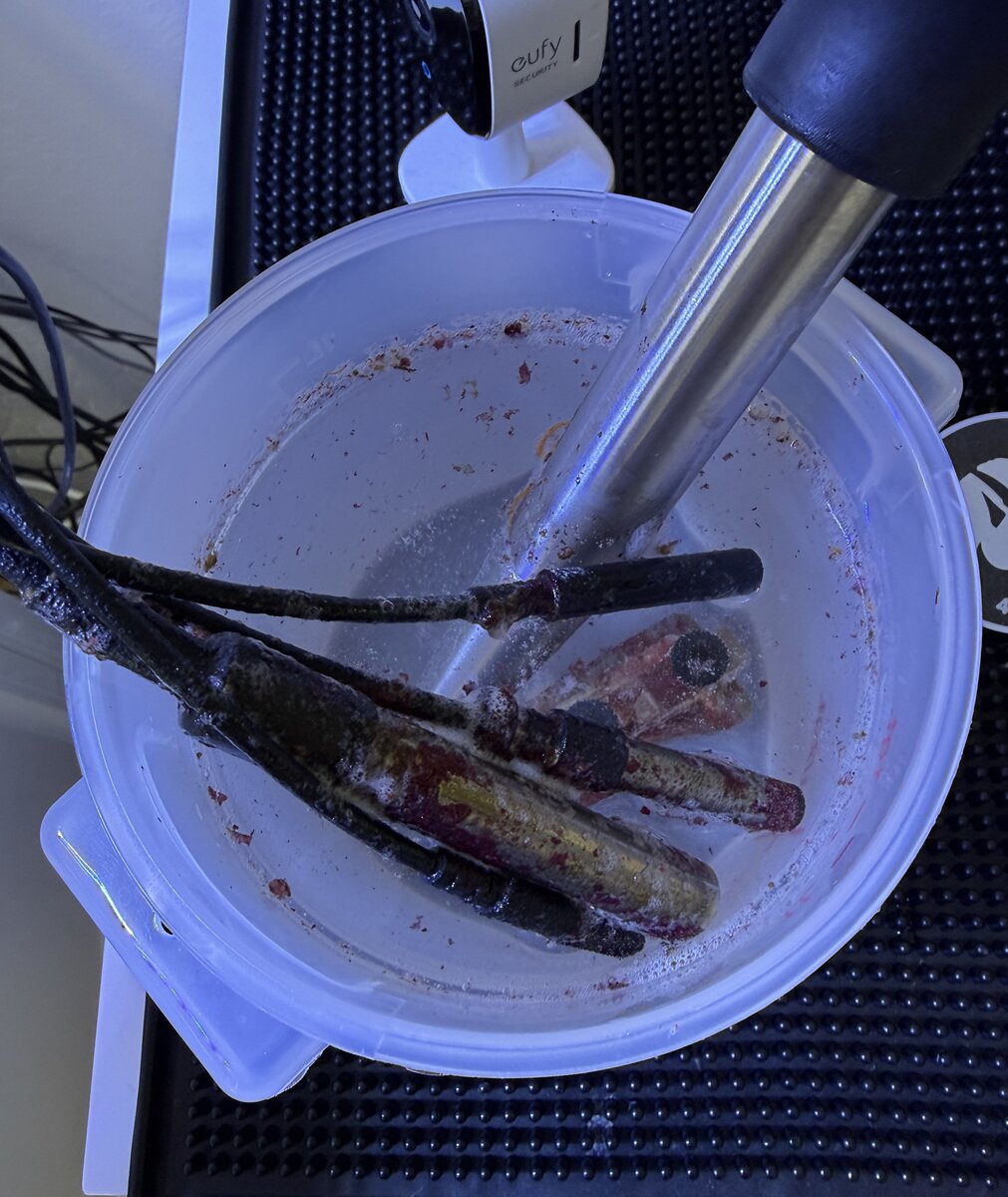
I am cleaning my three temperature probes regularly due to their location inside the display tank.

I was under the impression that it is better to keep the probes where they supposed to measure the water temperature, i.e., the display tank, but I am starting to get annoyed with cleaning them regularly from their heavy coralline algae exposure.

Therefore, I thought I would do a little poll to see where everyone keeps their probes, and if there are any good reasons to have them either inside the display tank or sump.

My initial concern was that during a power outage it would not properly alarm me of the falling temperature, but I have a heavy power backup which will power the tank’s main pumps long after a large temperature drop.

Not sure if I am missing anything.

Poll shows two options for display tank to isolate those who cannot keep their probes elsewhere.
IMG_8380.jpeg
 

tbrown

Cronies #3?? Heathens' Coffee Snob???
View Badges
Joined
Nov 22, 2019
Messages
80,901
Reaction score
218,355
Location
Peoria, AZ
Rating - 100%
2   0   0
I keep my Hydros temperature probe in the sump in the return section of the sump measuring the temperature going back into the DT and my Inkbird and a second Hydros probe in the DT near the overflow weirs.

In my AIO I have 4 rear chambers. The heater is in the second chamber and the Hydros probe is in the third chamber right before the return section. My Inkbird probe is right before the weirs to the rear chambers.

On both setups, I figure if the Inkbird fails and the heater overheats, the Hydros shuts it down so it's set a degree higher than the Inkbird. Inkbird regulates the tank and the Hydros is my safety just in case the Inkbird fails.
 

Reef Jedi

Valuable Member
View Badges
Joined
Jan 21, 2018
Messages
1,643
Reaction score
3,985
Location
Erie, CO
Rating - 0%
0   0   0
I put probe in next to the down pipe to measure tank temp coming into sump. Then heaters in second sump chamber next to skimmer. Works well and keeps it consistent.
 

BeanAnimal

7500 Club Member
View Badges
Joined
Jul 16, 2009
Messages
9,265
Reaction score
15,537
Rating - 0%
0   0   0
The probe should always be in the same compartment as the heating element and slightly upstream of it.

This prevents short cycling and the heater freewheeling if the return pump is shut off. You can possibly boil water in the sump compartment if the probe is separated from it and the pump is off.

We can do the math for different heater sizes and sump sizes, but you get the idea.
 

BriDroid

I glue animals to rocks.
View Badges
Joined
Aug 2, 2024
Messages
1,418
Reaction score
1,930
Location
Prosper, TX
Rating - 0%
0   0   0
I have a Hydros collective. I somehow ended up with 2 temp probes so I put one in the sump and one in the display. The one in my sump swings with the heaters turning on and off. I’m really surprised how stable the one in the tank is. Maybe a 0.2 to 0.3 degree swing.
 

Gumbies R Us

God, Bouldering, and Reefing
View Badges
Joined
Nov 10, 2022
Messages
28,944
Reaction score
51,301
Location
North Georgia
Rating - 0%
0   0   0
I had my in the overflow area that was right next to the thermometer. Gave me an accurate temperature every time
 

BeanAnimal

7500 Club Member
View Badges
Joined
Jul 16, 2009
Messages
9,265
Reaction score
15,537
Rating - 0%
0   0   0
Does cleaning them impact their accuracy?
Not directly, but buildup may affect response time in extreme cases.

Something to note: the cord has to enter somewhere. That means there has to be a seal between the cord and the probe. It may be epoxy, silicone, another sealant, interference, a gasket, or chemical bonding. The seal is there to prevent water influx at some maximum depth (pressure).

What we often do not understand is that buildup of biological material, precipitation, or crystal growth can sometimes breach the seal by acting as a wedge as it grows. That is why an IP water ingress rated enclosure can sometimes fail from salt creep, for example. The crystals may wedge themselves through the gasket interface over time. The Ranco probes that I have seen fail were due to erosion of the sealing area by biological material.

Cleaning temperature probes is not a bad thing, even if it does not directly improve their accuracy.
 

Freenow54

5000 Club Member
View Badges
Joined
Mar 5, 2021
Messages
6,561
Reaction score
5,092
Location
Ontario Canada
Rating - 0%
0   0   0
The probe should always be in the same compartment as the heating element and slightly upstream of it.

This prevents short cycling and the heater freewheeling if the return pump is shut off. You can possibly boil water in the sump compartment if the probe is separated from it and the pump is off.

We can do the math for different heater sizes and sump sizes, but you get the idea.
I still like the idea of using whatever brand you wish to just act as a safety as opposed to a control. Ie shut off the hydro supply .
 

davidm777

Community Member
View Badges
Joined
May 17, 2024
Messages
98
Reaction score
79
Location
San Diego
Rating - 0%
0   0   0
I would be nervous to have the sensor in a location other than where the heating element is. For instance on the overflow... what if the return pump fails?
Just food for a though.
 

tbrown

Cronies #3?? Heathens' Coffee Snob???
View Badges
Joined
Nov 22, 2019
Messages
80,901
Reaction score
218,355
Location
Peoria, AZ
Rating - 100%
2   0   0
I would be nervous to have the sensor in a location other than where the heating element is. For instance on the overflow... what if the return pump fails?
Just food for a though.
I have a Sensor in the sump of my 70 in the return section with the heater.

In my 8 gallon, chamber 2 houses my heater and chamber 3 houses my probe. The water flows between the two chambers from the bottom so they're essentially the same chamber when the water flow is off.
 

TOP 10 Trending Threads

WHAT AMOUNT OF LIVE ROCK AND SAND SHOULD BE PRIORITIZED FOR OPTIMAL BIODIVERSITY/FILTRATION?

  • 100% live rock + bagged sand

    Votes: 34 27.6%
  • 100% dry rock + 100% live sand

    Votes: 43 35.0%
  • 50/50 live/dry rock, 50/50 live/bagged sand

    Votes: 27 22.0%
  • 75% live rock, 25% live sand

    Votes: 11 8.9%
  • 25% live rock, 75% live sand

    Votes: 8 6.5%
Back
Top




