the unbeatable, legendary algae. Pls help lol

MeganV

Community Member
View Badges
Joined
Dec 10, 2022
Messages
51
Reaction score
50
Location
Findlay, OH
Rating - 0%
0   0   0
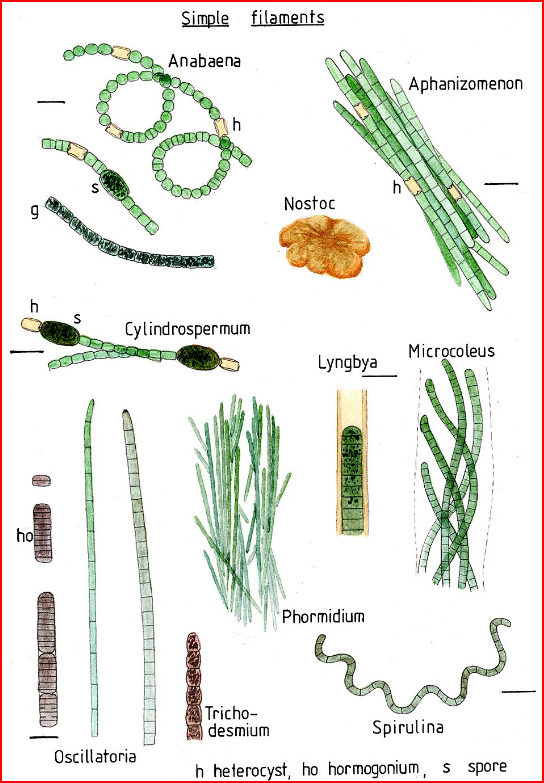
If you clean a spot - how long time before its back in the same amount. When I clean real hairy algae - it will takes att least 7-14 days before it is re-established as it was before. Try to look in an microscope - filamentous cyanobacteria looks like this. You can see the cell walls.

1758285813752.png
Before you proceed with anything more than just scrubbing and cleaning - try to determine whether you have a problem with algae or cyanobacteria.

Remember that all pictures of "green algae" on internet not need to be right.

Sincerely Lasse

This is your next course of action - you need to confirm what you are dealing with. A microscope is one of the best tools a reefer can have.
 

benaer

New Member
View Badges
Joined
Sep 19, 2025
Messages
9
Reaction score
1
Location
london
Rating - 0%
0   0   0
I have been plucking it with my hands which seems efective, and you can try it to! But, I am getting tired, so I'm just going to get an abalone.
 

JumboShrimp

7500 Club Member
View Badges
Joined
Aug 12, 2018
Messages
9,141
Reaction score
12,550
Rating - 0%
0   0   0
1758317098850.jpeg


When I had hair algae this bad, I dropped in a giant Turbo Snail, Tuxedo Urchin, and Sea Hare all at the same time. Tank fully cleaned (sand, rocks, and glass) within a week.
 

mcarroll

10K Club member
View Badges
Joined
Jan 8, 2012
Messages
15,213
Reaction score
8,968
Location
Virginia
Rating - 0%
0   0   0
I’ve gone and siphoned basically the entire volume of water into a filter sock just cleaning it out, within days it’s back over my rocks, I’ve been having issues bringing my PO4 and nitrates up but dosing those at this point daily. I’ve since just used a UV and socks. Skimmer off and nothing else going on really.
If it's regrowing like that, there's no way you have enough cleanup crew – so they just aren't able to get around the whole tank before algae resettlement happens.

Snails also hunt by memory, so if a place was too overgrown they may have stopped visiting there. IF you are sure you have enough cleanup crew, then next time you clean a spot, gently take one or more snails and place them in the newly-cleaned zone so they know about it.

And turn that skimmer back on....what are you thinking. ;)

If you clean a spot - how long time before it's back in the same amount. When I clean real hairy algae - it will takes att least 7-14 days before it is re-established as it was before. Try to look in a microscope - filamentous cyanobacteria looks like this. You can see the cell walls.

1758285813752.png
Before you proceed with anything more than just scrubbing and cleaning - try to determine whether you have a problem with algae or cyanobacteria.

Remember that all pictures of "green algae" on internet not need to be right.

Sincerely Lasse

I have trouble distinguishing between filamentous algae in these pics and those pics of cyano you posted....which were great, BTW.

Lots of these seem to exhibit the same structure, at least to my untrained eyes.

Is it me or are there far fewer resources online for needs like identification of cyanobacteria (as compared with other pest algae)?
 

Lasse

10K Club member
View Badges
Joined
Mar 20, 2016
Messages
12,664
Reaction score
31,364
Location
Källarliden 14 D Bohus, Sweden
Rating - 0%
0   0   0
I agree - the pictures on internet confirms it

I think that you need to look att the cells and the cell walls. In cyanobacteria - they seems to be very regular cells size and distinct cell walls (exceptions for those who have heterocyst (that´s special cells responsible for nitrogen fixation)

IMO - cyanobacteria of all species grows much, much faster than all filamentous algae I knows. Its a matter of hours according to dubbling the biomass compared with days for algae. Also - probably because of toxins - the clean up crew want eat them. Putting this together with the knowledge that there is filamentous - even branching - marine cyanobacteria may be a better tool than just looking at pictures. IMO a "messy" and and slimy appearance also suggests that it is cyanobacteria.

Sincerely Lasse
 

Bruttall

Valuable Member
View Badges
Joined
Feb 19, 2023
Messages
1,446
Reaction score
2,413
Location
Council Bluffs
Rating - 0%
0   0   0
Picture of Bryopsis, I see almost every type of algae mentioned in this thread excerpt this extremely hard to get rid of variety. And the pics OP posted look like Bryopsis to me, but my eyes are not great these days.

1759054368369.png


If this is Your Issue, Reefflux works pretty well to eradicate this stuff, but it KILLS ALL GREEN ALGAE in your system.
 

TOP 10 Trending Threads

WHAT AMOUNT OF LIVE ROCK AND SAND SHOULD BE PRIORITIZED FOR OPTIMAL BIODIVERSITY/FILTRATION?

  • 100% live rock + bagged sand

    Votes: 38 26.0%
  • 100% dry rock + 100% live sand

    Votes: 48 32.9%
  • 50/50 live/dry rock, 50/50 live/bagged sand

    Votes: 34 23.3%
  • 75% live rock, 25% live sand

    Votes: 15 10.3%
  • 25% live rock, 75% live sand

    Votes: 11 7.5%
Back
Top