Velvet (Amyloodinium ocellatum)

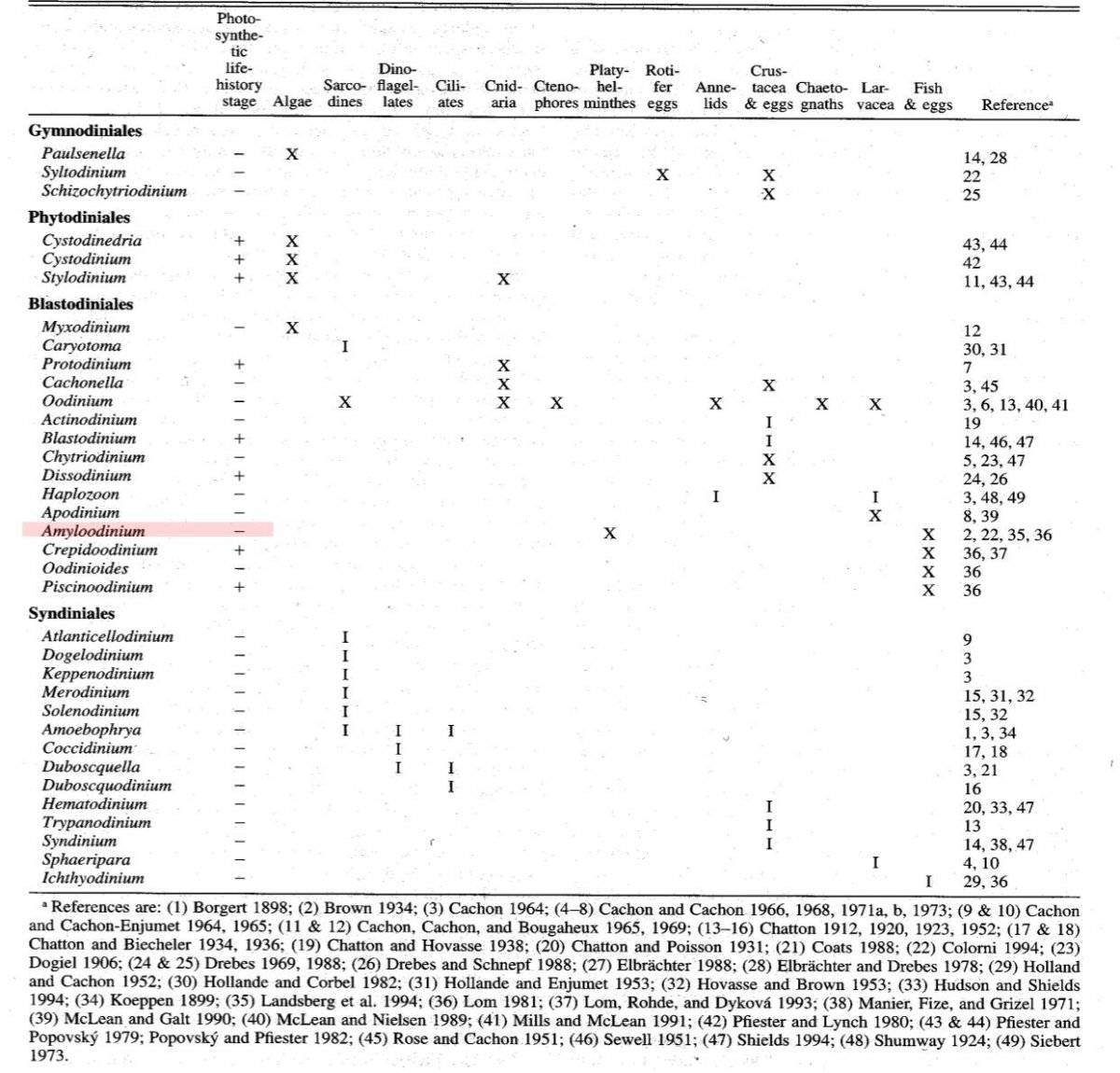
Yes. Amyloodinium ocellatum. Never had chloroplasts or photosynthetic apparatus.

Most references are not new, but it seems to me the photosynthetic myth was just created and repeated by us aquarists.

Check Wayne (attached) for source of this table:
E978BBC6-76B6-4B2B-A45C-21CA610E8FED.jpeg

Great, thank you for taking the time to post that. I think you are correct, there are many myths which are propogated and repeated in the hobby. Often it's time consuming/difficult to find the scientific fact.

I think the confusion stems from the fact that the related freshwater dinoflagellate, Oodinium DOES have chloroplasts. Back in the olden days, we called it Oodinium ocellatum. Amyloodinium does not, to my knowledge, have chloroplasts.

Jay

This again makes sense. There are many freshwater references which are often incorrectly transferred to marine. It's the reason that I refuse to refer to Cryptocaryon irritans as Ich/Ick/Whitespot. It usually spawns people advising to raise the temperature etc, which is a strategy for combatting Ichthyophthirius multifiliis, Freshwater whitespot.

I'm proposing to only refer to it as Crypto.. lol
 
Last edited:
Great, thank you for taking the time to post that. I think you are correct, there are many myths which are propogated and repeated in the hobby. Often it's time consuming/difficult to find the scientific fact.


This again makes sense. There are many freshwater references which are often incorrectly transferred to marine. It's the reason that I refuse to refer to Cryptocaryon irritans as Ich/Ick/Whitespot. It usually spawns people advising to raise the temperature etc, which is a strategy for combatting Ichthyophthirius multifiliis, Freshwater whitespot.

I'm proposing to only refer to it as Crypto.. lol
I agree about ich. I only use that term because it is the convention here, just like Amyloodinium is called "velvet". I tried using both names in order to cover everybody, but it takes too long to type (grin).

Jay
 
Perhaps this has already been answered and I'm missing it among all the pages. Any advice on how to treat the medicated bath situation for scaleless fish, specifically puffers? I know their dose of copper needs to be adjusted accordingly, but I'm reading a lot of accounts that these two medications burned the skin of scaleless fish, often causing death. My only thought is to continue the freshwater dips daily and maintain therapeutic levels of cupramine, which I already seem to be successful with (thanks to another user's advice before I found this). I'm still very early in the treatment of both velvet and ich on two very new puffers (one's still not eating, and the other is only picking at food) and a blenny in quarantine. Doing ok for now, but would like to keep it that way. I'll be adding Kanaplex when it comes in tonight.
 
Perhaps this has already been answered and I'm missing it among all the pages. Any advice on how to treat the medicated bath situation for scaleless fish, specifically puffers? I know their dose of copper needs to be adjusted accordingly, but I'm reading a lot of accounts that these two medications burned the skin of scaleless fish, often causing death. My only thought is to continue the freshwater dips daily and maintain therapeutic levels of cupramine, which I already seem to be successful with (thanks to another user's advice before I found this). I'm still very early in the treatment of both velvet and ich on two very new puffers (one's still not eating, and the other is only picking at food) and a blenny in quarantine. Doing ok for now, but would like to keep it that way. I'll be adding Kanaplex when it comes in tonight.

Welcome to Reef2Reef!

Coppersafe and Copper Power are safe with puffers. It is the old ionic copper that they had issues with. I'm not sure about Cupramine, it is a bit harsher than the other two products.

Why are you adding Kanaplex? Do the fish show signs of bacterial infection? If not, I would just hold it at the ready in case they do.

Jay
Thanks. I'm using Cupramine per a recommendation I trust from a puffer-specific forum.

And planning on the Kanaplex in reference to the original post by Humblefish on the first page of this thread:

  • While in QT, use a wide spectrum antibiotic (exs. Seachem Kanaplex, Furan-2) for the first week to ward off any possible bacterial infections. Secondary bacterial infections are very common in fish with preexisting parasitic infestations such as velvet.
 
Perhaps this has already been answered and I'm missing it among all the pages. Any advice on how to treat the medicated bath situation for scaleless fish, specifically puffers? I know their dose of copper needs to be adjusted accordingly, but I'm reading a lot of accounts that these two medications burned the skin of scaleless fish, often causing death. My only thought is to continue the freshwater dips daily and maintain therapeutic levels of cupramine, which I already seem to be successful with (thanks to another user's advice before I found this). I'm still very early in the treatment of both velvet and ich on two very new puffers (one's still not eating, and the other is only picking at food) and a blenny in quarantine. Doing ok for now, but would like to keep it that way. I'll be adding Kanaplex when it comes in tonight.
Don't use copper, use Chloroquine Phosphate. I use CP for basically all my fish. Eels as well. It's much safer and easier.
 
Don't use copper, use Chloroquine Phosphate. I use CP for basically all my fish. Eels as well. It's much safer and easier.
Thanks, I thought CP was via prescription only. Is there a place I can get it a little easier? I saw a post with a link to nationalfishpharm, but holy crap I cannot afford those prices.
 
Thanks. I'm using Cupramine per a recommendation I trust from a puffer-specific forum.

And planning on the Kanaplex in reference to the original post by Humblefish on the first page of this thread:

  • While in QT, use a wide spectrum antibiotic (exs. Seachem Kanaplex, Furan-2) for the first week to ward off any possible bacterial infections. Secondary bacterial infections are very common in fish with preexisting parasitic infestations such as velvet.

I strongly disagree with using antibiotics as a preventative - if the fish do not show obvious bacterial infections, if you use antibiotics, you can either misidentify the problem, or in the worst case, develop antibiotic resistant strains.

Chloroquine has its own toxicity issues, in many cases, much worse than amine-based copper products. I've lost wrasse and lionfish to a normal CP treatment, where that never happens to me with amine-based copper products.

Daily FW dips are never something that I do - the repeated handling can increase the chance of secondary bacterial infections. Actually, I ONLY use FW dips two ways; as a diagnostic tool (using a microscope to inspect the dip water to identify parasites that may have fallen of) and as a stop-gap measure to buy some time while other treatments have time to work. For example, with Amyloodinium, velvet, the fish are often in a bad way by the time an aquarist has diagnosed the problem. Copper takes up to 72 hours to start to cure the fish. In those cases, a FW dip is warranted to buy enough time for the copper to work. The same applies to flukes and buying some time for the praziquantel to work.

Jay
 
Thanks, I thought CP was via prescription only. Is there a place I can get it a little easier? I saw a post with a link to nationalfishpharm, but holy crap I cannot afford those prices.
That's where I got mine. $150 for a lifetime supply isn't that bad in my opinion. Maybe split it with someone else?

https://store.nationalfishpharm.com/items/view/616/chloroquine-phosphate?return=/items/search
Chloroquine has its own toxicity issues, in many cases, much worse than amine-based copper products. I've lost wrasse and lionfish to a normal CP treatment, where that never happens to me with amine-based copper products.

I personally have never lost a fish during a CP treatment. I know LOTS of people who have lost fish to copper. It's a poison that hopefully kills the parasite before the fish.
 
I strongly disagree with using antibiotics as a preventative - if the fish do not show obvious bacterial infections, if you use antibiotics, you can either misidentify the problem, or in the worst case, develop antibiotic resistant strains.

Chloroquine has its own toxicity issues, in many cases, much worse than amine-based copper products. I've lost wrasse and lionfish to a normal CP treatment, where that never happens to me with amine-based copper products.

Daily FW dips are never something that I do - the repeated handling can increase the chance of secondary bacterial infections. Actually, I ONLY use FW dips two ways; as a diagnostic tool (using a microscope to inspect the dip water to identify parasites that may have fallen of) and as a stop-gap measure to buy some time while other treatments have time to work. For example, with Amyloodinium, velvet, the fish are often in a bad way by the time an aquarist has diagnosed the problem. Copper takes up to 72 hours to start to cure the fish. In those cases, a FW dip is warranted to buy enough time for the copper to work. The same applies to flukes and buying some time for the praziquantel to work.

Jay
Thanks for the perspective on CP, I wouldn't have known. And what your saying makes a lot of sense.
 
That's where I got mine. $150 for a lifetime supply isn't that bad in my opinion. Maybe split it with someone else?

https://store.nationalfishpharm.com/items/view/616/chloroquine-phosphate?return=/items/search


I personally have never lost a fish during a CP treatment. I know LOTS of people who have lost fish to copper. It's a poison that hopefully kills the parasite before the fish.
Good idea. I'm looking for some in local groups now...I also worry about the time it would take to get here vs the time my fish actually have. I'm gonna do some more research on it, but I'd like to get it on-hand in case I do decide to go that route.
 
Hi @Humblefish

If you had no choice or a qt, would you rather run copper or Ruby reef in the main display? What are the precautions and downsides to running Acriflavine in the whole display?

We are talking about too many fish to even start to consider qt in my cousins tank. We also followed your recommendations on lowering the temp and salinity to slow metabolism.

You can’t use copper in the display if you currently have inverts.

If you don’t have inverts, but might at some point, you probably shouldn’t use copper as it can be difficult if not impossible to remove it without replacing all of the rock and substrate.
 
This is indeed a great write up so thank you. Maybe one day it can be updated as it has been a while since we used 1.75ppm copper power to treat parasites. Regardless good guidance here.

I did want to share that at least in my case, being a bit more aggressive on the front end seems to have paid off as the first time I encountered velvet I did not do it and it cost me.

As soon as I saw velvet, immediately brought copper power to 2.5ppm in display FOWLR. The next day the mucus on the skin was really compromised and fish were breathing very rapidly. Thought it was over. Decided to get aggressive. Performed 5 minute FW dip on all the fish, followed immediately with a 4-5 hour bath in Acriflavine (Rally pro) @ 1 tsp/gallon with high aeration. Before putting into a 40g breeder fully cycled QT (not the display) , gave them another FW bath but this time 3m vs 5m. Of course throughout all of this, fish were monitored to ensure no undue stress. Got up the next morning and fish looked much better, Breathing better and moving around more normally. Fed them mysis, flakes and nori and they all ate!

Not sure if I just got lucky but being aggressive, early and fast is so important when dealing with this disease. It worked for me…..thx again.

Yes - this is a really old thread, more than a decade since the first post!

For active velvet / Amyloodinium, the key is to get the fish up to 2.5 ppm amine-chelated copper in a few hours, using the Hanna HR copper tester to measure.

True Velvet is pretty rare in marine fish. People often miss the early symptom which is simply more rapid breathing and hovering in water flow. If you don’t catch it soon enough, no treatment will really work.

You can sometimes buy a little time by using a 30 minute 75 ppm hydrogen peroxide dip.
Hmmmm. I didn't catch it at that early stage but did find the baths helpful in getting fish to last long enough so copper could work on both gills and water column during swimming stage looking for a host.
 
Yes - this is a really old thread, more than a decade since the first post!

For active velvet / Amyloodinium, the key is to get the fish up to 2.5 ppm amine-chelated copper in a few hours, using the Hanna HR copper tester to measure.

True Velvet is pretty rare in marine fish. People often miss the early symptom which is simply more rapid breathing and hovering in water flow. If you don’t catch it soon enough, no treatment will really work.

You can sometimes buy a little time by using a 30 minute 75 ppm hydrogen peroxide dip.
What do we mis diagnose it with? Velvet is like tiny fine salt like crystals Sprinkled and sheen like all over the body which creates mucus secretion right away. Ich tends to be bigger spots and more dispersed in the early days. If untreated can turn into many as free swimmers multiply and look for host.Do I have that right?
 
What do we mis diagnose it with? Velvet is like tiny fine salt like crystals Sprinkled and sheen like all over the body which creates mucus secretion right away. Ich tends to be bigger spots and more dispersed in the early days. If untreated can turn into many as free swimmers multiply and look for host.Do I have that right?

They don’t misdiagnose it with something else, they miss the early diagnosis of it. That leads to poor outcomes for treatment since it kills fast.

Amyloodinium doesn’t show skin changes until very late in the infection, and sometimes not even then. The references to small dust is a confabulation from freshwater velvet, a different species.

I had to go through the libraries here and edit a bunch of images that were labeled “velvet” that were actually late stage ich (with finer spots).

So is this, or was this, Velvet?


IMG_0876.jpeg

IMG_0877.jpeg
 
Last edited:

TOP 10 Trending Threads

WHAT’S YOUR MOST MEMORABLE EXPERIENCE WITH A CORAL THAT LOOKED LIKE IT MIGHT NOT MAKE IT?

  • I’ve seen a dramatic comeback. I would have sworn it was a goner

    Votes: 17 44.7%
  • A slow recovery, and it got back to looking healthy

    Votes: 6 15.8%
  • It came back some, but never looked as good as it used to

    Votes: 3 7.9%
  • I tried to save one, but it didn’t make it

    Votes: 6 15.8%
  • Mine is still struggling...no comeback yet

    Votes: 3 7.9%
  • I’ve never had a coral in serious trouble

    Votes: 0 0.0%
  • See, this is why I don’t keep corals

    Votes: 1 2.6%
  • Other (Post in the comments)

    Votes: 2 5.3%
Back
Top
Home
Post thread…
Market
What's new