


Whos running high phosphates?

jimmypencil

Active Member
View Badges
Joined
May 29, 2021
Messages
460
Reaction score
200
Location
south carolina
Rating - 100%
1   0   0
Hey Everyone,

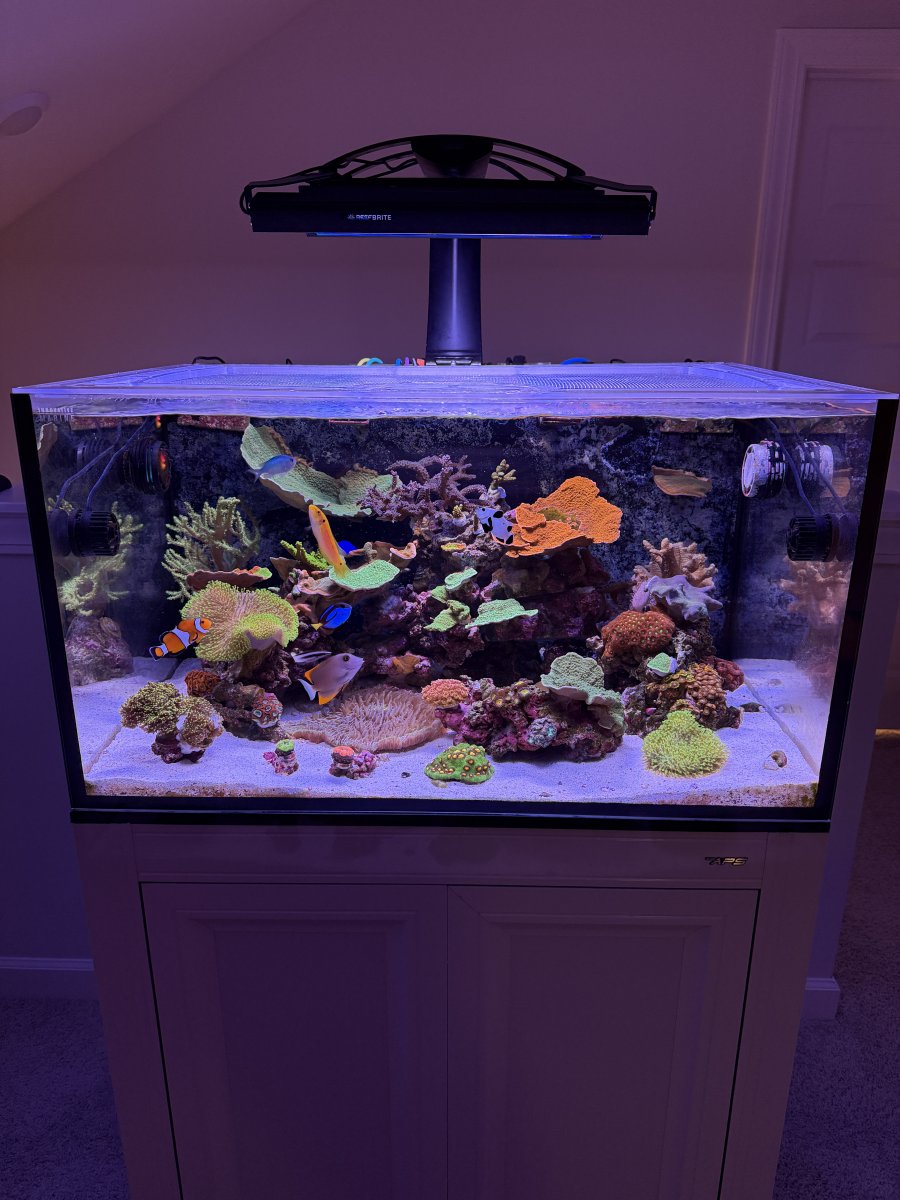
Since I started testing again, Phosphates in my tank have been high for the past year or so (.4-.5ppm with Hanna ULR phosphate checker). I got into the habit of not testing anything unless I saw issues. The high phosphate hasn’t really concerned me because I haven’t faced many of the issues associated with high phosphate (algae, poor coloration).

I recently got some new acros and I want to maximize color. I have done research on phosphate recently and it’s my understanding that my levels should turn sps corals brown and there should be hair algae. I do want to lower my phosphate using a media reactor with GFO - but I don’t understand why my tank is handling the high phosphate levels and I want to have a better understanding before I chase numbers.

Does anyone else run phosphate in the .3-.4+ range with success and no issues? Are there factors that balance this out that I’m not considering? Is my test kit lying? (Trident np usually has numbers in the same range). I also don’t understand why my levels are so high if I’m not really over feeding IMO.


I will list all the factors I can think of below:

- nitrates are always between 15-20ppm (Hannah checker)

-tank is 3 years old, it’s a 50 gallon AIO. I run a skimmer, UV, and an in tank basket with filter floss, chemi pure blue, and ceramic media. I use kalkwasser.

-I dose 30-50ml of algae barn phyto daily

-I feed nano reef frenzy (quarter size piece) and NLS pellets daily. I don’t see any change in phosphate when I stop dosing one of the two foods for a few days - a week.

-I do 10% or 20% water changes weekly

-I don’t think I have a massive bio load. I have 2 clowns, a tomini tang, a quarter size blue hippo tang, an azure damsel, a chalk bass, a yellow hog fish, and a green chromi. A conch, a few Halloween hermits, a bunch of blue legs, nassarius snails and

- it’s a mixed reef/sps dominant.


IMG_5191.jpeg
 

Randy Holmes-Farley

Reef Chemist
View Badges
Joined
Sep 5, 2014
Messages
89,252
Reaction score
92,283
Location
Massachusetts, United States
Rating - 0%
0   0   0
Many great tanks have phosphate higher than yours, without algae and with color.

Here’s one;

 
OP
OP
jimmypencil

jimmypencil

Active Member
View Badges
Joined
May 29, 2021
Messages
460
Reaction score
200
Location
south carolina
Rating - 100%
1   0   0
I
Many great tanks have phosphate higher than yours, without algae and with color.

Here’s one;

Thanks Randy,

Is there a phosphate range you recommend? When I was newer in the hobby I always thought phosphate was the most important thing to monitor, as I always saw the biggest changes in the tank based on phosphate. But if people are running .5* with no issues - I don’t see why people still reccomend .09 or lower.
 

kingranch2003

10K Club member
View Badges
Joined
May 4, 2024
Messages
18,486
Reaction score
130,981
Location
Mississippi Gulf Coast
Rating - 100%
1   0   0
Yes! I stay at .3-.4 in my 40 gallon AIO. It’s an lps dominant mixed reef, with some sps. As long as nuisance algae isn't an issue, your corals probably won't mind that range if it isn't dropped too suddenly. Nice looking tank you have there.
Screenshot_20250614_142141_Gallery.jpg
 

bubbgee

Valuable Member
View Badges
Joined
Jun 7, 2021
Messages
2,154
Reaction score
1,767
Location
Alhambra
Rating - 0%
0   0   0
I

Thanks Randy,

Is there a phosphate range you recommend? When I was newer in the hobby I always thought phosphate was the most important thing to monitor, as I always saw the biggest changes in the tank based on phosphate. But if people are running .5* with no issues - I don’t see why people still reccomend .09 or lower.
The lower po4 is just to help SPS with alk consumption. I run low po4 to grow my frags and I know I slow down growth when my alk isnt moving and that reflects on my po4 being out of my range. You can perfectly grow corals in higher po4. Of course that will also affect the growth or coloration of SPS.
 

Randy Holmes-Farley

Reef Chemist
View Badges
Joined
Sep 5, 2014
Messages
89,252
Reaction score
92,283
Location
Massachusetts, United States
Rating - 0%
0   0   0
I

Thanks Randy,

Is there a phosphate range you recommend? When I was newer in the hobby I always thought phosphate was the most important thing to monitor, as I always saw the biggest changes in the tank based on phosphate. But if people are running .5* with no issues - I don’t see why people still reccomend .09 or lower.

Yes:


4. What targets seem reasonable? Of course, that depends on all the other factors at play, such as types of corals, availability of ammonia, particulate foods, etc. However, for a mature mixed reef, this would be how I personally would run it:
  • Let nitrate float between 5 ppm and 50 ppm. I’d use gentle export in this range, such as growing macroalgae.
  • Above 50 ppm, I’d begin to focus more on reducing it, by organic carbon dosing, turf or macroalgae, etc.
  • Below 5 ppm, I’d begin to dose ammonia or feed more. The target level might drop lower if dosing ammonia, just like the heavy in/heavy out scenario where nitrate may not be as needed.
  • Let phosphate float between about 0.06 ppm and 0.3 ppm. This range is higher than I’ve recommended in the past. I’d use gentle export in this range, such as growing macroalgae.
  • Above about 0.3 ppm, I’d begin to focus more on reducing it, by turf or macroalgae, or a binder such as GFO or lanthanum (has its own risks to tangs). If a binder: GO SLOW. Turf and macroalgae will typically be slow enough.
  • Below 0.06 ppm, I’d begin to dose sodium phosphate or feed more to get the level up.
 

exnisstech

Grumpy old man
View Badges
Joined
Feb 11, 2019
Messages
18,932
Reaction score
30,388
Location
Ashland Ohio
Rating - 0%
0   0   0
Tank has been running for 15 months and has never had nuisance algae.
PXL_20250412_020306033.jpg


Screenshot_20250614-154325.png


I can't comment on acros and higher PO4 because my acro tank runs much lower but not by choice. it has always run as an ULNS on its own. It runs so low I dose ammonium at times to keep N and P detectable
 
Last edited:
OP
OP
jimmypencil

jimmypencil

Active Member
View Badges
Joined
May 29, 2021
Messages
460
Reaction score
200
Location
south carolina
Rating - 100%
1   0   0
Your tank looks great!

.4-.6ppm phosphate per Hanna 3 years.
I’ve asked myself the same question.
I can reduce to .2ppm, but it just likes .4ppm.
So until something changes my mind, I’m watching it does not rise continuously, and leaving it alone.

IMG_1007.jpeg
Thanks! Your tank looks great also! Do you run gfo or do you have a fuge?
 
OP
OP
jimmypencil

jimmypencil

Active Member
View Badges
Joined
May 29, 2021
Messages
460
Reaction score
200
Location
south carolina
Rating - 100%
1   0   0
Yes:


4. What targets seem reasonable? Of course, that depends on all the other factors at play, such as types of corals, availability of ammonia, particulate foods, etc. However, for a mature mixed reef, this would be how I personally would run it:
  • Let nitrate float between 5 ppm and 50 ppm. I’d use gentle export in this range, such as growing macroalgae.
  • Above 50 ppm, I’d begin to focus more on reducing it, by organic carbon dosing, turf or macroalgae, etc.
  • Below 5 ppm, I’d begin to dose ammonia or feed more. The target level might drop lower if dosing ammonia, just like the heavy in/heavy out scenario where nitrate may not be as needed.
  • Let phosphate float between about 0.06 ppm and 0.3 ppm. This range is higher than I’ve recommended in the past. I’d use gentle export in this range, such as growing macroalgae.
  • Above about 0.3 ppm, I’d begin to focus more on reducing it, by turf or macroalgae, or a binder such as GFO or lanthanum (has its own risks to tangs). If a binder: GO SLOW. Turf and macroalgae will typically be slow enough.
  • Below 0.06 ppm, I’d begin to dose sodium phosphate or feed more to get the level up.
Thanks Randy,

I plan to start running GFO and I’ll shoot for around .1ppm. I’ll just try my best to lower phosphate slowly and not tick anything off.
 
OP
OP
jimmypencil

jimmypencil

Active Member
View Badges
Joined
May 29, 2021
Messages
460
Reaction score
200
Location
south carolina
Rating - 100%
1   0   0
Tank has been running for 15 months and has never had nuisance.
PXL_20250412_020306033.jpg


Screenshot_20250614-154325.png


I can't comment on acros and higher PO4 because my acro tank runs much lower but not by choice. it has always run as an ULNS on its own. It runs so low I dose ammonium at times to keep N and P detectable
Tank looks great, thanks for the input!
 
OP
OP
jimmypencil

jimmypencil

Active Member
View Badges
Joined
May 29, 2021
Messages
460
Reaction score
200
Location
south carolina
Rating - 100%
1   0   0
Yes! I stay at .3-.4 in my 40 gallon AIO. It’s an lps dominant mixed reef, with some sps. As long as nuisance algae isn't an issue, your corals probably won't mind that range if it isn't dropped too suddenly. Nice looking tank you have there.
Screenshot_20250614_142141_Gallery.jpg
Thanks for the input, your tank looks great and it’s gonna be amazing when it grows out!
 
OP
OP
jimmypencil

jimmypencil

Active Member
View Badges
Joined
May 29, 2021
Messages
460
Reaction score
200
Location
south carolina
Rating - 100%
1   0   0
Yes:


4. What targets seem reasonable? Of course, that depends on all the other factors at play, such as types of corals, availability of ammonia, particulate foods, etc. However, for a mature mixed reef, this would be how I personally would run it:
  • Let nitrate float between 5 ppm and 50 ppm. I’d use gentle export in this range, such as growing macroalgae.
  • Above 50 ppm, I’d begin to focus more on reducing it, by organic carbon dosing, turf or macroalgae, etc.
  • Below 5 ppm, I’d begin to dose ammonia or feed more. The target level might drop lower if dosing ammonia, just like the heavy in/heavy out scenario where nitrate may not be as needed.
  • Let phosphate float between about 0.06 ppm and 0.3 ppm. This range is higher than I’ve recommended in the past. I’d use gentle export in this range, such as growing macroalgae.
  • Above about 0.3 ppm, I’d begin to focus more on reducing it, by turf or macroalgae, or a binder such as GFO or lanthanum (has its own risks to tangs). If a binder: GO SLOW. Turf and macroalgae will typically be slow enough.
  • Below 0.06 ppm, I’d begin to dose sodium phosphate or feed more to get the level up.
Also, I just added a fuge in one of the accessory chambers in my tank a couple of days ago. Mainly because I want to keep up with pod population. The chamber is like 4’x4’x9’. Is this too small to have a noticeable impact on po4 or should I give this a few months before trying GFO?
 

kingranch2003

10K Club member
View Badges
Joined
May 4, 2024
Messages
18,486
Reaction score
130,981
Location
Mississippi Gulf Coast
Rating - 100%
1   0   0
Also, I just added a fuge in one of the accessory chambers in my tank a couple of days ago. Mainly because I want to keep up with pod population. The chamber is like 4’x4’x9’. Is this too small to have a noticeable impact on po4 or should I give this a few months before trying GFO?
I'm not much help with a fuge, but I wonder if that's enough room or if the shape of the chamber would alow for the chaeto to tumble. but there are some algae scrubbers that would certainly fit, and man, do they ever work!

Also, I added phosbond (aluminum oxide, gfo mixture) to run in a small mesh media bag in one of the back chambers of my AIO. I was surprised by how effective it was. Eventually I just realized that my lps seemed happier at .3 or .4, and I had no algae issues.
 

TOP 10 Trending Threads

WHAT AMOUNT OF LIVE ROCK AND SAND SHOULD BE PRIORITIZED FOR OPTIMAL BIODIVERSITY/FILTRATION?

  • 100% live rock + bagged sand

    Votes: 37 27.8%
  • 100% dry rock + 100% live sand

    Votes: 45 33.8%
  • 50/50 live/dry rock, 50/50 live/bagged sand

    Votes: 29 21.8%
  • 75% live rock, 25% live sand

    Votes: 12 9.0%
  • 25% live rock, 75% live sand

    Votes: 10 7.5%
Back
Top








