Why I like a Reverse Undergravel Filter

  • Thread starter Thread starter Paul B
  • Start date Start date
  • Tagged users Tagged users None
OK, when you stop laughing, I will explain why I think a reverse undergravel filter is the best thing since doorknobs.

First, I will explain what a RUGF (reverse undergravel filter is.

Right after WW2, the aquarium hobby came into being in earnest. Our troops came home from the war, and they wanted a hobby. Many people started freshwater fish tanks and their kids soon followed. I was one of those kids and started my first tank around 1953. The tanks were metal-framed and sealed (not very well) with tar, since silicone hadn't been invented yet.

Virtually all of those tanks ran an undergravel filter as I did. We did have problems because the hobby was new, and no one knew much about keeping fish, but we did know, from the little bit of information available, that the fish needed oxygen and filtration. The undergravel filter solved both issues and did it cheaply and efficiently.

The UGF is basically a plate with holes in it that sits under the gravel and a little over the bottom glass. (At the beginning, the bottom of the tanks were slate)

A tube was inserted in it, and you put an airstone in the tube, forcing the water to come up and allowing the water to go down through the gravel and up the tube. This effectively filtered particles out of the water and created circulation, allowing oxygen from the surface to enter the water.

This worked great for a few years, but after a while the filter clogged, causing the oxygen to stop and creating anaerobic conditions that eventually killed everything and stank up the house. Luckily, we were young then and not married, or we would have gotten divorced, and our Xes would have taken our house, car, and all the dead fish.

We soon learned that occasionally we had to remove everything from the tank and wash the gravel.

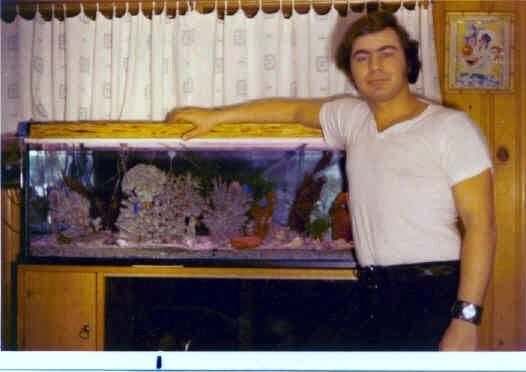
Fast forward to salt water. Salt water fish first came out in Germany and a couple of years later in the US. I came home from Vietnam in 1971 and saw my first saltwater fish for sale, and I had to have one. I set up my 40-gallon tank with an undergravel filter because that's what we knew, and nothing else was available.

Circa 1972 (I still look exactly the same, including my hair and watch)


Remember, there were no salt water books except one by "Robert Straughn" (The Father of Salt Water Fish Keeping)
Also, no computers, cell phones, or internet.

He recommended using undergravel filters, but at the time, the early 50s, he didn't know about or fully understand the function of bacteria in a salt tank and used the UG filter as a particle filter, as we used them in fresh water. He recommended removing the filter occasionally and cleaning the gravel.

That worked in a fish-only tank, but with a reef tank, where corals covered everything, that was not possible, as I found out the hard way, and my tank almost crashed from hydrogen sulfide, which is black, and it stinks like rotten eggs. Luckily, I wasn't married yet.

I did some experimenting and discovered that if I reversed the flow through the undergravel filter and instead of sucking water through it, I instead pushed water up through it from the bottom, the thing worked much longer with very little maintenance.

I had some failures until I came upon the correct flow rate, as too much flow will also cause it to crash due to detritus clogging the gravel.

Through a few years of experimentation, I learned that about 250 GPH pushed down "each" tube was perfect. (My reef is 125 gallons, is 6' long, and uses 3 undergravel plates)

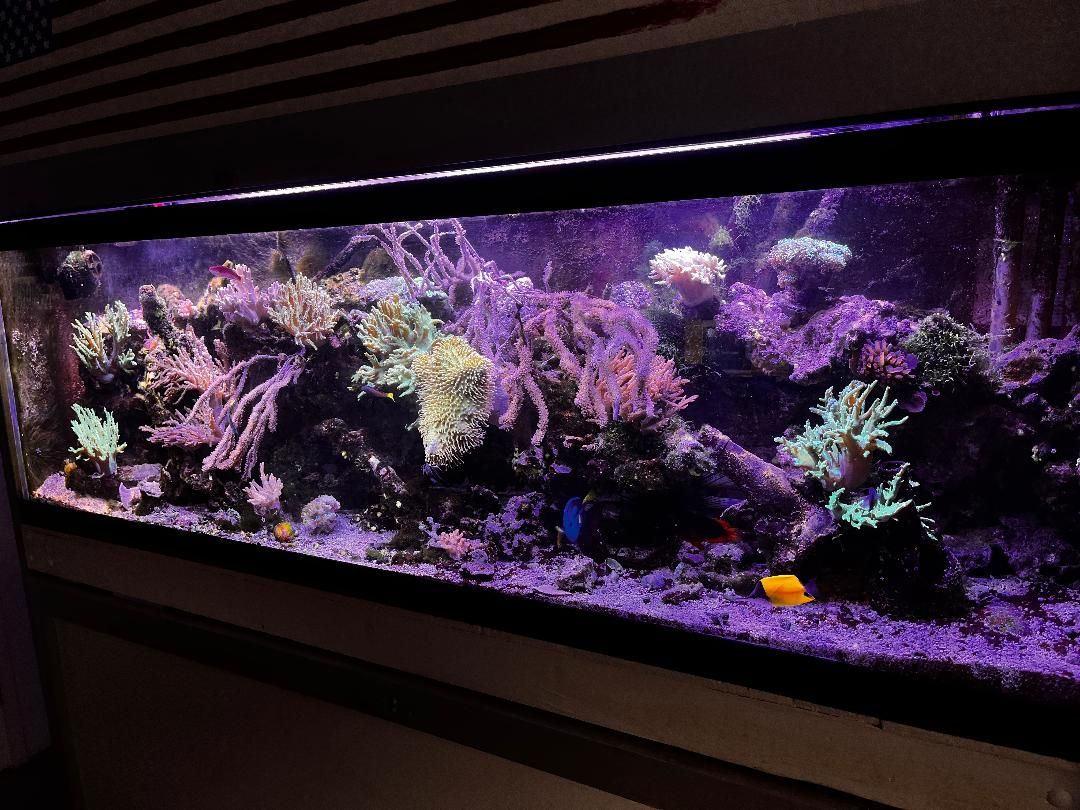
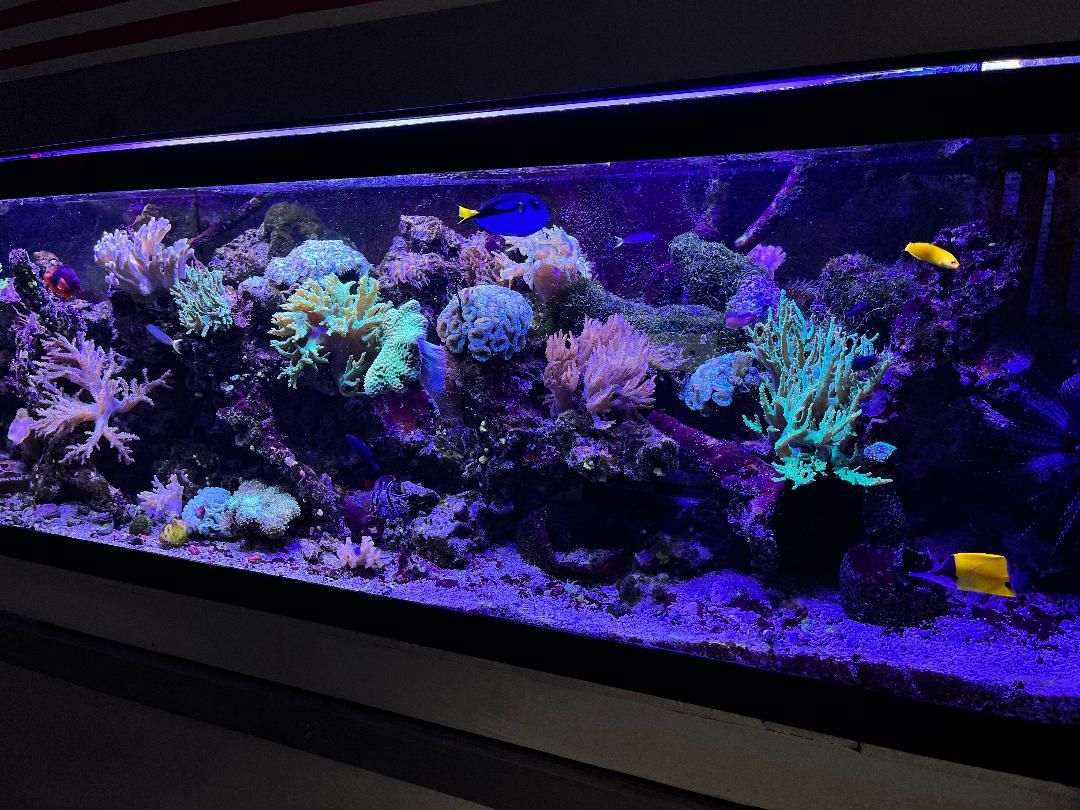
My still-running 55-year-old reef tank has had very few, if any, problems, but it does need a little maintenance. First off, sand can't be used as it is too fine, so I use dolomite gravel, which is about the size of rice. I think crushed coral would work fine.

For 20 years that tank ran fine but at that time I wanted to replace my rocks and re-aquascape mostly for aesthetic reasons and I really wanted to see what was under that filter.

It was mostly muck with thousands of tiny, red tube worms. Those are good signs, meaning there is still oxygenated water flowing through there with enough food to keep those creatures alive. The fact that they are living also means they are filtering out microscopic particles that would float around in my tank.

I cleaned the gravel by stirring it up and running a powerful canister filter to remove excess detritus. I didn't remove the gravel to wash because I wanted to retain those organisms and keep the bacteria.

Bacteria run our tanks, and we are only there to give the bacteria something to make fun of. That is why new tanks look lousy and are never healthy. The bacteria make the water healthy and livable, but it takes time to get to that state.

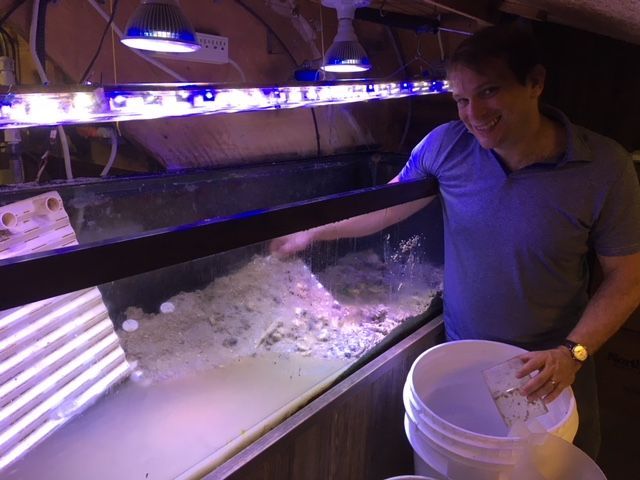
My tank ran another 20 years in that house, so 40 years in total and at that time my wife and I moved about 50 miles out to eastern Long Island. I put everything in the tank in large vats, including most of the water, and had to remove the RUGF.

Here is my son-in-law lifting the RUGF for the move. Notice the muck.


As I mentioned, a reverse undergravel filter needs maintenance. That maintenance is that the gravel needs to be cleaned, but not drastic like in fresh water. It just needs to be stirred by using a powerful canister filter and sucking out excess detritus. That's it.

The vast majority of reef tanks today use sand or even a deep sand bed. I don't like those systems, and as far as I know, none of them are really old, as nothing lasts without maintenance, and those setups can't be well cleaned efficiently because doing so may release harmful hydrogen sulfide, which cannot form with a RUGF.

The only really old tanks I know of, which are over 30 years old, use RUGFs. I am not saying sand substrates can't work. Of course, they can, but I feel they have a definite lifespan, and I started this hobby to be a lifetime endeavor and not a temporary thing.

Remember, it's the bacteria that run our tanks and most, (but not all) bacteria need oxygen. If it didn't work, my tank, which has never crashed, would not exist.





As someone who just rounded their first year with a saltwater tank, this was fascinating to read and I thoroughly enjoyed it. Thank you for sharing and a HUGE thanks to people like you for doing the groundwork it took to have what we have in this hobby now!! So cool to see how far aquariums have come.
 
Anyone have pictures of how they set this up before live rock, and then how they hid it after? Moving soon and would like to give this a shot when I set the new tank up.
 
I should have guessed an AquaClear powerhead 🤣 🙃 🤪

Thank you for your reply!
I’m thinking that green filter box was made by “Lee’s?” Or am I confusing them because they were the first mass produced Under Gravel Filters?
 
Anyone have pictures of how they set this up before live rock, and then how they hid it after? Moving soon and would like to give this a shot when I set the new tank up.
My ex kept all of the Polaroid pictures when she left me for dead.

Its Been A Long Time Waiting GIF
 
I wonder if sand beds are a limiting factor of reef tank longevity. Not so much because of the sand itself, but the lack of maintenance from the start. An undergravel system may be a better way to go with a more coarse substrate and less frequent maintenance in that case. What limitations are there in using this system with a mixed reef tank? Thanks for sharing sir!
Matt - this is the age old (well not older than Paul, we need carbon dating for that) "Is a DSB a ticking time bomb" argument. Proponents argue that it is a full ecosystem that needs no maintenance, and opponents argue it is just a nutrient sink destined to crash the tank one way or the other. Both sides would argue that I misstated their respective positions.

The beginning of the end of ReefCentral can be tracked back to this very debate.

Avengers Infinity War GIF
 
In the way back, when undergravel filters were more popular, you could get powerheads that fit the UG's uptake tubes, and you could run those powerheads in reverse. Out of curiosity, how are you guys driving your reverse flow UG's today? And please don't tell me with a 30 year old Maxi-Jet lol!

Do you guys run your return from a sump into your UG plates, or do you have some other kind of pump feeding the plates?

Thanks!
I made it easy for me to plumb in. I used a canister filter with suction in back of display tank and discharge into uplift tube which has since been covered in GSP.


image.jpg
 
@Paul B if enough sand sifters where put in a tank, that would help the issues of sand issues. Coarse sand, but as you stated fine sand would have some issues. And it’s l I have in my DT’s is fine sand. What I noticed when I took down a 4-5 year old tank about a year ago, was the sand had normal saltwater tank smell. But the system had a yellow watchman and a pistol in it. And they put in hard hours of work! The two had a tunnel system that was insane. They could travel between two rock pillars by underground tunnels haha.

Point being for this tank these two were the best thing. There were no detritus at all almost in the sand, and the sand did not have the foul smell at all. And it was clean. I guess the idea is to have sand sifters to move the sand.

Not trying to argue that a UGF or RUGF does not a place. Just saying there are animals out there can do some of the work for free. Just hav to get enough of them. My sand is about 2” tops in thanks now, and wouldn’t surprise me if it’s more like 1.5”. I don’t do the real deep beds.

Either way awesome post! Love the circa pic! Post some more.
 
I made it easy for me to plumb in. I used a canister filter with suction in back of display tank and discharge into uplift tube which has since been covered in GSP.


image.jpg


Off topic, what in the DIY tube name is that pipe on the left side?
 
I’m thinking that green filter box was made by “Lee’s?” Or am I confusing them because they were the first mass produced Under Gravel Filters?
I remember Lee's under gravel filter, but I don't remember if they made a HOB power filter or not. It could be an early AquaClear maybe? Were they green at one point?
 
. What I noticed when I took down a 4-5 year old tank about a year ago, was the sand had normal saltwater tank smell.
I don't know how to put this nicely, but 4 or 5 years is about a third of the lifespan of a hermit crab,, and just about any system will work fine for that time span. I am thinking decades or half centuries. 😬

I don't think any type of sand bed will last that long without some really invasive maintenance. The tropical sea gets typhoons all the time. I was in the Caribbean right after a tropical storm, and there were huge sea fans all the way up the side of a mountain, and I saw an elkhorn coral almost as big as my house upside-down from the turbulence. I feel our tanks also need that.

A 40-foot sailboat was also up there. 🥸

When I started my tank, I always said that if it lasted 50 years, I would call it a success. So now, even if it goes on fire, I think it is a success, but as far as I know, there are no sand systems very old unless they were maintained by stirring them up all the way to the bottom. Sand turns into concrete over time as detritus builds up.

I stir my gravel up as far as I can reach every 6 months to a year but a UG filter doesn't mind that and needs it.

I doubt a DSB will last long at all and if it does, it is just there and not doing anything. Of course I am guessing because I never ran one but I have never seen an old one.
 
Thank you SaltyCPA (If that is your real name. Most people just tell me I'm nuts. 😎

I, like Robert Straughn, loved the thing, and he was the one I learned from. It seems to work but I don't know what would happen if I stopped it. It makes sense to me because the entire bottom of the tank is oxygenated, and bacteria, along with microscopic creatures, need oxygen.
My tank also spawns numerous amphipods besides copepods which are a constant food source. Maybe thats why I can keep and spawn mandarins, Ruby Red dragonettes and various pipefish for many years with no additional feedings.
My only reason not to put one in is sorry it is an ugly thing . I hate HOB stuff. So was interested in whether as the one post suggested putting it in the sump. So if I find a way to install one and hide it you mentioned cleaning it . How and where do you put it to do that ? What am I missing ?
 
I really need to know as I am in the process of firing up my third Tank and will be my last so now or never . Already have the proper substrate that you use . ( cleaning )
 
I wonder if sand beds are a limiting factor of reef tank longevity. Not so much because of the sand itself, but the lack of maintenance from the start. An undergravel system may be a better way to go with a more coarse substrate and less frequent maintenance in that case. What limitations are there in using this system with a mixed reef tank? Thanks for sharing sir!

I'm not sure I see a reason why a sand bed would cause tank longevity, but there may be reasons.

As to longevity, as you know, folks have been talking about old tank syndrome for decades. I personally think the issue may just be the older a tank is, the more chance there is of things going wrong in all sorts of different ways.

The analogy is a person. A new tank is like a baby and an old tank is like an old person, who has accumulated a lifetime of things happening that are often detrimental.

If, after spending untold years studying and spending vast sums, we cannot get all people to live healthy lives well into their 90's, its not surprising that something like a reef tank may suffer a similar decline as the years go by.

Perhaps that's just a cop out to not label a specific reason for it, but I'm not convinced there is a single or small set of causes.
 
I'm not sure I see a reason why a sand bed would cause tank longevity, but there may be reasons.

As to longevity, as you know, folks have been talking about old tank syndrome for decades. I personally think the issue may just be the older a tank is, the more chance there is of things going wrong in all sorts of different ways.

The analogy is a person. A new tank is like a baby and an old tank is like an old person, who has accumulated a lifetime of things happening that are often detrimental.

If, after spending untold years studying and spending vast sums, we cannot get all people to live healthy lives well into their 90's, its not surprising that something like a reef tank may suffer a similar decline as the years go by.

Perhaps that's just a cop out to not label a specific reason for it, but I'm not convinced there is a single or small set of causes.
The well educated partners I stumbled on to who hold masters , and a PHD focused on marine biology and this hobby said most disasters happen in the 4 year mark , they thought mine was 4 years old. When I told then no going on forty they were pretty interested as to why I had an outbreak of what I though were Aiptasia , but were Hydroids ? admittingly I never babied it at all . So as to sand beds , I feel that they house untold secrets beyond my knowledge
 
I don't know how to put this nicely, but 4 or 5 years is about a third of the lifespan of a hermit crab,, and just about any system will work fine for that time span. I am thinking decades or half centuries. 😬

I don't think any type of sand bed will last that long without some really invasive maintenance. The tropical sea gets typhoons all the time. I was in the Caribbean right after a tropical storm, and there were huge sea fans all the way up the side of a mountain, and I saw an elkhorn coral almost as big as my house upside-down from the turbulence. I feel our tanks also need that.

A 40-foot sailboat was also up there. 🥸

When I started my tank, I always said that if it lasted 50 years, I would call it a success. So now, even if it goes on fire, I think it is a success, but as far as I know, there are no sand systems very old unless they were maintained by stirring them up all the way to the bottom. Sand turns into concrete over time as detritus builds up.

I stir my gravel up as far as I can reach every 6 months to a year but a UG filter doesn't mind that and needs it.

I doubt a DSB will last long at all and if it does, it is just there and not doing anything. Of course I am guessing because I never ran one but I have never seen an old one.

No offense taken. I just think if you get the correct amount of sand sifting creatures you will be just fine. And I did add that my sand beds are at most 2 inches. I don’t do that deep beds I have seen some do. In the take down of the 40, as you stated about sand turning into pretty much concrete there was nothing that the pair of shrimp and goby didn’t turn over. The mountains they would make was insane haha. When I broke down my 120 about 2 years ago same thing. It had a couple of spots that had some sand that was clunked up. But the sifters did their job very well. That system was up for 7 years prior to tear down. Moved it from the original house to the garage. And even used the same sands corals and even nems didn’t miss a beat! To add to the craziness, I even used the old sand! A biggest no no when it comes to sand and didn’t prewash anything. Straight up put it in the thank.

Within 7 year that sand would have toasted many of the corals with what was released. Make it even crazier I even used the same water haha

I stand on the need to have sand sifters, or yes move sand around manually. As for a UGF that would be the other part if manually doing things to keep the bed clean is not in your nature 😁
 
The well educated partners I stumbled on to who hold masters , and a PHD focused on marine biology and this hobby said most disasters happen in the 4 year mark , they thought mine was 4 years old. When I told then no going on forty they were pretty interested as to why I had an outbreak of what I though were Aiptasia , but were Hydroids ? admittingly I never babied it at all . So as to sand beds , I feel that they house untold secrets beyond my knowledge

Most folks are adding and removing and changing things all the time, but even in a tank with no apparent changes at all, many sorts of organism drifts and changes are bound to happen.

FWIW, my daughter with a small reef tank is trying to promote her aiptasia by feeding it. :)
 
Most folks are adding and removing and changing things all the time, but even in a tank with no apparent changes at all, many sorts of organism drifts and changes are bound to happen.

FWIW, my daughter with a small reef tank is trying to promote her aiptasia by feeding it. :)

That is a crazy one haha. I almost want to start a smaller tank and intentionally put aiptasia so it can house nudibranch snails haha
 
Most folks are adding and removing and changing things all the time, but even in a tank with no apparent changes at all, many sorts of organism drifts and changes are bound to happen.

FWIW, my daughter with a small reef tank is trying to promote her aiptasia by feeding it. :)
There is A very good you tube video regarding that
 

IF YOU HAD TO OPERATE EVERYTHING ELSE MANUALLY, WHICH AUTOMATED SYSTEM WOULD YOU KEEP?

  • Auto top-off

    Votes: 62 57.9%
  • Automated dosing

    Votes: 6 5.6%
  • Mechanical filtration / roller filter

    Votes: 4 3.7%
  • Automated water testing

    Votes: 3 2.8%
  • Automatic feeding

    Votes: 1 0.9%
  • Lighting schedule

    Votes: 21 19.6%
  • Controller and remote monitoring

    Votes: 4 3.7%
  • Leak detection and emergency shutoff

    Votes: 2 1.9%
  • Automatic water changes

    Votes: 3 2.8%
  • None. I prefer to operate everything manually

    Votes: 0 0.0%
  • Something else (explain in the comments)

    Votes: 1 0.9%
Back
Top
Home
Post thread…
Market
What's new