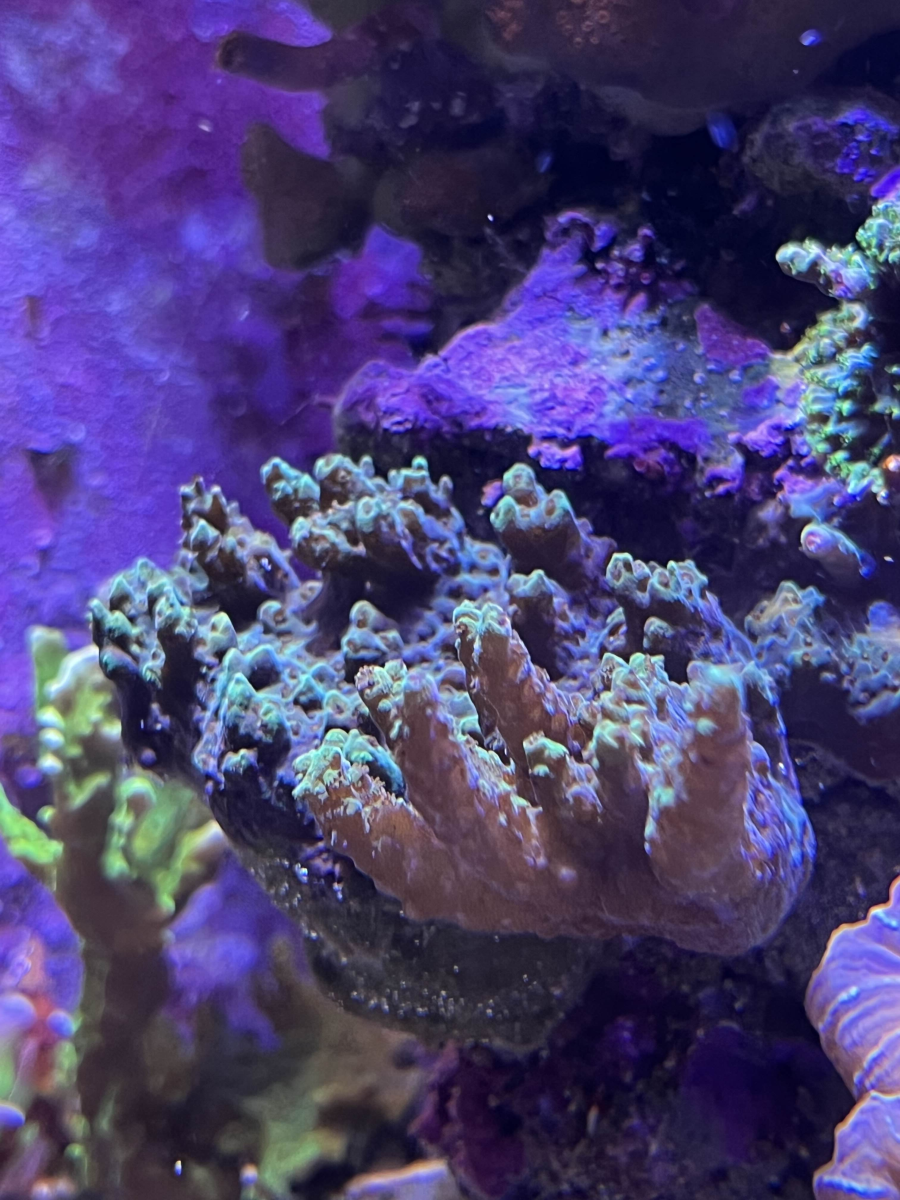
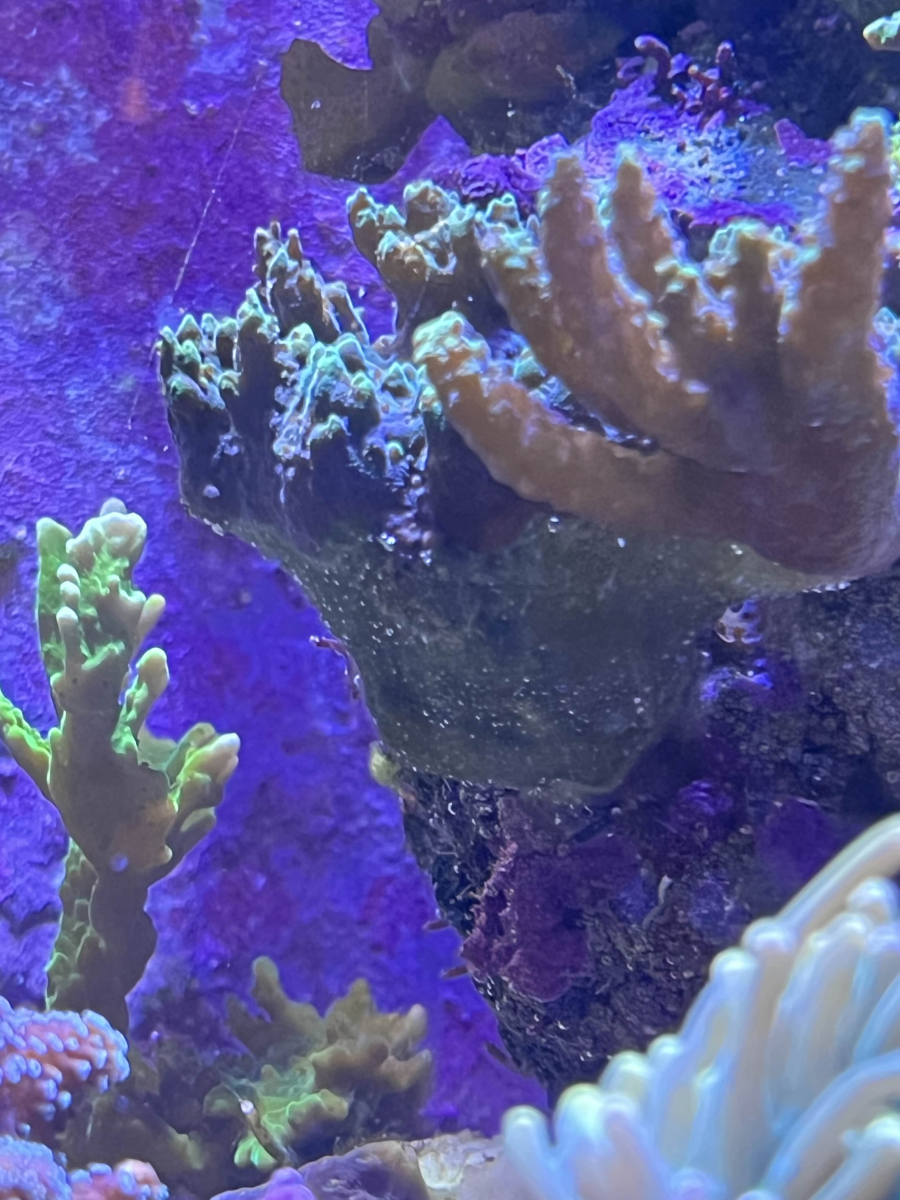
Acro STN

20gallonreefer000

Active Member
View Badges
Joined
Sep 23, 2024
Messages
182
Reaction score
141
Location
Ontario
Rating - 0%
0   0   0
I've had this coral for around 6 months and it's always grown well for me, shown great colour and polyp extension. Over the last few months it has died from the bottom, lost it's colour and has stopped growing. All of my other acros are doing excellent and show no signs of stress. My parameters are all good along with my flow and lighting. I haven't noticed any pests or external stressors. Any thoughts?
1765076821197.png
1765076845546.png
 

mcarroll

10K Club member
View Badges
Joined
Jan 8, 2012
Messages
15,213
Reaction score
8,968
Location
Virginia
Rating - 0%
0   0   0
i'm not sure how polyp extension got branded as an automatic sign of happy corals. 🤔

To me it seems just as likely that it indicates the coral is starving to death – it's a feeding response not a happiness response. 😁😎

There's a fairly strong trend of when somebody says their parameters are "fine", but doesn't post them that there's actually something off. Maybe not in your case but if you could post your parameters, we might see something that you're not thinking of.

IMO, the most likely things are phosphates too low (((inaccessible))) and, related, inadequate flow. Nutrients, feeding and flow are all interconnected, of course. i'm still guessing until we get more info from you, but a likely scenario to explain why these would be issues even though you don't think they are is that you are having success. A side effect of success in a stony coral tank is that your corals grow – this causes more flow blockage in the tank the more they grow. Every coral has a downstream "flow shadow" which grows bigger and bigger as the coral grows.

Just some thoughts… Get back to us with water test results. A full tank picture that shows your lighting and flow sources may also prove useful.
 

bubbgee

Valuable Member
View Badges
Joined
Jun 7, 2021
Messages
2,154
Reaction score
1,767
Location
Alhambra
Rating - 0%
0   0   0
If you believe your parameters are fine, it’s going to boil down to parasite or bacterial issues. I’m battling those two right now with my random STN. Similar issue that you’re facing. I am doing witch hazel dips and iodine to counteract.
 
OP
OP
20gallonreefer000

20gallonreefer000

Active Member
View Badges
Joined
Sep 23, 2024
Messages
182
Reaction score
141
Location
Ontario
Rating - 0%
0   0   0
i'm not sure how polyp extension got branded as an automatic sign of happy corals. 🤔

To me it seems just as likely that it indicates the coral is starving to death – it's a feeding response not a happiness response. 😁😎

There's a fairly strong trend of when somebody says their parameters are "fine", but doesn't post them that there's actually something off. Maybe not in your case but if you could post your parameters, we might see something that you're not thinking of.

IMO, the most likely things are phosphates too low (((inaccessible))) and, related, inadequate flow. Nutrients, feeding and flow are all interconnected, of course. i'm still guessing until we get more info from you, but a likely scenario to explain why these would be issues even though you don't think they are is that you are having success. A side effect of success in a stony coral tank is that your corals grow – this causes more flow blockage in the tank the more they grow. Every coral has a downstream "flow shadow" which grows bigger and bigger as the coral grows.

Just some thoughts… Get back to us with water test results. A full tank picture that shows your lighting and flow sources may also prove useful.

KH: 8.9
Calcium: 460
Mag: 1400
Ph: 8.2
Temp: 77
Salinity: 1.026
Nitrate: 10
Phos: 0.1

1765133549791.png

The flow in my opinion is more than enough(1900 gph total). Polyps are always dancing. I also run an Ai prime at 100% for 12 hours along with 2 support lights.
 

mcarroll

10K Club member
View Badges
Joined
Jan 8, 2012
Messages
15,213
Reaction score
8,968
Location
Virginia
Rating - 0%
0   0   0
KH: 8.9
Calcium: 460
Mag: 1400
Ph: 8.2
Temp: 77
Salinity: 1.026
Nitrate: 10
Phos: 0.1
Seems good all the way around, maybe depending on how stable those numbers are.

pH for example. If that's your number right before the lights go off not too bad. But if that's the number right before the lights go on, there might be some room to check the number or see if there's a problem behind it.

pH being so high does indicate a reduced amount of carbon dioxide available for photosynthesis, and that can cause problems similar to what you are seeing. it's not the most common problem (most folks have too much CO2; this could just be a testing error/artifact), but I would certainly take the effort to rule it out as an issue. What is the range of results you get if you sample pH in the morning before lights on and at night before lights out?

The flow in my opinion is more than enough(1900 gph total). Polyps are always dancing. I also run an Ai prime at 100% for 12 hours along with 2 support lights.
Is this the "20 gallon" from your account name or what size is this tank?

You definitely might be right, I'm not there so I cannot know. Just keep in mind that GPH does not really tell very much about flow. The quantity of water, which is what that measures, does not tell us the amount of work that the water can do. And of course, the water flow is in there to do work (and no other reason), So GPH is good for picking the right size powerhead for the right size tank, but it doesn't tell you much about (eg) what the corals are experiencing.

What we would really like to know about our pumps is how fast is the water moving – can that generated force move food to our corals? ... lift detritus off of the sand bed and rocks? But that's not very easy (cheap) to know and very few people have tested powerheads for that aspect.

One thing does seem to be true though in that most modern powerheads have flow that is so soft they just barely do the job... they seem very optimized toward the GPH (marketing) number.

Dana Riddle has done a few articles that talk about flow velocity which are hard for me to find nowadays thanks to the demise of advancedaquariust.com, but the following video is the other main resource I'm aware of that shows the difference between good and better performing pumps with respect to velocity. (illustrating the difference between flow and turbulence in the process)

 
OP
OP
20gallonreefer000

20gallonreefer000

Active Member
View Badges
Joined
Sep 23, 2024
Messages
182
Reaction score
141
Location
Ontario
Rating - 0%
0   0   0
Seems good all the way around, maybe depending on how stable those numbers are.

pH for example. If that's your number right before the lights go off not too bad. But if that's the number right before the lights go on, there might be some room to check the number or see if there's a problem behind it.

pH being so high does indicate a reduced amount of carbon dioxide available for photosynthesis, and that can cause problems similar to what you are seeing. it's not the most common problem (most folks have too much CO2; this could just be a testing error/artifact), but I would certainly take the effort to rule it out as an issue. What is the range of results you get if you sample pH in the morning before lights on and at night before lights out?


Is this the "20 gallon" from your account name or what size is this tank?

You definitely might be right, I'm not there so I cannot know. Just keep in mind that GPH does not really tell very much about flow. The quantity of water, which is what that measures, does not tell us the amount of work that the water can do. And of course, the water flow is in there to do work (and no other reason), So GPH is good for picking the right size powerhead for the right size tank, but it doesn't tell you much about (eg) what the corals are experiencing.

What we would really like to know about our pumps is how fast is the water moving – can that generated force move food to our corals? ... lift detritus off of the sand bed and rocks? But that's not very easy (cheap) to know and very few people have tested powerheads for that aspect.

One thing does seem to be true though in that most modern powerheads have flow that is so soft they just barely do the job... they seem very optimized toward the GPH (marketing) number.

Dana Riddle has done a few articles that talk about flow velocity which are hard for me to find nowadays thanks to the demise of advancedaquariust.com, but the following video is the other main resource I'm aware of that shows the difference between good and better performing pumps with respect to velocity. (illustrating the difference between flow and turbulence in the process)


I feel like the flow has nothing to do with what's going on with my coral. It is almost identical flow for all of my acros/sps and nothing has been added or changed.
 

mcarroll

10K Club member
View Badges
Joined
Jan 8, 2012
Messages
15,213
Reaction score
8,968
Location
Virginia
Rating - 0%
0   0   0
The old sherlock holms saying where whatever's left after eliminating other possible explanations must be the answer.....seems like you have ruled out what it's not, so what is left would be worth at least some consideration.

Seems like you can potentially look into the pH number, just to have the whole story at least. (As mentioned, 8.2 is not "bad", but there is room for "trouble" there, depending what your actual day/night numbers are like.)

Another option is that other corals (nearby or not) might be doing some chemical warfare in the tank which this coral may not be handling well. This is a known risk/downside of the "coral garden" setup where wildly different corals are all mish-mashed together – stonies, leathers, polyps, etc all together. Activated carbon MAY help if this is the case.

Also, do you specifically feed your corals? I don't like broadcast feeding (too much waste for a display tank to handle in most cases) but you might consider target feeding this coral to see if that helps. You might have to try a small variety of things to find anything that "works" since uptake is usually poor (try reading up to see if anyone successfully target feeds that coral, and what do they use)....even eaten food particles are often rejected (regurgitated) if they aren't right for the coral's preferences.
 

kynan

Active Member
View Badges
Joined
Oct 29, 2013
Messages
190
Reaction score
81
Location
Surfside Beach
Rating - 100%
1   0   0
Absolutely looks like AEFW bites. Have you tried a turkey baster to see if there are worms?
 

TOP 10 Trending Threads

WHAT AMOUNT OF LIVE ROCK AND SAND SHOULD BE PRIORITIZED FOR OPTIMAL BIODIVERSITY/FILTRATION?

  • 100% live rock + bagged sand

    Votes: 34 27.9%
  • 100% dry rock + 100% live sand

    Votes: 42 34.4%
  • 50/50 live/dry rock, 50/50 live/bagged sand

    Votes: 27 22.1%
  • 75% live rock, 25% live sand

    Votes: 11 9.0%
  • 25% live rock, 75% live sand

    Votes: 8 6.6%
Back
Top