

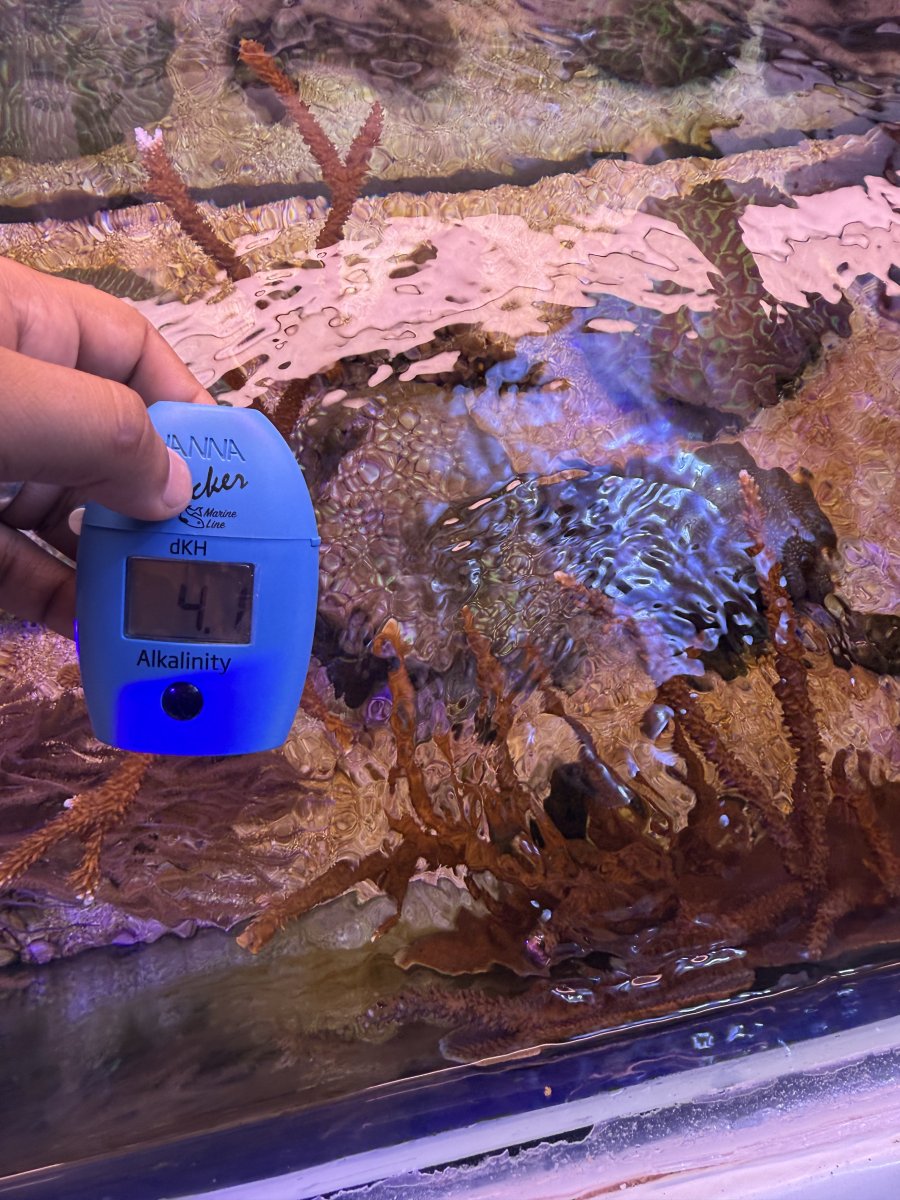
Acropora cervicornis at 4.1 dkh

  • Thread starter Thread starter 305 Steve
  • Start date Start date
  • Tagged users Tagged users None

305 Steve

Community Member
View Badges
Joined
Sep 24, 2014
Messages
73
Reaction score
63
Location
Florida Keys
Rating - 0%
0   0   0
Hey guys, so I take care of a few tanks at a small public aquarium and have started working on another one of their tanks and I’m looking through all of the chemistry logs and it seems to have maintained a DKH of 3 - 4.1 steadily. Of course my first response was testing inaccuracy and so I did a few redundancy tests using Hanna and salifert, 4.1 on the Hanna and 4.8 on the salifert. Ph is 7.9. Acropora cervicornis and all of the other local corals in the tank are not only growing but happy seemingly. Color is more brown than the 8.4 dkh system but polyp extension is great. As these corals are endangered and banned from trade, I want to get some insight on how this could be maintained at these levels for so long without signs of stress? Calcification is clearly still happening albeit not close to the full ability of which cervicornis can grow. Is this a significant thing? I would expect someone would want to study this more closely?
IMG_0907.jpeg
 
Did it start out near 4 or drift down over time? A LFS guy told me that they let their display drift down and the corals adapt.

Not going to name the store but they have been around the hobby for years with named coral in many places
 
i only read through the past year of tests I will check through the previous few years tomorrow and see if I can ID when it started. I’ve just never heard for corals being maintained in 3 dkh before I’m just in a bit of disbelief. To add the system genuinely looks decent too.
 
How is alk being maintained in this tank? Or is it not? The exact pH (over 24 h) will determine whether aragonite is slowly dissolving or not in this tank. That sand, if aragonite, may be slowly dissolving at night, helping maintain the alk that the coral uses.

In any case, I expect that the coral is growing much more slowly than it would at higher alk and/or pH, but is able to survive because it can just get what it needs.

The ocean has an alk in the mid 6 dKH range, even though we typically keep it higher.
This makes sense, there is no alk control other than weekly water changes. The tank has been setup since the 80s and has had some resets since then. I’m not sure what they did back then I know kalkwasser was used at some point but as of recently (at least the last 4 years) there has been no dosing at all. Only fish food and light (halides, t5, cannon) And consistent weekly water changes around 20% ( 227 total volume ). Some tips are literally growing out of the water. So the consumption must have just leveled out with what the salt is adding back at around 4dkh and has been stable there for 2 years it seems. I’ll be heading there today and will post some growth measurements and test logs and try and determine some form of actionable next steps.
 
IMG_0913.jpeg
IMG_0916.jpeg
IMG_0917.jpeg


So after some digging I’ve read back through 2018 and it seems the dkh was steadily in the 6-7 range with consistent PH readings at between 8.0 and 8.2. At some point mid 2019 someone dosed superbuffer and raised it from 7 to 10 overnight and crashed the tank. It seems since then the tank has remained around 5 dkh dropping down into the 3s and 4s over the last 2 years specifically.

Some of the Montastrea have experienced what was described to me as polyp bailout recently and the small buds that popped off the colony have settled and started growing on their own as well.

My first thoughts here are to use some form of 2 part, possibly c balance to try and bring the alkalinity up by about .2 per week to bring it to the 8.5 range. Any thoughts on this or a better method? I have planned on switching to kalkwasser on some of the other tanks so that is also a possibility.

Obviously the growth is severely stagnated compared to the normal growth rate seen on happy cervicornis so my question here is, do I allow it to maintain the way it has been since everyone is “happy” or do I increase alkalinity. I’m really not sure what we would do with the excess growth since we can’t even give it away.
 
That method to up it sounds fine, except I might limit it to 0.2 dKH added per day rather than necessarily adding enough to get a 0.2 dKH boost by the end of 24 h (which might be more).

Then slowly raise that.

Before starting, you might also check calcium. It's not likely to be as low (guessing in the 350 ppm range) but you never know.
 
Is that the aquarium in the John Pennekamp state park visitor center? I feel like I recognize it.
 
That method to up it sounds fine, except I might limit it to 0.2 dKH added per day rather than necessarily adding enough to get a 0.2 dKH boost by the end of 24 h (which might be more).

Then slowly raise that.

Before starting, you might also check calcium. It's not likely to be as low (guessing in the 350 ppm range) but you never know.
Great point, I’ll start with a .2dkh adder rather than trying to saturate the consumption and see a rise. I plan on doing some basic elemental tests for mag and calc tomorrow and will post the results here. I have looked through the logs and it seems the calcium has been within 380-450 and mag has fluctuated between 1200-1600 pretty consistently over the last 2 years at least. I didn’t plan on deep diving into this tank yet as I’m working on an Enteromorpha outbreak on another tank so right now I’m mainly in the evaluate and write up phase.
 
My wife and I took part of a long honeymoon there in August 1982. Part of it was intended to be a few days camping there in the park. Did go out in a little rubber raft we had, but two things ruined it.

1. Mosquitos were absolutely terrible. We spent just a single night because of them.

2. A racoon met a terrible fate during that night. Somehow it must have been messing around near someone's campfire. It caught on fire and was running through the woods on fire and screaming a horrible sound. :(
 
It sure is

I was wondering why the A. cervicornis branches were so thin, as the ones I've seen in public aquariums looked more beefy. I guess the low alk may be why. It's amazing the display looks as good as it does with such low maintenance
 
That method to up it sounds fine, except I might limit it to 0.2 dKH added per day rather than necessarily adding enough to get a 0.2 dKH boost by the end of 24 h (which might be more).

Then slowly raise that.

Before starting, you might also check calcium. It's not likely to be as low (guessing in the 350 ppm range) but you never know.
To clarify don’t think I should aim to add .2 per day or per week? I originally was going to go for the .2 per week which would keep me around 4 months to get to my target. Obviously slower by your recommendation though which I’m fine with. I want to ensure coral health and preserve what we have left.
 
My wife and I took part of a long honeymoon there in August 1982. Part of it was intended to be a few days camping there in the park. Did go out in a little rubber raft we had, but two things ruined it.

1. Mosquitos were absolutely terrible. We spent just a single night because of them.

2. A racoon met a terrible fate during that night. Somehow it must have been messing around near someone's campfire. It caught on fire and was running through the woods on fire and screaming a horrible sound. :(
Holy smokes (no pun intended). The mosquitos are just as bad but as of lately I have seen 0 reports of flaming raccoons! I can only imagine that was a 1 and done experience. This time of year is great for avoiding the bugs as long as you don’t mind the traffic! This place was something to talk about in the 80s I’ve heard, we are working very diligently to bring it back to the golden days.
 
To clarify don’t think I should aim to add .2 per day or per week? I originally was going to go for the .2 per week which would keep me around 4 months to get to my target. Obviously slower by your recommendation though which I’m fine with. I want to ensure coral health and preserve what we have left.

Nothing wrong with going slower, but I meant per day.

I'm just speculating as this is a pretty unusual situation. lol
 
This makes sense, there is no alk control other than weekly water changes. The tank has been setup since the 80s and has had some resets since then. I’m not sure what they did back then I know kalkwasser was used at some point but as of recently (at least the last 4 years) there has been no dosing at all. Only fish food and light (halides, t5, cannon) And consistent weekly water changes around 20% ( 227 total volume ). Some tips are literally growing out of the water. So the consumption must have just leveled out with what the salt is adding back at around 4dkh and has been stable there for 2 years it seems. I’ll be heading there today and will post some growth measurements and test logs and try and determine some form of actionable next steps.
What is the source for the new water for water changes? Mix or NSW?
 
I was wondering why the A. cervicornis branches were so thin, as the ones I've seen in public aquariums looked more beefy. I guess the low alk may be why. It's amazing the display looks as good as it does with such low maintenance
My assumption is high levels of phosphate caused thin and brittle growth because the staghorn we see out planted would be hard to cut even with bone cutters!
 

TOP 10 Trending Threads

WHICH REEFING SKILL WOULD YOU MOST LIKE TO DEVELOP FURTHER? (CHOOSE UP TO 3)

  • Coral propagation or fragging

    Votes: 0 0.0%
  • Fish or coral breeding

    Votes: 5 45.5%
  • Taking better tank photos

    Votes: 5 45.5%
  • Identifying corals, fish, and hitchhikers

    Votes: 1 9.1%
  • Aquascaping or reef design

    Votes: 3 27.3%
  • Understanding water chemistry and test results

    Votes: 3 27.3%
  • Caring for a challenging species

    Votes: 2 18.2%
  • Other (Post in the comments)

    Votes: 0 0.0%
Back
Top
Home
Post thread…
Market
What's new






