Ammonium dosing is a bit overrated

  • Thread starter Thread starter Miami Reef
  • Start date Start date
  • Tagged users Tagged users None
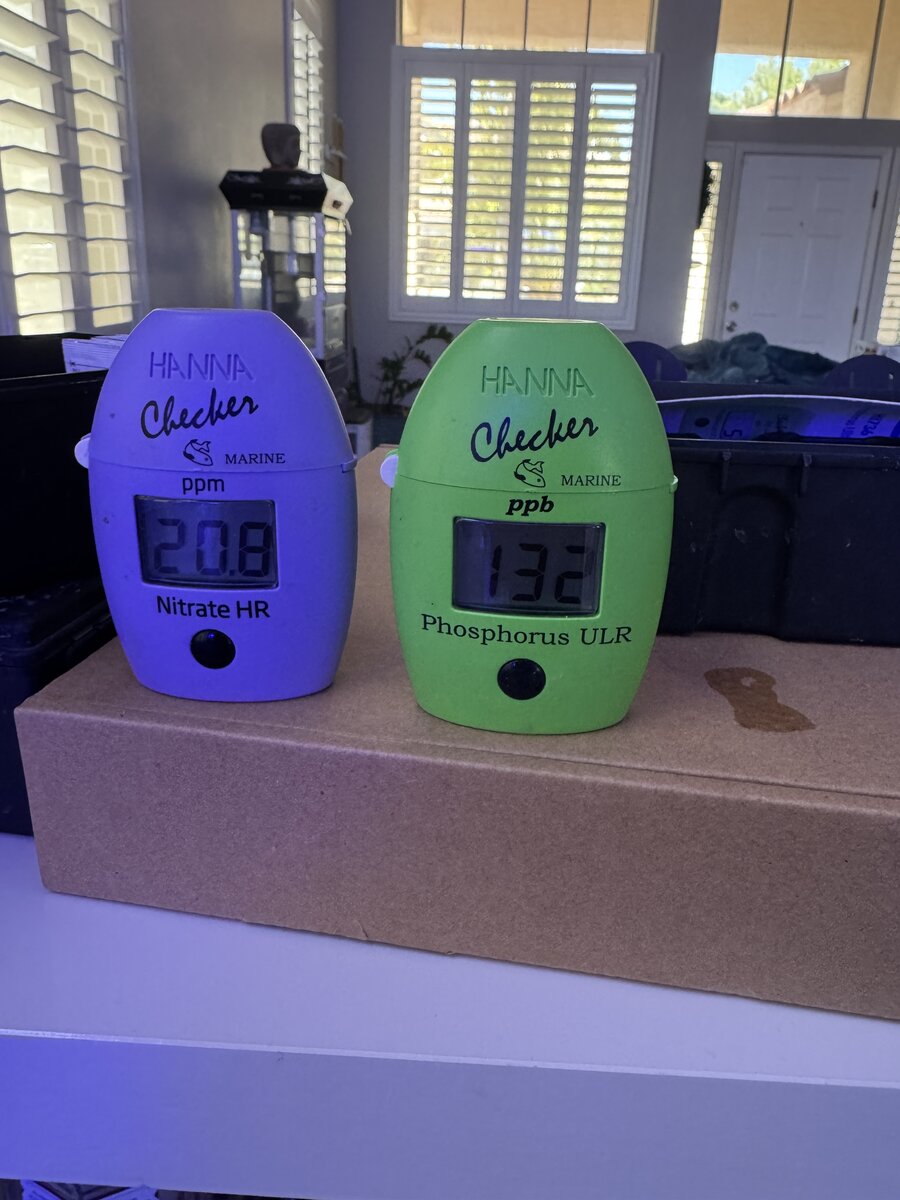
I’d say my tank looks pretty amazing! It’s sitting here… phosphate is super high!
IMG_8599.jpeg
It's a little high, about 0.405ppm PO4. I'd have a heart attack if mine were that high. I'm having anxiety with mine floating around 0.2ppm 🤣 That is right about the 50:1ratio though LOL. Or 78.6:1 N:P Molar ratio 🤣
 
Do you think higher dissolved inorganic nitrogen and phosphorus compounds in our tanks are needed help to compensate for the relatively lower particulate/prey sources?
Yes. Also in natural reefs the particulate/prey sources vary. There are reefs where the water is very clear and in other reefs the water is more cloudy so corals have more particulate food. Would be not smart for corals to restrict themselves to a special food source.
 
Last edited:
I was also surprised reading this. But is there any proof what is definitely too much? I had success with 1.0 ppm phosphate and 100 ppm nitrate, and other reefers even with higher values. So hard to say what's too much.
I’d say my tank looks pretty amazing! It’s sitting here… phosphate is super high!
IMG_8599.jpeg
What do you run you alkalinity at?
 
I was also surprised reading this. But is there any proof what is definitely too much? I had success with 1.0 ppm phosphate and 100 ppm nitrate, and other reefers even with higher values. So hard to say what's too much.

I’m not aware of good data on exactly what levels are too much and what are too little, and I’m sure it varies based on availability of other sources of N and P, and which organisms are being evaluated.

. There are loads of opinions which are often shown to be incorrect by someone else’s tank.
 
I’m not aware of good data on exactly what levels are too much and what are too little, and I’m sure it varies based on availability of other sources of N and P, and which organisms are being evaluated.

. There are loads of opinions which are often shown to be incorrect by someone else’s tank.
I think it’s safe to say there is no ratio and no right or wrong! The corals will adapt to anything given time.
 
What do you run you alkalinity at?
I typically run it at 8 but wanted to see what happens if I went higher.. I started getting Stn as I brought my alk up so I raised my nutrients to those numbers and bumped my alk to 11… everything looks great but I’m yet to see Increased growth.. give it another month and if no changes I’ll drop everything back down.
 
What do you run you alkalinity at?
I typically run it at 8 but wanted to see what happens if I went higher.. I started getting Stn as I brought my alk up so I raised my nutrients to those numbers and bumped my alk to 11… everything looks great but I’m yet to see I creased growth.. give it another month and if no changes I’ll drop everything back down.
Interesting. I would suspect high alk high nutrients results in higher growth but it could be some other limit like trace elements. I’d like to know your observations as it plays out.
 
Have you also seen successful reef tanks with a reverse ratio of 10:1 (phosphate to nitrate) for example?
Hard to do since when you have let's say 0.1 or 0.5 ppm phosphate you would have to find 0.01 or 0.05 ppm nitrate. Our Tropic Marin Nitrate Pro Test starts at 0.05 ppm nitrate and I think also handheld photometers do not go lower, but I'm not sure.
I’d like to see one of your lectures!

Do you think higher dissolved inorganic nitrogen and phosphorus compounds in our tanks are needed help to compensate for the relatively lower particulate/prey sources?
I have tried to find a record in English online but it seems like there isn't one.

Yes, I think in reef tanks higher dissolved inorganic nitrogen and phosphorus concentrations than in natural reef waters are helpful. The density of prey in reef aquaria may vary a lot and like others have mentioned in the posts above, it is hard to find a definite upper limit for nutrients where phosphate or nitrate start to get damaging corals.

0.5 ppm phosphate may seem quite high but if you know or run a tank yourself and you have no test results you will not be able to tell it has a high phosphate concentration. Maybe testing and removing phosphate is doing more harm than good. It would be funny to run double blind studies, the one who is running the tanks has no information about the phosphate concentrations and the one who is testing has no information about the tank. Then both may judge what is or should be going on in the tank and compare tanks and test results. 😃
 
Have you also seen successful reef tanks with a reverse ratio of 10:1 (phosphate to nitrate) for example?
Hard to do since when you have let's say 0.1 or 0.5 ppm phosphate you would have to find 0.01 or 0.05 ppm nitrate. Our Tropic Marin Nitrate Pro Test starts at 0.05 ppm nitrate and I think also handheld photometers do not go lower, but I'm not sure.
I’d like to see one of your lectures!

Do you think higher dissolved inorganic nitrogen and phosphorus compounds in our tanks are needed help to compensate for the relatively lower particulate/prey sources?
I have tried to find a record in English online but it seems like there isn't one.

Yes, I think in reef tanks higher dissolved inorganic nitrogen and phosphorus concentrations than in natural reef waters are helpful. The density of prey in reef aquaria may vary a lot and like others have mentioned in the posts above, it is hard to find a definite upper limit for nutrients where phosphate or nitrate start to get damaging corals.

0.5 ppm phosphate may seem quite high but if you know or run a tank yourself and you have no test results you will not be able to tell it has a high phosphate concentration. Maybe testing and removing phosphate is doing more harm than good. It would be funny to run double blind studies, the one who is running the tanks has no information about the phosphate concentrations and the one who is testing has no information about the tank. Then both may judge what is or should be going on in the tank and compare tanks and test results. 😃

I know that when the Hanna phosphorus ULR checker first came out I did way more harm to my tank trying to maintain low phosphate with this new tool. That was the worst 5 years of reefing for me.
 
I was also surprised reading this. But is there any proof what is definitely too much? I had success with 1.0 ppm phosphate and 100 ppm nitrate, and other reefers even with higher values. So hard to say what's too much.

I’m not aware of good data on exactly what levels are too much and what are too little, and I’m sure it varies based on availability of other sources of N and P, and which organisms are being evaluated.

. There are loads of opinions which are often shown to be incorrect by someone else’s tank.
I think the reason why there are so many opinions is because the systems are so complex. Each one is like a recipe where all of the ingredients need to be roughly in balance, but the balance varies depending on the recipe. If one person is making sourdough bread the amount of salt they need will be different from someone else making wheat buns.

What goes into a reef tank? Not just fish and corals, but sand, water, food, ambient air temperature, ambient carbon dioxide, ambient light, size of tank, equipment…these are all things that can vary greatly from one tank to the next. Then the microbes in the tank and their ratios are all different.

This is why I roll my eyes when I see someone insist that their way is the best or even only way to do something. It might be better for them, but might not work at all for someone else. Obviously there are some things that are tried and tested (don’t put a Tang in your nano tank), but again it’s all on a curve. Maybe someone got a rare dwarf Tang. ;)
 
I think the reason why there are so many opinions is because the systems are so complex. Each one is like a recipe where all of the ingredients need to be roughly in balance, but the balance varies depending on the recipe. If one person is making sourdough bread the amount of salt they need will be different from someone else making wheat buns.

What goes into a reef tank? Not just fish and corals, but sand, water, food, ambient air temperature, ambient carbon dioxide, ambient light, size of tank, equipment…these are all things that can vary greatly from one tank to the next. Then the microbes in the tank and their ratios are all different.

This is why I roll my eyes when I see someone insist that their way is the best or even only way to do something. It might be better for them, but might not work at all for someone else. Obviously there are some things that are tried and tested (don’t put a Tang in your nano tank), but again it’s all on a curve. Maybe someone got a rare dwarf Tang. ;)
That's true, and for me this makes aquaristics exciting. Otherwise I could just as well run a model railway.
 
I’d say my tank looks pretty amazing! It’s sitting here… phosphate is super high!
IMG_8599.jpeg
Interesting thread as I have followed it from day one.
Over the years I have always followed heavy in/out with nutrients running no3<5, po4<.1 and an alk of 7-8.
It has worked well for me in all systems past and current.

That does not mean other reefers like yourself have ran higher with excellent results. It's just the way I chose to run my systems.
I would never run po4 that high and when it got above. 3 I had issues, loss of color.

My 15g nano, last time I checked was 0 no3 and .02 po4.
I have always had success with low nutrients but I feed my fish more than most I would imagine.
I need to take a video to show how much I feed, lol.

This forum alows us to view many systems that are run counter to the way we run our own with great success.

My ammonia dosing comes from my fish, lol.

Many ways to a succesful reef tank as proven here.

It would be difficult for me to run high nutrients but that does not mean many are successful with it.
My 6 month old low nutrient nano.
20250817_152140.jpg
 
Now my favourite is a nitrogen-iron-colimitation.

Edit: ... well, maybe iron limitation allone is also good ... as concenssion to all high-nitrate-advocates. 😉

Reviving an old thread because I found a lot of what you have talked about with iron very interesting and want to learn more. Have you talked more about iron dosing anywhere that I can read? Seems like you are suggesting that maybe it is better to keep limited but would love to hear some more exact numbers.
 
Reviving an old thread because I found a lot of what you have talked about with iron very interesting and want to learn more. Have you talked more about iron dosing anywhere that I can read? Seems like you are suggesting that maybe it is better to keep limited but would love to hear some more exact numbers.
I have not talked much more about iron limitation and iron dosing beyond what you can find in this forum. I have given a talk in the Netherlands in December where I underlined it as one of the factors in reefing success.

There are no numbers on tank water concentrations from ICP I can give because the iron concentrations generally should be low and they are flucutating very much. ICP-OES hardly will find iron at limiting concentrations.

My advice is to find a regular iron dosage near the lower end of iron replete conditions for corals (iron limitation for algae and cyanobacteria) and stick with this dosage. The dosage and its ratio to calcium may vary a bit from tank to tank, depending on type of corals (hard corals or leather and soft corals), amongst others.

I think the key to increase our understanding is creating awareness of the role of iron and have a look at iron dosing and (intended and unwanted) developments in reef aquaria.
 
I’ll note that the DSR method has used (uses?) very high iron dosing to precipitate phosphate and is seemingly quite successful.
 
I’ll note that the DSR method has used (uses?) very high iron dosing to precipitate phosphate and is seemingly quite successful.
I know that there are other opinions on iron.

In my experience there are no problems directly connected to iron dosing short-term. The problems are more long-term and are mainly problems with growth of cyanobacteria and nuisance algae like Valonia. Just as long-term as the problems develop you need to get rid of them. So, there is neither a short-term problem nor a short-term success, and it is not easy to connect cause and effect. It is the experience of decades of regular dosing and years of taking a closer look.
 

TOP 10 Trending Threads

ARE YOU READY TO CONFESS TO CRAZIEST, DUMBEST, FUNNIEST THING YOU’VE EVER DONE IN REEFING?

  • Yeah, I'll confess! (Share your story in the comments!)

    Votes: 70 54.3%
  • Nah, I'll keep mine a secret...(Don't be like that, share with the class!)

    Votes: 59 45.7%
Back
Top
Home
Post thread…
Market
What's new