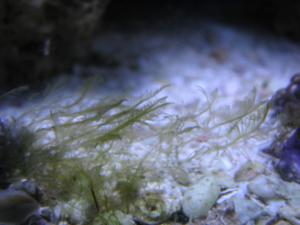
See if this looks familiar:
https://www.reefcleaners.org/nuisance-algae-id-guideBryopsis pennata and B. plumosa
Some of the hardest to remove species of macroalgae encountered in the hobby are
B. pennata and
B. plumosa. These two species have noticeable discernible midribs (center portion of the algae), that are wider than their branches. They are fast growing, and form a mat like root system on the rocks. Algae that grows from mats, instead of singular holdfasts, are harder to remove if they spread in your tank. This is due to the tedious work that is required to remove all of the algae from the surface it is growing on. Any piece that remains will likely continue growing.
B. pennata (pictured on the left) has irregular and more sparse branching than its closely related cousin
B. plumosa which has more symmetrical and fuller branching. (picture coming)There are many, many species of Green Hair Algae that have feathery branching, and are not necessarily members of the Bryopsis genus, nevermind
B. pennata and
B. plumosa. Simply because the hair algae in your system has branches does not mean it is one of these algae species.
Sea hares, nudibranchs, urchins, Emerald Crabs, chitons, and even the larger
Astraea tuberwill eat both of these species, but often do not consume it faster than it can grow, or the algae lingers half eaten. Pitho Crabs are effective at fully removing Byropsis.