Bacterial growth on sps? Need ID help

Denisk

Valuable Member
View Badges
Joined
Dec 6, 2016
Messages
1,651
Reaction score
1,833
Rating - 0%
0   0   0
hello everyone,

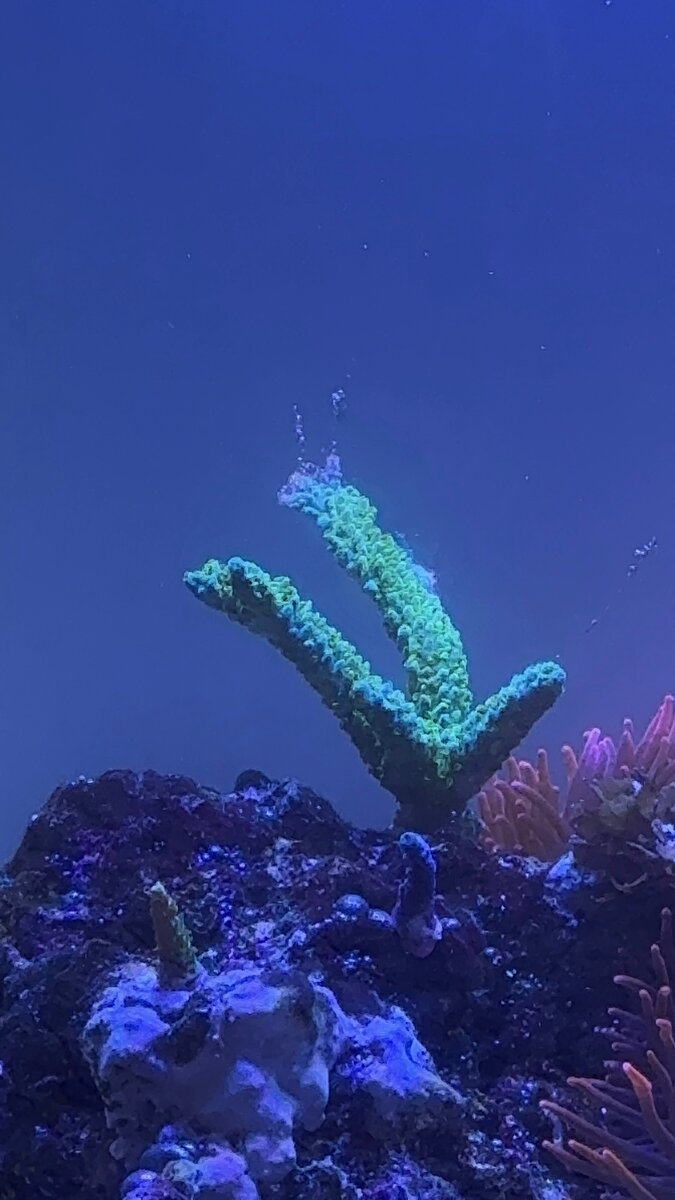
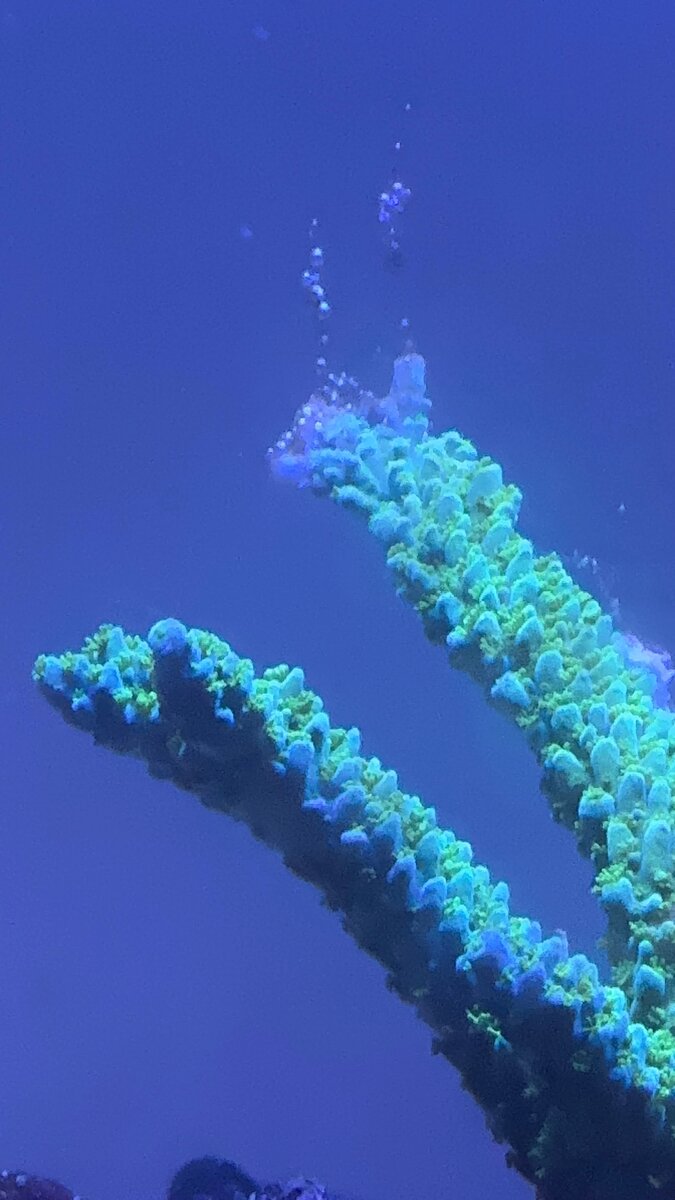
I’m curious if anyone can ID the white fuzz growing on my green slimer? It’s been doing so well for a long time. Nothing has changed recently except adding a c02 scrubber and skimmer which did cause in increase in dosing. Otherwise my parameters have all been rock solid.

At first I thought maybe it was a little Dino’s growing at the tips but it looks like some sort of bacterial growth that’s white. Not sure what could be causing this.

Current Parameters:

Salinity: 1.025
PH: 8.3 to 7.9
Alk: 7.5
Cal: 420
Mag: 1320
No3 : 7.3
Po4: .07
IMG_4014.jpeg
IMG_4011.jpeg
 

dvgyfresh

5000 Club Member
View Badges
Joined
Jul 9, 2020
Messages
5,370
Reaction score
9,451
Location
US
Rating - 0%
0   0   0
It looks like Dino’s on the tips as you mentioned , white growth - is that not just the Skeleton of the sps ? Flesh could have died due to Dino’s or be retracted
 

Red_Beard

I already did
View Badges
Joined
Feb 17, 2019
Messages
6,799
Reaction score
18,962
Location
Utah
Rating - 0%
0   0   0
looks like dinos to me too. i would snip that tip.
 

mcarroll

10K Club member
View Badges
Joined
Jan 8, 2012
Messages
15,213
Reaction score
8,968
Location
Virginia
Rating - 0%
0   0   0
It's not impossible that those are Symbiodiinium from the coral itself.
Nothing has changed recently except adding a c02 scrubber
IMO remove the CO2 scrubber and see if it improves.

CO2 is necessary in sufficient quantities for photosynthesis, and when it (or another liming factor eg phosphate) is insufficiently available, the coral's Dino's can be ejected from the coral – for the coral's health. This is likely during peak photosynthesis when tank pH is at its highest.

This ejection can eventually lead to bleaching if the coral can't achieve a balance....but often they are successful if overall conditions aren't too perturbed. (You can opt to do nothing and just observe until you can see if things are getting better or worse.)

High pH/low pH is a sorely overrated issue except in rare cases where household CO2 levels are extreme – into four digits, like 1000-2000 ppm. Co2 that high will affect your sleep and overall health, so it's beyond a tank problem if your tank really does have low pH from too much CO2.

Most houses are not well sealed enough for this to become an issue, but some modern builds are.

Anyway, if you really have low pH, don't address it with a CO2 scrubber, you get your HVAC adjusted or modified to introduce more fresh air to the house. There have been a few threads here on R2R documenting where this has actually happened. Most folks are just chasing pH numbers.
 
OP
OP
Denisk

Denisk

Valuable Member
View Badges
Joined
Dec 6, 2016
Messages
1,651
Reaction score
1,833
Rating - 0%
0   0   0
It's not impossible that those are Symbiodiinium from the coral itself.

IMO remove the CO2 scrubber and see if it improves.

CO2 is necessary in sufficient quantities for photosynthesis, and when it (or another liming factor eg phosphate) is insufficiently available, the coral's Dino's can be ejected from the coral – for the coral's health. This is likely during peak photosynthesis when tank pH is at its highest.

This ejection can eventually lead to bleaching if the coral can't achieve a balance....but often they are successful if overall conditions aren't too perturbed. (You can opt to do nothing and just observe until you can see if things are getting better or worse.)

High pH/low pH is a sorely overrated issue except in rare cases where household CO2 levels are extreme – into four digits, like 1000-2000 ppm. Co2 that high will affect your sleep and overall health, so it's beyond a tank problem if your tank really does have low pH from too much CO2.

Most houses are not well sealed enough for this to become an issue, but some modern builds are.

Anyway, if you really have low pH, don't address it with a CO2 scrubber, you get your HVAC adjusted or modified to introduce more fresh air to the house. There have been a few threads here on R2R documenting where this has actually happened. Most folks are just chasing pH numbers.
Interesting information and much appreciated!

Now that I’m home, I took a look and it appears the tips bleached/died off a little and caused Dino’s to grow on them. Wouldn’t have that the co2 scrubber would cause that.

I added one since I typically had my ph around 7.6 and 8.0 but now I’m running between 8 and 8.4.

P04 is .04
Nitrate 7.5
Alk is 7.1 which maybe a little too low?

I try not to make drastic changes so I was a little shocked to see this happening as all the other sps look great yet they’re all small frags so hard to really tell as they’re still just encrusting.
 
OP
OP
Denisk

Denisk

Valuable Member
View Badges
Joined
Dec 6, 2016
Messages
1,651
Reaction score
1,833
Rating - 0%
0   0   0
Alk needs to be up in the 8ish range for lower nutrients. Don’t think it’s Dino’s, just the natural stress response from acros.
I appreciate that. I will try to raise it over the next week or so. I think that’s slow enough not to cause too much stress
 

UMALUM

Valuable Member
View Badges
Joined
Sep 7, 2023
Messages
1,426
Reaction score
1,869
Location
Fl.
Rating - 0%
0   0   0
I think cyano is more likely to take up shop on newly exposed skeleton and depending on your flow can trap bubbles within. My play would be to chop it off 1/4 inch down and roll with it. Looks more like a reaction to a little scrap with a neighbor to me. Anemones are fun till there not.
 

mcarroll

10K Club member
View Badges
Joined
Jan 8, 2012
Messages
15,213
Reaction score
8,968
Location
Virginia
Rating - 0%
0   0   0
Wouldn’t have that the co2 scrubber would cause that.
Well, there are two ways I look at it....

A) no other changes were made, so whether we like it or not the scrubber is where the evidence points
B) it fits the damage, which is what I tried to explain (probably not that well) about CO2 and photosynthesis

Photosynthesis is hard for corals – a serious balancing act with their Dino's. So you do anything to throw that balance off, that they have the potential for this behavior. "Pre-bleaching" if you will.

I agree with raising the alk a bit, but I don't think that's directly related to the "burnt tips"....just a good idea so your tank has more alk capacity to allow for the higher demand you mentioned.

Biological control of aragonite formation in stony corals is an interesting article showing how corals are not picky about alk or pH when forming skeleton.

Results of the 1991 United States-Israel Workshop, “Nutrient Limitations in the Symbiotic Association between Zooxanthellae and Reef-building Corals” also talks about inorganic carbon (co2) limitation and its effects. Check my notes on the link....also there's a PDF download link for the original article if you follow the linked in the article. (Heck of a title for that paper, eh? LOL)

Turning down your lights a bit should also help....but you didn't change the lights and your other corals aren't responding like this.

So.....the scrubber has to go. :)
 
OP
OP
Denisk

Denisk

Valuable Member
View Badges
Joined
Dec 6, 2016
Messages
1,651
Reaction score
1,833
Rating - 0%
0   0   0
Well, there are two ways I look at it....

A) no other changes were made, so whether we like it or not the scrubber is where the evidence points
B) it fits the damage, which is what I tried to explain (probably not that well) about CO2 and photosynthesis

Photosynthesis is hard for corals – a serious balancing act with their Dino's. So you do anything to throw that balance off, that they have the potential for this behavior. "Pre-bleaching" if you will.

I agree with raising the alk a bit, but I don't think that's directly related to the "burnt tips"....just a good idea so your tank has more alk capacity to allow for the higher demand you mentioned.

Biological control of aragonite formation in stony corals is an interesting article showing how corals are not picky about alk or pH when forming skeleton.

Results of the 1991 United States-Israel Workshop, “Nutrient Limitations in the Symbiotic Association between Zooxanthellae and Reef-building Corals” also talks about inorganic carbon (co2) limitation and its effects. Check my notes on the link....also there's a PDF download link for the original article if you follow the linked in the article. (Heck of a title for that paper, eh? LOL)

Turning down your lights a bit should also help....but you didn't change the lights and your other corals aren't responding like this.

So.....the scrubber has to go. :)
this is all very interesting. I will have to take the time to read through those articles. Looks like I have a busy weekend ahead of me haha.

I went back to check all my notes since I log everything and completely forgot that I rented a par meter before my trip just log if my par numbers were good. I did raise my light intensity while I was measuring the par at different intensities but brought it back down to what it was at originally at least I thought I did. While I was looking at my mobius app just now, I made a mistake and left my par at 31% instead of 28% which is 3% higher than what I originally had them set to. So I wonder if that increase in 3% could’ve caused that for the green slimer since that corals placement gets the most impact from even the smallest increase in light intensity.
 
OP
OP
Denisk

Denisk

Valuable Member
View Badges
Joined
Dec 6, 2016
Messages
1,651
Reaction score
1,833
Rating - 0%
0   0   0
I think cyano is more likely to take up shop on newly exposed skeleton and depending on your flow can trap bubbles within. My play would be to chop it off 1/4 inch down and roll with it. Looks more like a reaction to a little scrap with a neighbor to me. Anemones are fun till there not.
Yeah that anemone is pretty large. I use to have more but since relocated 3 others that have split since they kept moving around and one got stuck in the powerhead. There wasn’t much damage and nothing was really affected so I didn’t do a large water change or anything. I would gladly get rid of it if I didn’t have clowns that were 10 years old hosting in and laying eggs every so often haha
 

mcarroll

10K Club member
View Badges
Joined
Jan 8, 2012
Messages
15,213
Reaction score
8,968
Location
Virginia
Rating - 0%
0   0   0
So I wonder if that increase in 3% could’ve caused that for the green slimer since that corals placement gets the most impact from even the smallest increase in light intensity.
Yeah, potentially. Higher light levels will drive higher photosynthesis levels...which increases demand for resources like CO2, etc.

That the coral had multiple of these issues to adjust to at once (at least light increase and CO2 decrease) might be what triggered Dino-releases. Very likely IMO.

BTW, can you sample those strands and get a pic under a microscope? IIRC, Symbiodinium are pretty distinct looking. Not a bad idea to confirm what's going on that way....plus it's interesting to look!

Footnote....having a good margin of safety on your PO4 levels would be a good idea too...."low" should be no lower than 0.05 ppm IMO...higher should be fine. Nitrates being on the low side would be good tho....1-5 ppm is probably fine....no need to drive it to zero tho.
 

p1u5h13r4m24

Valuable Member
View Badges
Joined
Jun 2, 2015
Messages
1,538
Reaction score
2,155
Rating - 100%
3   0   0
Alk needs to be up in the 8ish range for lower nutrients. Don’t think it’s Dino’s, just the natural stress response from acros.
The alk at 7 is fine. it’s actually the opposite from your statement. Lower nutrients requires lower alkalinity. Seems low phos caused dinos. I also want to remind you that dinos is toxic and you should run GAC to remove those toxins
 

Reginald Reefer III

Coral Connoisseur
View Badges
Joined
Dec 15, 2020
Messages
2,354
Reaction score
4,152
Location
Boise, ID
Rating - 0%
0   0   0
0.04 PO4 and 7.5 NO3 isn't really low though and it's not really that high. It's at the sweet spot typically for a lot of tanks. ~8.0dkH is what I have seen stated, but anything from 8-12 are ok as long as it stays stable.

Dunno - only time I have seen dinos was when both my nutrients were 0.00 with multiple retests at 0.00.
 
OP
OP
Denisk

Denisk

Valuable Member
View Badges
Joined
Dec 6, 2016
Messages
1,651
Reaction score
1,833
Rating - 0%
0   0   0
The alk at 7 is fine. it’s actually the opposite from your statement. Lower nutrients requires lower alkalinity. Seems low phos caused dinos. I also want to remind you that dinos is toxic and you should run GAC to remove those toxins
Thank you for letting me know.
 

TOP 10 Trending Threads

WHAT AMOUNT OF LIVE ROCK AND SAND SHOULD BE PRIORITIZED FOR OPTIMAL BIODIVERSITY/FILTRATION?

  • 100% live rock + bagged sand

    Votes: 38 27.3%
  • 100% dry rock + 100% live sand

    Votes: 47 33.8%
  • 50/50 live/dry rock, 50/50 live/bagged sand

    Votes: 30 21.6%
  • 75% live rock, 25% live sand

    Votes: 14 10.1%
  • 25% live rock, 75% live sand

    Votes: 10 7.2%
Back
Top