

Bolus dosing

  • Thread starter Thread starter Domi
  • Start date Start date
  • Tagged users Tagged users None
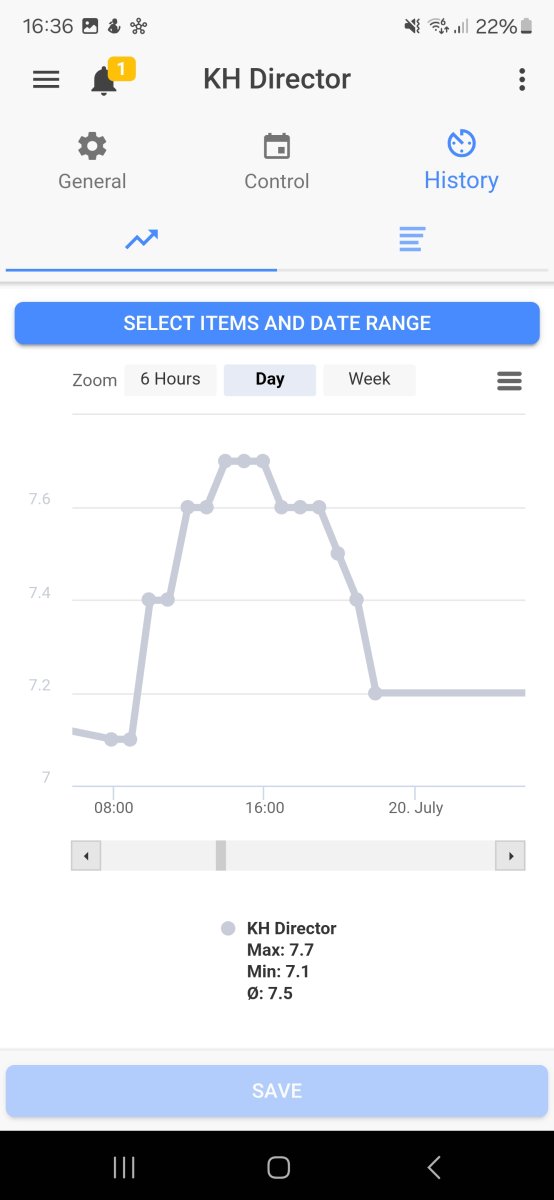
Totally my bad, wrong graph posted (doh) will add correct one shortly. Sorry for the confusion folks but this looks just like a daily graph trend too and I'd just woke up!

Edit: here's a graph from around that time over 24hrs
1000046987.jpg


Regardless of potency claims, I see nowhere near the amount dosed ever show up even if you base it on half of what Fauna state

Dose is at 9am

I’ve not actually seen detailed alk vs time data with any sort of alk dosing scheme except auto controlled alk dosing. Would be interesting to compare methods, including carbonate, hydroxide, and AFR, in different systems.

 
Will do the straight bicarb dose test shortly so at least you can compare apples to apples in that regard, it could be exactly the same behaviour mind but the pH behaviour makes me wonder.
 
Totally my bad, wrong graph posted (doh) will add correct one shortly. Sorry for the confusion folks but this looks just like a daily graph trend too and I'd just woke up!

Edit: here's a graph from around that time over 24hrs
1000046987.jpg


Regardless of potency claims, I see nowhere near the amount dosed ever show up even if you base it on half of what Fauna state

Dose is at 9am
If we examine "it never shows up" and ignore the time.. then one would logically conclude maybe a few things.

- Some of it precipitated out
- Some of it was taken up before it could be sampled in the water colum

Thoughts?


When we add that to examined time - then what about CO2 levels and local pH in the highly concentrated area? "High flow" does not mean evenly mixed throughout the system -- I would not try to guess how long that takes for any given system.

Other thoughts?
 
I’ve not actually seen detailed alk vs time data with any sort of alk dosing scheme except auto controlled alk dosing. Would be interesting to compare methods, including carbonate, hydroxide, and AFR, in different systems.

Technically I could do the AFR test but if I am being honest I do not feel comfortable dosing 95 ml of it in one fell swoop. I spread it out over 8 hours.
 
When I started reefing I total bicarb for day in one metered dose over 30 min as ESV or maybe BRS before halides came on. I likely did this for 5 years.

It worked fine and grew sturdy green and brown staghorn corals to top with no big issues.

Not sure we are progressing hobby here.
 
@Welsh Reefer. Has edited his chart for anyone interested;

 
When I started reefing I total bicarb for day in one metered dose over 30 min as ESV or maybe BRS before halides came on. I likely did this for 5 years.

It worked fine and grew sturdy green and brown staghorn corals to top with no big issues.

Not sure we are progressing hobby here.

I don’t think anybody in here is questioning the method. That was proven decades ago. FM certainly isn’t progressing the hobby in any way especially with their claims. It’s the claims that can’t be substantiated in any way
 
It’s the claims that can’t be substantiated in any way

True - but this is also true with a lot of products in our hobby. Market speak on the box is strong and could lay the smackdown even on a Jedi...
 
Hold the phone. No need to repeat experiment, turns out KHD/I did actually log KH on normal bicarb.

There was a lot going on in my life around this time with health and personal issues so I must have simply not screenshotted any data from KH readings, hadn't thought to look back through GHL itself (I didn't even know it retained data this far back) the other day when I didn't find data grabs!

Fauna KH
1000046993.jpg


Vs kitchen cupboard Bicarb - I think I likely dosed 2.0dkh to the best of my ability using randys recipe.
1000046992.jpg


I have overlaid pH data.

Discount out the theory of 'mixing time'. Precipitation - if we're talking bound precipitation in the sump I have very very little detritus build up and I run zero mechanical filtration, not even a filter Sock. Display has around 45-50k lph of flow not accounting for return flow which is a fair bit in a 3ft tank, sand is pristine as no flow is directed to push water away from the weir in an attempt to keep display as clean as possible. Return pump hasn't been cleaned in over 6 months and is remarkably clean without calcium carbonate build up caking it which is something all my equipment had when dosing sodium hydroxide.

So I have no answer as to the behaviour, impurities in the bicarb? Not sure, it's just a straight up food grade baking additive.
1000046994.jpg
 
Making sure I understand. Baking soda spiked alk and then decayed in the same tank that the FM alk dose showed a slower alk rise?.

Was the lighting schedule the same?
 
Making sure I understand. Baking soda spiked alk and then decayed in the same tank that the FM alk dose showed a slower alk rise?.

Was the lighting schedule the same?
Yes correct, everything else identical - no equipment changes or lighting schedule differences.

Note that pH depression with baking soda
 
Yes correct, everything else identical - no equipment changes or lighting schedule differences.

Note that pH depression with baking soda
Looks like at the time you used the standard bicarb you were running a higher alk over all? Also was this the same amount dosed between the standard bicarb and FM product? Weird if so, you get 1.5 dkh out of standard bicarb and only .6 from fm?
 
Yes correct, everything else identical - no equipment changes or lighting schedule differences.

Note that pH depression with baking soda
What's the accuracy of this device? (I may have asked you this before, sorry). Appears to struggle at the lower end consumption (unless the magic crystals exist). I'm Assuming more FM calculator confusion with the dosages.
 
Looks like at the time you used the standard bicarb you were running a higher alk over all? Also was this the same amount dosed between the standard bicarb and FM product? Weird if so, you get 1.5 dkh out of standard bicarb and only .6 from fm?
Yup, my alk ranges from 7.5-9 at times but I believe Randy has said a higher overall alk should have a higher pH so that's working in favour of the bicarb there.

I'm 99.9% sure I dosed 2.0dkh of randy alk and I've just gone into my doser log and I dosed 110ml alk which is essentially 2.0dkh according to Fauna's stated potency. I seem to remember this being a discussion point around this time when nobody believe FM was bicarb based.
 
What's the accuracy of this device? (I may have asked you this before, sorry). Appears to struggle at the lower end consumption (unless the magic crystals exist). I'm Assuming more FM calculator confusion with the dosages.
I think you're barking up the wrong tree here, with potency aside, it trends completely differently and spikes pH vs depresses. I dose over 50% more alk now than I did back in June/July and see exactly the same alk trend over a day if I set KHD to 24x a day.

However it's marketed as being accurate to 0.1-0.2dkh depending on sample size and I use a sample size at the upper end of what you can choose.
 
I think you're barking up the wrong tree here, with potency aside, it trends completely differently and spikes pH vs depresses. I dose over 50% more alk now than I did back in June/July and see exactly the same alk trend over a day if I set KHD to 24x a day.

However it's marketed as being accurate to 0.1-0.2dkh depending on sample size and I use a sample size at the upper end of what you can choose.
Maybe, I agree. However, if you reduce the top three readings by 0.1 and raise the second 7.4 up 0.1, you get the tabletop, just saying :)
 
Maybe, I agree. However, if you reduce the top three readings by 0.1 and raise the second 7.4 up 0.1, you get the tabletop, just saying :)
Which is something that doesn't occur with straight bicarb though, so there has to be a difference of some sort in the two. The bicarb dosage shows it's peak with the test performed 50 minutes after dosing finishes.

I can run it again in an A/B test over two consecutive days, Fauna one day, bicarb the next.

But I need to be clear on exactly the 'Randy' potency in DKH of 500g of Fauna fully saturated in 5.5L water, so that I can match the bicarb dose to be exactly equivalent. This removes the variable of all the calculator/label dramas discussed over and over.
 
Also a confounding factor, if you dose in the return pump compartment and the KHD takes its sample in the sump before the return. There will be a mixing delay at play. It will take about 5 times the tank turnover for the KH to equilibrate between tank and sump. Depending on that time a certain amount may have been used or precipitated and not show up.
Add to that any error in net tank volume estimation and other factors.

How I interpret the data:
- FM KH 110 mL thought to have been dosed. Stated the KH solution was mixed 500 grams in 5.5 Liter. Likely potency ~3000KH.
110*3/275=1,2 KH increase to be expected. 0.6 KH increase seen.
- Bicarb 2 KH was doses to best of ability.
1.4 KH increase seen.

Both show the same 0.6 KH difference in dosed vs measured KH.
Likely the same confounding factor caused this error. Effect of that is more pronounced in the FM KH graph, due to its influence being relatively higher with the lower KH dose.

P.S. note that the FM mixing instruction state to mix the KH solution to a total volume of 5L, not 5,5. So, the FM solution used is ~10% less potent. In my interpersonal I take this into account and I assume the FM calculator to be wrong.
 
Last edited:
Also a confounding factor, if you dose in the return pump compartment and the KHD takes its sample in the sump before the return. There will be a mixing delay at play. It will take about 5 times the tank turnover for the KH to equilibrate between tank and sump. Depending on that time a certain amount may have been used or precipitated and not show up.
Add to that any error in net tank volume estimation and other factors.

How I interpret the data:
- FM KH 110 mL thought to have been dosed. Stated the KH solution was mixed 500 grams in 5.5 Liter. Likely potency ~3000KH.
110*3/275=1,2 KH increase to be expected. 0.6 KH increase seen.
- Bicarb 2 KH was doses to best of ability.
1.4 KH increase seen.

Both show the same 0.6 KH difference in dosed vs measured KH.
Likely the same confounding factor caused this error. Effect of that is more pronounced in the FM KH graph, due to its influence being relatively higher with the lower KH dose.

P.S. note that the FM mixing instruction state to mix the KH solution to a total volume of 5L, not 5,5. So, the FM solution used is ~10% less potent. In my interpersonal I take this into account and I assume the FM calculator to be wrong.
The 5ltr is interesting. Fauna instructions for balling light suggest filling the containers to the top of the cap neck which is 5.5ltrs when using their cans (I do).

I'm going to rerun this back to back matching the KH of both solutions in dosage and see.

Also if you look at percentage of amount seen vs dosed it looks a little different. Fauna = 50% of dose seen and bicarb = roughly 75%
 

TOP 10 Trending Threads

ARE YOU READY TO CONFESS TO CRAZIEST, DUMBEST, FUNNIEST THING YOU’VE EVER DONE IN REEFING?

  • Yeah, I'll confess! (Share your story in the comments!)

    Votes: 32 57.1%
  • Nah, I'll keep mine a secret...(Don't be like that, share with the class!)

    Votes: 24 42.9%
Back
Top
Home
Post thread…
Market
What's new







